Sai Silks (Kalamandir) - only listed player in the organized saree market

Latest concall updates on income tax raid for the company and promoters:

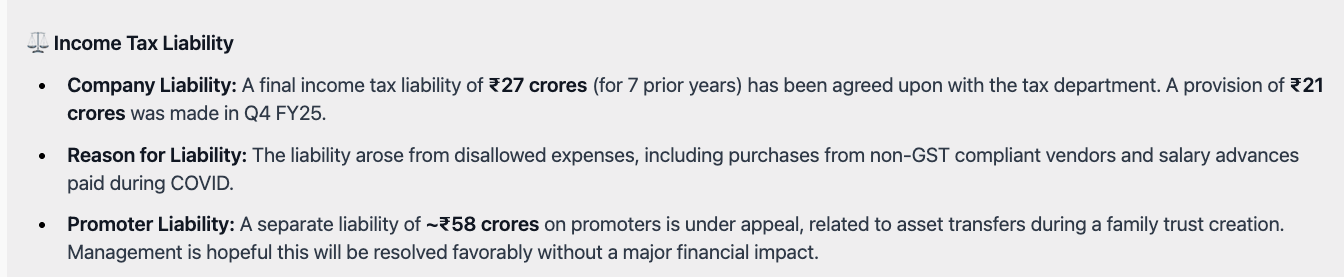
Q4 FY25 - An income tax raid led to a liability for the company and promoters.

Q1 FY26 - The company’s tax issue is resolved. Promoters have appealed for the liability on them and will handle the matter themselves.

I have started accumulating this share and listing to earnings call. It is a family run business.

I have tracking this company for more than two years now. I got shares allocated in IPO.

My perspective on Saree market changed after listening to one of founder’s podcast.

They track expenditure to minute level and trying to optimize.

Kalamadhir has offerings catering to all economies middle class ,upper middle class and premium etc.

I am still trying to dig in detail on their operations margins etc by analysis annual reports.

Disclaimer: I am invested in this.

3 Likes

Current correction would be the result of adding Valli silks format (Low margin) stores instead of VM format (High margin) stores in the current quarter.

1 Like

In light of increase in GST rate from 12% to 18% for apparels above ₹2,500, is it likely to negatively impact Sai Silk? Wedding sarees usually cost above INR 2,500.

3 Likes

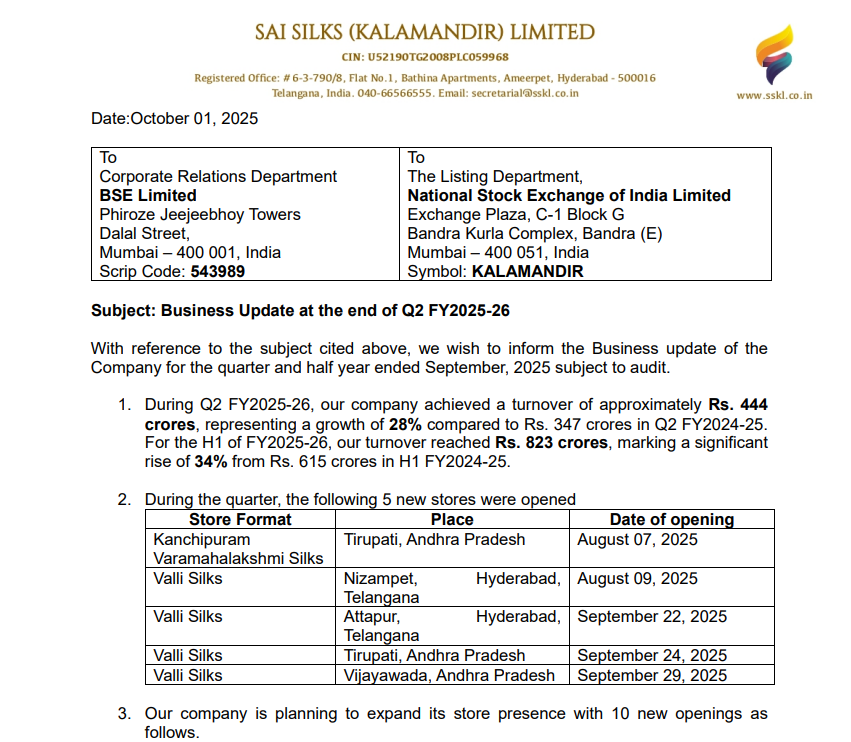
Q2FY26, Business update
28% YoY sales growth (444 cr)
5 new stores opened, to add 10 more

6 Likes

In my opinion 6% increment in wedding saress is nothing for wedding shoppers.

1 Like

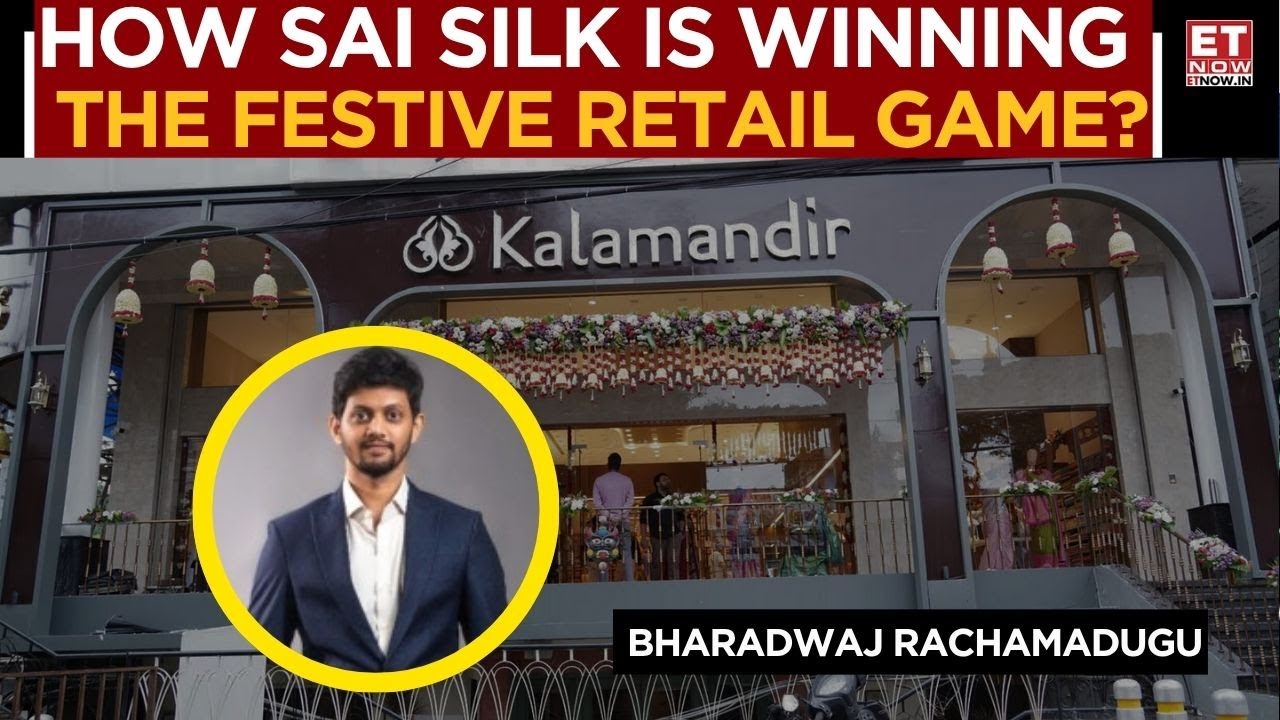
Recent Interview by Management.

2 Likes

I think he has a over hyped take about the technology they own. At one point in this interview he says they have system with 12 lakh lines of code to manage only incentives for the employees. Either there is some kind of a slip up from his side or the whole incentives module is written in assembly.

4-5 Crs loss during the early to mid-90s is a humungous amount. He belongs to a family that can muster that much amount and yet he goes to Dubai and gives interview for starting roles.

He was obsessed with lising the company on the stock market. Not sure if the reason he gave for the withdrawal from the IPO in 2013 is logical enough.

Somehow I can’t believe eveything he says there, now I am starting to wonder if the reason given about last year not having good dates for wedding is just a cover up, just like how they covered up the income tax raid notification under a business update notification to the exchange.

He says, he said to himself “Game On” when he was able to list the company. Never mentions anything in terms of about using the proceeds etc. Multiple times during the interview he mentions “He is not a speculator”, something doesn’t sit right.

Invested a small position looking at the commentary and future possibilities but this interview has made me take a harder look at the company.

Edit: This post in Manyavar(Vedant Fashion)'s thread gives good clarity about 2024 having lesser wedding dates than 2025.

4 Likes

As per my understanding, Last year Q1 is washout quarter for them due to lack of wedding dates and posted only 2 Cr PAT. Lack of wedding dates in this quarter is true.

1 Like

Q2 FY 26 highlights

  1. 28% growth in revenue. 26% increase in EBITDA. Strong OCF of 180 cr for H1 vs 107 cr for full year FY 25. SSSG stands at 17.5%
  2. 6 new store openings in the quarter with 4 of them being Valli format stores
  3. Overall, currently at 7.5 lakh sq ft retail area with 74 stores. (Valli – 7, Kalamandir 9, KLM 19 and Varmahalaxmi 39). Likely to have more contribution from Varmahalaxmi and Valli in next 1-2 years
  4. Valli format
    a. Store count is 7. Opened 4 new stores in the quarter and converted 3 existing stores to Valli (post considering market dynamics). My notes – We might see few more KLM (had mentioned about -ve SSSG in this in the past) / Kalamandir store formats being converted to Valli going forward.
    b. Requires 25 to 30% reduced capital expenditure and relatively lesser inventory requirement.
    c. Digital first shopping experience, seeing good consumer acceptance currently. The business here can be reviewed meaningfully after it completes at least a couple of quarters
  5. Operating at Healthy rent to revenue ratio. Compared to other traditional peers who operate at 8%; #SSKL operates at 4% ratio; attributable to higher productivity levels at store level
  6. Targeting to open 30,000 sq ft retail space in H2.
    a. Of which, 5 to 6 Valli format stores
    b. 3-4 Varamahalaxmi Silks stores
  7. New expansion in Varamahalaxmi stores will be in new cities (mainly Tier 2 markets in South) while expansion in Valli would largely be in existing markets
  8. Not looking at expanding beyond 4 Southern states in next 1 to 1.5 years
  9. Optimistic on H2 prospects and H2 is usually better than H1; healthy pipeline of wedding dates in H2.
  10. Overall, expecting to grow by around 18-20% on full year basis. Notes - Likely to surpass the initial guidance of 15% growth
  11. FY 27 – Looking to add 8-10% retail sq ft area; guidance to be shared later

Disc: invested with a tracking position

10 Likes

even if company grows its topline and bottomline by 15% to 20% , given a very reasonable valuation, i think there is lot of scope of pe rerating - would like to know others thoughts ?

Yes, its available at ~20 P/E of FY26, a growth of 15-20% at this valuations is very reasonable and we may expect rerating till 30 P/E if they can hit the 20% growth.

I feel they can end up in high teens, but on bottom line growth would be 160-170%

2 Likes

Sai Silks -

Q2 FY 26 results and concall highlights -

Company’s brands -

Kalamandir - Sell ethnic wear for middle income audience. Company operates a total of 11 Kalamandir stores ( large + medium + small format ) - across AP, Telangana and Karnataka. Price range of products being sold vary from Rs 1k to Rs 1 Lakh

Mandir - Sell ultra premium designer sarees. Price points vary from Rs 6k to Rs 3.5 lakh. Company operates 4 such stores ( small format stores ) in Telangana

Vraha Mahalakshmi - Sell premium ethnic sarees and handlooms for weddings and occasional wear. Price points vary from Rs 4k to Rs 2.5 lakh. Company operates 35 ( large + medium + small format ) such stores across AP, Telangana, TN, Karnataka

KLM ethnic fashion - Sell sarees for daily wear and western wear for women, men and children. Price points vary from Rs 1k to Rs 75k. Company operates 19 such stores ( all large format stores ) across AP, Telangana, Karnataka

Opened 5 new stores in Q2. Total stores now @ 74 vs 69 at the end of Q1. Total retail area now @ 7.5 lakh Sq Ft

Company has started new format stores - VALLI SILK - is targeted towards lower priced silk sarees aiming at mass mkts. Valli Silk stores shall be smaller stores ( say about 5-6k Sq Ft vs 12-18k sq ft for Kalamandir stores ), focus on pocket friendly ranges of women wear + fashion items. Have converted few of their existing stores into VALLI format stores taking the total no of VALLI stores to 7 ( opened 4 stores in Q2 + converted 3 stores to this format )

At present, 50 of company’s 69 stores are in mature category ( > 24 months old )

State wise breakup of stores -

Telangana - 28
AP - 20
Karnataka - 11
TN - 15

Q2 outcomes -

Revenues - 444 vs 347 cr, up 27 pc
Gross Margins @ 41.9 vs 42.2 pc ( marginal decline )
EBITDA - 72 vs 55 cr, up 30 pc ( margins @ 16.2 vs 15.9 pc )
PAT - 40 vs 23 cr, up 68 pc

H1 outcomes -

Revenues - 823 vs 614 cr, up 34 pc
Gross margins @ 41.98 vs 41.77 pc
EBITDA @ 129 vs 74 cr, up 73 pc ( margins @ 15.7 vs 12.1 pc )
PAT - 70 vs 26 cr, up 171 pc

Early onset of festive season was a natural tailwind for the company

SSSG in Q2 stood at a strong 17 pc ( company reports SSSG only for mature stores ie > 24 months old ). SSSG in H1 stood @ 21 pc

Remain optimistic about H2 due upcoming wedding + festival seasons

VALLI Silks also has a far greater online presence and online focus. This helps the company connect with younger customers + helps cater to evolving consumer needs. VALLI Silk stores are seeing encouraging consumer response

02 more Vraha Lakshmi stores are under construction. Also aim to open another 5 Kalamandir stores in near term

LY, third Qtr was a bumper Qtr for the company. Hence the growth rates seen in H1 should moderate going forward. On a full yr basis, company estimates - they may hit 1750 cr kind of sales vs 1462 cr clocked LY. That would mean a 20 pc kind of growth for full FY 26 over FY 25

Capex requirements and working capital requirements for Varha Mahalakshmi stores are 1.5 to 2 X that of a Valli Silk format store. Majority of clothing being stocked @ Valli Stores are priced in the < 4k / piece. With the Valli format its also gonna be far easier for the company to target the tier 2/3 mkts - because of the affordability

Should keep adding add 8 -10 pc of retail space / yr in the medium term

For FY 27, company intends to clock 8-9 pc PAT margins with a 15 pc kind of topline growth over FY 26 ( that would translate to a topline and bottomline of aprox 2000 and 160 cr respectively )

Majority of company’s sales come from Sarees. It’s a one size fits all kind of product. Its a great advantage to have in fashion retail business

Company’s primary focus continues to remain on Women’s wear ( they do sell Mens and Kidswear through their Kalamandir stores ). If they have to venture into a new product line, they would rather go towards Women’s Kurtis etc vs into different types of menswear

Should open about 5-6 Valli Silk and 3-4 Varha Mahalakshmi stores in H2

Company pays avg rentals in the range of 4-5 pc of revenues vs the Industry norm of 8-9 pc - this helps their profitability. They r able to achieve this by clocking better sales per store and good bargaining power that they command as a brand. Company generally gets into a 9 - 15 yr kind of agreement with 15 pc hike every 3 years

Disc: holding, added recently, not SEBI registered, not a buy / sell recommendation, posted only for educational purposes

4 Likes

The major risk factor here is that the Saree market, especially the non premium will enter de growth as most young women prefer western clothes on a daily basis.
With urbanisation, and more women joining the workforce, demand for traditional daily wear is going to come down. Revenues can be increased majorly through the premium and ultra premium segment and gaining market share.
Gaining market share is again difficult as the product is not very differentiated and the company would need to spend on marketing.

My biggest worry is that the company is not trading at high multiples because the product is not a growth product like jeans or bags.

1 Like

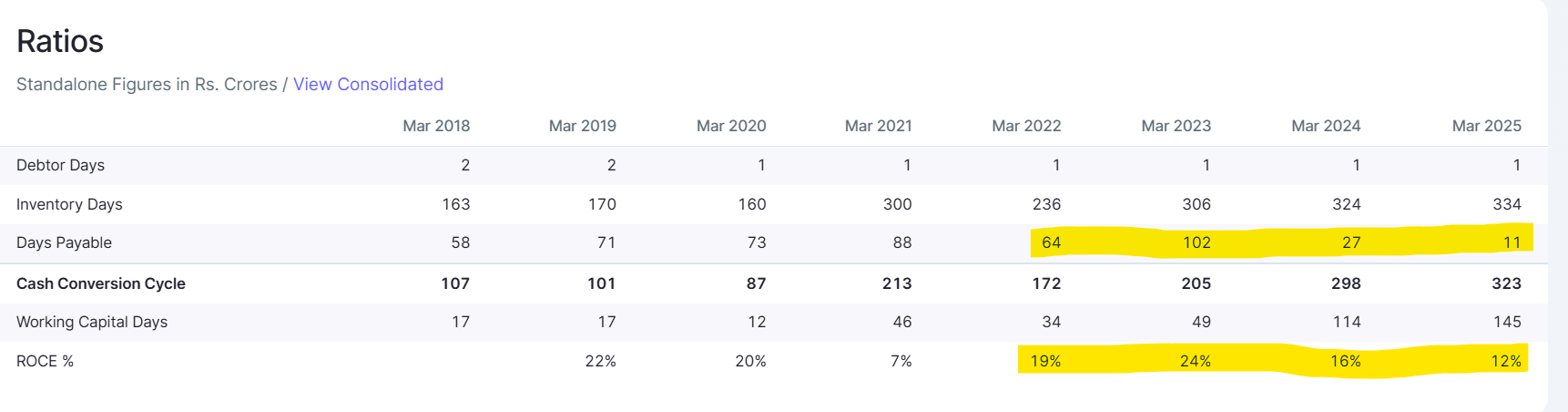
The real problem is the working capital cycle.

Post IPO, the company either stopped taking supplier credit or suppliers stopped extending credit to the company (whichever is the case). This disrupted the working capital cycle, deteriorated return ratios, and made growth more capital intensive.

In retail, growth is typically driven by supplier credit. Without it, inventory has to be financed through internal cash flows, which structurally limits the pace of growth.

Currently, the company is using IPO funds for store expansion, but this will result in inefficient expansion.

6 Likes

Management version is little different, as they are paying the suppliers quickly they are getting the inventory at better pricing and GM% is also increased significantly in the pat 4-5 years.

At any point where they feel that this model is restricting the growth potential then they can switch to old model with extended payable days.

1 Like

Well it’s not showing in RoCE so far so I don’t know what math management is doing.

Unfortunately in this case, management commentary has been away from reality in usual and dicey at best.

Post IPO management claim was Varamahalakshmi (VML) has higher gross margins, so as % of Varamahalakshmi store increases, its gross margins should increase.

Between June-23 to June-25, (comparable quarters interms of wedding dates)
area under VML increased from 19% to 36%, yet gross margins remain flat at 41%.
One may also question what happened to incremental margins from lower payable days?

Then their other claim was overall ROCE from VML is superior to other formats, which again has not played out. ROCE deteriorated from 20% to 12%

Thirdly, the plan was to add 1 lakh sqft annually in FY24 and FY25,
combined they have added 1 lakh sqft in those 2 years.

From VML (premium/luxury format), management has moved to ‘Valli’ (a mass market brand).

Not to forget this:

Disclosure: Had been invested in the company previously; currently, no position.

2 Likes

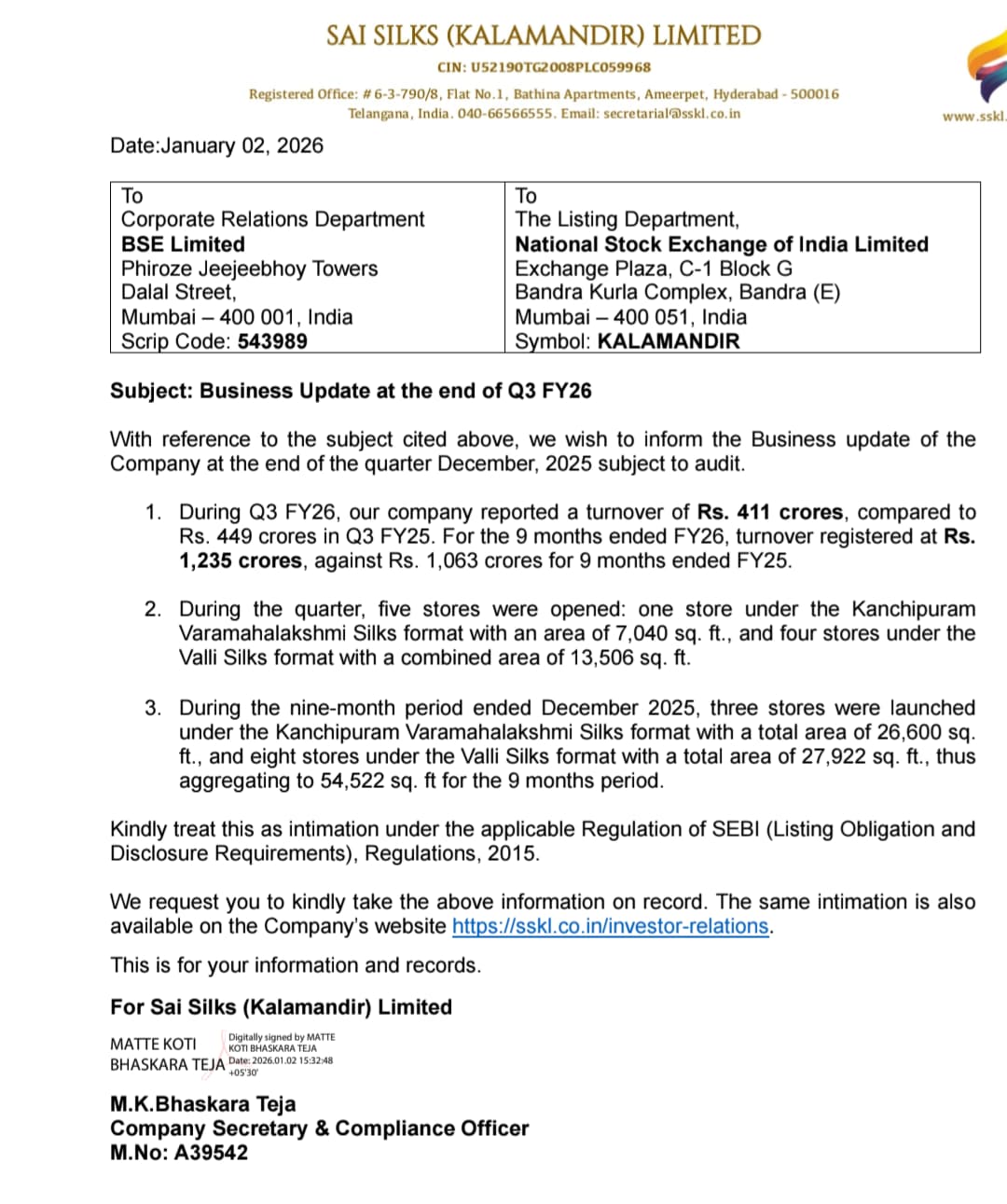
Q3 business update
Hardly walking the talk

2 Likes

Despite of Q3 update, isnt 15 PE for a profitable ethnic retail company too low?

Because these kinds of businesses may have a long pathway in front of them. Even with low YoY growth, they can give sustained income.

2 Likes