
Honestly, q3 update was not a surprise and was pretty much expected based on mgmts commentary and a very high base last year due to bunched up wedding dates. 9m performace has been quite solid so far. Based on their guidance in q2, one can expect 15 pc growth in q4 as well.
1 Like
Q3 numbers are not bad.
in this Year there is some spill over of Q3 revenue to Q2 due to Festival season is started at the end of Q2 in this year, where as Festival season is full concentrated to Q3 last year.
Same applicable to wedding dates as well.
I am expecting 13-14% Top line growth in this FY against management expectation of 15%. PE would be ~15 with EPS 9-10/-.
It would be buy for me even at current levels and at 5-10% further fall.
2 Likes
I think Q3 was as expected - lower sales due to Q2FY26 windfall, plus a higher base effect from Q3FY25. Overall, for FY26, expecting to close at 14-15% revenue growth, with INR 120 crores profit (41% jump in PAT YoY). Expecting more Vara Mahalaxmi formats vs Valli format for FY27. Looking forward to the 19 Jan result announcement. If EBITDA < 12%, would take it as a negative signal. If around 14-16%, normal. If >18%, very positive.
PS: Holding with 2 years’ horizon.
3 Likes
Sai Silks came out with disappointing numbers in Q3 with 8% sales & 17% profit degrowth and justified it with shift of Dussera to Q2 compared to Q3 last year and the warning given in Q2 concall already.
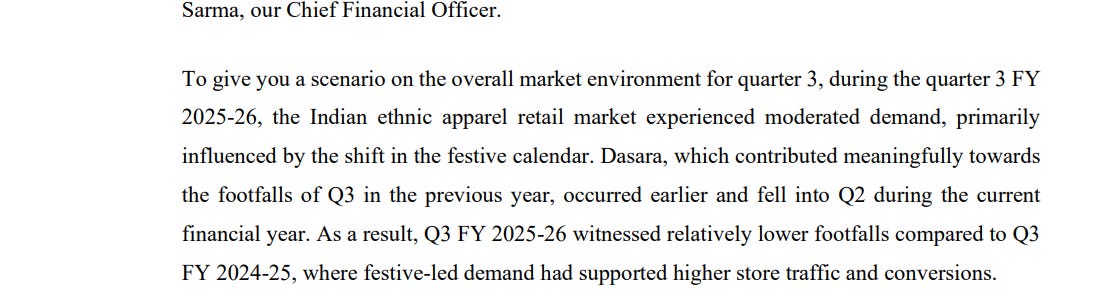
- But other things were said in the Q2 con-call too, like Rs.925 cr revenue in H2 and Rs.1750 cr for the full year- which translates to Rs.514 cr for Q4 (411 cr done in Q3), which translates to 28% growth target for Q4.
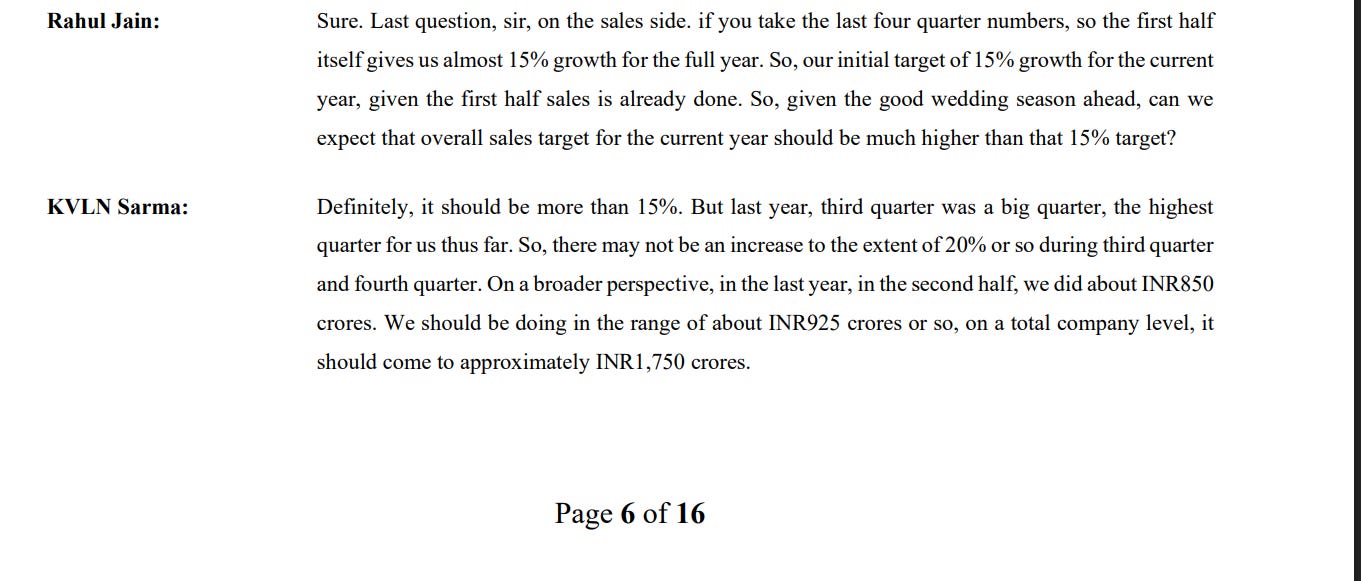
- Surprisingly, they were quite optimistic for H2 in Q2 concall and flipped the tone in Q3 concall.
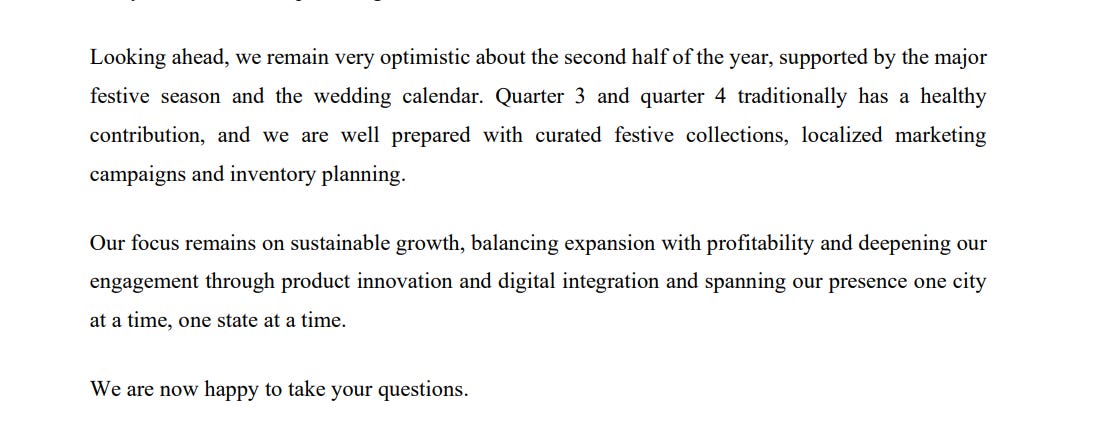
**Q2 FY26
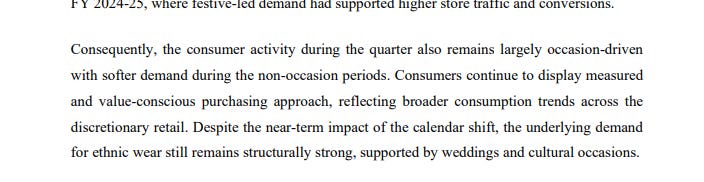
**Q3 FY6
-
Also, an analyst rightly pointed out, there was hardly any growth compared to last year combining Q2 and Q3.
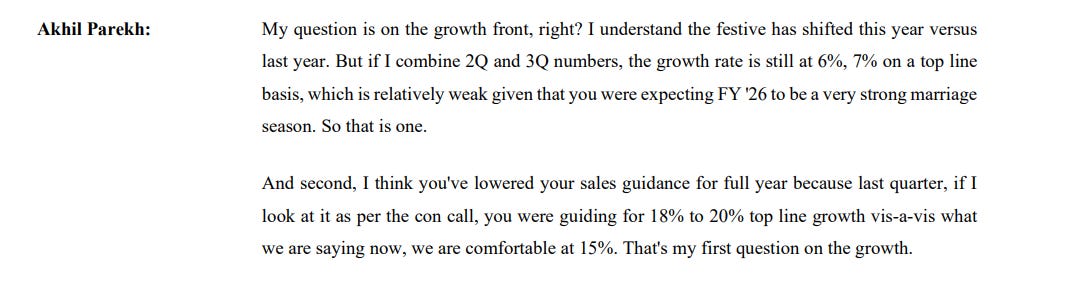
The mangement didn’t answer is directly but pointed towards 9 month growth and how they are in right direction as per guidance which did not seem satisfactory. (Consider me baised)
-
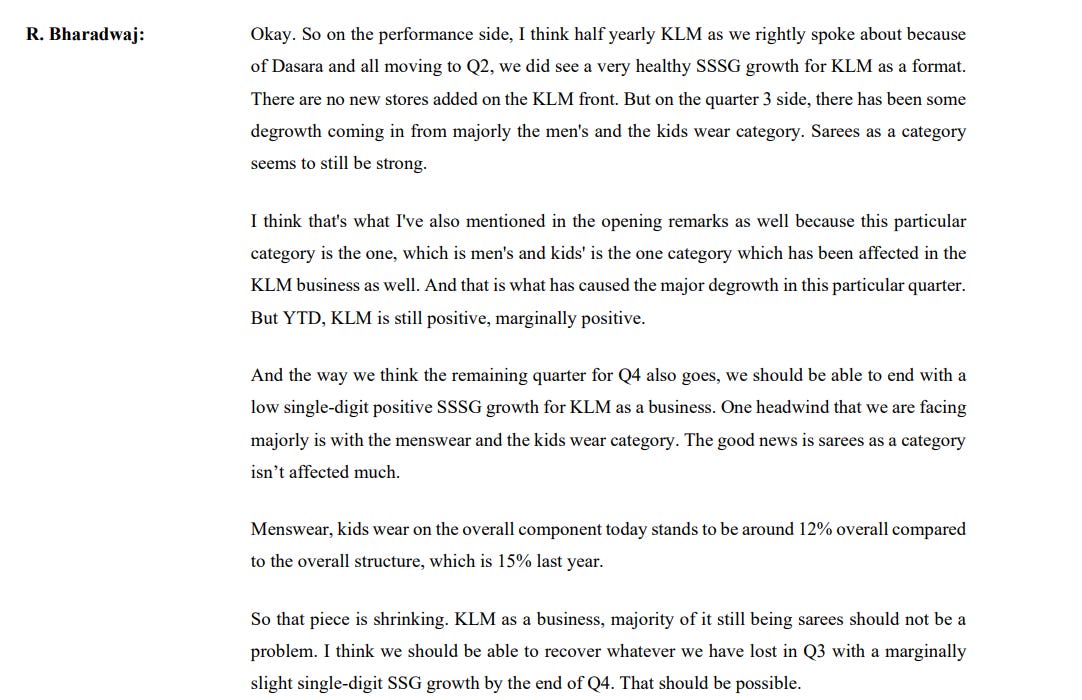
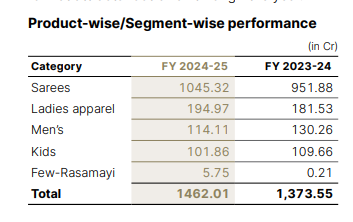
The slump in sales in mainly because of degrowth in sales of KLM store in kids and men segment and the management has rightly stopped expanding KLM stores.
Way ahead:
-
The co. is in line with store expansion at 54,500 sq. feet from the said 60,000 sq. feet guidance.
-
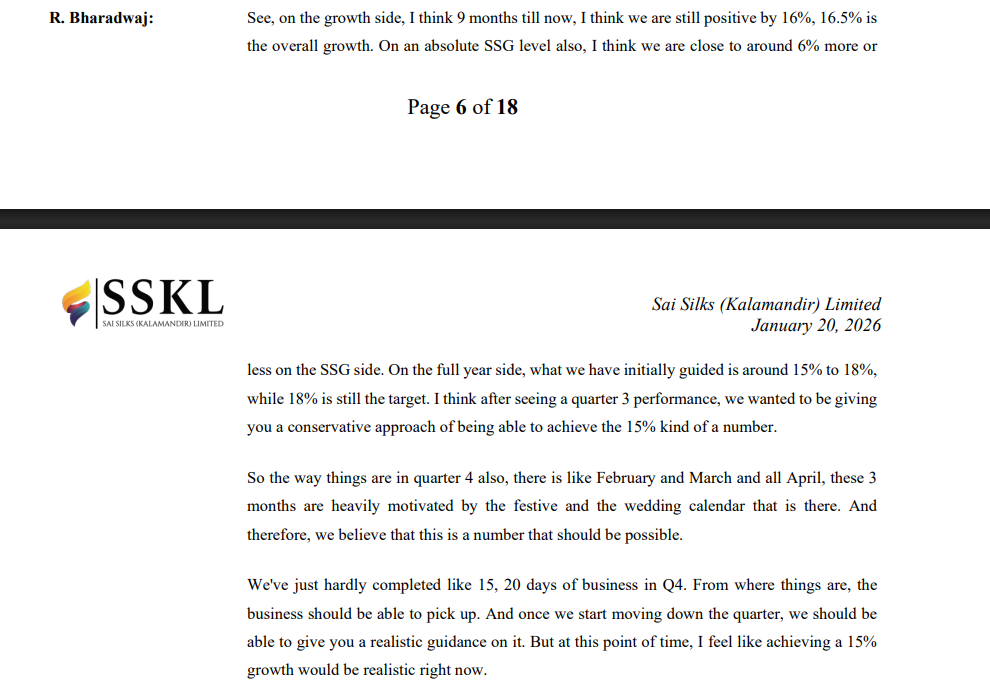
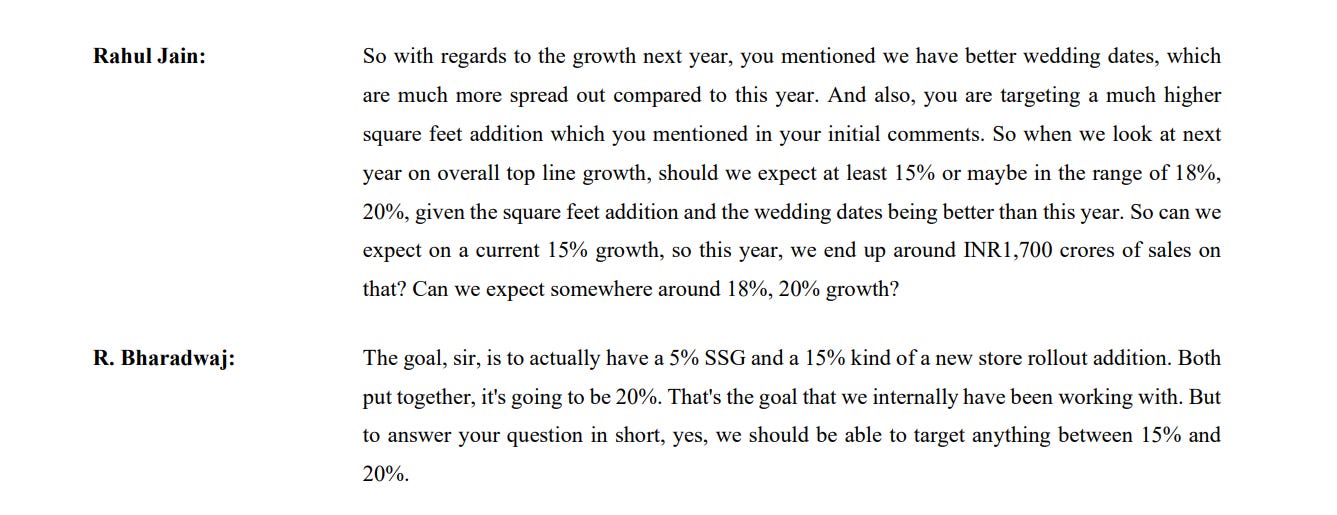
Q4 has similar wedding dates as last year and the 15% growth guidance is intact.
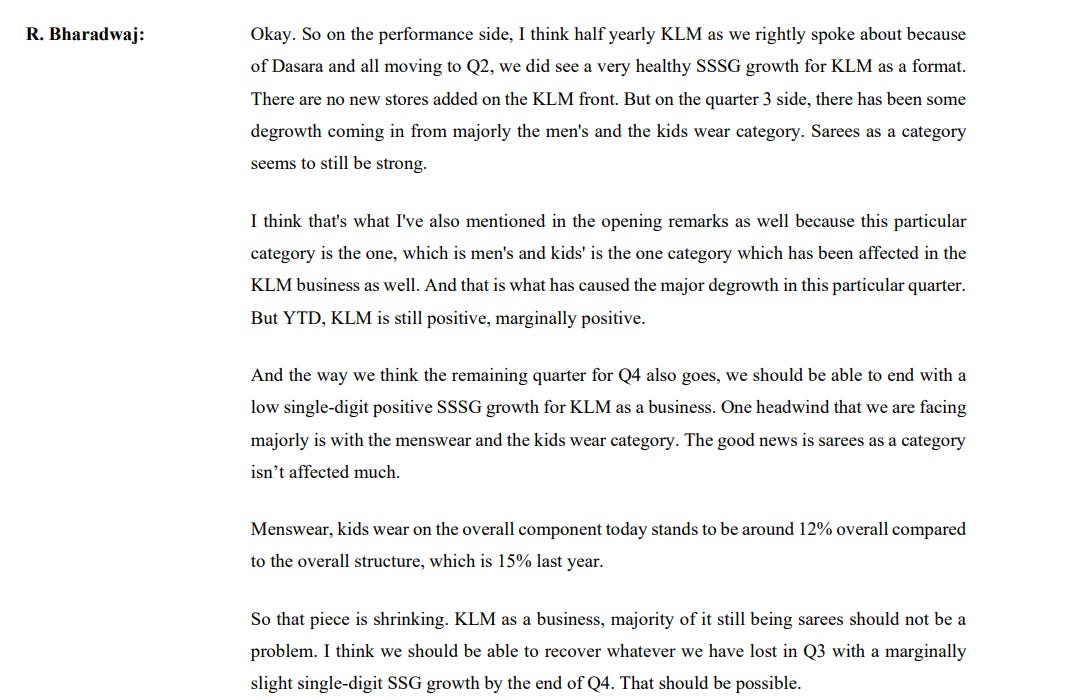
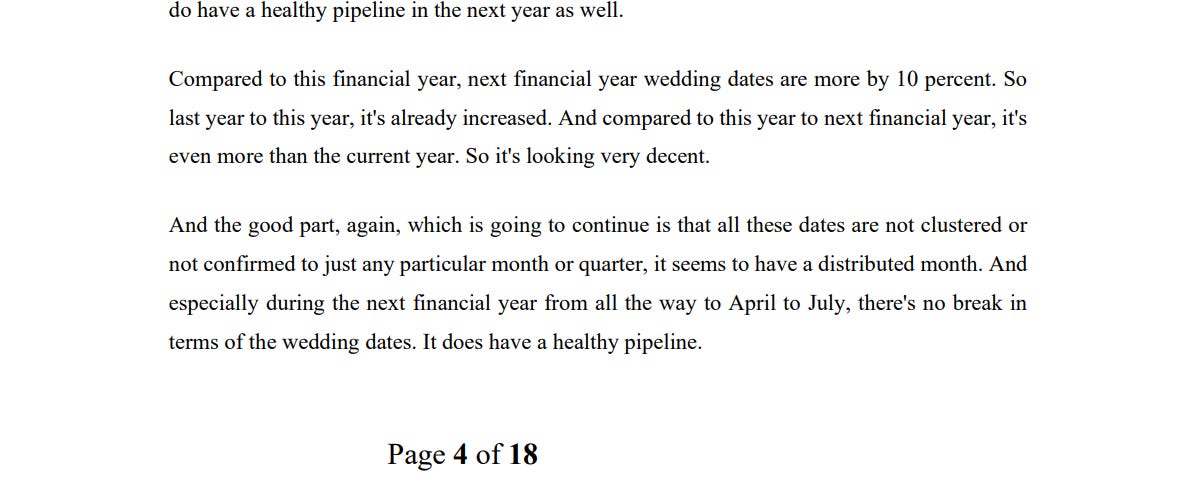
- Targeting 80-85k sq. feet store for FY27-mainly Varalaxmi (50%+) & Valli format which are high margin.
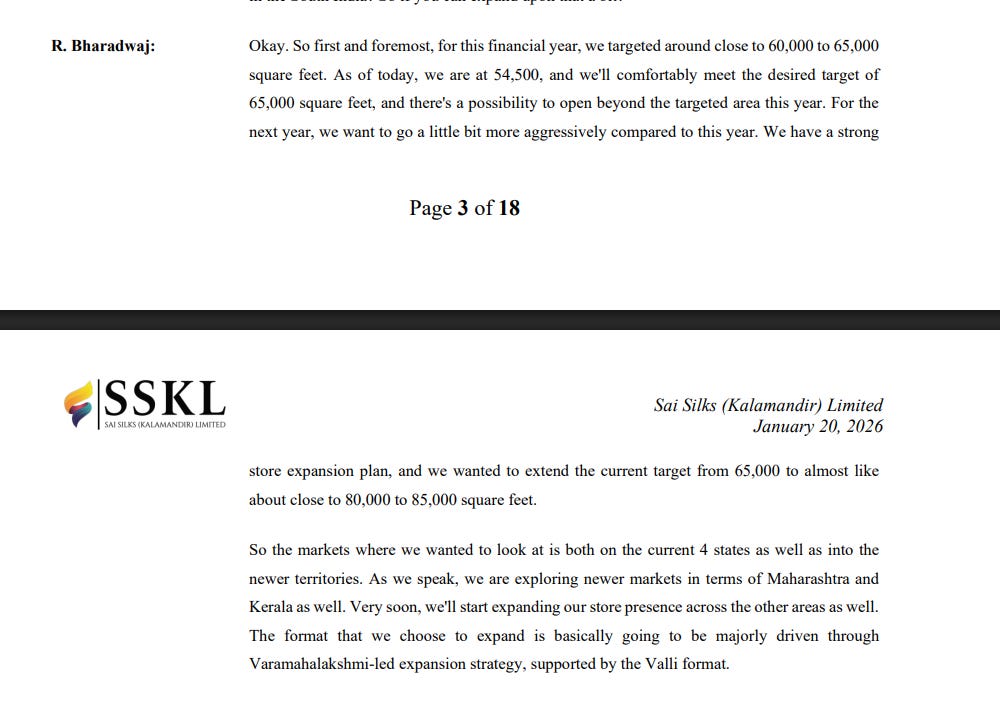
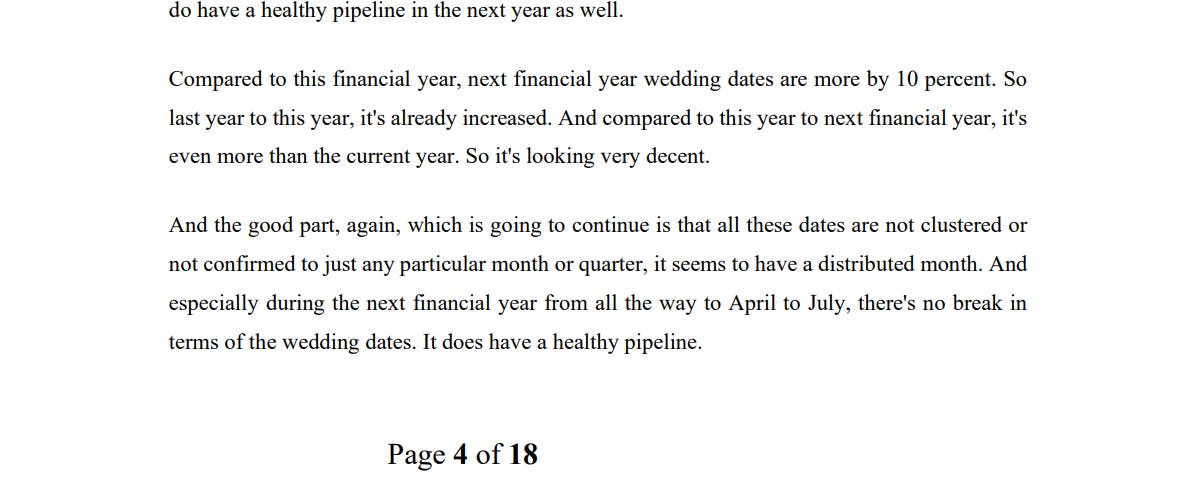
- FY27 has 10% more wedding dates compared to FY26 which is also equi-distributed, which is a big positive.
- Targeting 15-20 % growth for FY27 with minimum 5% from SSSG and 15% from store addition.
Closing thoughts:
-
The growth vis-a-vis the valuations seems very lucrative buy for the stock given that the management is broadly moving in right directions stopping loss making ventures and focusing on high margin profitabe stores.
-
The management is eying to go beyound the 4 core states which will be inetresting to watch.
-
Track per square foot productivity to know about matured stores growth.
-
You have to judge yourself on how much you are willing to trust the mangement with your money and can’t relax only lloking at margin of safety with the valuations, there are players in the sector posing for higher growth.
1 Not a buy or sell recommendation, not registered.
2 Consider me baised and dumb.
2 Likes
Q1 last year was a washout due to elections and heatwave, therefore weddings got postponed to Q2 and Q3, creating a high base for those two quarters last year. A washout quarter is typically followed by pent-up demand in the subsequent quarters, because it is very common for weddings to get postponed by 3 to 6 months, but they don’t get cancelled altogether.
YoY comparisons of individual quarters or two quarters can be misleading due to seasonality effect of variable wedding dates, festive dates, and other factors. 9M and 12M comparisons paint a much better picture.
Like someone mentioned above, Dussehra fell in Q2 this year but was in Q3 last year, while Telugu calendar had almost no auspicious wedding dates in December, which resulted in negative topline growth for Q3.
Management commentary of occasionwear companies like Vedant Fashions and Sai Silks in tepid quarters might sound like excuses to investors who are used to tracking only general apparel businesses like Trent and V2 Retail (for whom seasonality is negligible).
IMO, this is a good company available at cheap valuations, but the management is lacking in clear communication. Their guidance sometimes has been all over the place. I feel like they are still going through the learning curve of being a listed company, especially with the pressure of their stock price being down 50% from the IPO price.
Disc: Invested, with multiple transactions this month, so I might be biased. DYOR.
3 Likes
I think in Q4 they will do ~400 Cr similar like Q4FY25 as management commentary for Q4 Biz in Jan is not so robust.
In long run, even though company trying to be at 18% growth, we may expect 15% moderate growth. At the current valuation with 15% Growth rate is very much attractive. They may not require any further capital till FY28 to expand the stores.
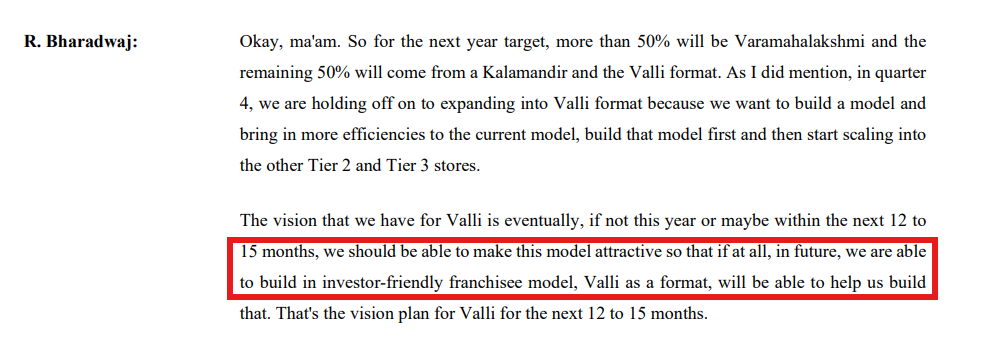
I think Franchise kind of things also are there in management mind, which may turn the biz asset light slightly going forward.
1 Like

Sai Silks (Kalamandir) – Business Reality from Q4 FY25 → Q3 FY26 Concall Analysis
Executive Summary
Sai Silks is an organized premium wedding saree retail chain with strong gross margins (~42%) and improving profitability driven by operating leverage. However, growth is currently largely driven by store expansion rather than strong same-store demand. The long-term investment case hinges on whether store productivity improves toward management’s target of ₹45,000 per sq ft. If that happens, the model compounds strongly; if not, expansion becomes capital-intensive and returns weaken.
1. Business Model
Sai Silks operates multiple ethnic apparel formats, with the Varamahalakshmi format as the primary growth engine.
| Format | Positioning | Status |
|---|---|---|
| Varamahalakshmi | Premium wedding sarees | Core growth driver |
| Kalamandir | Mid-premium ethnic wear | Stable |
| KLM Fashion Mall | Value fashion + mens/kids | Weak |
| Valli | Low-price saree format | Early stage |
Revenue mix is heavily skewed toward sarees.
~85–88% Sarees
~12% Mens + Kids wear
Demand is therefore event-driven:
-
Weddings
-
Festivals
-
Cultural occasions
Management itself describes demand as occasion-driven rather than steady discretionary consumption.
2. Growth Model
Across concalls, management consistently frames growth as:
4–5% Same Store Sales Growth
+ ~10–12% Store Expansion
= ~15–17% Revenue Growth
However, analysts have pointed out that financial data shows:
| Metric | Growth |
|---|---|
| Revenue CAGR (2 yrs) | ~10% |
| Retail area CAGR | ~9–10% |
This suggests:
True SSSG ≈ 0–1%
Meaning growth may currently be driven almost entirely by new stores.
3. Store Productivity – The Key Variable
The entire economics depend on revenue per square foot.
| Stage | Revenue / sq ft |
|---|---|
| New stores | ₹29k |
| Current average | ₹37k |
| Management target | ₹45k |
Timeline to reach target:
FY27
Higher productivity drives:
-
margin expansion
-
faster store payback
-
higher ROCE
Without this improvement, expansion becomes weaker economically.
4. State-wise Store Productivity
Using 9M FY26 revenue and retail area data:
| State | Revenue / sq ft (9M) | Annualized |
|---|---|---|
| Tamil Nadu | ₹25,390 | ₹33,900 |
| Karnataka | ₹15,670 | ₹20,900 |
| Andhra Pradesh | ₹15,200 | ₹20,200 |
| Pondicherry | ₹15,500 | ₹20,600 |
| Telangana | ₹13,270 | ₹17,700 |
Insights
-
Tamil Nadu productivity is ~60–90% higher than other states.
-
Telangana, despite the largest store base, has the lowest productivity.
-
Tamil Nadu economics likely drive a large portion of company profitability.
This explains management’s earlier aggressive expansion in Tamil Nadu.
5. Store Economics
Concall disclosures imply the following economics.
Capital required per sq ft
| Component | Amount |
|---|---|
| Store capex | ₹4k–₹5.5k |
| Inventory | ₹8k–₹9k |
| Total capital | ₹12k–₹15k / sq ft |
Typical Varamahalakshmi store:
~40,000 sq ft
Capital invested:
~₹50–55 Cr
If productivity reaches target:
| Metric | Estimate |
|---|---|
| Revenue | ₹180 Cr |
| EBITDA margin | ~18–20% |
| Store EBITDA | ~₹30 Cr |
Estimated store payback: ~2.5–3 years, which is attractive.
If productivity remains near ₹35–37k/sq ft, payback extends toward 3.5–4 years, weakening expansion economics.
6. Inventory Intensity
One structural characteristic of the business is very high inventory intensity.
| Metric | Value |
|---|---|
| Inventory | ₹770–800 Cr |
| Revenue run rate | ~₹1,700 Cr |
Inventory to sales ratio:
~45–50%
Inventory days historically:
~180–190 days
This reflects the need for deep assortment in wedding sarees, but also ties up significant capital.
7. Expansion Strategy
Store footprint currently:
~7.7 lakh sq ft
79 stores
Planned expansion:
~75k–85k sq ft annually
Geographic strategy now expanding beyond the traditional southern stronghold.
| Region | Status |
|---|---|
| South India | Core market |
| Maharashtra | Entering |
| Kerala | Exploring |
New markets will initially follow a cluster strategy:
1 store → learn market → expand cluster.
8. Emerging Strategic Issues
Weak KLM Format
KLM Fashion Mall stores continue to face:
-
declining menswear and kidswear demand
-
weak same-store growth
Management is shifting focus back toward sarees.
Valli Format Uncertain
The low-price Valli format was initially positioned as a new growth driver, but expansion has been paused to refine the business model.
Geographic Risk
Ethnic apparel preferences are highly regional. Expansion outside South India introduces merchandising risk.
9. Financial Trends
| Metric | FY25 | 9M FY26 |
|---|---|---|
| Revenue | ₹1,063 Cr | ₹1,234 Cr |
| PAT | ₹72 Cr | ₹108 Cr |
| PAT margin | 6.7% | 8.8% |
Profit growth is currently faster than revenue growth, indicating operating leverage.
10. Investment Debate
Bull Case
-
Large ethnic wear market with low organized penetration
-
Strong gross margins (~42%)
-
Premium wedding saree niche
-
Store productivity still improving
-
Balance sheet improving after IPO
Bear Case
-
SSSG may be weaker than management claims
-
Capital-intensive inventory model
-
Store ramp time 2–3 years
-
Heavy reliance on wedding saree category
-
Geographic expansion risk
Conclusion
Sai Silks is currently best understood as a premium wedding saree retail chain scaling through store expansion. The business has attractive gross margins and improving profitability, but the long-term quality of the model depends on store productivity reaching management’s target of ₹45,000 per sq ft.
If productivity improves meaningfully, store payback remains under three years and the expansion model becomes highly attractive. If productivity stagnates closer to ₹35–37k per sq ft, growth will remain capital-intensive and expansion-driven, limiting long-term returns.
In short, the next two years of store productivity data will determine whether Sai Silks evolves into a high-quality retail compounder or remains a moderate expansion-led growth story.
8 Likes
Promoter tax demand waived off
It seems that company negotiated/requested with IT department that they can pay any amount of tax demand related to the company but they should waive off the promoters tax demand.
“With the disposal of the appeals, the tax proceedings arising from the search and seizure operation, in respect of the Company and its Promoter, stand concluded”
Am I missing anything? The intimation reads tax that both company & promoters’ proceedings have concluded
Tax demand for company is ~ 21Cr and for promoter is 58Cr.
Company has not negotiate anything from 21Cr demand and paid full 100% amount in FY25,
In promoters demand company appealed and paid only 1%(50 lakhs out of 58 Cr demand) of the demand amount. How funny it is and clearly indicates that it’s negotiated such way that company liability will be fully paid but promoter liability should be waived off.
2 Likes
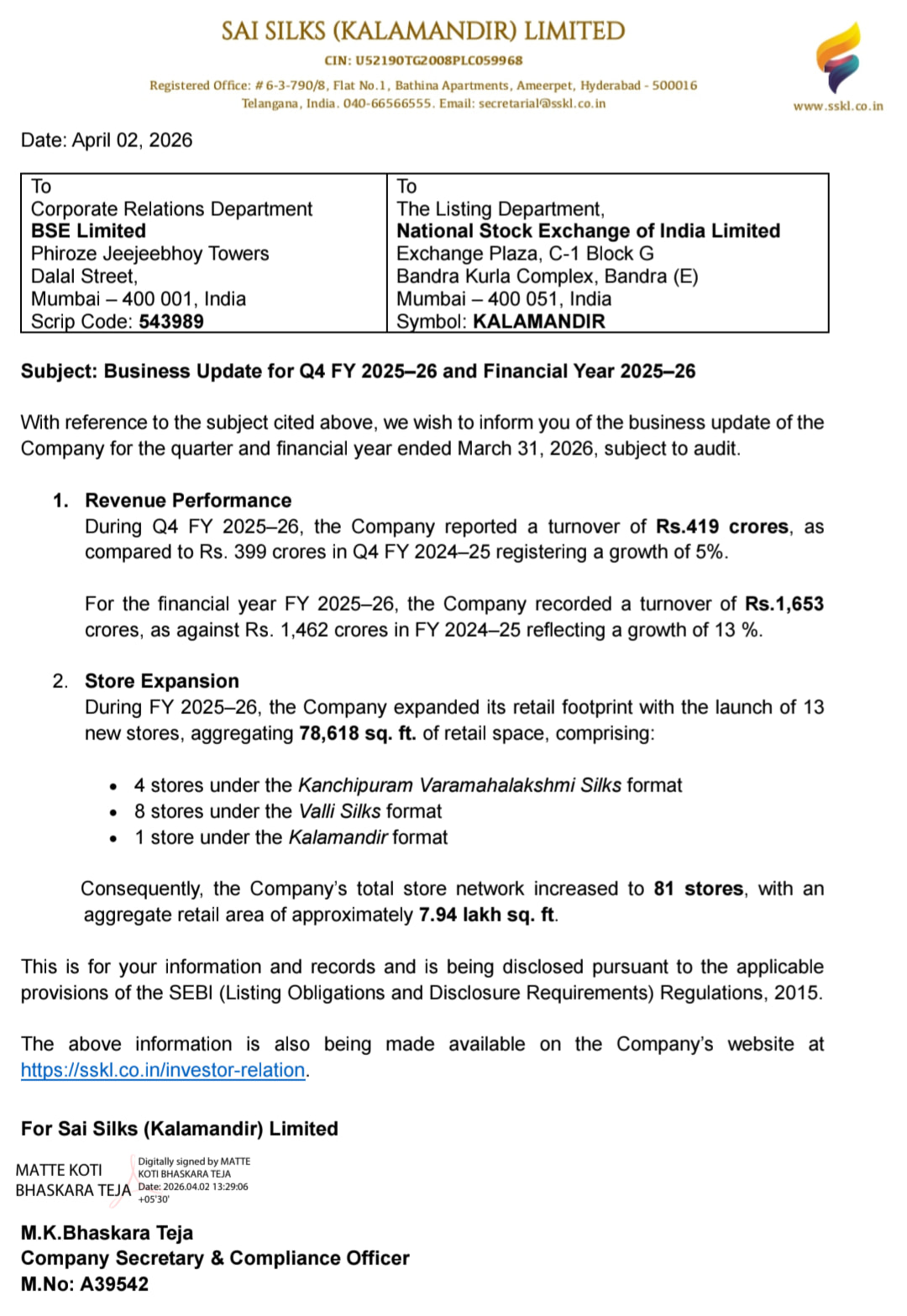
I think this is what factored in the > 60% correction in the past 6M, Its good to see that people anticipated this slowdown ahead of the results.
It’s not just kalamandir almost all retail companies saw such big correction as whole sector
Trent
Manyavar ( Vedanta fashion )
Stanley Lifestyle
Go Fashion
Credo brands
Yes, but Vedant is trading at higher valuations so correction happened. In case of Kalamandir it’s only trading at 20-25 TTM PE 6 months back, still it’s corrected ~ 60%. Now even with new store openings growth is only 5%, which shows -ve SSSG.
Can Valli format bring back some growth movement with low ASP ? I am not sure.
1 Like
Their Q1FY27 turnover stands at 375Cr, lesser than Q1FY26 which was 379Cr, inspite of additional stores added during the year.
I think Kalamandir now at extremely cheap valuation and very low probability of loss of capital. Now it’s time to ignore hot theme (having PE above 100) and go for consumption theme which is available at reasonable valuation. This is good time to go with Kalamandir! Hope, all negative factors (no or negative SSGS, etc) already priced in at current valuation.
Disc- started buying today @76 and views are biased!
3 Likes
Yes Consumption theme is Relatively cheap but CREDIT CARD SPENDING and LOAN FOR CONSUMPTION is growing much faster than Nominal GDP… I worry one day that will rupture and that can drag consumption down but STREET might already priced in this ! But Consumption sector is definitely CHEAP
1 Like
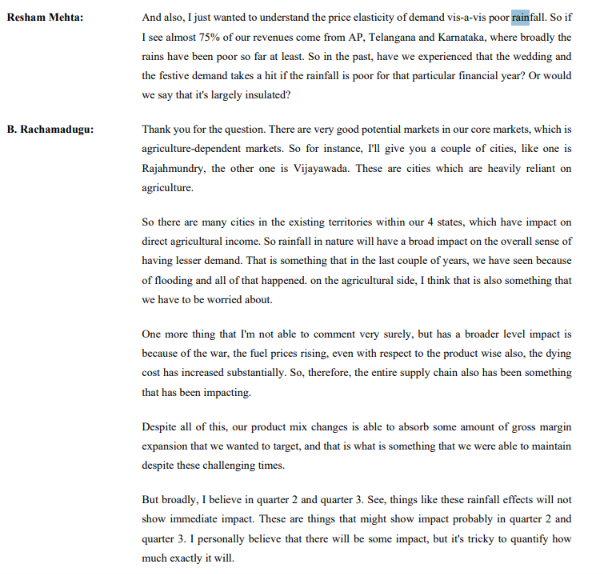
From Q1 con-call - Poor rain fall will impact overall demand. Also, due to war dying cost has gone upward, resulting overall supply chain cost inflation and pressure on margin. We need to wait and watch for Q2 result. It is better to buy in SIP form to accumulate it with keeping eye on risk.
1 Like
Next quarter results will also be going to be bad as no wedding muhurat in last two months of quarter. High base effect of last year Q2 will also make things look worst.
I think this counter can have more time correction followed by price correction.
Disclaimer: Not holding. Just studied out of curiosity.
3 Likes