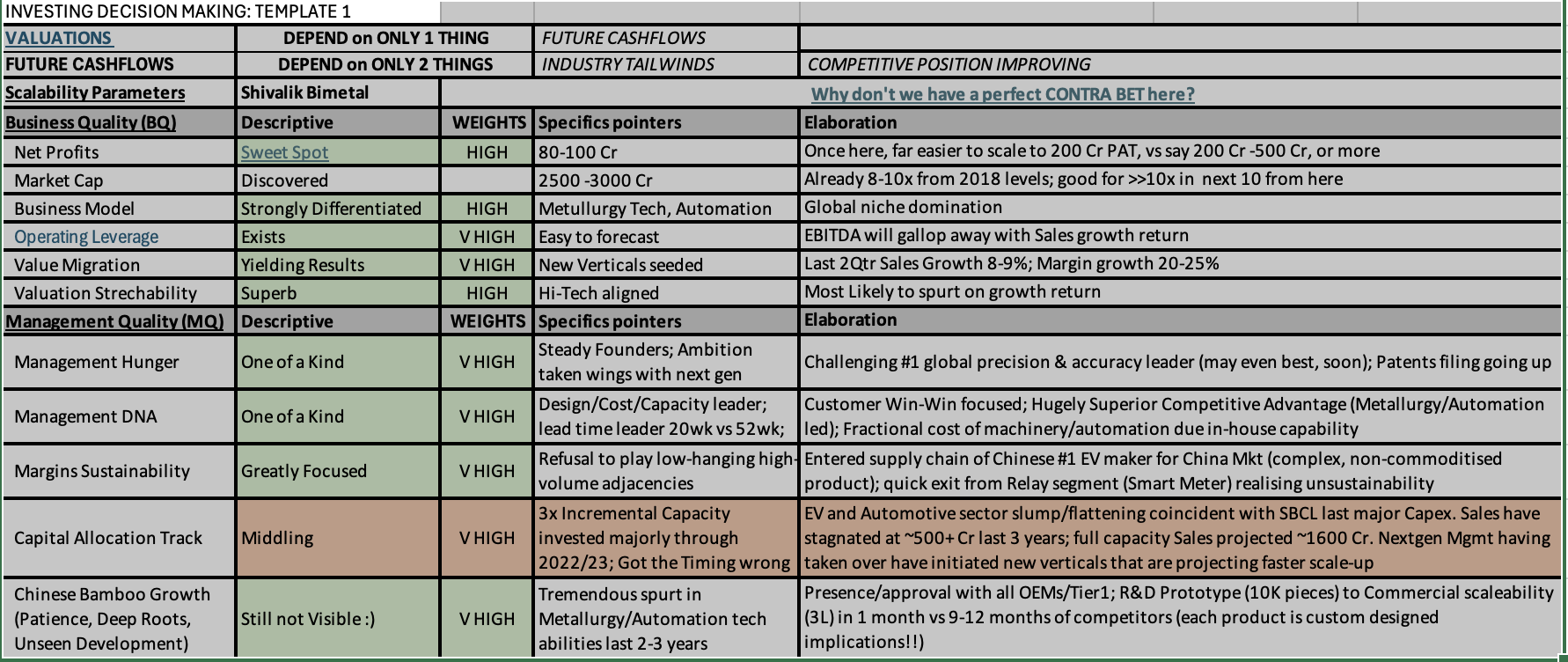
Investing Decision Making; Template1

Hi Everyone

I have been meaning to capture this back at VP for a looong time - primarily for the same selfish reasons that drove me before - a) so that this gets imprinted in my head (more on this later), and b) seek inputs from the best of minds in our investing community.

WHAT THIS Decision-Making Template is NOT (based on random checks with guys)

  1. NOT for diversified portfolio guys (applies to concentrated portfolios )
  2. No, this is NOT suitable for Screening (Screening is for arriving at a promising Shortlist)
  3. This is NOT a Checklist (Checklists are without weights)
  4. This is NOT a COMPLETE drill-down (over and above basic thresholds, what matters most??)
  5. This is probably NOT applicable in initial buys OR even say the first year of familiarity with the business/Management

So what is this Template about?

  1. This Template is primarily aimed at Practitioners of the Concentrated Portfolio approach
  2. This Template can only be filled up ideally - when someone knows a business in and out, has preferably tracked and followed management speak and their walking-the talk for a few years, and also has engaged/asked probing questions of Management at every opportunity - analyst calls, AGMs, and/or investor meets. Preferably has also engaged in scuttlebutt with competition and industry sources to corroborate management speak/ask leading/probing questions
  3. May look like a tall ask for GenZ newbie investors; but not really for any serious investor worth her salt - whether new to the craft or a senior practitioner herself
  4. Given a few things being equal (which means say your shortlist has 4-5 seemingly good candidates which pass your normal thresholds desired (like Debt, RoE, Cashflows, decent balance sheet with decent growth, and absence of major corp governance issues/red flags) - this Template can be very useful in separating the Men from the Boys.
  5. This can be used for creating your curated BUY LIST - for use at major market corrections (which by the way happens a couple of times every year, as we have seen in FY25 as well). For a concentrated portfolio having that buy list handy is MANDATORY - as when suddenly everything starts looking very interesting - one is spoilt for choices, and therefore confused - where is the best bang for my buck? If one had made the right buys in Feb/Mar 2025 …
  6. If one were to buy now e.g., again no reason why you can’t use the Template for CONTRA BETS …Shivalik Bimetal is used below as a case study

Legacy VP Links
Scalability Thinking, Sweet Spot, Operating Leverage, Business Quality, Management Quality, Contra Bets (Value Plays), Management Q&A


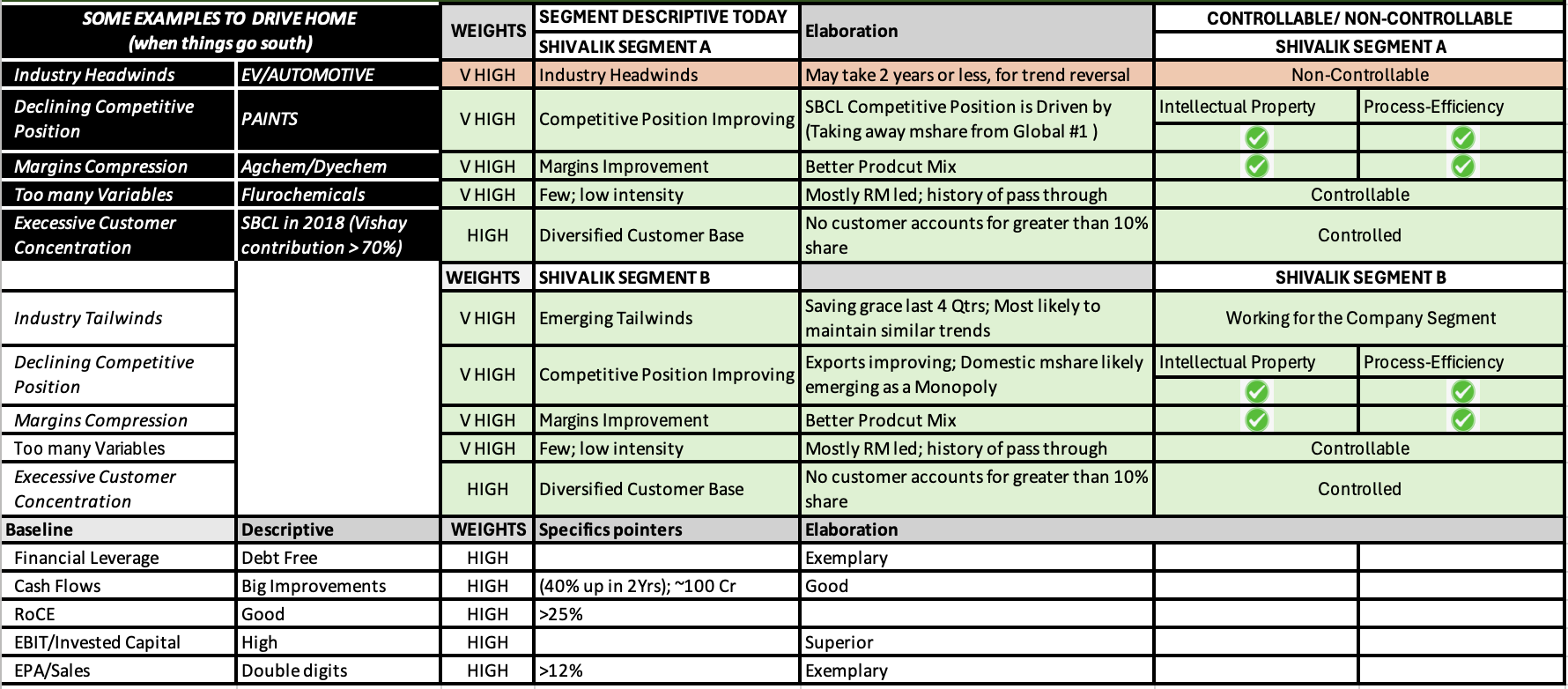
  1. If this Template is a good pointer for buying, it can serve equally well for SELLING at the right time, as well . When filled with proper diligence (“Things going South” section) will force top of mind awareness of things that do go wrong (commoditisation possibility, margins vulnerability, excessive customer concentrations) that often can get ignored while being happy with initial ride success.

  2. More importantly, it served the purpose of imprinting big-time in my mind - the strong linkage of "Competitive Positioning remaining strong/growing stronger trait" and hence (margins sustainability trait) in a business to the presence/absence of IP-led differentiation (as opposed to only process-led efficiency) enjoyed by that business.

As always, whenever I attempt to put my neck out and attempt to influence a long-awaited discussion topic - provocatively titled - I myself learn big time. It helps bring laser-focus on most important aspects - that otherwise I know (all sincere investors know of), but probably NOT aware 100% of the time and used well in decisions made - because our mind is NOTORIUS for taking SHORT CUTS!! (even after working very hard, and being a serious student of the investing game!!)

I will make another post with some examples and counter-examples from my investing experience that I can recall from 2010 onwards VP journey. When I published the first Opto Circuits Analysis Report in Dec 2008, I was theoretically coming upto speed, but as a practitioner completely raw!!. To showcase how (even as I knew the concepts, I was not so good at applying them well) I learnt from my brilliant fellow investors around me, and from reading up from published work of great practitioners of the craft like MIchael Mauboussin (for me there is none better at explaining what moves the needle the most) in improving as an investing practitioner every year.

And then throw the floor open (to VP Collaborators at first) for more examples and counter examples to drive home - how to use this template. There are many ways to slice the investing dice (CALL the risk/reward ODDS that is). This is only one style that suits me and has served me very well. Thanks due to the excellent band of VP Collaborators, but mostly my Mentor Mr D (Dnyanesh Bhatwadekar from Thane Mumbai) of the Capital Allocation and Art of Valuation VP Hall of Fame discussions, for early direction setting. Without the benefit of these in 2011, the VP journey (and individual growth) could have been very different for us!

When we come up with a few more Templates (from our band of senior VP investors) - that will be our way of paying the way forward for others at VP!

57 Likes

A Practitioner will show us how its done with hard-hitting simple home truths, simply because he/she has been there, done that, many times. He will give us simple, practical distilled wisdom in a manner not served in the classics/text books, that one can very easily apply in the field. Any layman will also GET IT. As different from say a theoretical framework (Gyan).

So here’s a brief rundown on my growth as an investing practitioner, as guided by my Mentors and fellow investors around me.

2008: Had read most of the investing classics.
2009: Started putting some money; 10-12 stocks concentrated, 8-10-15% initial allocations
2010: Early examples of decision-making success in Manjushree Technopak, BKT, Mayur Uniquoters
2011: Capital Allocation, Art of Valuation entrenched in decision-making. Astral, Ajanta Pharma investments
2012: Business Value Drivers, Economic Profit Added (EPA) entrenched. Copeland Valuation book (valuation bible); started Ranking each business in Portfolio; new business cannot join at 9th or 10th; has to dislodge at least 1 before; Allocations adjusted based on Ranking
2015: Started imagining/debating “Next Level” for any business we were invested in;
2016: Industry Tailwinds, Improving Competitive Position entrenched in decision-making; Concentrated 6-7 stocks, 10-15-20 % initial allocations
2017: Operating Leverage, “Hope” vs “Visibility” entrenched in allocation decision-making
2020: Value Chain migration entrenched in allocation decision-making
2023: “Valuation Stretchability” glamour-quotient entrenched in allocations decision-making
2023-25: Getting to super concentrated naturally (somehow can’t help it); 4-5 stocks initial 15-20% allocations;

A common thread right from 2010 till date has been that we could buy the same business (averaging up) for the initial 2-3-4 years each year as the businesses kept performing and we grew in conviction.

=====================================
More detailed rundown follows on how we grew as from amateurs to more seasoned investors in a nurturing VP Collaborative environment - learning from each other.

Post the Lehman crisis no one was interested in Indian Markets. We could research any business in great depths for 6 months and more, write and report on length, publish Management Q&As, and seeking help from investing seniors.mentors in guiding us on what would be a better investment and why. A common success mantra that emerged (we had observed and validated with seniors

Learning 1: Small differentiated business, RoE >30%, growing at 30%, available at 5-6 P/E

2012 was sort of a year of reckoning for most of us in VP - still amateurs, but very passionate and learning very fast. We could sense that there is a method in all the madness - what we were doing was working in our markets.

Interestingly within the year Manjushree Technopak was up 3x, BKT 2x; *
> Mayur had gone up 15x, Astral about 10x by early 2014
> Ajanta though only about 4x during same time frame

Meanwhile we had started VP Public Portfolio in Aug 2011 since we believed in holding ourselves Accountable (as distinct from “Gyanis”), and to be seen as providing Actionable Advise apart from being a Democratic place (all scuttlebutts, management interviews, research, and tools for FREE). A fierce debate was ON whether Mayur and Astral have run out of steam (time to find the next horse(s), and what about Ajanta Pharma which hadnt moived much, and prone to big swings ! I was on a completely different trip. Mayur Uni was everyones darling with those fantastic return numbers with good growth, but I was so convinced form inside that Astral was a better business than Mayur, and that Ajanta Pharma was actually the best of the three.

Learning 2: ***All things being equal (good growth, balanced debt, good cashflows),
if we find steady Improvement in Operating Margins - that MOVES the needle the most

Success Patterns, Art of Valuation, Business Value Drivers hugely engaging discussions happened. And we were firmly on the quest to ask better and understand better which is a better business and why?

By 2015 Ajanta Pharma was the fist business in the VP Portfolio to go up 50x. I felt sort of validated, all those laboured discussions on EPA (Economic Profit Added) and the significance of the business with higher Invested Capital back in 2012, did reach us somewhere, or did it?

I was calculating Operating Leverage in my Excels right from 2012.
But I had not learnt this one very big lesson in 6 years of active investing.
It was present in my investing toolkit, but surprisingly I was NOT actively using or focused on Operating Leverage while making important Capital Allocation decisions**

Learning 3: ***All things being equal (good growth, balanced debt, good cashflows),
Operating Leverage at play for next 2-3 years - that MOVES the needle humongously
1 Rupee in incremental Sales for the next year =>> 3 Rupees in EBITDA.
If you like a business that you find investible, if it also forecasts good to great Operating Leverage, BET HEAVY!

Not till I had that discussion with @Anant in 2016/17 as I was discussing my new found fetish with Operating Leverage courtesy a Mauboussin paper on the same (if the product mix doesn’t change, than its so easy to forecast superlative earnings if you know a business reasonably well). He said yes Dada, mere liye to yahi khuda hai (he hadn’t invested in Ajanta Pharma 2012, but did it with ferocity in 2014 if I remember correctly), I tripled my investments in Ajanta after spotting that, he said. You didn’t, he asked disarmingly?; I said no @ayushmit and me increased our allocations maybe 50% more, just betting on the fact that margins were becoming better and better! blissfully ignorant of OpLev at play :grinning_face:!

Learning 4: More MONEY makes humongously more MONEY
A friend and the first to visit Mayur Uni facility in Jaipur in 2010, invested 15L each in 2011 in Astral, Mayur, and one more business I forget. I had invested 1L each (thats all I had).

I couldn’t have learnt a better lesson, early (even as I didn’t have the wherewithal). Eventually by 2016 or so, as I was maturing as an investor I understood that the ODDS for the Risk/Reward equation investment in a single business, remains the SAME for even multiples of a Cr (in our kind of small to medium businesses given the depth of VP research work ethics) !!

We are getting closer to why I keep harping on the obvious! (not to newbies, they will love this discourse i know as exposure is less); but to hit it home with senior investors - that we ALL TAKE SHORTCUTS in our decision-making. Point is unless I put it down in a Template like this, it doesn’t SIT in my head all the time, and I sometimes I don’t articulate it at all - when I explain to someone less experienced than me - my approach to the Investing puzzle we are trying to solve.

Learning 5 : Margins Sustainability for next 2-3 or 5 years
Any decent investor with 2-3 years experience will think about this. But might probably NOT link it directly to the presence of Intellectual Property and/or Process Efficiency (as in Template above) in the business. The reason why a business/products is less likley to get commoditised.

Oh! the beauty or the ease with which we/our mind takes shortcuts - if only we are MAN enough to admit it! Now, I admitted to @spatel as I put it down in this template in the manner I did (under “what can go wrong and usually does”) hey, this linkage (we had put it down way back in 2012, probably in the Art of Valuation thread) isn’t in my active mental Models. Sandy said exactly Dada, I always take Notes when we speak, but in our discussions say of last 2-3 years, I don’t see you mentioning any of Intellectual Property vs Process Efficiency in our sustainability discussions.

There lies the CRUX!
If you are NOT articulating it/bringing it up in every dissection of a business you are at, the mind probably leads you into its shortcuts (read, ignore something important) while taking decisions, even as you might have done tremendous hard work on the business/industry.

The reason why probably there are scores who have burnt their hands and left to rue some decisions, as margins were extrapolated into the future and guilty of NOT watching the business like a HAWK (one WOULD, if one was AWARE that in all likelihood the said business will get commoditised in near future, and thus actively LOOK FOR proof of that). This is something that our genius friend @Anant (any wonders?) again does humongously well at.

POINT Anant makes is you DON’T need a PI or a Bajaj Finance to make humongous money (a subtle dig at my predominant style; mostly collaborators would tease me “Dada yeh accha lag raha hai, par aapka type nhi hai” :wink:). You can still bet the house on a business (w/o significant IP or process efficiency, which you know can likely get commoditised) with full awareness till such time as say the whole industry is doing well/tailwinds are present). Will let @Anant expound more on that style.

I do have a counter. If you do get a business like PI or a Bajaj Finance that you see doing everything very differently from the Industry and leading with IP and process efficiency as very big differentiators, I would much more easily bet the house on that. Once having done the real hard work of establishing presence of IP and Process Efficiency on top of all the other goodies, I would rather bet heavily here. No more looking over the shoulder, ever. Monitoring results once a year is enough. Thats the much smarter, easier feet-up-on-table route for me. Could hold PI Industries from 2011 till 2023 (12 years of complete bliss :innocent:), Bajaj Finance from 2015. And best part, scores of Fund Managers with large Teams to educate you on the latest (make it a point to meet some of them/talk extensively once a year)

Trouble is you DON’T FIND these kind of businesses in their infancy often!
So you gotta find and include in the mix styles that sit pretty with others like @hitesh2710 @ayushmit, @Anant @rupeshtatiya @Rokrdude

Learning 6 : New Mantra: SPOTTING a Business in Transition is very rewarding
I reluctantly had to give in to other predominant styles in those early days of our collaboration, as I couldn’t find anything after Mayur and Astral …for almost 6 months…as I insisted on finding something similar or I don’t invest. I remember @ayushmit gently coaxing me saying Donald a business may not look that great to you today, but can dramatically improve how they run the business/strategise for the future as they gain some scale in the niche 2-3 years down the line. Some of our biggest wins came from that single observation of Ayush.

Thanks to @ayushmit I could ride Atul Auto for the fastest 10x in 1.5 years (mid 2012 onwards Ithink); still remember Ayush’s excitement/almost jumping out of the car on spotting an Atul Auto in the South on our company visits). ride Canfin Homes courtesy @hitesh2710 again 10x within 12 months I think of the Modi wave catching up. Our brilliant Hitesh summed it up for us in one sentence - Donald, PSUs are NO MORE a dirty word. I agreed wholeheartedly and jumped promptly on the bandwagon (avoided so far due the same overhang) based on the solid work done by @spartan and Vinod MS. These guys probably enjoyed many many more such rides (maybe of lesser magnitudes) but these again are very very easy picks for them; hope is to get them to articulate their decision-making mental models/Template for the same on separate threads under this new category).

I was glad we coined a new term OPPORTUNISTIC BETS. One can find that in the VP Public Portfolio, described well. I said even among your many many easy grossly price-mismatched bets, tell me the ones that have the potential to migrate to our Core Picks like say a Mayur, Astral, Ajanta. That is where we can envisage that NOT only are they price-mismatched and are now doing very well, there is every chance that they will deliver on the potential to get to the “Next Level” for the business.

Learning 7: Imagining the Next Level for your favourite business
By 2014 as we went around meeting many of our businesses for the 3rd year running it occured to me that usually I was quite sure of what is the main thing I wanted to extract - if they confirm/deny my hypothesis of the next level (business/industry we understood reasonably well by then)

While it is a great way to probe how Management thinks about their future, It can be a very good indicator to sell off if they miss the avowed bus, or simply shift the goalposts

Mayur Uniquoter: Supplying to Ford & Chrysler, Merc and BMW should be tomorrow?
Confirmed in 2013, but admitted in 2015 they can’t (Sales/Margins issue with Lear Corp. I sold off. They finally did it recently, but business hasn’t scaled up yet?

Poly Medicure: US business should be your next big vertical?
Confirmed. But unfortunately the timing was wrong. US distribution got consolidates a year after.
and in 2016 they shifted the goal posts to Domestic Cathlabs, Blood Bags. Easy decision to get off

Kitex Garments: Shifted the Goalpost of becoming #1 globally in infantwear, from #3
Easy decision to get off.

PI Industries: It was the reverse; they knew exactly where they were going, and achieved them.
Easy decision to continue to stay put for 12 years, till probably “Reversal to the Mean” rule, caught up? Business that Defy Reversal to the Mean

By the way, one must read those legacy Management Q&As, they are a great collection of how to do our homework to get to extract the most out of a meeting with Management (normal analyst calls go for 45 mins to an hour, VP meets would go on for 2.5 hours easily; went 5 hours with Avanti Feeds, Ayush did it with Sandur Manganese - 5 hrs interview - what a gem of an interview that).

Learning 8: Can’t ignore when REWARDS overwhelmingly tilt the ODDs: Avanti Feeds
@Ayushmit is fond of saying the most money is made where the Markets keep disbelieving. Results after results stunned us, Cash Flows went from 30 Cr to almost 300 Cr by 2017, but Avanti Feeds kept stagnating at 3-4 P/E for well over 2-3 years. Then to 6x to 10x in 4th or 5th year, finally peaking at 40PE in 2017. Egged on by our solid evidence on the ground scuttlebutts and interviews with all kinds of stakeholders {Avanti Field study 2016] and this core understanding of investor behaviour. Ayush/family recorded100x in Avanti Feeds

The POINT being made is NOT about the Returns so much. We made the heavy bets with eyes open. We watched every development like a hawk. There were so many things that could have gone wrong but didn’t. The risks were big, but the rewards could be extraordinary if the variables HELD and Industry Tailwinds persisted, they all did. CVD and Duties held; Cyclones did come - and they wiped out neighbouring Orissa, left Andhra unscathed; diseases did occur every year, but easily contained; RM fluctuations were there but Avanti BRAND has taken hold so they could raise prices. In recent years, we know its no more same.

We MUST participate in Opportunistic Bets.
While being fully AWARE of WHAT can go WRONG, and watching it like a Hawk all through the journey. If we are lucky we can ride such a thrilling one for 5 years like we did in Avanti and had to sell off when peak margins-peak valuations were no longer sustainable in 2018. But a 2 year journey in Opportunistic Bets is a no brainer - especially as VP Collaboration makes it easy to track what is going wrong (provided we are fully AWARE).
Question is, Are we?

Learning 9: Can’t ignore CHINESE BAMBOO evidence: HBL
@Anant is best placed to explain what he means by this. Beyond just “Optionalities”!
I had mentioned we cant ignore an investment in HBL due “Multiple Optionalities” while introducing HBL Stock Story penned so ably by @YachnaBhatia. As we all know Anant, Yachna and Hitesh are the ones to have maxed their investment in HBL!!

Learning 10: Forecasting Future Earnings (next 2-3 years) is easy if the Product MIx doesn’t change, and we understand the business/industry well enough. A business owner understands his business so well that he can easily describe to us - to generate 1 rupee in incremental sales, how much of working capital (Working Capital Intensity), and how much of fixed capital (Fixed Capital intensity) will his business need. Assuming that the businesses Product Mix does NOT change - we as investors can easily compute/forecast that too if we understand the business well and can predict a reasonable growth rate (say 10-15% range, or 15-20% range). Mauboussin’s Expectations Investing book and Online Tutorial is here for those interested

Related Excels : Incremental Working Capital, Incremental Fixed Capital calculations.

Request also @spatel @Rokrdude @Anant @YachnaBhatia (who inspired me to pen down something I wanted to do for months), who probably have many aspects and many more examples to illustrate - how important it is to CLEARLY ARTICULATE your decision-making - so that we KNOW - now we are past mind-tricks and will consistently APPLY these in our decision-making.

If you have reached this far, thank you for bearing with me. Its kinda a ramble of sorts, but I didn’t know any better way of putting it across in (hopefully) as simple hard-hitting way, than this.

By the way why isn’t Shivalik Bimetal a perfect Contra bet now? That is what started off this bang-the-table kind of rambling from me :smiley:

83 Likes

During my many conversations with fellow investors, the most frequent response has been to ask me to supply more context and illustrate better with examples and even counterexamples as possible. A few senior VP members have also mentioned that they will respond in detail at this thread itself, but haven’t yet :grinning_face:.

So here I am back again trying to capture the essence of my 1-1 conversations wherein I supplied more context and there was better unequivocal appreciation on the relevance of this thread.

A. How does the 1-2 line enumeration of say Management DNA (when attempted after proper familiarity) practically help in decision-making?

My earliest experience of this was in my interaction with Shri Chetan Parekh (Jeetay Investments) in 2013/14. As is my wont I had sought time to understand how they view the businesses we at VP were invested in then. I asked him about our current love Poly Medicure.
He said Donald we had visited a year back with my fund Manager, spent a day with them visiting the factory and held extensive discussions. We decided NOT to invest.

I said, Sir Could you tell me why? He replied we came to the conclusion that a plastics device manufacturing business like Polymed can’t have these kind of margins, sustainably (esp. when compared to others).

I said Sir, let me tell you 3 things about VP reading of Poly Medicure from closely tracking the business and our interactions of the last few years, and then let’s revisit.
Poly Medicure Management DNA is extreme focus on Cost Efficiency.

  1. When I first visited Polymed in 2011/12 there were about 50 people manning the assembly line. Next year that count dropped to 15, and astonishingly in year 3 or 4, that count was 3. And all along it was home-grown automation (not the imported B&D types); they even started exporting these in a small way
  2. In 2011/12 they suddenly invested if I remember correctly 17 Cr in Power Inverters, when they were still a very small company hardly 100-200 Cr in Revenues). When I questioned the prudence of such a big investment at that stage they re-iterated that every small power shutdown meant a 45 min stoppage for them (wax coagulation & cleanup) before the line could be restarted. Now we are running uninterrupted 3 shifts 24x7
  3. They successfully reverse engineered a special steel alloy (imported from Japan) used in the safety needles after 4-5 years of persistent efforts. The RM cost dropped to 1/6th of imported, now imagine a million needles!

Sir immediately said Donald, if you had told these 3 things to me 1 year back, we would have invested in Polymed. That impact has stayed with me ever since - and I couldn’t thank Mr D more - for his insistence on us imbibing the “Elevator Pitch” enumeration on a business - highlighting the most important things that set apart one business from the other. As an aside, this was also the year where we could settle the debate on whether Mayur is a better business, or Astral, or Ajanta unequivocally within 5-10 mins of articulation. Rahul Rathi (Purnartha) with a 3% allocation in Mayur Uni then, readily conceded that Astral was better than Mayur, and that probably Ajanta Pharma was one better (as of our reading in 2013/14)

Everyone also teases me on ONLY quoting examples from the past (that’s when I worked the hardest :innocent:). So let me take a current investment HBL and very briefly mention how one could succinctly describe HBL Managment DNA. And probably just how that single 1-2 line description can help us think with lot more CLARITY on the future capital allocation direction of HBL.

HBL Management everyone will define as perhaps one that is focused/driven by hugely superior technology-led competitive advantage. But NOT too many will put a fine finger on that reading as our AJ (@Anant) can, when he further adds “In domains that does NOT mandate Huge Capex”. If one is able to come to that kind of assessment pretty soon in the ride (VP pick from 2022), just think (all things being equal) if that insight wouldn’t make one a much better capital allocator?

B. Can you exemplify better what is meant by “Sweet Spot”
This is another simple aspect that once imbibed, helps us think with much more clarity on where the ODDS are significantly stacked in favour (everything else being equal) in terms of rapid scale up of the business prospect.

At the core of the Scalability Mental Models thread lies this aspect of the Sweet Spot being 80-100 Cr Annual PAT Levels (for some exemplary hardworkers like @rokrdude that sweet spot, starts at 30-50 Cr, he too shall add value here, hopefully soon). That 100-200 Cr PAT transition/migration happens enough times and quite easily. 200-500 Cr PAT transition is another beast though, but very few businesses actually cross 1000 or 2000 Cr PAT levels.

Think through this well. at its simplest nuance, when the PAT doubles to 100 Cr and further to 200 Cr, such niche businesses are NOT known enough of, so someone doing very hard work including on-the-ground scuttlebutts that nail down a lot of unknowns, obviously has a big Alpha. So as the business doubles and triples, so does the reratings. A 3x in profits with a 3x in valuation rerating almost always gets you a 8-10x even in 3-4 years or less - IF the business keeps executing - as read by us. So when someone talks to me about “Ather Energy” ( ~28000 Cr MCap) exhibiting much of what we have articulated in the pictures above - he can when pointed to the Sweet Spot - easily GET IT - on where best to focus on working harder at! I actually had to exemplify that in one of our conversations.

The second nuance - separating the Men from the Boys on SCALABILITY past the 500 Cr PAT threshold - when we find that an Avanti Feeds (a VP 50x) hasn’t doubled its PAT (485 Cr 2020) even after almost 6 years now, and Ajanta Pharma (another VP 50x) (559 Cr 2016) took 8 years before doubling PAT and is stagnating there for almost 3 years now. But an HBL has had a much easier journey sprinting past 500 Cr (2024 PAT 377Cr) and likely doing close to 1000 Cr next year onwards. Should give us food for thought to think through better on the Why’s and is there a pattern for us to decipher/take advantage of while making other investment decisions.

C. Capital Allocation Track
Added this as a new row to the concise weighted-map picture we posted above to aiding us choose better. As my good friend @rupeshtatiya never stops reminding me - Dada aap SBCL ka Capital Allocation track record se kaise khush rah sakte hain? Yes they have been guilty of that in the past (I being biased attribute that to the older generation :innocent:; now that newgen Mgmt has effectively taken over, I expect that to being decisively addressed), the next 2-3 years for SBCL are promising to be very different

49 Likes

Business quality in a lot of places is an outcome of the Management quality which can be abstracted to management DNA. Sometimes it is obvious and management itself can state this and in some cases one needs to observe the business for some years to identify the same.

HBL: There are three points which can describe HBLs DNA and the management here is actually very good in describing how they look at their business.

The first point that Dr Prasad makes is that they are here to fill the technology gaps. In the Indian context one can see significant technology gaps which exist and HBL’s job is to find and fill them. Everything that HBL has done is a very clear outcome of this and is illustrated by products HBL has developed over the years like PLT batteries, TMS, TCAS etc.

The second point is that HBL wants to be in a business which is Engineering heavy and not Capital heavy. The choices they have made in terms of developing TCAS or Electronic Fuzes are examples of what they have picked. This is further demonstrated by the business they chose to let go – Li Ion batteries for auto segment. when all the competition was putting up large capex focused on Li Ion for auto HBL despite having the first cell mfg plant did not venture into it. In some ways this point also conveys that projects/businesses that HBL picks will have a long development cycle.

The third point that Dr Prasad says is they want to be no. 1 or no. 2 in every business they are in this is again demonstrated by their defocusing from the Lead acid battery business. One can think this is a very simple idea but on deeper thinking it reflects that the management is well aware that they don’t want to be in a business where they have no competitive advantage and would rather focus their time and capital on more enterprising possibilities.

Divi’s: The DNA here is keep getting deeper into Chemistry, developing better processes, cementing global client relationships, focusing purely on human APIs (no formulations, no drug discovery, no AgChem) with utmost focus on quality and regulatory aspects. The entire Divi’s journey from its humble beginnings to where it has come today is an iteration of this mantra. Although simple but when one looks at other competitors like Hikal or Dishman (who at one point of time were comparable companies in size) one can see how Divi’s DNA has shaped them, the contrast with Hikal and Dishman makes it all the more clear.

Pokarna: In case of Pokarna the MD Mr. Gautam Jain has clearly said that I want to create a business which makes the top quality Quartz slabs which differentiates in aesthetics and design. This comes from Mr. Jain’s experience in garments and textile industry, a business that he was running before and exporting. So once you put this into perspective it becomes very clear as to why Pokarna chose Breton Stone technology and why the business is going to be extremely capital heavy. It also become clear as to why Pokarna is able to sell its slabs at 2x to 3x the rest of the industry.

Identifying a business’s DNA helps significantly in making investment decisions as it summarises how the promoter or management themselves are looking at their business, how different business opportunities might be evaluated by them, how capital allocation decisions will be made and whether all this rhymes or resonates with the investor. It can also help identify nuances in me too looking businesses and sometimes these few choices that the management is making can make all the difference. At one point of time Bajaj Finance was another me too business in the most commoditised space and Divi’s was another Hikal or Dishman.

67 Likes

Concentrated investors are a breed by themselves. They have the temperament to be able to buy big chunks of a company and are able to ride their position comfortably. They are not too distracted or disturbed by short term gyrations in stock prices if they are convinced about the earnings trajectory of the company in question.

For them, zeroing on a company to allocate big capital involves a few important parameters in the business.

First and foremost is the business itself. It should be easy to understand the business and the triggers for growth in the business. If this analysis involves too many variables and feels like studying rocket science, its better left alone. A simple business, easy to understand and track, is one of the most important factors in decision making.

Next is the promoter pedigree. For allocating big capital, this is a box that has to be ticked with a thick plus. There can be no room for errors here. And if there comes some kind of discomfort because of promoter/management antics, swift decision making is of paramount importance. Promoters have to be honest, dependable, and should have articulated their business plans in clear terms.

Valuations in some companies at the inflection point are often stretched on TTM basis. But if growth visibility is clear, predictable ( approximately) within a reasonable timeline, then investment based on 1-2-3 year forward earnings can be considered, even if current valuations may appear stretched.

Some folks have a very good grasp of the kind of exit multiples a business will fetch in a 2-3 year time frame. This is a gift very few investors possess. If there is a business where this aspect is clear, (many a times its only a hypothesis at the time of investing, but there is atleast a working hypothesis rather than going ahead on gut feeling). then taking a call on allocation can be slightly easier.

Many a times, taking big bets comes naturally to some investors and this is often based on past successes with this strategy. So here experience in the markets counts.

There is no place for ego, or indecisiveness in concentrated investing. If there is even a hint of hypothesis going astray, or wrong, one has to be quick to take a decision to trim/exit a position.

For me personally I also give a lot of importance to the chart structure and technical picture considering different vantage points. Here I dont want to go into details, but those who dabble in technicals will have their own methods of analysing charts. Whatever suits and whatever works is okay. For that matter I have seen folks like Donald and Anant invest purely without much assitance of technicals and their approach also has worked wonderfully for them.

To boil things down to few important considerations in investment decision in a particular company,

First and foremost is how easy is it to understand the business and its triggers.
Second is management quality in all matters concerned.
Third is valuations considering exit multiples if they can be arrived at.
Fourth is technical picture.
Fifth (for bigger portfolios) although of lesser importance is size of the company and liquidity.
There can be few more but I have penned down the most important ones that immediately come to mind.

Once all these factors are in place the next question is how much to allocate in terms of portfolio levels. Here there can be drastic difference even among concentrated investors, but broadly a portfolio consisting of 8-10 or less stocks with varying levels of allocations to individual positions is the key.

I have in the past listed down some of the winners I have had with the kind of details I had about the business and how the investment thesis worked out at other places on VP. But maybe at a later time, I will jot down these too. For this thread I think this much is the more relevant stuff I can think of.

59 Likes

Earlier when evaluating opportunities I would look at adjacencies to the business or some business seeding that the promoter has done or doing and some of these adjacencies/seeds could someday become another tree (division) at the same time one was not paying anything for these seeds/adjacencies.

Chinese bamboo: A Chinese bamboo tree grows around 90ft in 6 weeks after 4 years of no visible growth.

The Chinese bamboo investing metaphor: There are companies which invest years and years in R&D and product development at the cost of their balance sheet, P&L, cash flows and market caps. The market treats the business with disdain and the promoter with doubts. Just like a Chinese bamboo these businesses are test in patience and perseverance. If one can establish the depth of R&D, promoter focus and the right environment investing in these business can create significant wealth along with the satisfaction of being part of an amazing journey of a promoter. The most interesting aspect is that most of the market participants refuse to accept and believe in the story until it is too late.

Wockhardt: When I first spotted Wockhardt (thanks to a friend) everyone hated it and no one believed in what the promoters were saying and they were not wrong since Wockhardt has destroyed massive wealth and had all kinds of regulatory and financial concerns and no one believed that an Indian company can ever succeed in NCE development. Wockhardt kept on publishing the evidence generated by compassionate use of WCK5222 and the lives that it had saved but that did not change market’s disbelief. Wockhardt’s drug discovery was a classic case of Chinese bamboo where at some point you were getting the entire drug discovery portfolio for free.

Similar examples can be seen in HBL and a lot of other Indian defence companies lke Astra micro, Zen etc.

My current investment thinking has changed and moved away from betting on optionalities to finding out these Chinese bamboos preferably just before they are about to shoot. One has to be cautious though as not all drug discovery companies will be Wockhardt and the best thing to do is to keep collecting evidence until it becomes irrefutable.

53 Likes

Very happy to see @Donald writing a detailed post on framework after a very long time. As usual fantastic work on the framework @Donald. BQ/MQ framework has been instrumental in my journey as investor and gave me very steep learning curve that translated into very actionable insights for me during early years. This framework too has evolved for me over time as market showers you with success and humbles one with mistakes. For me, one aspect which was not part of the BQ/MQ frame work before or rather not explicitly so, was the concept of Inflection Point and Catalysts. I have realized over years that it is super important to understand significance of both and put it down separately in one’s thesis/framework so that we do not make mistake of buying too early/sitting on a dud for long period of time/ getting worn out at the most inappropriate time.

Inflection point: Inflection point in a business/investment is a point where the rate of change in earning shifts dramatically and once this happens market takes cognizance of the same and the valuation band assigned to that business (perception) changes too leading to re-rating of the story. There are many reasons which may lead to a business reaching inflection point - change in the industry structure, change in consume behavior, shift in govt policy, geopolitical realignment, capex/opex done over years finally starting to give benefit, management change and many others.

Why Inflection points are important: Short answer is faster returns and hence better IRRs. Most of us are not decadal investors (truth be told :grinning_face:) and our typical investment horizon is 3-5 years and shrinking fast! :grinning_face: Hence we want to be in stories where our hypothesis gets validated in numbers and hence recognized by market faster so idle time for capital at work is much lower. In the parlance of the examples that @Anant and @Donald gave for Chinese bamboo tree, one wants to pick a bamboo tree when first shoots are visible above ground so that we don’t have to wait for 4 years while it is growing underground!!

For example: When I first invested in TD Power in 2016, company was doing all the right things in terms of business architecture from becoming a single product/single country company to multi product/multi country company. However that transition which started in early part of the decade (2013-14) took 7-8 years to result into meaningful business opportunities from international markets for the company. Hence, numbers did not show up till 2019 and early part of 2020. I distinctly remember during one of the quarter when it did significant loss (some 30 odd crores if my memory serves me right) and I lost patience and sold some qty while nothing had changed in story and it had only gotten better in terms of qualitative parameters. It was only post 2020 that all the efforts made started bearing fruit - new products/new markets and power cycle turning all converged leading to stock becoming 20X in less than 4 years even if one had bought at twice the price of 2016! Identifying that finally all the efforts done is translating into real and substantial business was the key- that was the inflection point for TD. When I had bought in 2016, though I had chosen the right business, mistake I had made was not recognizing that it was far from inflection point.

One can give similar examples in HLE (management change and merger of HLE with Swiss Glass coat converging with capex cycle in chemical/pharma) or APL Apollo (industry consolidation and change in pricing power demonstrated by APL Apollo - they reduced debtor days to single digits post covid) Shivalik Bimetal/Permanent Magnet (EV boom) Shaily (GLP-1 wave aligning with their pen/auto injector capability built for insulin business) and many others that has worked beautifully in giving huge multi baggers in a very short period of time. These are some of the stories I was part of. However there are many others where inflection point was visible but I could not recognize it. For example completely missed the defense sector as I was not able to understand that inflection point for industry had arrived due to change in govt policy. HBL is another such story where I could not understand the inflection point.

I have also realized that good companies have multiple inflection points in their journey and many a times business performance/earnings plateaus for a long period before next inflection point comes. If one stays invested, through these plateau it can have significant dent on portfolio IRR and it can be very frustrating especially for concentrated investor(for me Bharat Rasayan or NGL are case in point, the only saving grace is I am not very concentrated investor). The better approach may be to take money off the table and wait for next inflection point while continue to monitor story and get in when it approaches next inflection point. This will come naturally to someone like @hitesh2710 or @Anant but may be far more difficult for most of us as one has to time exit and entry at right points. However it helps in being aware of this dynamics so one is taking an informed decision when one decides to stay put, if at all, in such plateauing stories.

As mentioned if one gets the inflection point wrong then you have a big laggard in your portfolio that will pull down your IRR significantly despite many of the typical BQ/MQ criteria being met. For that one needs to have clarity around triggers and catalysts that can help company reach inflection point. But more on that in another post.

53 Likes

One of the myths propagated in investing is that - macro environment does not matter in investing, especially if you are fundamental investor. Nothing can be further from reality is what I have experienced over last many years. Macro environment matters and industry level macro trends matter the most.

In Modi 2.0, the capex of the central government went from 3L cr to 10L cr. In addition to that, there was resistance to indigenization push in defence industry during Modi 1.0 which started to melt in Modi 2.0. Then there is significant effort to modernize railways. The biggest wealth creators in Modi 2.0 were Water, Solar, Defense, Railways - entire B2G basket. Macro matters!
Some of this spending is now starting to break and one can start to see derating in these sectors.

SHILCHAR TECH
One of the biggest wealth creators for me in last 3-4 years has been Shilchar Tech (25x). There are 3 things that worked if I were to look at it retrospectively -

  1. The starting valuations were cheap
  2. There was a massive transformer demand cycle - created by COVID supply chain disruption, oil & gas capex, solar/wind capex and data center capex.
  3. promoter quality

Each of the 3 things are important.

Valuations - I like being early in the stories I am investing in for 3–5-year timeframe.
I am not a valuation purist (15x PE fair valuation, 5-10x is cheap) and also not a valuation extremist (buy at any price).
If I can figure out earnings growth for the next 2-3 years and if company is cheap w.r.t. historical valuations or in the context of exponential growth and macro context is broadly supportive - I can buy. Being early in the story with tailwinds is the focus, not getting something dirt cheap. If it is available dirt cheap, it is added bonus.

Shilchar was dirt cheap when I was buying.

Demand cycle - Transformer demand cycle got massive boost due to variety of the factors like
a. Post COVID, people wanted to build inventory
b. Oil prices shot up post COVID and decent amount of O&G capex was taking place
c. US/EU/India were big on the green energy (solar/wind) and there was a good demand for products like distribution transformers etc.
d. Data center capex was just taking off once chatGPT was launched - which created additional demand for energy.

How strong the demand was - this I realized only in the hindsight.

Promoter Quality - When I was scanning the story - there were many options available Bharat Bijlee (cheapest), TARIL (good capability inn higher rated transformers), Voltamp etc.

I ended up buying Shilchar simply because I did not want to invest in a company with a big B2G exposure and especially in a government department like power where distribution companies make losses and there is continuous working capital stress in the downstream companies. (Due to B2G bias, I have missed many stories or have done less allocation to many stories - more on that later).

The clarity of the promoter to not deal with utility companies was outstanding is what I felt.
There were two other smart things that promoter had done which I realized as I remain invested in the story -
First, the company had developed products for green energy (solar/wind) and it had decent lead over other competitors at the time.
Second, the company had invested time and people to develop products for export markets, and it had all the required certifications from various refineries around the world and also from green energy companies. Getting these certificates is a 3 year and many times 5-year process.

The reason to sell Shilchar was also reversal of some these things - I like being early in stories and by extension do not like being late in selling. Most of the times, valuations peak out before the earnings peak out.
Once I figured out that transformer was the consensus and many mediocre companies started coming for IPO, it was clear that valuations had maxed out. Along with that, one can sense that reversal of green energy policies were going happen in export markets with arrival of Trump.
At the ground level, I still do not see a lot of stress on either demand or margins - but markets are unwilling to give high valuations now to transformer companies.

I am not big on checklists around these variables - valuations/demand-growth/management quality/business quality as every industry has different nuances. With smart managements, they keep making right decisions and keep getting into newer industries and over time it helps to build good competitive advantage for 3-5 years which created a lot of wealth. But checklists cannot hurt, in a way, that they will force you to think about these things.

Some of these patterns repeated in other winners -
Laurus - it was available at 3000cr m-cap, an outstanding promoter, clarity on large ARV tenders for 3 years, seeding of CDMO business and early phase growth in that, continuous capex (not asking innovators for the money and not waiting for capacity) etc.

Gujarat Fluorochemicals - available at 8000cr m-cap post demerger, was available cheap because investors did not like holding company structure, single source manufacturer of fluoropolymers in India and only amongst 3-4 in the world, massive demand cycle caused by COVID inventory, EV/green energy upcycle and corresponding hikes in selling prices etc.

One can see some of these patterns (not all) in Shaily Engineering, OneSource, Orchid Pharma, HBL Engineering etc.

SHIVALIK BIMETAL
Shivalik moved from 80 to 700 in 2021-2023 timeframe and that rise has coincided with boom in EV sales in Tesla and other car manufacturers driven by EV policies of US and other countries (Expansion of EV tax credits in Inflation Reduction Act, 2022, California - largest EV market - mandating to go 100% EV by 2035, similar regulations in Europe etc.).

I managed to sell Shivalik at 700 and it looked like a controversial call at that time :smile: .
I have been tracking SBCL story since 2017-18 timeframe thanks to people like @Donald, @ayushmit. The sales call was triggered by following sequence of events -

  • In one of the AGMs in FY18 or FY19, promoter had asked attendees to deposit mobile phones, laptops because he was paranoid that some of the information will be used by the competitors. Promoters were unwilling to share almost anything which can help in making decisions.

  • Promoter completed a fairly large capex of 100cr for their size using internal accruals. Promoters came up with a presentation that current expanded capacity can yield 1600cr revenue at peak utilization.

  • Then in June or July of 2023, post the completion of capex, promoter stayed in Mumbai for about a week for investor roadshows. They had started making presentations and conf calls only few months prior. Company was trading at 4000 cr odd type m-cap at 50 PE.

And I started thinking - why is this promoter doing so much investor outreach? He does not need money for capex, his BQ is low capex, high ROCE, and he has been extremely paranoid in sharing information historically and now suddenly he is ready to discuss about anything and everything including customers.

To me it was clear that, promoter stake sale is one of the possibilities. Whether there were more legs for earnings growth was unclear at that time.

One of the emerging themes at the times was that they will supply products for smart meters (India was aiming to install 25cr smart meters in quick time). When I looked at import data for smart meter products, it was clear to me that existing players were importing from China and it was a competitive space.

With the motto of not selling late and high valuations and possibility of promoter stake sale - it looked like an easy decision for me to sell at that time!

To be fair, SBCL promoters have built an outstanding business - which has low capex intensity, high ROCE, backward integration, niche with only 2-3 high quality suppliers.

@Donald has asked me to take a look at this business many times in the last 3 years and I have resisted citing macro environment.

The landscape for EV sales has deteriorated quite significantly and I might add this is just the beginning. The EV tax credits are gone; Trump has forced California to reverse 100% EV by 2035 deadline. Europeans have also diluted 100% EV by 2035 deadline because homegrown German, European carmakers are lagging in EV compared to Chinese. And shunt exports of SBCL have gone down from 30cr per quarter few years ago to 15cr per quarter if memory serves me. Domestic business has helped them somewhat fill this gap - due to EVs and smart meters but smart meters have not taken off as anticipated.

Finally, it seems like SBCL might get an opportunity to work with BYD and that is first thing I have seen in 3 years that warrants another look at SBCL.
There is also talk about SBCL getting into busbars and that also warrants some tracking. Though, I must add that KDDL supplies busbars to Tesla and Pegatron. I am not sure whether they are for EVs or for energy business. But it is going to be an uphill battle for SBCL to get entry into Tesla.
I am also not sure whether busbar is as complex tech as shunts are.

CREATION of THE NEW

The most important thing to check while judging promoter quality is creation of new business segments. The pace of creation of the new segments also matters.

In general, it is difficult to grow beyond a point in an existing industry. What I have seen is growth starts to plateau in 3 to 4 years. To keep growing for 10-15-20 years, promoter continuously needs to create new capabilities and new business opportunities.

Laurus I think is a great example of this. They originally were only ARV API business. Then they added ARV FDF business, then non ARV API business, non ARV formulation business, Nutraceutical business, CDMO business, Animal Health CDMO business and now OLED chemistry business. Within chemistries also they have added several new capabilities.

Pharma is generally a long gestation business and development of new business segments/capabilities needed investments and earnings suffered between 2021-2024. Only from H2 FY25, investments in CDMO started showing results and I think this segment will carry them for 2-3 years. (Disc - I sold Laurus around 700 when Paxlovid sales got reported. Unfortunately, have not been able to buy back at lower levels later due to valuations).

The pacing of new segments one after the another is extremely hard but a necessary ingredient if one is looking for 10-20-50-100x kind of returns in 5-10 years. Bajaj Finance is one business which kept on creating new lending segments and successfully scaling them every 1-2 years and that is why it has been a huge wealth creator.

Most businesses will have 2-3-4 year gap when new capability starts yielding results and returns start to suffer in the meantime - Laurus, Fluorochem, Shivalik Bimetal, Permanent Magnets, Neuland Laboratories etc. are the examples of this.

FINAL THOUGHTS
Finally, one needs to be lucky to find multibaggers, to ride multibaggers, to exit at the right time. All of these are extremely hard things and one should not beat oneself up over the misses.

We should focus on extensive reading, building a grounds up view of the business, develop scuttlebutt network, network extensively with fellow smart investors and slowly, over time, these things fall in place. And VP is a great place to do all of the above things !

70 Likes

Some people have been relentlessly asking me …yeh experience sharing to theek hai, maaja bhi aa raha hai, kuchh seekhne ko bhi mil raha hai …but what is the purpose of this thread…where do you want this headed? Logical closure/direction kya hai? in short where are the 'Actionables"??

As CONCEPTS - there is nothing new in the Template; any decent student of the investing craft knows all these.

  1. The PRIMARY PURPOSE of the template is to force everyone to keep the weighted parameters top of mind - while making decisions. And to make us all ACKNOWLEDGE that each one of us are prone to taking SHORT CUTS. Without these firmly in place as top of mind, I have shared how my mind is prone to take short cuts - while taking the investing call - or even while evaluating to stay on/sell. No exceptions, yet to meet anyone that subconsciuosly doesn’t (most people shy away when openly challenged, as I bluntly do often :))

  2. The OTHER PURPOSE is to help people reach the CLARITY needed to separate the MEN from the BOYS …when we spot the big impact patterns …that in our experience has worked exemplarily well. Repeatability of success, ability to untangle where we are on the LUCK vs SKILL investing game.

  3. The third purpose is to get all the smart folks like Aman Viz, Yachna and many others who haven’t yet perked up (think i should start naming names :wink:) - fill this up for their favourite business (as also some institutional friends) - it’s easy peasy for someone - who has worked very hard and in-depth -that someone knows their business in and out - can probably write the bear case (what all can go wrong) better than the nosayers - and defend the thesis very well. That helps TRANSFER Conviction among others very easily and with simple hard-hitting facts - to others ((who also work very hard and probably have the same info set) but haven’t reached similar insights - and can thus SLOT better whether it works for them or NOT (on the lines of say shouldnt I have caught on to HBL, e.g.)

  4. Fourth and Final purpose is to get sharp COUNTER VIEWS (from smarter folks in the industry) for us to work more on our business to see if these views are mitigated/ mitigatable, and are able to KILL our story better then them, and thus probably know - as much as can be known!!

I have got commitments from 2 very celebrated Senior investors in Mumbai in the last 2 days to work with VP guys who produce such a CLEAR pic as done on SBCL example (businesses like Genesys - jisme sab lok hil gaye - incl. me, or something like SHAILY …which even from here is a great ride beyond 2-3 years, and why) and potentially every business where some of our smartest guys in VP have the highest conviction in (even if it falls in the OPPORTUNiSTIC BET category).

PS: As I was revisiting my old collections of Mauboussin papers, I was again amazed by the stunning quality of distilled Practioner Insights from him. Many of these are difficult to find online now, so putting up some of the leser known but probably best of the lot here - that has helped enormously in refining my investing toolkit!

Base Rate- Integrating Past to better anticiopate the Future.pdf (7.3 MB)
Thirty Years- Ten Attributes of Great Investors.pdf (568.2 KB)
Mining the Opportunity.pdf (1.7 MB),
Methods to Improve Decisions.pdf (578.9 KB),
Cultivating your Judgement Skills.pdf (615.8 KB)
Total Addressable Market.pdf (351.7 KB)
Capital Allocation- Evidence, Analytics, Assessment.pdf (1.1 MB)
Thoughts on Valuation.pdf (351.7 KB)

54 Likes

This thread has been an absolute delight to read. Thank you for this Donald.

Regarding my own investing experience, it spans a mix of structural stories, turnaround, and cyclical plays. A few observations that have materially influenced my allocation, risk management, and position sizing.

Structural story + visible inflection warrants a large allocation
HBL in 2023 presented a strong structural opportunity that fit most qualitative BQ parameters — a large addressable market, specialised technology, and limited competition. There was nothing exciting in the historical financials till 2023; sales and profitability had been flat for 7–8 years. However, what made the opportunity compelling was the clear and visible inflection in expected Kavach orders visibility. Additionally, the exit of an existing PE investor due to fund life constraints kept the stock under price pressure, creating an attractive opportunity to accumulate between ~₹65–100 (somewhat reminiscent of the Warburg exit phase in Laurus).

Another important aspect of HBL was the embedded optionality, as @Anant and @Rupesh have highlighted — strong management teams continuously enter adjacent products and industries (for instance, TMS, fuzes, PLT batteries etc.). Over time, this builds competitive advantage over a 3–5 year horizon and enhances earnings longevity. This was particularly relevant given the key concern at that time: Was HBL a single-product Kavach story?

HBL’s management DNA also stood out for its focus on avoiding capex heavy segments and crowded product categories, and for strong governance, as reflected in the decision to expense years of R&D through PnL instead of capitalizing it.

However, despite all this background work, a key learning for me in HBL journey was that - Outcomes do not always play out as modelled - While the original thesis in HBL was largely centred on Kavach, more than 50% of the earnings growth over the next year (FY 24) came from batteries, which is something I had not modelled in when I initiated my position. This kind of reinforced that despite a sound thesis, luck meaningfully influences actual outcomes. It was also later followed by a long lull of no Kavach orders – again something that was not anticipated to start with.

Another key learning was that markets offer multiple entry opportunities every year or two and one needs to have a clear buy list of strong structural businesses which can be accumulated at such times.

In case of HBL, earlier this year it corrected to ~400 due to a lull in Kavach orders over the prior ~ 1–1.5 years. Closely tracking the business helped in decisive action during this phase of temporary pessimism. I had personally sold a large part of my position around Rs 650 much earlier (based on lower order visibility and technicals) and subsequently re-entered earlier this year. The added uncertainty on tariffs in March/April this year made HBL an obvious choice for the portfolio given the relatively higher certainty on earnings. Technical tools, including Elliott Wave, helped as secondary aids for managing entry and exit timing.

Portfolio level implications

From a strategy perspective, instead of tracking a wide universe of non-moated cyclical businesses, may be one should focus on tracking a smaller set of moated structural businesses closely — those with patents, IP, or differentiated USPs that are hard to replicate. Such businesses tend to throw up repeated entry opportunities driven by short-term business cycles. One can then take large positions in such businesses at inflection points or during market corrections (use technicals to manage entry/exits/scaling up) and make a meaningful difference to the portfolio.

On a separate note, Wockhardt was another play like HBL where historical track record and numbers offered no comfort, but the thesis revolved around Zaynich, where compassionate-use cases hinted at significant embedded value in the drug. But unlike HBL, which had a base business with multiple optionalities, Wockhardt from a 2-3 year perspective seemed overly dependent upon outcome of Zaynich – which though a very promising drug – was still a binary risk. And thus, I could not build as large an initial position as HBL; and could only scale it up progressively as various milestones progressed. Another point here, was that the tailwinds from insulin business (WHO push towards biosimilars and capacities shifting towards GLP-1) was something that emerged later and was not part of initial thesis (luck factor).

Separately, I maintain a portion of the portfolio for medium-term positional bets in cyclical businesses such as Sandur Manganese and GPIL (and few others). In these businesses, outcomes were driven a lot by where we were in the commodity cycle. Here, entry and exit discipline mattered far more, and I found technical tools and Elliott Wave useful in guiding entry and exits. Also, position sizing had to be taken care of considering the cyclicality.

From a broader macro perspective, the current environment appears supportive of a potentially longer commodity cycle, driven in part by currency debasement resulting from prolonged monetary expansion. Gold and silver have led this move so far, while several base metals appear to be in relatively early stages of the cycle (breakouts in copper, aluminium, DBC index, iron ore BO – imminent). Against this backdrop, cyclical stocks can offer selective opportunities.

Position sizing and style evolution

On a separate note, one of my key learning has been that position sizing and portfolio structuring deserves far more attention than precise entry points for each company. I am naturally not a concentrated investor. When I started my investing journey I used to take multiple 3%-7% allocation across 15-20 stocks. Over time, I realised that it is extremely difficult to track so many companies in sufficient depth, and that one needs to be right on a large proportion of such bets to move the needle meaningfully.

The biggest takeaway in my investing style has been - When a high-quality, high-conviction structural opportunity presents itself with clear visibility, one must size up meaningfully (thanks to @Donald, @Anant and @rupesh for this). Such decisions tend to make a disproportionate difference to long-term portfolio returns.

For the rest of the opportunities – it is important to have a clear distinction in the mind on the type of opportunity - structural vs cyclical, compounder, or turnaround or opportunistic and assess the degree of confidence (hope /certainty) on near term earnings— and that should guide the allocation size and the entry / exit thesis.

Lastly, as an investor, I think we evolve as we go through multiple market cycles and experiment with various strategies to figure out which is the one which aligns with our temperament and feels natural.

50 Likes

Not sure if I am even qualified to comment on the thread as Donald has mentioned that this is specifically for concentrated investors while am a diversified investor but let me try to pitch in with some of my views.

Management Quality: I think ‘good quality management’ is a highly misused word. In fact, I and many of the fellow VP investors, have made many multibaggers in stocks where management perception has changed from either ‘horrible’ to ‘average’ and in many cases to ‘good’ as well. The same company whose Management Quality has been rated ‘One of a kind’ in the template has had a history where promoters didnt talk to minority investors and didnt indicate about the downturn in the performance in their earlier AGM. The price during the AGM where the investors were forced to keep their mobile outside of the venue and glim outlook during the AGM led to stock crashing by 20% on the same day of the AGM. Off course, one of the promoters has moved out of the business. But most of the hunger, management DNA for growth is largely linked to industry/demand growth and companies capitalizing on the same. Most of the defense, railways companies always had very good management but things picked up mostly in the past 4 - 5 years once the sectors opened up. Let’s talk about the current favorite of ours - the company manufacturing devices for GLP - 1 drugs. If we look at the management - they have a history of overpromising and under delivering - reaching USD 100 million revenue by 2020, toys foray, carbon steel foray and so on. However, things clicked with the GLP devices part for them over the past two years (for which they were working for many many years) and we can consider the management ‘visionary’. Same goes for a power generator manufacturer which @desaidhwail mentioned in his post. The company diversified significantly since 2013-14 from being a steam generator manufacturer to diversified company into gas, hydro, railways etc till 2020 but results started coming in 2021 and its now a ‘proxy to AI industry’. Was management not hungry then and became hungry post 2021? No. Things changed in the industry, demand picked up, industry consolidated globally. One more example I can sights is of a music streaming player. They stopped their investment in devices and started giving segment wise information on streaming revenues etc and markets re-rated it significantly and stock became a 6 - 8X within a year. The so called visionary management is now facing serious charges of ‘capital misallocation’ by investing in a film production company. A company which is a big brand in SCF/PPF industry has had a history of taking high salary and a related party transaction. However, the business model strengthened with them moving away from commodity to specialty over the years and reporting stupendous cash flows. In fact, the related party transaction still remains. So many of the companies which were considered top notch in terms of hunger for growth faltered over the years once industry tailwinds disappeared or valuations and margins peaked. The so called ‘visionary and growth hungry managements of the chemical industries’ are now considered as ‘capital mis allocators’. Every management when they invest in capex always weigh pros and cons but many of the times, things aren’t in their hands. We assess management quality from a rear view mirror! Our job is to assess whether a perceived poor/below average management can deliver nos, improve balance sheet/cash flows and quality of earnings that can lead to change in perception of the company and hence its re-rating.

Business Quality: The simple mantra which has worked for many of us has been ‘Revenue growth + Improvement in margings + Re-rating’. Time and again industry tailwinds has played a big role in this. Anyone who would have evaluated defense/railways/transformer/capital goods/solar etc from their performance on business as well as financial indictors (like cash flows, RoCE, EBIT/Invested capital) in 2010 - 20 would have missed the huge opportunities which emerged in them in past 4 - 5 years. Many of us could have never imagined the performance as well as valuations assigned to a simple assembly business of transformers or that of solar EPC players. One has to be cognizant of changes taking place in an industry and as @rupeshtatiya said studying a bit of macros or various industries significantly helps in that. However, there are quite a few businesses which will never fit in the business quality are ‘super executioners’. Some of the biggest wealth creators in the past decade or so have been companies which would never fit int he BQ template. The largest steel pipe manufacturer of the country (been a huge wealth creator) always had increasing competition, low bargaining power against its large steel suppliers (eventually it became their largest customer and procured at lowest cost), very low margins and so on. The same company started operating at negative working capital from covid onwards (something unheard off in this industry). Same can be said about some of the jewelry cos where a small TN based jeweler became one of the fastest growing players in the industry and has been a big winner. They got the processes right and kept executing. One thing I have learned in a hard way that once a sector starts facing headwinds, even the best of BQ business will face challenges on the growth front. Scuttle butt (customer, supplier, ex employee feedback and so on) plays a big role in assessing the business quality and its something one should focus on extensively.

Selling: This is the most difficult part of investing in my view and there will always be regret here - selling early, selling late etc. I feel most of the business cycle lasts for 3 - 4 years and although one only knows in hindsight and its most difficult part is to try to sell at ‘peak margins and peak multiples’. There are very few businesses like Bajaj Finance which are buy and hold and continue to delivery consistently year after year (although coz of scale they have also reached a scale where growth rates have reduced).

55 Likes

Disclaimer This post is mostly about highly concentrated investing and this is just one way to invest and many of the VP veterans have done very well without the need of such concentration. Examples of stocks should not be considered as advise

My investing journey started in 2013 with 20 stock portfolio trying to live by Mr Buffett quote of having a punch card with only 20 investment decisions. That time stocks selection was mostly based on reading VP and finding cheap stock with good ROE and good growth. The portfolio did well till 2017 end.

2018 -2020 was tough period with lot of lessons. Realised the importance of business quality, peak margins and saw lot of watchlist stock do better than portfolio stocks so decided to switch to diversified portfolio - 40 stock portfolio

After Covid fall saw lot of portfolio stocks like Bajaj Finance , Alkyl Amine, Saregama moving 10x and more but given low allocation not even single stock on its own end up moving the portfolio in a significant way

Had a chance meeting in January 2023 with fellow VP and senior investors where they had encouraged me to aim for higher returns (Till then I was happy with my 20-25% CAGR ) and be more ruthless with stock selection. Post that I decided to modify my Investment Philosophy around 4 Goals

Goal 1: To get a 1000x portfolio return (or roughly 2^10 or 10 portfolio doubles)

Goal 2: Aim to compound at 40%+ CAGR vs getting satisfied with 20%-25% CAGR

Goal 3: Find ideas which can grow earnings at 40% - 45% CAGR over 3 years (3x in 3 years) It’s difficult for business to grow topline at 40%-45% CAGR so need help of operating leverage

Goal 4: Find business which are unique, where triggers are coming in next 1-2 quarters which can change company’s margin and growth trajectory completely (not because of cycical factors but fundamental improvement) and most importantly investors are not able to grasp the drastic improvement in business all this can eventually lead to multiple rerating

Irrespective of whatever amount one starts if good chunk of your networth is in equities and you are able to grow that amount by 1000x you are most likely set for life

There are multiple ways to achieve this goal :-

Invest in good compounder stories growing at 25% so that your portfolio grows to 1000x in 30 years (10x every decade)

Other way is to invest in say 5 ideas with 20% allocation each

Each stock should have potential to become 5x in 2-3 years (3x growth in earnings in 3 years and multiple expanding) or double your portfolio in 2-3 years without help of other 4 stocks

So if 1 stock is able to double your portfolio every 2-3 years you just need 10 such stocks (with high allocation) to achieve your 1000x portfolio

If you had 20 stocks each with 5% allocation then for 1 stock to double your portfolio it has to become 20x which is way more difficult or you require 100 such ideas each going up 5x to achieve same 1000x portfolio

Now lets talk about downside What if 1 position become -50% so net portfolio impact is -20% if you are aiming for 20-25% CAGR big impact but if aim is 40%+ then you end up making 20-25% (Provided 1/5 idea did work )

Instead of aiming for 10 bagger, 50 bagger or 100 bagger, aim for 5 baggers (much higher number) over 3 years , rinse and repeat

If a stock in portfolio become 5-7x-10x and you had less than 10% allocation say 5% allocation it is a big miss it was among those 10-15 ideas you needed in your life and just because of under allocation it didn’t change your portfolio it’s a big stupid miss, you had done all hardwork to understand and keep idea in portfolio and just because of lack of conviction you could not put enough allocation

Limitations of highly concentrated approach

  • Requires Clarity of even quarterly numbers and if it is a miss vs your projections you need to be sure that next 1-2 quarter will make up for this quarter miss. Have seen that there is Never a single bad quarter, highly likely more bad quarter are coming and bad quarter doesn’t necessary mean degrowth even 20% growth is bad quarter as aim is 40% growth unless future growth can be 60-70-100% growth
  • Requires you to constantly think and read about your portfolio companies - its international peers, competitors if they are doing concall, read about industry megatrend - find 3 big triggers and 3 big dealbreakers - you aim is to be among the most well read investor in the country on that company and one who understands both risks which can break the thesis ( not general risk but company specific, Industry trends specific risk). I still think that information edge and connecting the dots is the biggest advantage that an investor has specially in this world where everyone wants to take shortcuts
  • FOMO Have to skip lot of Companies which are run by good managements but no clear visibility such companies can also deliver very good returns
  • Can’t afford multiple wrong calls - hit rate has to be high
  • Portfolio swings are too high Can easily see double digit monthly returns both positive and negative

How and where to find such ideas
Companies earning yearly profit of 30-50cr, business having gone through cycles and can grow 50cr profits to 300-500cr PAT, anything lower like 10cr to 30cr most companies are structurally weak ( most case wither commodity product or 1 product dependency) and 1 single macro event might significantly impact the company
Anything above 500cr starting PAT means ending PAT has to be 1500-2000cr very few companies have done that so Ideal starting market cap is around 1000-3000-5000cr (with 30-100cr PAT) which can become 10,000-30,000- 50,000cr market cap over next 3-5 years
Such specific filtering criteria means you have to study very few companies and eliminate fast (Remember the goals - 3x in 3 years in earnings, good chance of multiple rating and unique business rule Hardly 30-50 companies you have to study in detail in a year

Ideal candidates are companies who would have invested a lot of money and time in creating scalable/ exponential growth products. Companies whose 1 product can change the companies trajectory and at same time they have multiple such projects/optionalities. It is similar to a spring coiled for last 5-10 years, the next 2-3 years will compensate for previous 10 years of low/no growth. You want companies who haven’t done much in last few years so that even if stocks become 2x people won’t believe the story. Some examples

  1. Shaily Themes- Pens/Autoinjectors, Consumer Electronics, Semiconductors
    Management bets like CRC caps, Toys and so on didn’t work out so most people did not trust them when they had guided in their Q2FY24 call that their margins will improve structurally with healthcare number scaling. If you had done study of global listed peer -Ypsomed and gone through their call you would have realised that Ypsomed does 35% EBITDA margins in their Own IP pens and even at 10x size of shaily was talking about growing sales 5x in 5 years

  2. HBL last 10 years 300cr investments in R&D which has led to high margin scalable products like Kavach, Fuze, Defense batteries
    Just had to grow through their annual report and attend AGM to understand the amount of optionalities this company had.

  3. Wockhardt WCK5222 NCE spending 100’s of crores, WCK 6777
    Had to grow through VP thread and speak to some doctors to understand why WCK5222 could change companies trajectory

  4. Garware PPF, SCF value add proportion scaling
    Had to look at the change in amount of disclosures, their concalls as well as what XPEL which is one of the biggest player in US markets is saying about industry

  5. Dynamatic Technologies with Aerospace business scaling and Dynauton as big optionality
    FY25 AGM along with last 2-3 years Analyst meetings which is available online talks about their plans and vision

Where to look for next set of ideas

  • Quarterly Results - India and US markets (for themes)
  • AGMs
  • 52 week high list
  • Services/websites like Wrap and Kavi
  • Your friends high allocation ideas
  • Can start looking at stocks which has returned say above 50% for the year and also at stocks whose stock returns for last 3 years were 40%-45% CAGR (3x in 3 years) Every year you will find 50+ companies. Many companies who will eventually become 3-5x in 3 years will have to go up 50% for the year first

Any idea you like even if you don’t invest put your views and projections in notes in screener /note app and keep revising it and incase it turns out a 5-10 bagger and you missed it think hard about it why did you miss. Many ideas you would realized you could have never seen the key trigger and it is ok if you miss such idea

On Selling

  • Since it is very high concentrated strategy you need be more ruthless. If for whatever reasons, thesis is delayed by a year, you sell and reenter after a year
  • On Quarterly hiccups - if it is a miss vs your projections you need to be sure that next 1-2 quarter will make up for this quarter miss.
  • Sometimes you will realise that the underlying theme is no more unique and there is not much differentiation as more number of listed players have come in so even if company can still grow at 30%+ chance of rerating has gone down significantly so need to freshly evaluate (Example can be co working space)
  • Finally on stocks that has done well (run up 3-5x), you have to be extra careful since most of the re rating would have already happened. People don’t need big reasons to exit. Have to constantly think what can be the maximum upside in next 2-3 years from current market cap. If the maximum upside is 50-100% , I normally think about reducing/exiting. Need to think if there is still some big informational asymmetry - or newer growth areas which can lead to outsize performance even after initial 3-5x.

I would highly recommend the following websites/services

  1. Screener (for tracking, screening and note taking),
  2. The Wrap (weekly meet and Data Tools)
  3. TIKR (for finding themes working outside India and tracking peers/customers for Indian companies)
  4. Tijori (Market Monitor and Idea Dashboard)
  5. Kavi (Transcripts)
  6. VP (Detailed threads)

Advise for new investors who want to try out such high concentrated portfolio strategy
Try to allocate 10%-15% allocation with 1/2 position and see if this investing style works for you rather then going All in with 5 stock 20% allocation strategy

Will finish with 2 interesting quotes which I have seen work in my own life


59 Likes