I missed that key point. AI will affect white collar jobs which will impact their TAM. Maybe that’s the reason for severe decline across it and all its competitors.
Another hypothesis I came across for EdenRed was the regulations in Brazil and Italy that capped the merchant commissions. I realize the regulations can be adopted by other countries but that seems like a long shot. I don’t see why it would result in 60-70% drawdowns.
Your argument about white collar job loss seems to be the biggest industry headwind that I can see. At least it is the best hypothesis I have till now.
But still curious to hear thoughts of other VP members.
Before IPO, I got a job in Zaggle. They had an older tech stack that they were wanted to upgrade. Reason why they wanted to hire me. Didn’t join as I did not wish to relocate to Hyderabad. Company seemed fine.
Anyway, personal context aside - They seem to have many products. You don’t get one giant Sequoia by planting every seed you find; you get a mess that’s too expensive to water.
I am not saying that their products are not good, this is just a risk.
That’s only partially true, in product companies you can’t focus all your energy on one product prematurely, you never know which ones will have customer demand - you have to try lots of them to see which ones stick, and then expand on the successful ones.
Edenred and Pluxee make money primarily by acting as intermediaries in the employee benefits and corporate services market, utilizing a high-margin “float” model. They generate revenue through transaction commissions from merchants, service fees charged to corporate clients for managing benefits (like meal cards), and interest earned on the funds held between when companies pay for the benefits and when employees spend them.
From Gemini. Zaggle is better off as it relies on Interchange (Like Ramp) vs Interest rates. So lower rates also means lower profits. Circle (USDC parent company) is also suffering share price wise.
I don’t think white collar job loss is a threat. It isn’t like everyone will become unemployed. There might be stagnation in some sectors while growth in others. It would be a risk, if Zaggle solely supplied to IT companies which is not the case.
Lots of interesting comments over last few and interesting/distressing movement in the stock market. Let me add a few points which might be helpful
Corporate Relationship and contracts are a huge value. You can write a software partly using AI, but AI cannot go and sell it for you.Understand this crucial aspect. They have multiple products through which they reach nearly 3500 customers - mostly large SME’s and smaller enterprises. They clearly have a well functioning sales team, doing deals literally every working day.
Some people hypothesize that corporates can write own software using AI and dont need Zaggle’s of the day. Nothing can be further from the truth. AI can write software. But it has to be maintained, supported and improved. None of the corporates have appetite or inclination for this, and even more so when the value they are paying for the software is next to zilch. Software companies are not going away anywhere.
Indian customers dont like paying much for software, particularly their target segment. Zaggle hardly makes money on software, but earns interchange of which 2/3 is passed back. This is a moat in a way. Larger software companies like SAP concur can’t play this game. VC funding is not available presently - so overnight no new disruptor can arise. Pine Labs their most credible competitor in a couple of areas is also listed, and they too wont be playing a deep discount game and burn cash. This virtually free software and incentives to customers on the interchange on spend, plus credit in some cases, is a big sticky point.
Zaggle has a breadth - which if looked at -vely can be interpreted as them to be lacking focus. If looked +vely it gives them a hedge against some earth shattering development in one area and also a larger porffolio to approach the market with and break into accounts.
Net Operating Cash Flows - this is a function of growth and EBITDA margins ceteris paribus. At a growth of 30% and 11 or 12% EBITDA this can turn positive. However, thats not my point. My point is, why is this such a huge issue? It can be an issue if it prohibits growth, which clearly it doesnt. Zaggle has option to raise working capital finance. Its capex requirement is very low. The same analyst are ok with Capex done with a 2:1 or 1:1 debt equity ratio. Just think of working capital as thier Capex and apply the same logic.
Revenue Growth and Margin growth are sometimes working at cross purposes. If you can lower your margins you can get a larger share of incremental business in the market - particularly the rewards business. So the pie grows, total profits grow, but margins are trending downwards. Do you pick up that business or not - this is a question which is most difficult to address and have different impact over the short and medium term. My bias is towards growth in such situation. Most analyst have the opposite bias - they rather sacrifice lower margin busines and push up margins.
My concerns on Zaggle
Not being able to close acquisitions. If you take 500Cr for acquisitions and after an year your are still sitting on nearly 400Cr of that - I dont like it. If you were not clear of using the money - then why raised it?
Acquisition other than Greenedge - basically Rio and Dice (when it closes), which have cash burn definitely for FY27 and also for FY28 - at maybe a lower rate. Again need not be problem per se, but not clearly articulated or understood by the investing community. So company needs to do a better job of explaining the rationale for the acquisition and the glide path for burn, break-even and then likely margins post that. In absense of same, analyst just dont know what to do.
Deal duration - though they are improving on it and are showing some deals of 3 years, many of their deals are for a year or two. Whatever is there for a year is a transaction (possibly low margins) and no stickiness. They need to push deal terms to 3-5 years to have real value.
This is the most important one. It is essentially in many ways an aggregator kind of business. They are not able to demonstrate to the market the value of thier software and their being embedded in customers workflows - this is what perhaps is the most significant issue as there is no value for the “brand” and “products” in the company valuation. Aggregators wont get large PE’s. Real Product companies do. Brands do. - They need to show that in thier results and also better explain to investment community.
They will likely slow down organic growth from 45% this year to maybe 30-35% next year - to address margin issues to some extent and to some extent they will be working off a larger base. This is best time to spend money and drive growth (just like in stock market, its a great time to buy shares as there is a discount sale going on), but would they?
Hey, I’ll tell you why suddenly this is all bogging down to cashflow. Go through the earlier calls, Zaggle used to classify itself as a software/ saas business which illusioned a lot of people on cashflows. SaaS companies are expected to have predictable cashflows. Now that, after the change in revenue or reporting the net revenue street understood that gross revenues dont matter at all. It is the net revenue. And if it essentially becomes a burn business, company will have to keep on raising funds for working capital and your EPS will keep on be hitting. The market hates that and your money will never compound.
Now it’s really essentially to fund it’s working capital. If it doesnt then it never becomes a compounder. Investing in growth is right, but the burn rate is what hits all the metrics. ROCE wouldn’t improve and with this the street will never give an exit multiple of 30x also. It will become a commodity, working capital intensive business. So anyone entering right now should discount that re-rating will only happen once cashflow position improves.
Look at EPC companies, they are at sub par 10-12 multiple. Because of their poor working capital and cashflow problems.
Again, I believe management is competent enough to understand that and improve their cashflows which I believe will make this company grow from these levels. They have guided for getting cashflow positive by FY28 properly. The only trigger - good acquisition and cashflow. Now they can do that by reducing the burn rate or improve market share at competitive margins.
So you might be thinking it has a debt free balance sheet. But if cash is not there in the business, company keeps on raising via equity or debt. Market is 2 year ahead. If cashflow doesn’t improve all metrics go for a toss. If they go for debt, PAT takes a hit. Again, management is competent but street is never wrong.
If that is what the street believed, then it is not Zaggles fault. Currently being a SaaS company itself is a bad tag to have. Zaggle has been caught in the cross fire with being beaten down due to Cash Flows as you highlighted as well as being a SaaS company. Reality is I feel Cash flow is just a function of growth and secondly it is not a pure SaaS company and the real moat is the banking relationships, deep integration with the companies spend among others.
The assumption is that Zaggle’s cash flows never improve which I do not believe is the case. Fast growing companies are usually not cash flow positive
There are many cash flow EPC companies that generate great OCF as well as dividends but are sub 10 P/E. It is a function of the industry absence of a real moat. On the other hand some specialized and massive players like L&T and Va Tech have P/E above 25
I am not upset about them being slower on finding good acquisitions. I am happy that they raised at higher valuations which means the dilution was limited. Current depressed market state could be good to get great businesses for cheaper valuations so hoping that Zaggle seizes the opportunity. Sure you may say that Zaggle unnecessarily raised 500 Cr, but at the same time, better they raised this amount higher than now.
Rerating is a function of the street understanding that it is not fair to place Zaggle in the same bracket as IT companies.
White collar reduction is a very far off threat. Many positions will pop out of existence and many new ones will come up. India is a lower middle economy, so the effects if any should be less pronounced than developed economies. Zaggle does not provide their services only to IT/SaaS firms anyway
And what is problem with working capital debt? Almost all manufacturing companies have working capital debt.
It is not hindering the company from growing. It is not leading to dilution of equity. They diluted in QIP to raise cash for acquisition.
I think the problem in this matter is more of perception as management is not giving clear answer, except saying BE in FY26 and +ve in 27. When you can give Topline and EBITDA guidance, might as well be more specific on Cash Flow too. Else analyst carry mistrust.
Based on what I am seeing, the only way out is for perception change. Even if Zaggle does 50% growth next quarter, p/e will derate. Let’s see, short term market is a voting machine and long term it is a weighing scale.
I think guiding on cash flows is harder than topline or EBITDA. Zaggle kind of uses it cash to generate more revenues, so the revenue itself is a function of the working capital and may change. If you guide on the output, the input will need to be adjusted and vice versa.
So Zaggle could very well give a decent guidance on the cash flows, but sticking to that could cause the Revenues to shift up to down.
There is no such problem with that. But see what multiples IT/Fintech comapnies get. Why do they get such high exit multiple, the only reason is that they’re lean on their balance sheet. Common understanding. High Working Capital always compresses your return profile.
This would be the last thing in my opinion, if one starts comparing a fintech company with a manufacturing company. Think about it. Again. These manufacturing/ capital intensive companies are cyclical companies. They get depressed multiples because of the cyclicality nature.
Again, if you want to compare Zaggle, then keep in mind 15x should be the exit multiple. Then even if Zaggle goes to a 160 cr profitability it’s overvalued.
Personally, I don’t consider it in that way. Only one thing is important, improve working capital, cashflow, slow the growth but fund it well without future dilution / debt.
Working capital typically speaks about business model. If it improves, Zaggle becomes a compounder.
15 times multiple is ok after 10 years but for next 2-3 years I think 20-30 times PE is it deserves( market was giving 100+ PE in bull market now 20 PE is also feeling expensive but i think we don’t need to worry too much it will get above 25PE), after analysis I don’t think we can expect too much cash flow nor management is focusing on it, but i am comfortable with it if they grow by 40-45%. In my view risk to reward ratio is very favourable easily next year they will have 15RS eps so stock available at very attractive valuation, that’s why i was thinking why don’t promotors increase their holdings
They already did.
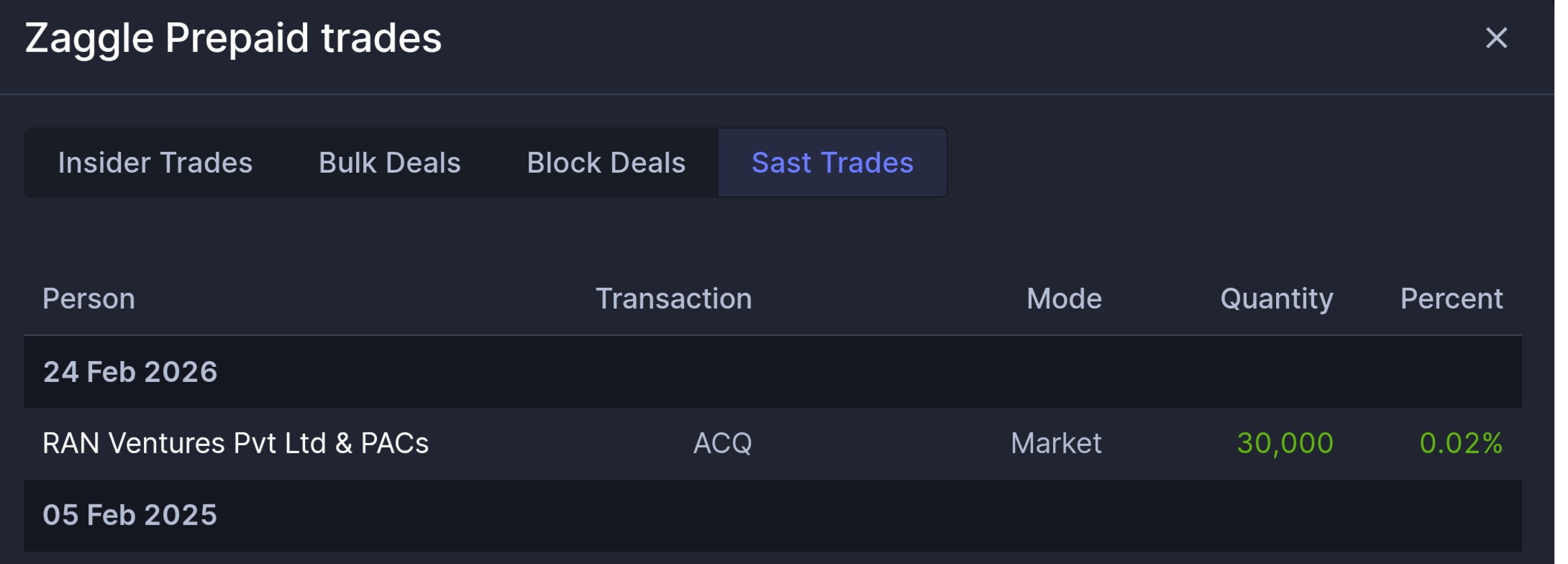
I guess they bought from open market nearly 2.65 L shares from february last year alone. Promoter & promoter group. (RAN Ventures, Raj P Narayanam, Avinash Godkhindi, etc)
Its all 2025 not 2026, I searched everywhere i found only from 2025 not 2026, that’s why I raised the question why dont they acquire and increase their holdings to above 50%
It’s always easy for us to raise questions like why promoter doesn’t increase their stake more in such scenarios.
And that can be said to numerous good companies which are down 50% + from their peaks.
But we should also consider that no promoter in micro/small cap would be sitting with crores of idle cash with them to deploy.
coming to Zaggle, they already bought 30,000 shares in february.
Now if you say why not they raise the stake to 50%, that would come to additional buying of 78,65,800 shares. If we consider the current average lower price of ₹210, that investment would come to ₹16,51,81,800 (₹ 16 crore +). If you ask any promoter of sub 10,000 crore companies, (and that too in this type of bear phase where his other investment would also have tanked), no one would be sitting on such high liquidity or no one would be keen on selling his other investment - take losses & buy.
And this apart from the fact that the promoter group has already committed on warrants for 3,57,734 shares at ₹ 567/share.
So I guess, management is confident enough in their company.
Now that’s altogether a different story, what would be the stand of management, incase the stock price is well below ₹567 at the time of maturity of warrant.
Incase they cancel to buy at that time, would definitely have a bad impression on investors & that would be a definitely green signal to take exit. But company with ethical promoters generally don’t do that. But again that’s a wait & watch story.
Imv warrants will be cancelled for sure, if they can’t buy at cmp don’t have hope they will do it at such price, many smes companies such as avp its having mcap less than 500cr, promoters infused 30cr personally a single man in warrants, you should have voting rights with you its a very basic need for company with so many promotors 15-20cr is not big amount