
I don’t think so NPAs, writeoffs, bad loans would be a concern for Zaggle right? They are essentially just the platform earning the interchange right (Only looking at the EBITDA)? And to push in money (loading money )for the prepaid cards, that is something the tie up with banks would take care of right? Again, I’m new to the company so am I missing something? Who exactly are the trade receivables of the company? For Propel, inventory sits in OCA. But that’s still fine. When do we primarily record the revenues in the program fees is the question? If it’s interchange, money should flow in b/s within 2 quarters?
1. In 2020, MDR charges were reduced to zero for UPI transactions and RuPay debit cards. If a similar regulatory move were to extend to prepaid cards — which currently form the backbone of Zaggle’s revenue model — it would significantly impact the company, given that Program Fees & Transaction Revenue (primarily MDR-linked) contributes about 60–65% of total revenue.
These MDR charges being 1.5-2%, are a big burden on the shop or even customers. So there is high likelihood that there may be a policy to, even if not eliminate but reduce it which may hamper substantial revenue.
- Zaggle’s one of the considerable moat today lies in the compliance and spend-control limitations that prepaid cards impose, enabling clients to monitor and save on employee expenses. However, if UPI evolves to support seamless multi-party corporate disbursements — with tracking and compliance features enabled through the Account Aggregator framework — this moat could erode significantly. In such a scenario, the prepaid card value proposition weakens, and Zaggle’s business model, which derives 60–65% of revenue from MDR and transaction-linked fees, would face material disruption.
I understand that these may not happen overnight but they pose substantially high risk.
I’m early in my journey of tracking this business, so I welcome corrections and deeper insights from the community.
4 Likes
UPI is not free. Govt funds it through subsidies as it can be considered a digital public goods. While not impossible but I would consider this to be low risk scenario.
If you look objectively all business verticals of zaggle are facing headwinds. From spend management to card fees, everything is either being disrupted by AI or fear of being disrupted. Institutions are selling from some time and retailers are bag holders.
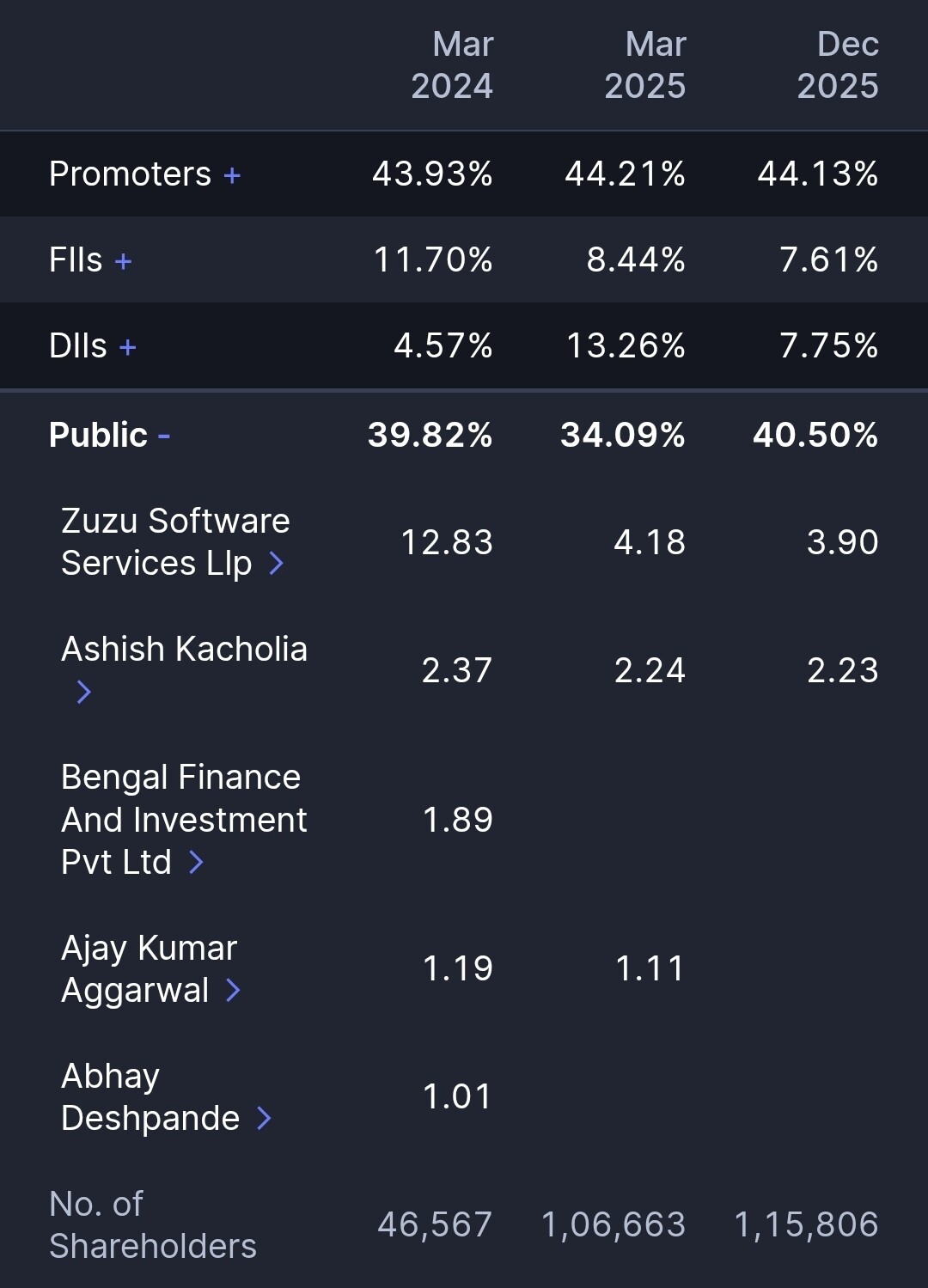
On top of this management is clearly not acknowledging the problem and instead making stupid statements like ‘we are the biggest beneficiary of AI’. I do hope things turn around for them.
3 Likes
You raise two very valid risks, and they are worth discussing seriously because Zaggle’s current revenue model is indeed heavily linked to transaction economics and MDR.
However, there are a few nuances that might provide some additional context.
1. MDR Risk on Prepaid Cards
While MDR elimination on UPI and RuPay debit cards in 2020 did disrupt the payments ecosystem, prepaid corporate cards operate in a somewhat different context.
A few points to consider:
-
The zero-MDR policy on UPI was primarily a financial inclusion push, encouraging adoption of digital payments for retail consumers.
-
Corporate expense management ecosystems are less politically sensitive compared to retail payments.
-
Prepaid corporate cards typically run on Visa/Mastercard networks, where MDR economics are part of the broader card network model involving issuing banks, networks, and program managers.
If MDR on prepaid cards were completely eliminated, the impact would not be limited to Zaggle. It would affect:
-
issuing banks
-
card networks
-
other corporate spend platforms
Given this broader ecosystem impact, a complete MDR removal seems less likely, though regulatory pressure on rates is always possible.
2. UPI + Account Aggregator Disruption
Your second point about UPI evolving into a corporate spend infrastructure is also an interesting scenario.
However, today’s corporate spend management problem is more complex than just payment rails. Companies need:
-
policy-based spending controls
-
merchant category restrictions
-
department-level budgeting
-
audit trails
-
reconciliation with ERP systems
-
tax and compliance workflows
Prepaid cards solve many of these problems at the infrastructure level.
Even if UPI enables multi-party disbursements in the future, Zaggle’s value proposition is not just the payment instrument but the software layer sitting on top of it:
-
spend management
-
workflow automation
-
compliance tracking
-
reconciliation
-
integrations with accounting systems
In that sense, the payment rail (card vs UPI) may be less important than the enterprise spend management platform itself.
3. The Real Question
The key question investors should probably ask is not:
“Will cards disappear?”
But rather:
“Can Zaggle evolve from a card-driven model to a broader enterprise spend platform?”
If the company successfully transitions toward:
-
SaaS revenue
-
subscription fees
-
workflow / expense management platforms
then dependence on MDR-linked income should reduce over time.
4. Bottom Line
Your concerns are legitimate long-term risks, especially:
-
MDR compression
-
payment rail disruption
But the durability of the business will depend on whether Zaggle remains a card program manager or evolves into a full-stack enterprise spend management platform.
That transition is something worth tracking closely.
If company is facing headwinds from all sides, how are they achieving 50% revenue growth rates while expanding margins?
I personally believe AI fears are over exaggerated. While BPO’s and the likes may lose business, you need people who can effectively run AI. I would still stay away from IT service companies until it’s evident who the winners are. There will be winners and loser in IT services. Infact the whole market should grow rather than disappear
4 Likes
Lots of acquisition done using qip cash which is pushing the revenue growth over 50%.
Let me be clear. I am not saying this business is on verge of shutting down. In fact they have so much cash right now they will comfortably survive for the foreseeable future even if degrowth happens. But when market strikes you down >60% from ATH there is bound to be some problem with business model. I am just trying to get answers because this fall may be an opportunity to double down or signal to exit. What AI will do is grey area to me but I never said market will disappear.
I have sent them a mail asking for present status of CTO position. No response yet. Will wait another week or two.
1 Like
Technically it has not made the bottom, 200-210 is still on the cards i guess, fundamentally market will wait for Q4 for breakeven in OCF before starting upmove again
Acquisitions are yet to scale up. Nearly all the growth has been standalone.
Cash will be used for further acquisitions. I understand that investors are getting impatient but I would rather let them find the best deals than just buy whatever they see. They are even investing in VC funds so that they get access to the best deals.
I understand the concerns on AI but I also recognize that there is just too much doom and gloom surrounding AI. Especially when Zaggle has fallen mor than other IT service and SaaS companies.
Lastly on the 60% fall. See I don’t really care and using this as an opportunity to increase allocation. Zaggle had a large retail base and if you want 5-10x companies, you need to face 50,60 and even 70% drawdowns. The fall was not led by falling revenues but massive derating which is fine as I believe Zaggle can continue their growth for the next 3-4 years. I could be wrong but that is what I believe
1 Like
Regarding UPI disrupting the market with 0 MDR -
RBI has launched eRupee working on UPI stack , whose use case will be same as prepaid cards. Employers can issue eRupee and are able to track where these rupee are used that to in real time using UPI stack and can be easily integrated in ERP etc .. Startups like Cotopay is using above stack for expense managment , employee benefit solutions.
Although given the low MDR and ecnomies of scale and stickyness , difficult to replace the market leader.IMO the bigger problem can be decrease in white collar jobs
2 Likes
It’s kind of question which I don’t have answer neither I think its very right question to ask, but my whole thesis exsist around this very question.
I expect in FY27 for full year their revenue is expected to cross 2,000 crores assuming base case.
Now they will spend 1,000 crores out of this 2,000 on incentives.
How someone new can replace this spending, how a vc Will let you burn this much cash when largest player in the space zaggle itself is yet to reach 200 crore profits that too after 15 years of operation.
Another thing is Zaggle is freemium software kind of thing for users. They made money from MDR or interchange fees. Now corporate don’t pay this interchange fees although merchants might try to charge it indirectly.
It’s an illusion of free software and incentives. I am saying illusion because I don’t have another word for it. This illusion is moat.
To some extent master card and visa does this. Yes their network effect is far stronger than the incentive game. But it’s part of their game.
I will be eagerly waiting for counter argument for this thesis.
1 Like
Your thesis is interesting, but I’d challenge one key assumption.
Incentives are usually a growth strategy, not a moat. If Zaggle needs to spend ₹1,000 crore on incentives on ₹2,000 crore revenue, it suggests the ecosystem is still being subsidized. The real test of a moat is whether customers stay after incentives reduce.
Corporate expense platforms do have some stickiness (ERP integrations, compliance workflows, employee policy controls), but these switching costs are not insurmountable if a competitor offers better economics.
Also, the economics ultimately come from MDR/interchange fees, not from corporates directly. If payment rails evolve (UPI corporate payments, MDR regulation, direct bank rails), the pool that funds those incentives could shrink.
Visa/Mastercard also use incentives, but their moat is the global payment network itself, not the subsidy.
So the key question is:
Is Zaggle’s moat the incentive pool, or what remains after incentives normalize?
1 Like
Zaggle’s moat is not the incentives. Incentives is what is required to maintain stickiness. That is what should not scale up as much as revenue (which is why Zaggle also expects margins to improve). Currently software is also similar, and this could change.
Zaggle’s moat in my opinion is the workflow and automation software that Zaggle is giving away for cents on the dollar.
They have a large distribution and a lot of tie-ups with many banks, which is another moat (they can always ditch a bank if they get excessive, and smaller banks will tie up with you for very favorable economics for growth)
Another moat is their rapid iteration and development, which seems to be incremental. Zatix, Zoyer and the fleet management platforms are getting deals. Not easy to keep coming out with products that are sellable!
MDR is a risk, but that is also a risk for massive US companies like Ramp, Shopify, Srtipe and so many others that make money from the interchange. Get rid of the interchange, and the full Fintech space suffers. The government knows that, and Fintechs are a net positive to the economy. Incentives are a huge selling point for cards anyways and this gets financed to a large degree by the interchange.
Thanks for highlighting the MDR issue though. Discussed with Gemini and got a decent rsponse. Do let me know your thoughts
“It is a common misconception that all debit/prepaid cards are capped at zero or low rates. Zaggle operates in a regulatory “sweet spot” where the standard retail caps simply do not apply.
Here is why they can bypass the “normal” low rates:
1. The Prepaid (PPI) Loophole vs. Debit Cards
The Indian government (via NPCI) capped Debit Card interchange and mandated Zero MDR for RuPay Debit/UPI to protect small merchants. However:
-
Zaggle uses PPIs: Most of Zaggle’s employee cards are Prepaid Payment Instruments (PPIs), not bank account-linked debit cards.
-
No Regulatory Cap: There is currently no hard regulatory ceiling on interchange for private-network prepaid cards (Visa/Mastercard) in India, unlike the strict caps on Debit cards. This allows Zaggle to negotiate rates that are closer to 0.90% – 1.10% for domestic spends.
2. The “Commercial Card” Classification
This is the “secret sauce.” When Zaggle issues a card to an employee for fuel, meals, or travel, it is often classified as a Commercial/Corporate Card by Visa or Mastercard.
-
Higher Tiering: Card networks charge higher fees for commercial cards because they offer “data-rich” processing (tracking exactly what was bought for tax compliance).
-
The Yield: While a standard debit card might earn 0.30%, a Commercial PPI can command an interchange of 1.5% to 2.0% because the merchant is paying for the “privilege” of accepting a corporate payment tool.
3. Direct Network “Growth Agreements”
Zaggle doesn’t just rely on the merchant’s swipe fee. A massive chunk of their “High MDR” is actually Incentive Payments from Visa and Mastercard.
-
The Deal: Zaggle has long-term (5–7 year) contracts where the networks pay them extra basis points on every rupee spent.
-
The Math: If the standard interchange is 1.0%, but Visa pays Zaggle an additional 0.7% as a “marketing/growth incentive,” Zaggle’s effective revenue (Take Rate) hits that 1.7% – 1.8% range you see in their reports.
4. Restricted Merchant Categories (MCC)
Zaggle cards are often “locked” to specific categories like Fuel or Restaurants (for tax-free meal vouchers).
-
Surcharges: In categories like Fuel, there is a statutory 1% surcharge that often flows back to the card ecosystem.
-
Merchant Side: Merchants in these categories are used to paying higher MDRs than a local kirana store, allowing Zaggle to capture a larger slice of the pie.
5. Why the Govt doesn’t stop it?
The Indian government’s “Zero MDR” push is focused on Financial Inclusion (small merchants and UPI).
-
Corporate exclusion: The government views corporate spending and employee benefits as “premium services.”
-
Tax Compliance: Because Zaggle helps the government by ensuring “Meal Vouchers” are actually spent on meals (digital audit trail), they are not viewed as a target for the same “Zero Fee” restrictions applied to common citizens’ UPI.
Summary Table: Why Zaggle Wins
| Feature | Standard Debit/UPI | Zaggle Employee Card |
|---|---|---|
| Asset Class | Savings Account Linked | Prepaid Instrument (PPI) |
| Category | Retail/Personal | Commercial/Corporate |
| Govt Cap | Strict (0% or 0.30%) | Uncapped/Market Driven |
| Network Bonus | None | High (Growth Incentives)” |
4 Likes
if incentives normalise to Zero zaggle profits will be 5-6 times of current profits.
I don’t see incentives are going away ever. Management is saying they will reduce it but they will not go away.
How do you expect an competitors to offer better economics when your competition do not have money to offer incentives like you have.
My assumption here that corporates don’t perceive MDR as their cost. I don’t have any theory or anything behind it. It’s so badly structured that it may just be called hunch.
Why would RBI go behind MDR or PPI and credit cards. They don’t serve social inclusion objective.
I don’t think software and innovation is a moat. It’s not patented drug where you know there’s no treatment available except that durg.
Someone can make a better software i don’t believe it a moat.
Yes relationships are something to bank upon, because literally you need to market things to corporates and get them off the earlier software they use and integrate it.
Softwares of zaggle are used by large number of employees of an organisation so now adding new software will create little bit of disruption in the company when everyone is on zaggle software.
Why will you create an disruption when you are getting your softwares for free (perceived) and is doing good job and you also getting incentives ( perceived).
It’s bit difficult to but doable.
I will add that on the top relationship moat incentives make this moat wider and difficult to fill in with just better software.
3 Likes
They don’t even talk about rio money now. Paid 22 crores for a company with topline of 12 lakhs. Lot of fancy words. Projected revenue from rio money as per management is 500 cr by the way.
Headcounts reduced from 400 to 325 and casually forgot to mention CTO exit. No once even asks them. I sent a mail and it hit a brick wall.
3 Likes
Why he get shy on cash flow I don’t understand, no confidence at all, he don’t provide ball park numbers on cash flow, atleast 20 or 30% give some numbers
Why is everyone so stressed about Cash Flow I really do not understand. They have no debt whatsoever and it is clear they could be cash flow positive if they wanted to but they are investing in growth. I want my company to invest in growth and stay a market leader rather than distributing cash.
On one hand investors complain that Indian companies are not RnD focused and dont spend on research but when a company does that, they complain about being cash flow positive XD.
Real worry is when company is highly levered and cash flow negative. If anything question AI threat or margin expansion (which seems to be satisafctory for now)
Acquisitions are too early for me to judge. So time will tell how they do.
9 Likes
Right—and the funny thing, in my view, is that cash flow risk is something I’d worry about before buying a business at an 80–100x multiple. For someone entering fresh now, I think that risk is already fully priced in, yet there still seems to be value left on the table.
You’re looking at a ~23x multiple for a business growing 35–40%, plus around 1000 in net cash sitting on the balance sheet with essentially no meaningful debt. If I adjust for the cash, the core business is trading closer to ~15x.
So how should I feel about the cash flow concern? Personally, I think it’s a bet worth playing. There are no picture-perfect businesses without risk—the real question for investors is what price they’re paying (or paid) versus the value they’re getting (or got). New here so just curious, when the stock was trading 80x, was there still cash flow problem, or is it a recent phenomenon?
Discloser: Recently entered, avg position size.
6 Likes
Is the stock declining due to potential for business model disruption. I ask because it seems like it and all its competitors (EdenRed, Sodexo, PLuxee etc.) are down 60 to 70%. Something is not right but I am not able to figure out what it is. Anyone got any thoughts.
Markets are beating IT and sft related stock left right and center . Also white collar job reduction will directly impact zaggle.
On the other side zaggle is expanding its horizon in many related activities trying be to one shop for many activities of corporates etc ex take corporate expense , gift cards, expense Software integrated into ERP, prepaid cards , credit cards , fleet management , zattix (analytics) , HR activities like taxes , Golf benefits , UPI s, Global payments , Middle east expansion . Many of above business are like tiny samplings which might become huge .
All the above expansions are into related and complementary fields.
1st gen founder management having execution capability (Zaggle is a market leader in India).
Low valuations given the pessimism in the sector . US comp valuations- ramp (32b$) , coupa (9b$).
On negative side it is against the Sectoral tailwinds
Some of the above points ticks the checklist which our seniors at VP forum looks for .
3 Likes