Nicely summarized. Would like to add a few thoughts on how I’m approaching it.
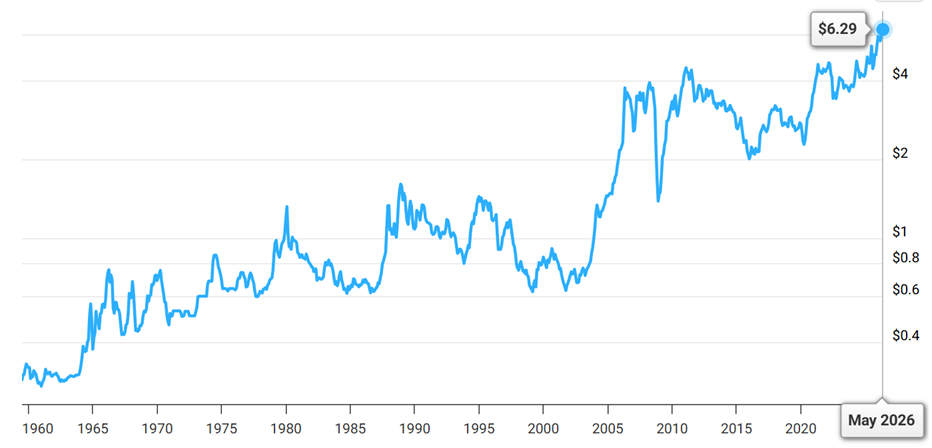
First things first, forecasting commodity prices is not my cup of tea, so having a sense of the underlying trend is good enough for me. After studying copper for some time, it’s quite clear that copper is in a structural uptrend driven by both demand and supply dynamics. That said, it’s never going to be a one-way ride, commodities are inherently volatile, and I expect the same here as well.
Earlier, I was playing this theme through Sunlite Recycling, but after reading more, I realized that value addition is extremely important. You cannot rely purely on commodity sales. When you are supplying OEMs with value-added products, those sales tend to be recurring in nature, and demand is relatively inelastic to smaller fluctuations in copper prices. In contrast, commodity sales such as rods or cathodes can be highly opportunistic, with intense competition.
That’s why I shifted my position to Bhagyanagar. I realized that value addition takes time and requires meaningful capex. If you look at the balance sheet, Bhagyanagar already has ~200 crore of gross block, largely plant & machinery, which supports the argument that for a commodity player to transition into value-added products, the process will likely be slow and capital intensive.
On the other side, even companies already selling value-added products won’t find backward integration into scrap easy. For example, Precision Wires is undertaking ~240 crore capex for scrap backward integration, that’s a serious amount of money, money Bhagyanagar doesn’t need to spend. So it’s not a flip-the-switch process for value-added players either. It requires serious capital, and even after that, you still need to build a global sourcing network which takes it own time. Look what happened with Jain Resource in Q4, its copper EBITDA/tonne crashed to ~13,000 because it was doing commodity sales and was overly dependent on the Gulf region for scrap sourcing.
So we have a fairly unique setup here, and a lot of it is not fully captured on the balance sheet, which makes it even more attractive from a value-investor’s perspective.
Now, coming to what was asked regarding the 200 crore asset value, that is only the circle rate of the real estate. The actual market value is likely several multiples higher. Of course, none of this matters if those assets remain idle, but management has clearly indicated that one of the land parcels alone could generate ~400 crore of free cash flow. So I do see meaningful value here. I may continue holding that piece as well, depending on the market cap at which it eventually gets listed.
As pointed out earlier, the biggest risk remains a global recession, which I completely agree with, no demand means no growth. One also has to remember that China accounts for ~50% of global copper consumption, and its domestic real estate market is still in a bear phase, which can keep copper prices softer for longer.
That said, Bhagyanagar’s FY26 realization was only ~956/kg, while current copper prices are around 1,330/kg, so from a near-term pricing perspective, there doesn’t seem to be much to worry about over the next year.
And finally, every thesis remains just a thesis until management actually executes. None of us can forecast that with certainty. But considering all the variables at hand, the risk-reward appears quite attractive.