
Infact Sandeep sikka appeared in an interview on CNBC recently and said that they are looking at adding additional 50% capacity with in next two years via organic and inorganic route. He also clarified that this 25% greenfield expansion in Madhya Pradesh is over and above the 50%.
3 Likes
AGI Greenpac targets 8-10% revenue growth for FY26 - CNBC TV18
HNG is now Plan B
1 Like
Though Court matter is long dragged but AGI is still in the race it seems. Hon’ble Supreme court has allowed review petition and hearing will start as early as mid April.
3 Likes
Review is permitted only on error apparent on record. Normally, this is done by circulation. 99% of the review petitions would be dismissed. However, I note that the Hon’ble Court has agreed to a open hearing.
2 Likes
Interesting saga, I have certain questions for my fellow investors:
- Considering the fact that we may not be able to see a growth of more than 10% each years till FY27 end from existing business, are the current valuations justified? I ask this question to assess our downside risk and margin of safety
- Probably in 3 years we will be able to see a 50% capacity addition atleast as guided by the management as well, and HNG capacities may not keep up for another 2 years making HNG lose market share to AGI, other exsisting players or any other entrant; does this thesis make sense or there can be caveats here?
- Are the margins sustainable ast 20-22%+ levels going forward as well? because in my opinion majority of the valuation AGI is getting right now is due to its high margin profile which can be mostly impacted either due to raw material price volatility or price realisations volatility, while latter may not be impacted much due to demand side being intact and supply issues may arise due to HNG not being operated well for sometime
- Is the market susceptible to imports?
2 Likes
- as per my DCF analysis with conservative numbers the fair value came out to be around 1000. the company is undervalued in my opinion. if we look at the recent events nothing fundamental about the business has changed apart from the HNG verdict. The market over reacted is what I feel.
- I feel the same but need on ground data abouth what other companies are upto. gujarat glass is another dominant player in the industry
- 19-20% OPM should be sensible because the soda ash pricing was always a concern. company is Debottlenecking its facility that should contribute to the margins too. need to pay attention to the financing activity
- absolutely
5 Likes
Well, the management is targeting a 8-10% growth in its revenues for the next year. The company is currently operating at a 95% utilisation. New capacities will be commissioned by the end of FY2027.
So how exactly are they planning to increase revenues by 10%? Any idea?
Disc: Not invested, tracking
2 Likes
effects of Debottlenecking, capturing share from HNG on top of the usual business growth
2 Likes
So here’s my take
Let us assume that the probability that the acquisition of HNG will go through is 30% (conservative imo). In such a case, due to new capacities, the management quoted that it could achieve a revenue of 5000-5500 crores within 2-3 years of acquisition.
So revenues for the FY 28 assumed at 5000 crores. An EBITDA of 23% and multiple of 12 gives us an EV of 13800 crores for FY 28. Discounting that EV in FY 25 using WACC of 15% gives us an EV of 9073 as of FY 25.
In the other scenario where the acquisition does not go through (with a probability of 70%), I assumed that the company will grow its revenue by 8% every year till FY 27 and in FY 28 it will do 650 crores of revenues from the Gwalior plant alone which would commission by the end of FY 27. So ignoring the usual business growth from the existing capacity in FY 28 for conservatism purpose, the revenue for FY28 can be (2528 x 1.08 x 1.08) + 650 crores (650 being the revenues from Gwalior plant estimated based on average realisation and capacity).EBITDA of 23% and a multiple of 12 gives us an EV of 9935 and discounting it back 3 years gives us an EV of 6532.38 crores.
So the probability weighted average EV of FY 25 comes around 0.30 x 9073 + 0.7 x 6532.38 which gives us 7294. Deducting net debt as of March’25 gives us an estimated market cap of equity to be 7140 crores
Current mcap is around 5300 crores (ignoring 3 months mcap gain/loss). It prima facie provides a cushion
Disc: Not invested, tracking
6 Likes
From an industry standpoint, demand is pretty much stable with an upward slope over a long period of time. What matters is the industry supply. The current capacity of glass containers for the Alcohol & beverages segment far exceeds the annual demand. So from an economics view, there exists huge pricing pressure.
Let us go back to FY 2014. EBIT of the container glass segment decreased by 86%. Yes, you read that right. Reasons? Well there was so much capacity in the industry that the demand was not able to cater the increased inventories, which ultimately led to lower realisations. That coupled with an increase in input costs just eroded the company’s margins.
Both HNGIL and AGI Glasspac operated at less than 70% utilisation that year. Now, this is a industry with a very high operating leverage. So much so that it does more harm than good. Fuel & Power contribute around 20% of the total costs which is fixed. That means whether you operate your furnaces at 95% capacity or 65% capacity, the costs would be the same. So for favourable operating leverage to kick in, utilisation has to be greater than 90% else costs hit the roof.
In fact, according to me, this was one of the primary reasons why HNGIL went bust. It continuously operated at lesser utilisations adding to the accumulated losses.
This is the reason why industry players are extremely cautious to lay even a single dime for CAPEX growth unless there are obvious growth prospects.
So now since this has been established that overcapacity is the trigger for the profit downfall, let us look at the current scenario. HNGIL declared insolvency. AGI Glasspac, operating at 95%, is not adding any new capacities till FY 27. PGP glass (Piramal Group + Blackstone owned) has added a 120 TPD capacity for COSMETICS AND PERFUMERY segment. So effectively, no new capacity will be added for at least 2 years in the Alcohol segment.
ROCE’s, ROE’s and OPM are all at an all time high as of the last quarter. Is the cycle at its peak? I dont know. One of the reasons for the elevated margins is probably the fall in crude prices barring last month. This is a dangerous territory. If there’s a downcycle next, expect profits to evaporate. But again, in this industry, the cycles are not very prolonged.
And in fact, if there indeed was a clear downcycle ahead, the company would not have announced a 25% existing capacity expansion. This is where the dilemma is. At which point of the cycle are we standing.
Also I am not very confident on the growth drivers 1-2 years down the line. 95% utilisation and no capacity addition means the guidance of 8% will be achieved either by a change in product mix towards value added products or increasing realisation prices (which is not likely). I am not really convinced with the debottlenecking effects.
Will revert after digging deeper into the industry cycle
Disc: Purchased 1 share because why not
13 Likes
Very insightful analysis. Could you please also take another point in your analysis when you will dig further for industry . Long term demand trend for glass as packaging in India. Per capital consumption of Glass as packaging in India is at 2 KG. In China it’s at 12 KG. US at 32 KG and some European nation at over 50 KG per year .
2 Likes
Hi @SMondal15
So usually I don’t look at the macro numbers such as the per capita glass consumption figure that you mentioned. I am not saying those are not useful, it just doesn’t provide me any utility.
India by its virtue, will be under penetrated in all possible metrics that exist as compared to say USA, China or EU nations. Be it Housing Credit penetration to GDP, glass consumption, PVC consumption or any other metric you can think of.
But since you have asked, I will definitely try to provide a view from a macro standpoint. Quite frankly, the only thing left to identify in AGI is the cycle. But unfortunately that is the difficult part. Let’s see though.
5 Likes
So before I begin, I would like to disregard my probability weighted valuation of the company for the following reason:
If the company had made the acquisition, it would have spent Rs. 700 odd crores on refurbishing its furnaces. Instead in the last quarter, the company announced a Rs. 700 crore greenfield capex in Gwalior. The best case assumption underlying would be to assume that the acquisition will not go through.
1. Industry & Cycle
I will be upfront. All things indicate that the business is nearing its peak, period. From all the methods that I tried, all of them indicated the business to be at its peak. EBIT margins are at an all time high, ROCEs are at an all time high, average inventory to sales ratio are at an all time low and capacity utilisation has been above 95% since the last 3 years.
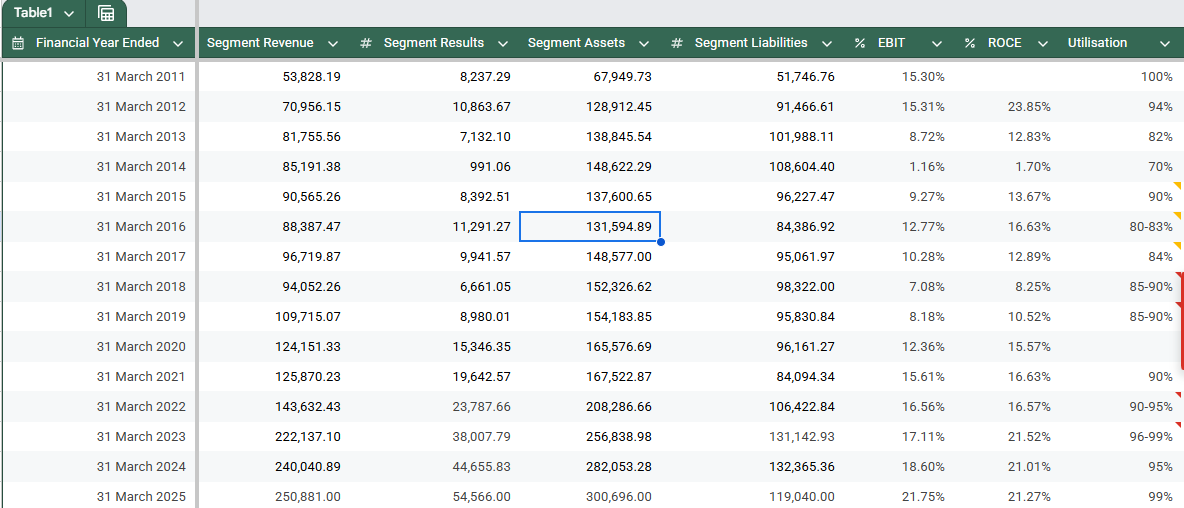
However, does that mean there’s a downturn next? Probably not. As mentioned in my post from 8 days earlier, industry dynamics have to be seen from the perspective of supply i.e. capacity.
So from FY 2011 to 2013, AGI Greenpac (then HSIL) added a total of around 475 TPD capacity in its glass container business. HNGIL increased its capacity from 2930 in FY 11 TPD to 4300 TPD in FY 13. So two of the biggest players did a major exapnsion and the next year it all went bust.
Learning from the past, in the last 3 years, there have been no major capacity expansion in the industry. A 100 TPD by AGI in FY 22 due to debottlenecking and a specialty glass furnace addition worth 154 TPD. HNGIL did not add a single capacity since that dreadful year of 2014. PGP glass in fact did an addition of 250 TPD in the industry but that was to cater needs of the US Specialty markets. (Note: PGP glass, though in the same business, is not really a direct competitor since more than 75% of its revenues come from export sales as opposed to less than 5% of AGI).
So the point is, no major capacity addition in the last 3 years, no major expansion in the next 2 years and a major major expansion post FY 27. As per the management’s earnings call, it intends to add 50% of its existing capacities excluding the Gwalior plant. So effectively, the capacity could be around 2000 + 1000 + 500 (Gwalior) = 3500 TPD.
I am not really worried about this addition because
- HNGIL is operating at very very low capacities and the more the litigation drags, it will continue to operate at such low capacities. After the decision is made, it will take huge capital and at least a few quarters to refurbish the furnaces as stated earlier. And, even after refurbishing, capacities will operate initially at lower levels.
- Another reason for not worrying about increase in industry capacities is the geographical dynamics. HNGIL primarily serves to the northern part of the country as compared to the southern presence of AGI. Gwalior plant will be established to expand AGI’s reach into the northern part where there is a supply constraint due to HNGIL.
So more or less, the industry overcapacity risk is mitigated.
2. Competitive Scenario
Since there are now limited players in the glass packaging industry, the pricing power of the company could increase as compared to earlier. Now of course, seeing in an absolute basis, the clients of the company are well established liquor manufacturing companies who could put some pressure on AGI.
Most of the liquor manufacturing companies do not produce glass bottles on their own because it takes a lot of capital and a lot of effort in terms of staying up to date with technology to do so. They find it much easier to purchase it from companies like AGI. Imports of glass bottles are on the lower side too.
Now for liquor companies that do manufacture their own bottles, it is because their focus is on premiumization and customization of bottle aesthetics. If, AGI can deliver customizable designs, this risk could be mitigated too. Hello 154 TPD Specialty Glass plant 
50-60% of the revenue contracts are formula based wherein raw material price increase/decrease are passed on to the customer though with some lag. The balance contracts are negotiable wherein the management has to negotiate with the customer for it to agree to a price hike. The management has been successful in the past to do so.
And for the competitors, I am not really concerned much. PGP is the 3rd largest, but it primarily focuses on Cosmetics and Perfumery segment and exports to US for the alcohol market.
3. Risks
Price Risk - If the review petition filed by the company gets rejected by the Honb’l Supreme Court, it could probably cause the stock to fall by a good 10-15% or probably more, who knows.
Business Risks
-
First things first, in formula based contracts, price increase take a quarter or two to get passed. So this could impact margins for the relevant quarter if there is an increase in RM prices. For negotiable contracts, customer not agreeing to a price hike is a major risk. The management has also stated difficulty to pass on extreme price hikes of more than 10% to customers in the negotiable segment.
The major raw material is Soda Ash which the company imports because even after Anti Dumping Duty, it is cheaper for the company to do so. -
Revenue Concentration - Revenue from top 3 customers account for 41.38% of the company’s total revenues.
-
Hike in the power and fuel costs could impact margins as it is a fixed component that is independent of utilisation levels.
AGI had a 2% stake in Andhra Pradesh Gas Power Corporation Limited which enabled it go get power at a concessional rate. APGCL ceased operations, AGI wrote off its investments and thus the concessional rate no longer exists. -
New plant at Gwalior will initially be operated at lower levels. Why? Because well it is a new plant and company will take time to ramp it up. Plus, the industry dynamics are such that in the northern side, installed capacities are high and utilisations are low in contrast with the southern side where installed capacities are low but utilisations are high. So lower utilisations could lead to a decreased margin from the new plant in initial years.
-
And obviously, the biggest risk is that my view of the industry capacity turns out to be wrong, 2014 repeats, profits fall faster than water from a waterfall and everything goes down. Pretty cool right?
4. Mispricing reasons
The million dollar question, was the 50% fall when SC rejected bid justified? Let’s take a closer look.
There is no doubt that the rejection caused 12-18 months of sales. Why? Because it takes a lot less time to refurbish existing furnaces already located and built than buying a land, setting up a factory and starting production in Gwalior. (It is always better to switch than reload)
Also, there was a sharp rally in anticipation of the acquisition. Management was quite optimistic. (We cannot really blame them for this because it was not in their control). Anyway, sharp rally beforehand and an ever sharper fall post the decision, fueled by a drawdown in the small cap space in the Indian markets caused the steep fall.
Right now though, everything appears to be priced in. All things that could go wrong have been priced in as far as my conclusion goes. Any new improvements could result into a good news for the business.
5. Management Quality & Outlook
I am in no position to judge the quality of management. They have been in this business for more than twice my age. They haven’t done anything out of the blue to this day.
They are also starting to plan for retail B2C sales through e-commerce. The thing with retail sales is that there will be higher costs in terms of platform fees and all other related costs. But once volumes start to kick in, those costs remain same. BSE circular dated 20th May states that AGI has invested 6 crores for up to 25% stake in an e-commerce start up. Talk about far sightedness.
Coming on to the valuation, stock is not cheap per se.
Value of equity of 5000 crores along with debt of 560 crores with cash, bank and other FDs/current investments give EV of around 5390 crores. EBITDA of 688 crores gives an EVEBITDA of 7.8 times.
This might look cheap, but keep in mind this ratio is based on PEAK EBITDA. So a ratio of 8 times peak EBITDA is certainly not a bargain.
6. Conclusion
I am just backing the company to deliver on their “de-bottlenecking” process for the next fiscal. Soda ash prices have fallen pretty considerably. Once it reverts to its mean and the company passes on the increase to its customers, realisations will grow. Improvement in product mix could also increase it since realisations of specialty glass is twice the price of the commercial glass.
A favorable decision by the Supreme Court could act an a catalyst. Although I don’t know what the company will do if that happens with HNG + their own capacity additions.
"Funny thing about catalysts – the most meaningful ones are hardly ever expected. " - Dr. Michael Burry
Disc. Holding 1 share. Will buy
7 Likes
thank you Kautuk - that makes for a great read - I am not too sure if the acquisition of HSG now remains as attractive as it did prior to the cap addition decisions - unless some of the acquired facilities are moth-balled to take out additional capacity. It remains afterall, like you rightly point out an industry that depends highly on managing supply / moving into markets where there is potential to corner existing demand.
simply rolling out new capacity (which is currently the case) for them is going to allow them to grow organically in their existing markets with potential to move up on the premiumization - this is coming though wtih a drag on the margins as capacity util goes down, and a drag on ROIC as its going to be financed by debt.
my concern here is would you pay 8x EBITDA (and a higher P/E with the int. payments) - which I see as the average multiple at which this thing has been valued for the past 10 years for a weaker financial profile going forward..
P.S. also just started to study about them - and waiting on the sideline as far as a position goes.
1 Like
“When the facts change, I change my mind” - John Maynard Keynes. re-evaluating the company with current risks involved, I became conservative with the numbers. and assuming a fair value around 545-680 would make more sense as of today.
so what changed? The debt that will be incurred in the medium term which influences enterprise value of the company, altering the risk adjusted returns.
1 Like
Hi @RoHa
Regarding the acquisition of HNG, it certainly does not make sense after announcing capacity additions. In fact, I think the management did not want to delay their plans or wait for the litigation to settle (which has a high probability of an unfavorable decision for them).
Now your worry of the drag in margins and ROIC is valid. But a couple of years of relatively less margins for an opportunity to expand in the northern side looks reasonable to me.
Interest costs would be capitalized and not expensed as per Ind AS - 23 “Borrowing Costs” so the earnings and higher PE is not much of a concern.
My biggest worry is the next 1 or 2 years. If the management is really a great one, it could squeeze out 3-4% of revenue growth with full utilisations and no additional capacity. I think that increase in utilisation of specialty glass from 70% to 80-85% could help. I am not a fan of debottlenecking per se.
Regarding your concern about valuation, it is justified. But riddle me this - you’re getting the biggest player in an industry, which has a moderate to high barrier to entry (in terms of capex and time to commence production), with headroom to grow in the northern part where its biggest competitor used to be, with headroom to increase specialty glass share (which has double realisations) to sustain margins with export underway as well. All of this at 8 times EBITDA.
I might sound biased but that’s my take.
3 Likes
 Capacity to increase 25% by Mar 2027
 Anticipating 8-9% growth
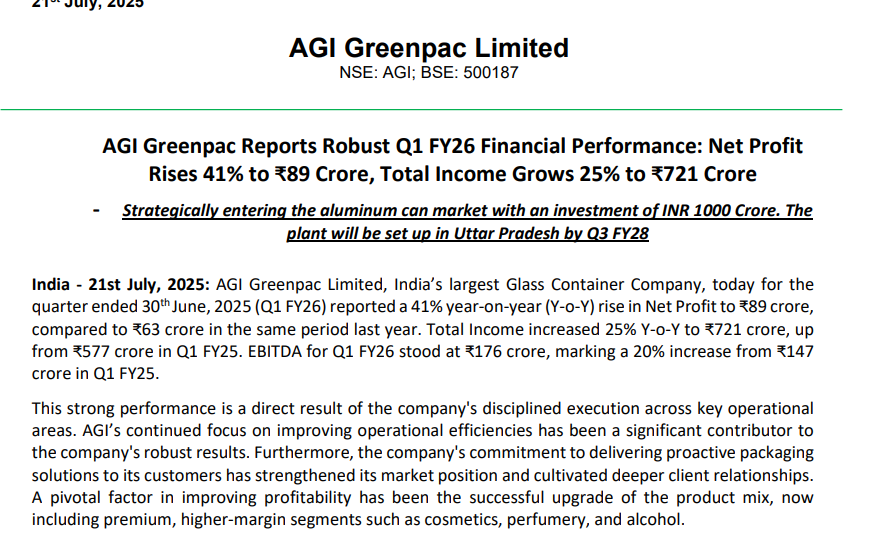
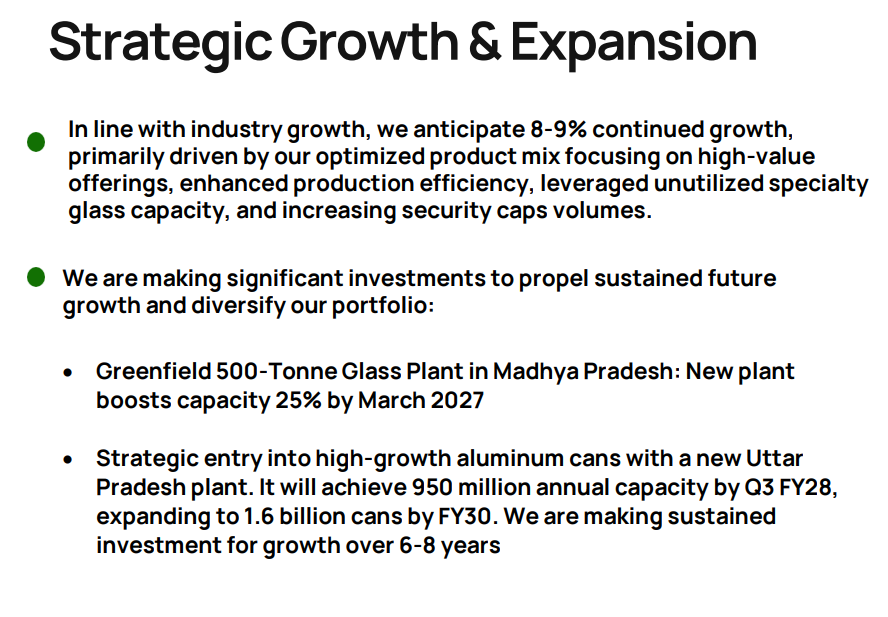
with the news of agi greenpac capex into 2 peice aluminium beverage can , now one may consider this packaging sector will go from a duopoly to oligopoly in coming future once their can making line commences their production , as current market players in 2 pc beverage cans are canpack group and ball corporation both of them are multinationals and have a global presence in various countries.
6 Likes
AGI Greenpac _22072025.pdf (639.2 KB)
Agree and Interesting to watch growth after FY26. FY 26, growth somewhere 8-10% but afterwards 15% Plus!!! The Indian Industry CANS Capacity will be 2X
3 Likes
Refer below: Unprecedented shortage of cans …
It would be much better if AGI’s management fast-tracks the can project on top priority.
2 Likes