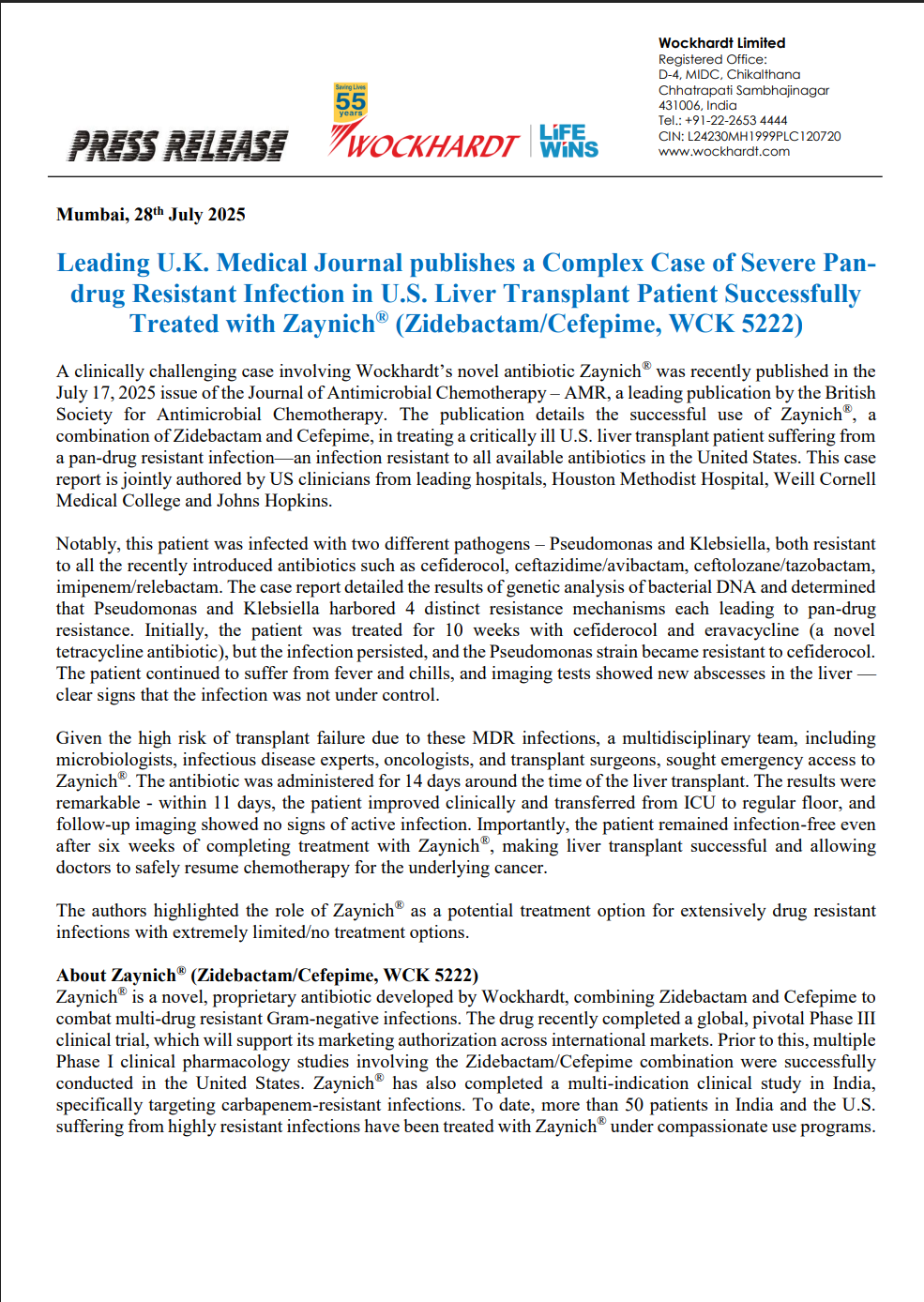
Wockhardt’s novel antibiotic Zaynich has successfully treated a severe pan-drug resistant infection in a U.S. liver transplant patient.
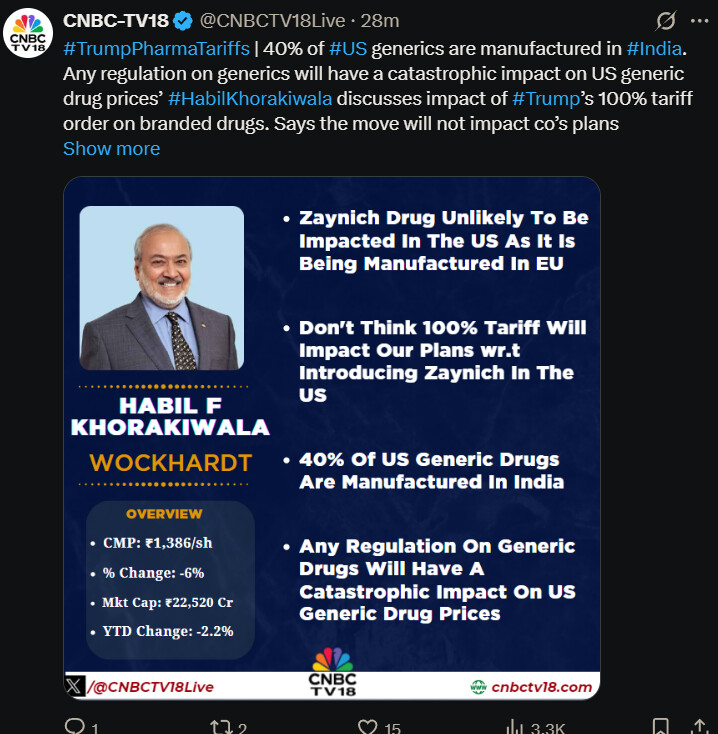
What is the repercussions of Trump pharma tariff on Zaynich? As the expected tariff may reach 250% in 2 years coinciding with launch of Zaynich, a damocles sword is hanging on Wockhardt share. Experts are requested to give insights.
Wockhardt would have patent and exclusive rights for it’s formulations, so I guess Wockhardt can bypass this by having it contract manufactured in US or license it to a US brand.
This may lead to erosion of some profit margin or may increase price for US.
Press Release - “Prestigious Medical and Public Health Journal " The Lancet Regional Health” Publishes Pivotal Phase 3 Clinical Study on Miqnaf (Nafithromycin)
https://www.thelancet.com/journals/lansea/article/piiS27723682(25)001374/fulltext
A phase III data on nafithromycin has been published.
Non inferiority against an antibiotic - Moxifloxacin has been established. (Not superiority)
Moxifloxacin became approved in 2010.
A 7 day course of Moxifloxacin costs about 175/-.
How much more patients will be willing to pay for a shorter three day course for comparative efficacy ?
Rgds
The reports says that
ECR was observed in 91.3% (220/241) of patients in nafithromycin group and 89.0% (210/236) of patients in moxifloxacin group of the MITT population [difference, 2.3%; 95% CI (−3.1, 7.8)]
So why nafithromycin was not superior if any one can explain
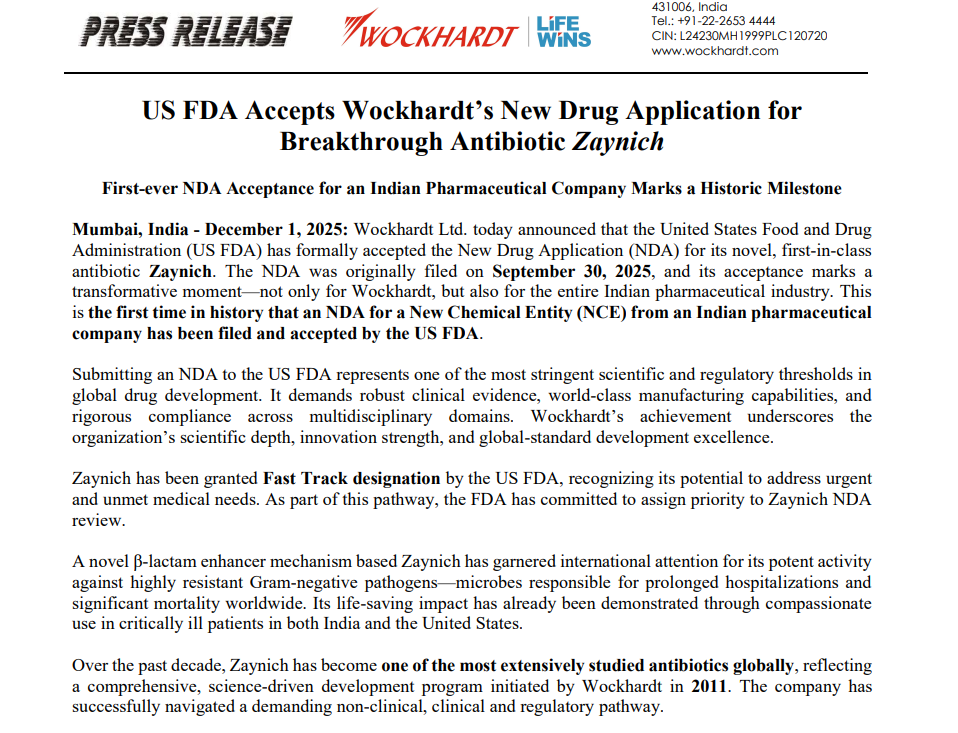
Wockhardt has filed a New Drug Application (NDA) with the USFDA early last week [Moneycontrol].
Following the NDA submission in October 2025, Zaynich will undergo the USFDA’s structured review process. The agency first conducts a 60-day filing review to determine if the application is complete. Once accepted, the drug may be granted either Priority Review (6-month timeline) or Standard Review (10-month timeline), culminating in a decision by the Prescription Drug User Fee Act (PDUFA). The process includes facility inspections, labeling negotiations, and potentially an advisory committee meeting, especially for novel therapies.
I am expecting Zaynich to be launched in the US before the end of calendar year 2026.
Its going to be fast track review…for approval…Good trigger
Zaynich Launch Timeline: -Total TAM- $9B globaly
India: End of FY25
Global: FY26
US: FY26 (May 26- Jul 26)
BEYOND ZAYNICH: THE PIPELINE Fast Track for Zaynich validates Wockhardt’s entire anti-infective platform:
ERTAPENEM-ZIDEBACTAM (WCK 6777) EMROK/EMROK O 4 novel drugs. All targeting critical resistance gaps.
So there are 4 more like this…Very close tracking required.
Wockhardt Limited has announced successful Phase 3 clinical trial results for its novel intravenous antibiotic Foviscu (WCK 4282), marking a significant milestone in the fight against drug-resistant bacterial infections. The antibiotic successfully met its primary endpoint in treating complicated urinary tract infections (cUTI) and acute pyelonephritis caused by Gram-negative bacteria, including extended-spectrum β-lactamase (ESBL)-producing pathogens.
Phase 3 Trial Results and Clinical Performance
In the randomized, double-blind Phase 3 study, Foviscu demonstrated therapeutic equivalence with meropenem, the gold-standard carbapenem widely used for severe drug-resistant Gram-negative infections. The trial results showed impressive clinical outcomes:
| Parameter: | Foviscu | Meropenem |
|---|---|---|
| Clinical Cure Rate: | 93.23% | 92.31% |
| Safety Profile: | Well-tolerated | Well-tolerated |
| Primary Endpoint: | Successfully met | Comparator |
This represents the first Phase 3 head-to-head trial of an antibiotic specifically developed for ESBL infections compared directly with meropenem. The study enrolled 323 hospitalized patients with cUTI and acute pyelonephritis across combined Phase 2 and Phase 3 programs, with Phase 2 including 60 patients and Phase 3 encompassing 263 patients.
Addressing Critical Antimicrobial Resistance
The trial results highlight the urgent need for effective alternatives to combat rising antimicrobial resistance in India. Key findings from the patient population include:
-
More than half of Enterobacteriales isolates (51.4%) were ESBL-positive
-
33.8% of Gram-negative bacteria were resistant to cefepime
-
Most common causative pathogens included Escherichia coli, Klebsiella spp., Enterobacter spp., and Pseudomonas spp.
ICMR data reveals a high burden of ESBLs and rising resistance to commonly used antibiotics such as piperacillin/tazobactam and cefoperazone/sulbactam. This resistance pattern increasingly forces clinicians to rely on carbapenems like meropenem, thereby accelerating carbapenem resistance. Currently, approximately 65 lakh treatment courses of meropenem, piperacillin/tazobactam, and cefoperazone/sulbactam are used annually in India.
Foviscu’s Unique Formulation and Development
Foviscu represents a breakthrough as the globally only scientifically developed single-vial dosage form that combines pharmacodynamically optimized and clinically validated doses of tazobactam 2 g and cefepime 2 g. This combination is enabled by proprietary technology designed to ensure safety and efficacy.
The antibiotic has undergone extensive global evaluation through a comprehensive program covering:
-
Clinical development across multiple countries
-
Pharmacokinetics/pharmacodynamics (PK/PD) studies
-
Antimicrobial susceptibility testing methods
-
Microbiology studies on global bacterial isolates
Phase 1 and renal impairment studies were conducted in The Netherlands, PK/PD studies in the US, Europe and India, and microbiology studies on global bacterial isolates in the US and India.
As of May 2026, Wockhardt reported a strong Q4 turnaround, with revenue growing 23.8% year-over-year (YoY) to ₹1,156 crore, driven by robust performance. EBITDA increased by 21.9% to ₹140.8 crore, reflecting a significant rebound in profitability for the quarter.
Key Quarterly Results Highlights (Based on May 2026 data):
-
Revenue: ₹1,156 crore (23.8% YoY growth).
-
EBITDA: ₹140.8 crore (21.9% YoY increase).
-
Performance Driver: Strong turnaround in operational efficiency.