
Imagine you run a big appliance brand. You could build your own factories for every product you sell — or you could tell a trusted partner “here’s the design, make me 400,000 air conditioners,” put your logo on them, and sell them through your own shops. VOEPL is that partner. This is called OEM/ODM manufacturing: OEM (Original Equipment Manufacturer) means VOEPL builds to a design the customer already owns; ODM (Original Design Manufacturer) means VOEPL does the design work itself and offers a ready-made product that a brand can simply put its name on and sell. It’s the same model that makes iPhones in someone else’s factory — just for appliances instead of phones.
For most of its history VOEPL has been almost entirely an OEM — a builder, not a designer. That changed in FY26, when the company launched its own ODM range in air conditioners for the first time. This matters commercially in two ways: an ODM product is stickier (the customer is buying VOEPL’s design, not just capacity, so switching suppliers is harder) and it opens the door to new customers who don’t already have their own AC designs — which is exactly how VOEPL has started adding customers beyond its original anchor relationship.
The Six Product Verticals
· Air Conditioners (IDU + ODU) — the indoor unit and outdoor unit of a split air conditioner. This is the core business and, even after several years of deliberate diversification, still the largest single chunk of revenue.
· AC Components — the physical parts inside the products above — heat exchangers, copper tubing, sheet-metal shells, cross-flow fans, plastic/EPS parts, and controller boards. VOEPL makes these for its own use and increasingly sells them to other manufacturers too.
· Refrigeration — commercial deep freezers (the chest freezers seen in shops for ice cream and frozen food) and water dispensers, plus a small, recent amount of premium multi-door refrigerator assembly for a couple of customers. Deep freezers are the more established of the two; the company says it is the only OEM/ODM player currently assembling premium multi-door refrigerators in India.
· EMS & LED Lighting — the oldest part of the company. Covers LED lamps, panels and street lights, plus circuit boards and controllers for appliances, EV chargers, and BLDC fans. A mature, competitive, price-pressured business that VOEPL keeps running steadily but doesn’t lean on for growth.
· Compressors — the newest major category (commercial production began around January 2026). The compressor is the pump that does the actual cooling in a fridge or freezer. Built through a majority-owned subsidiary, Virtuoso Compressors Private Limited, using technology licensed from two Chinese partners (Huayi and Jiaxipera). This is the segment carrying the most optionality — and the most policy risk — of anything in the portfolio (see Section 5, Growth Drivers, for the full compressor thesis).
· Washing Machines — the newest addition of all: semi-automatic (twin-tub) washing machines, just entering mass production. A marquee customer has reportedly been finalized but not publicly named.
How the Product Mix Has Shifted
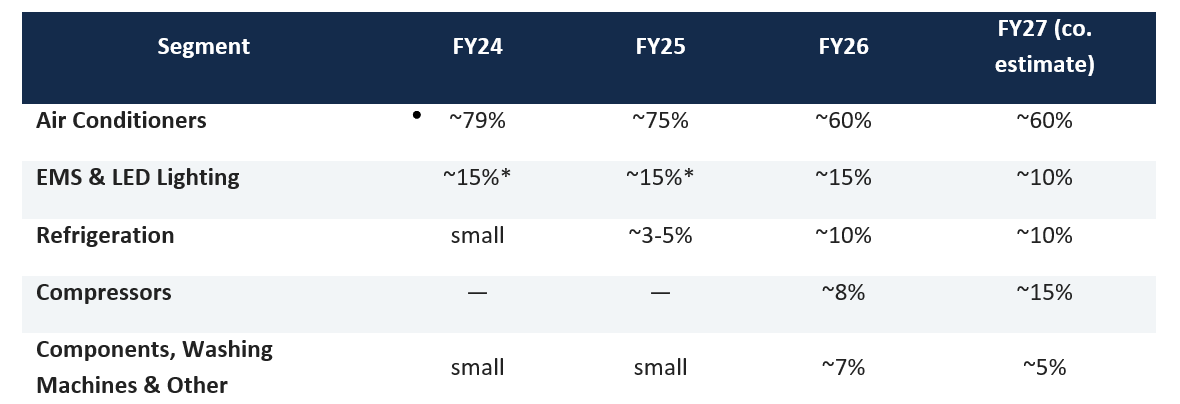
The single most important trend in the whole business is deliberate diversification away from air conditioners. Three years ago AC was roughly 80% of everything; by FY26 that had fallen to around 60%, with the freed-up share absorbed by EMS, refrigeration, components, and — starting this year — compressors
Manufacturing Footprint — Where It’s Made
VOEPL operates 10 manufacturing facilities across three states, plus a sales office:
· Nashik, Maharashtra — 7 units — AC Unit 1 & 2, EMS & LED Lighting, Polymers, Compressor, Refrigeration, and Washing Machine. This is the corporate headquarters and the historical core of the business.
· Chennai, Tamil Nadu — 2 units — component manufacturing under Virtuoso Polymers (VPPL), plus a leased AC manufacturing line (Star Eltech) added in late 2025/early 2026 to serve customers beyond Voltas and add geographic reach in the south.
· Sanand, Gujarat — 1 unit — component manufacturing under VPPL, commissioned in late 2025/early 2026.
· Delhi — 1 sales office — not a manufacturing site, but the company’s northern commercial presence.
Selling is business-to-business only. Management has said repeatedly that VOEPL has neither the desire nor the infrastructure to sell to consumers directly — everything it makes goes to a brand, which then sells it under its own name.
Who Buys It: The Customer Story
This is the thread most worth understanding in detail, because the headline “diversification” story is real but easy to overstate if you only look at the AC-segment numbers in isolation.
For years, essentially all of VOEPL’s AC business — and therefore the majority of the whole company’s revenue — went to a single customer, publicly understood to be Voltas. As recently as H1 FY26, management described Voltas as “close to 100%” of AC revenue. The ODM launch in late 2025 changed this: by early FY26 the company had signed three to four new AC customers, and management’s own guidance for FY27 is that Voltas will fall to somewhere between 40% and 60% of AC revenue specifically — not of total company revenue.
Beyond AC, the other segments each have their own customer relationships, generally described in calls only in general terms (multinational brands, anchor customers) without company names disclosed:
· Refrigeration — Two anchor multinational customers for deep freezers, with a third in the pipeline as of late 2025; a separate relationship with Vijay Sales (under its “Vise” brand) for water dispensers.
· Compressors — Sold to whichever brands need compressors domestically — not tied to Voltas or any single AC customer; described as early-stage customer relationships as of the compressor plant’s launch.
· Washing Machines — A single unnamed “marquee customer” reportedly finalized as of mid-2026, ahead of the product’s mass-production launch.
· EMS & Lighting — Multiple customers across LED lighting (including Panasonic historically, and additions like GreatWhite and Gold Medal more recently) plus appliance-controller and EV-charger component work for other, smaller customers.
Pricing & Margins by Product
Realization (the average selling price per unit) and EBITDA margin both vary a great deal by product — this is the mechanical reason why the shifting product mix matters so much for the company’s overall profitability, independent of how fast total revenue grows:
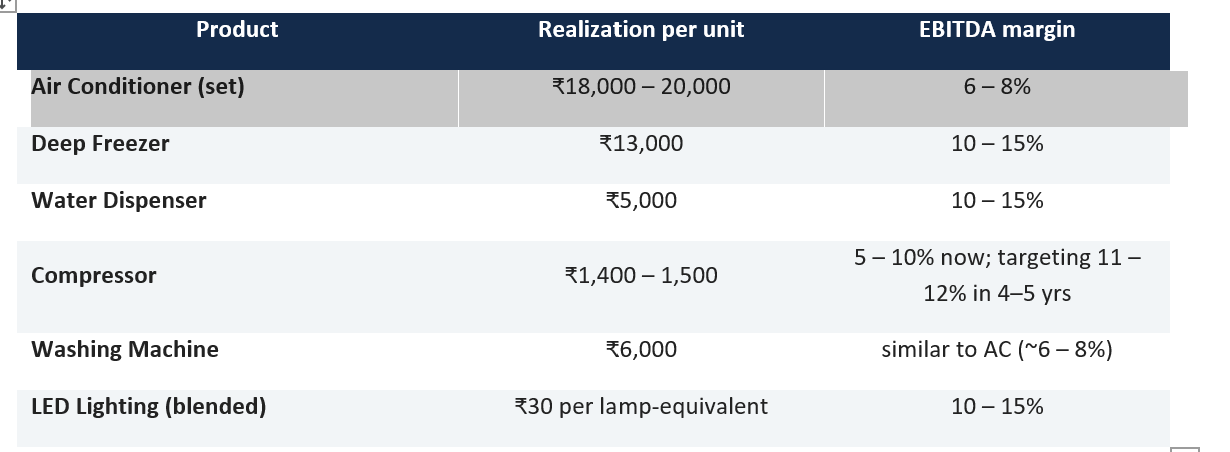
The pattern to hold onto for the deck: air conditioners are VOEPL’s largest business but its lowest-margin one. Every point of revenue mix that shifts toward refrigeration, EMS, or (eventually) backward-integrated compressors is a point of mix-driven margin expansion — this is the mechanical explanation behind management’s own “non-AC growth is a margin lever, not just a revenue lever” framing, covered in more depth in the Growth Drivers section
Financial Performance.
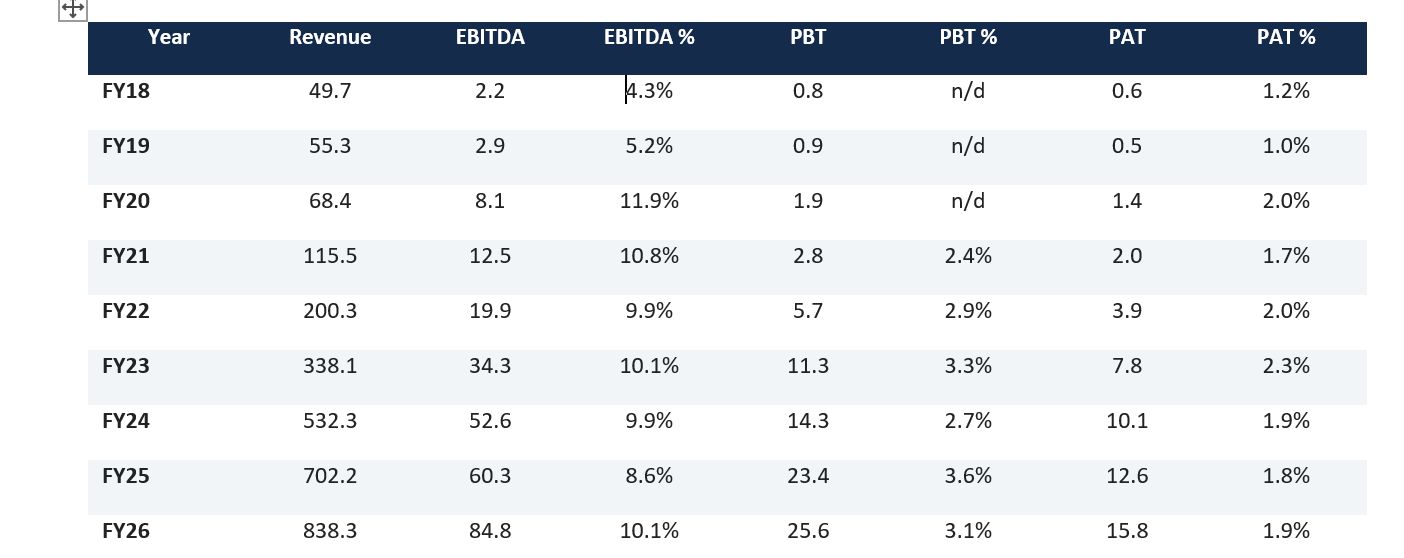
Nine years of standalone financials show a business that has compounded revenue roughly 17x since FY18 but with growth decelerating every year since FY23 (+68% → +18%), EBITDA margin holding in a stable-but-modest 8.6-11.9% band, and PAT margin never exceeding 2.3% in any single year. Consolidated results (available only from FY25) are close to standalone, meaning the new subsidiaries haven’t yet meaningfully changed the group’s financial character. The single most important trend for the deck to carry is capital efficiency: ROE has fallen from 18.53% at IPO to 3.46% today, and ROCE is falling too — growth has been real and largely delivered operationally, but it has come at the cost of the returns this business used to generate on the capital already inside it.
Growth Drivers
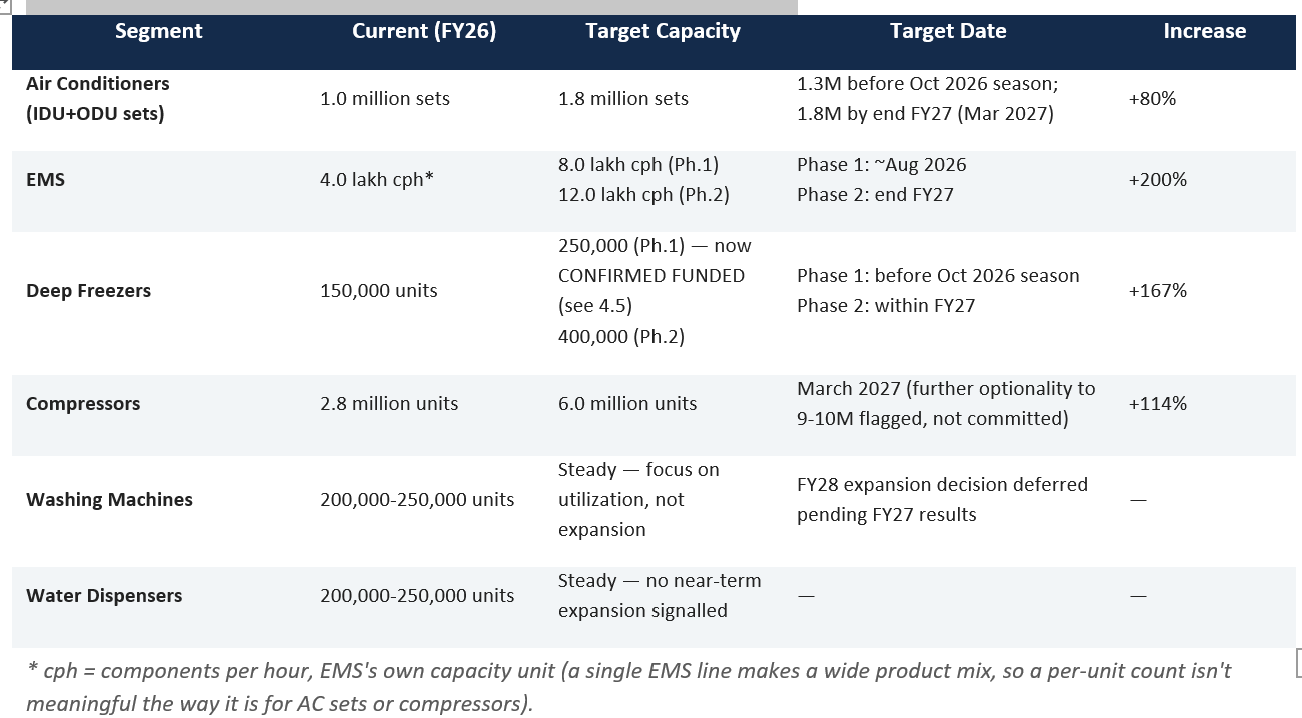
VOEPL is mid-way through the most aggressive capacity expansion in its history, across every product line simultaneously. The table below sets out, segment by segment, where capacity stands today (FY26 exit), what it’s being taken to, and by when — all figures are management’s own, stated across the Feb 2026, Jun 2026, and Aug 2026 earnings calls and presentations.
Revenue Potential, If Every Target Capacity Runs at Full Utilization
This is back-of-envelope modelling built on management’s own disclosed capacity targets and per-unit realization figures — not a company forecast. Multiplying target capacity by realization gives a theoretical revenue ceiling per segment:
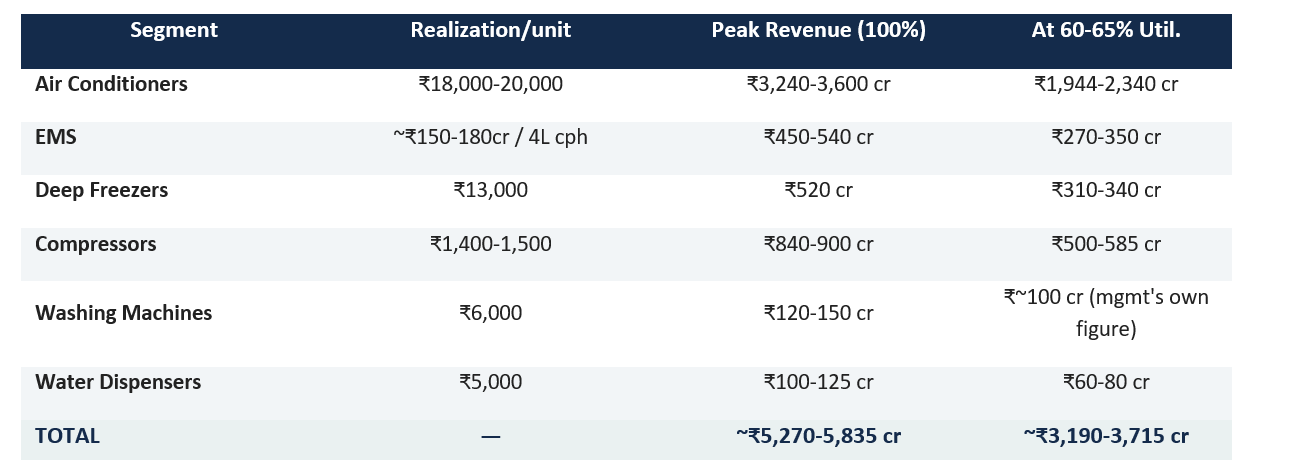
— Backward Integration: The Margin Lever
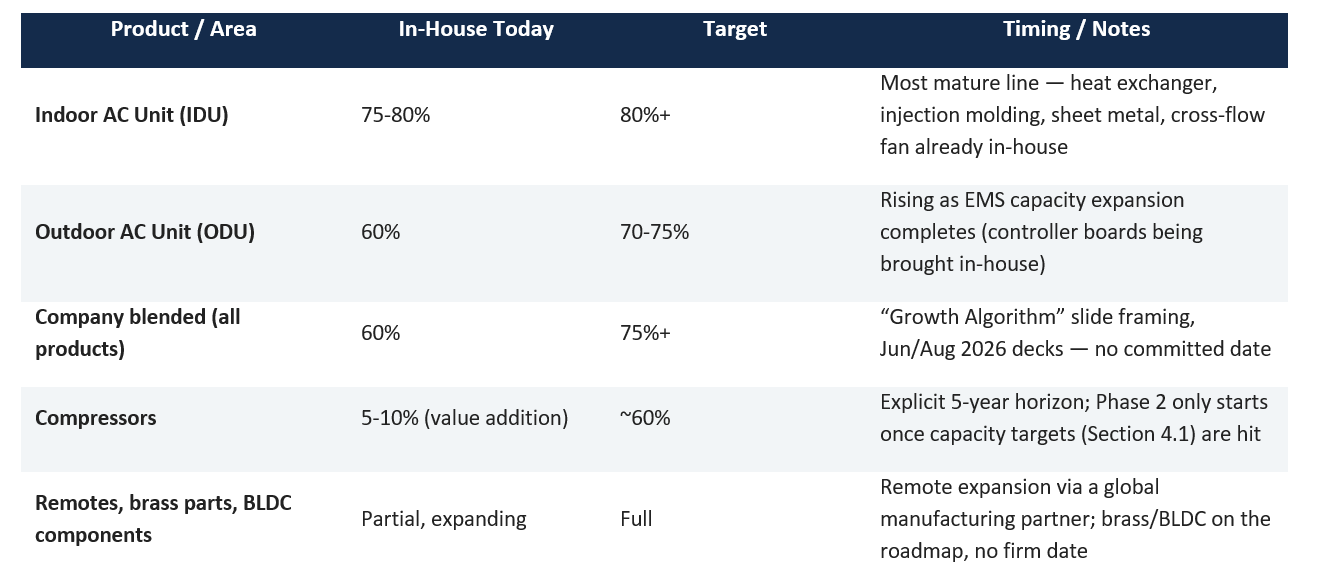
Where capacity build-out (4.1) is about growing the top line, backward integration is about improving what VOEPL keeps from each rupee of that top line. The idea is simple: every component VOEPL stops buying from an outside supplier and starts making itself, it captures as extra margin on the same sale — a lever that works independent of how fast sales grow
Where the Idea Started
This isn’t a new theme — it’s the company’s founding diagnosis of its own margin problem, stated on the very first earnings call (Jun 2023). Asked why outdoor AC units (ODU) earned a lower margin than indoor units (IDU), Sukrit Bharati’s answer was specific: the compressor and the controller board — both bought-out at the time — together made up about 45% of an ODU’s cost. Buying nearly half the product from outside suppliers meant VOEPL only captured value on the remaining half. Backward integration, in VOEPL’s own telling, exists to close exactly that gap — and the compressor business launched in 2026 is, in a real sense, the company finally attacking the single largest piece of that original 45%.
The Compressor Case Study — the Cleanest, Most Quantified Example
Compressors are the newest and most explicitly staged illustration of how VOEPL thinks about this lever, because management has put numbers on both ends of the journey:
• Phase 1 (now, through FY27): get the last-mile assembly business running and filled with volume first. Value addition today is only 5-10%; EBITDA margin is 6-7%. Asset turns are attractive (3.5-4x) precisely because so little is made in-house — it’s mostly an assembly operation on bought-in components from the Chinese technology partners
• Phase 2 (from ~FY28 onward): only once capacity targets are met, begin backward integrating the compressor supply chain toward ~60% in-house over roughly five years. Management’s own margin math: 6-7% today → potentially 11-12% in 4-5 years — but only if two separate things both happen: further government import restriction (QCO tightening) and the backward integration itself. Neither is guaranteed on its own.
The Compressor Opportunity
Compressors are the newest, fastest-scaling, and most policy-dependent growth driver in the whole portfolio. Two things need to be understood separately to present this well: the underlying commercial driver (a large, structural import gap), and the specific government mechanism that is actually forcing that gap to close on a timeline (the Quality Control Order). Neither alone fully explains the opportunity — the gap has existed for years; it’s the policy that has made it actionable now.
The Core Driver: A Structural Import Gap
India consumes an estimated 22 million refrigeration compressors a year (the type used in domestic and commercial fridges and freezers — a different, older technology called “reciprocating” compressors, distinct from the “rotary” compressors modern split ACs have largely moved to). Of that 22 million, roughly 14-15 million — close to two-thirds — have historically been imported, predominantly from China. The remaining domestic supply comes from just a handful of players: large Korean manufacturers and one Indian multinational, together accounting for the other 7-8 million units. There is, in other words, a large, concentrated import dependency in a component that sits at the heart of two of VOEPL’s own product categories (refrigeration and, eventually, air conditioning).
VOEPL’s specific angle: it has secured an exclusive India manufacturing partnership with two Chinese compressor makers, Huayi and Jiaxipera (part of the same corporate group — Huayi is described as the world’s largest refrigeration compressor manufacturer). These two partners were themselves supplying an estimated 4-4.5 million compressors a year into India before import restrictions began to bite — meaning there is an already-proven pool of demand VOEPL is positioned to capture locally, not a market it has to create from nothing. Management describes VOEPL as being among the first small/mid-sized Indian companies positioned to do this at OEM/ODM scale (i.e. manufacturing for other brands, as opposed to a large integrated player making compressors only for its own products) — a claim echoed in the FY26 Annual Report’s own MD&A, not just on calls.
The Policy Story: What’s Actually Happening in India
This is the part worth being able to explain clearly and confidently, since it’s the mechanism that turns a long-standing import gap into a live, time-bound opportunity:
• The mechanism — Quality Control Orders (QCOs): compressor imports into India now require mandatory BIS (Bureau of Indian Standards) certification — including factory inspection and product testing — a compliance barrier that simply did not exist before. This is the same tool the government has used across several other product categories to support domestic manufacturing under the broader “Make in India” / “Atmanirbhar Bharat” push.
• Timeline: Chinese suppliers’ BIS certifications for compressors were originally set to lapse around 2025/early 2026. The government initially extended the deadline by about a year, which is why management spent much of 2025 describing this as a real uncertainty rather than a settled outcome.
• The actual resolution — a 40% import allowance, not a full ban: as of the Jun 2026 call, the government settled on a calibrated approach rather than a blanket ban: manufacturers may still import compressors up to 40% of their own FY24-25 (base year) import volume; the remaining 50-60% of requirement must be sourced domestically. This has now been extended through March 2027.
• Why a partial allowance rather than a full ban: management’s own explanation is that this was a genuinely deliberate, calibrated decision — the government reportedly weighed existing domestic OEM/ODM capacity (like VOEPL’s), the captive capacity of vertically-integrated compressor/appliance makers, and new capacity due online this year, before setting the 40% threshold. A full ban with no ready domestic alternative at scale would have caused real market disruption; a calibrated, phased approach avoids that while still forcing a majority of each manufacturer’s requirement toward domestic sourcing.
• Broader policy tailwind: management has noted the government is reportedly considering extending PLI-style incentives to compressors and other refrigeration components in a future scheme round, beyond the existing AC-specific PLI VOEPL already holds (₹100 crore sanction, separate from the compressor QCO story). Nothing here is confirmed policy yet — flag it as a tailwind under discussion, not a committed benefit.
The OEM-to-ODM Transition
As a refresher from Section 2: OEM means VOEPL builds to a design the customer already owns; ODM means VOEPL does the design work itself and offers a ready-made product a brand can put its name on and sell. This section covers specifically how and why VOEPL shifted its AC business from OEM-only toward a meaningful ODM component — the transition management itself calls the “qualitative upgrade” of FY26.
Why It Took So Long
It’s worth being precise about scope here: lighting was already an ODM business from early on — this transition is specifically about air conditioners, VOEPL’s largest and most important category. And the delay had a clear, stated reason, not just inertia. On the Nov 2023 call, asked directly about the OEM/ODM split, management said AC was “majorly OEM” and explained why: “the requirement of these [ODM] capabilities is not as significant, because the customer that we are currently catering to being Voltas has these capabilities in-house themselves.” In plain terms — VOEPL’s only real AC customer already did its own product design, so there was no commercial pull to develop VOEPL’s own design capability. ODM only became strategically necessary once diversifying beyond that single customer became the goal (see Section 2’s customer-concentration discussion) — you cannot win a new AC customer who doesn’t already have a product design without offering them one
This is the same underlying mechanism behind the customer-concentration improvement documented in Section 2: ODM is how VOEPL added the 3-4 new AC customers that are expected to bring Voltas down from “close to 100%” of AC revenue to a guided 40-60% by FY27 (roughly 20-36% of total company revenue, down from an estimated 75-80% historically — see Section 2’s worked example). If asked “how did VOEPL actually reduce its Voltas dependency,” ODM is the specific, concrete answer — it’s not a vague diversification aspiration, it’s the product mechanism that made new customer wins possible
Overcapacity: Building Well Ahead of Demand
Risks & Concerns
VOEPL is deliberately building capacity roughly two years ahead of the utilization it expects to need it — a strategic bet that peak-season demand will require the buffer, not a near-term utilization plan. This same pattern repeats across every segment
· Competitive erosion — management has itself disclosed two additional domestic entrants are expected within 18-24 months, with combined industry capacity (VOEPL plus both) potentially reaching 15-18 million units against a 14-15 million unit import gap — meaning the opportunity could be substantially filled by competition alone, independent of any policy change.
Policy reversal — the entire compressor opportunity rests on the government maintaining and eventually tightening import restrictions.
Capital Dilution - As per management -" We intend to continue to be the most cost-efficient player in each of the product verticals we will enter. This cost leadership will be achieved through initiatives like having large manufacturing capacities, backward integration and being a sizeable player in the industry in that particular vertical."
Disclosure - No reco, INvested & Biased