Veefin and PSB Xchange: Building the Working-Capital Rail Inside Corporate India
A small business can have demand, customers and orders — and still struggle to make money.
The reason is often simple:
Working capital.
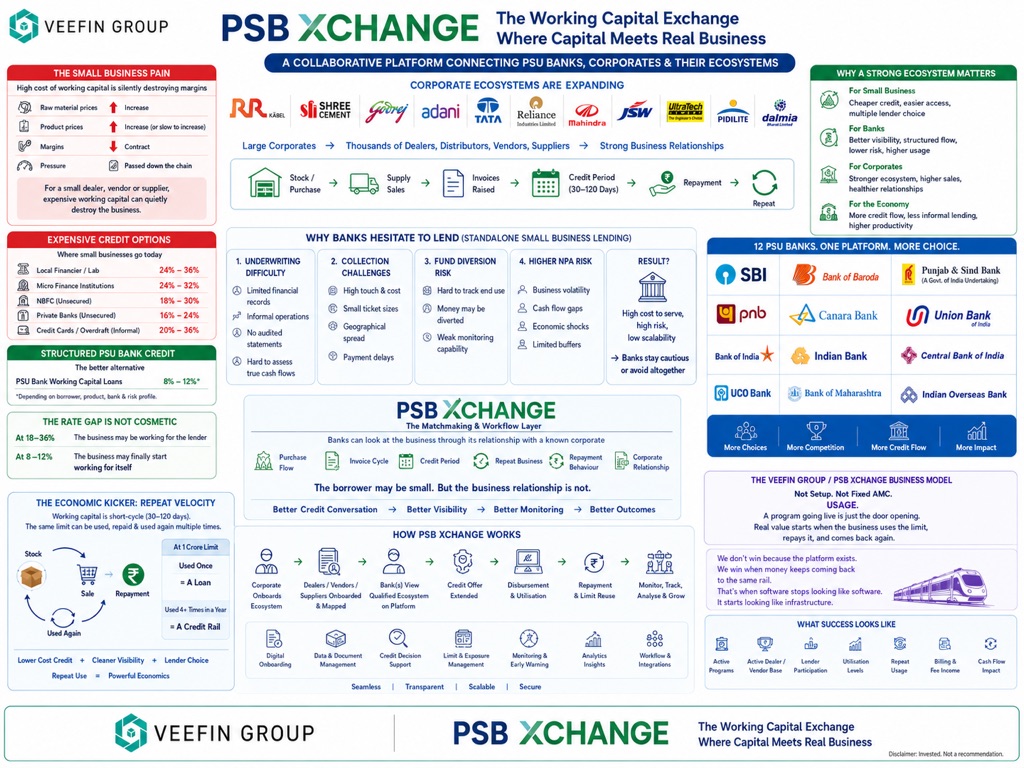
Take a large company like RR Kabel, Shree Cement or Godrej.
Around such companies sits a wide network of dealers, distributors, vendors and suppliers. Many of these businesses are small or mid-sized.
They need money to buy stock, supply goods, wait for invoices and keep the cycle moving.
 Stock.
 Supply.
 Invoices.
 Repeat.
But when input costs rise, the pressure becomes brutal.
 Raw material prices go up. Product prices usually follow. If prices do not move up, margins contract somewhere in the chain.
The company may absorb it.
The distributor may absorb it.
The vendor may absorb it.
The customer may pay more.
But the pressure does not disappear.
For a small dealer, vendor or supplier, expensive working capital can quietly destroy the business.
Borrow at 18–36% from a local financier, informal lender, expensive NBFC or any high-cost credit source — and the business may still run.
But the margin may not survive.
Now compare that with structured PSU-bank credit in the broad 8–12% range, depending on borrower, product and bank.
That rate gap is not cosmetic.
For a small trading or supply business, it can decide whether margin survives or disappears.
At 18–36%, the business may be working for the lender.
At 8–12%, the business may finally start working for itself.
That is why cheaper and more structured PSU-bank credit matters.
 This is where PSB Xchange becomes interesting.
A bank does not have to see the dealer, vendor or supplier as a random borrower.
It can see the business through its relationship with a known corporate:
- purchase flow
- invoice cycle
- credit period
- repeat business
- repayment behaviour
The borrower may be small.
But the business relationship is not.
For banks, this is also a better credit conversation.
A personal loan is mostly borrower-led. OD/CC can become broad working-capital exposure.
But supply-chain credit is linked to real business movement:
- stock
- invoices
- purchase flow
- credit period
- repayment behaviour
- known corporate relationship
That does not make the loan risk-free.
But it can make the risk more visible, more structured and easier to monitor.
For the borrower, it can mean cheaper credit.
For the bank, it can mean cleaner visibility.
Now add the real X-factor:
12 PSU banks on one side.
Large corporate ecosystems on the other.
That creates choice.
For the small business: not dependent only on the local lender.
For the bank: not searching blindly for borrowers.
For the corporate: a healthier dealer/vendor/supplier ecosystem.
PSB Xchange becomes the layer where capital meets real working-capital demand.
Then comes the economic kicker.
Working-capital credit is short-cycle.
A 30–120 day credit period means the same limit can be used, repaid and used again multiple times in a year.
Stock → sale → repayment → used again.
So the opportunity is not just loan size.
It is:
 lower cost credit
 cleaner visibility
- lender choice
- repeat use
A ₹1 crore limit used once is a loan.
A ₹1 crore limit used again and again across the year starts looking like a credit rail.
 And that is the core Veefin / PSB Xchange business model.
Not software setup.
Not fixed AMC-style revenue.
Usage.
A program going live is only the door opening.
The real value starts when the business uses the limit, repays it, and comes back again.
That is the bet.
Not setup.
Repeat use.
Veefin does not win because the platform exists.
It wins when money keeps coming back to the same rail.
That is when software stops looking like software.
🚀 It starts looking like infrastructure.
P.S. This note is not a full Veefin valuation note.
It is specifically about PSB Xchange — and why the platform may matter if it helps PSU-bank capital flow repeatedly into dealer, vendor and supplier ecosystems.
For borrowers, the value is cheaper and more structured credit.
For banks, the value is cleaner visibility and better credit context.
For corporates, the value is a healthier dealer/vendor/supplier ecosystem.
For Veefin, the value is usage — if money keeps moving through the same rail.
Disclosure: Invested. Not a recommendation.