Another fire incident. Given 2 fire incidents in a year , is there something fishy ?
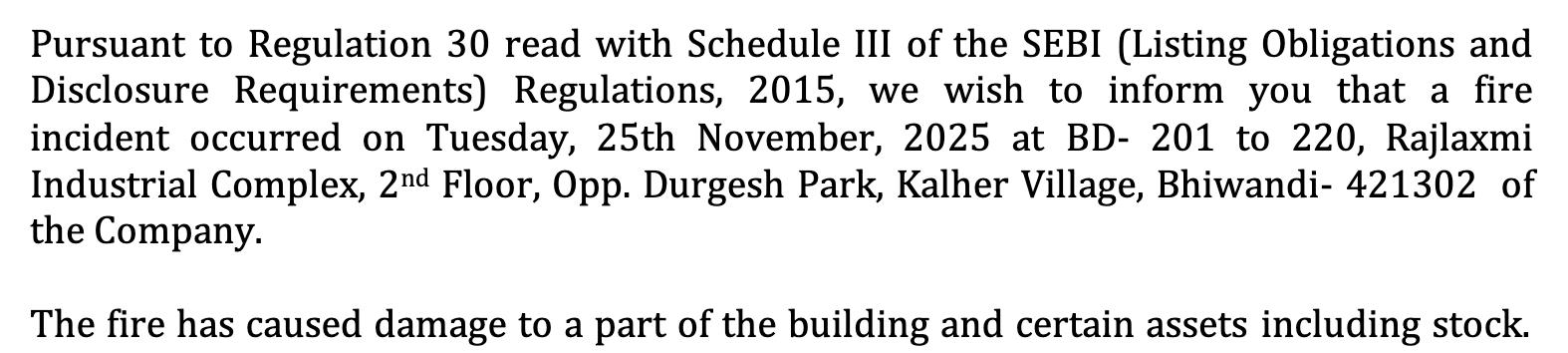
Had the same feeling - 2 fires in a short span of time. Also, on the first concall Vedant didn’t seem so confident of growth. I believe he only mentioned high teens growth rate in revenue which seems low for a small company.
Key Highlights of Concall ( 03 JUNE 2026 )
-
Consistent Growth: Q4 FY2026 marked the 10th consecutive quarter of revenue growth for the company. Revenue for the quarter stood at INR 78 crores, a 63% year-on-year (YoY) growth.
-
Fire Incident & Borrowings: A major topic of discussion was a fire incident from the previous year. The company currently has an insurance claim receivable of approximately INR 21-22 crores sitting in other current assets, which is temporarily being offset by an equivalent draw-down in short-term bank borrowings. Once the claim is settled, short-term debt is expected to decrease proportionately.
-
Shift to Wholesale Model: For certain fast-selling styles, the company has transitioned to an outright B2B/wholesale model, selling directly to the distribution arms of marketplace partners (like Myntra and Amazon) at a discount to retail price. This guarantees volume and offloads inventory risk, while remaining margin-neutral at the EBITDA level.
-
Segment-Wise Success: The B2C Own Brand segment (Thomas Scott) grew by 62% to INR 91 crores. The Licensed and Other Brands segment grew by 53% to INR 148 crores. The B2B Contract Manufacturing business grew by 91% to INR 13 crores.
-
Improved Margins: The company successfully reduced its material cost from 58% of total expenses in March 2025 to 52% in March 2026, driven largely by the premiumization of its product portfolio.
-
Continued Growth Trajectory: Management intends to maintain their current high double-digit growth rates. They will continue relying heavily on their digital-first, data-driven “test and scale” model.
-
Capital Allocation: The company has no immediate plans for equity dilution. Management stated they are comfortable funding their current growth phase using existing short-term borrowing limits and internal cash flows.
New Products, Services, or Business Initiatives Planned
-
Category Expansion: The company recently launched its maiden foray into footwear and introduced early collections in women’s wear, both of which have shown encouraging initial traction.
-
AI “Super App”: Instead of commercializing their proprietary AI tools (thread.ai and catalog.ai) as third-party SaaS products right now, management is consolidating them into a powerful internal “super app” to handle planning, demand forecasting, and catalog management for their own core operations.
Expansion Plans (Markets, Geographies, Customer Segments)
-
Supply Chain Localization: To cater to younger consumers who demand fast delivery, the company is planning to open additional fulfillment centers across different geographies to localize inventory and improve delivery speed.
-
Targeting Aspirational Consumers: Thomas Scott is strategically pivoting toward an aspirational customer base by offering high-quality natural fabrics (like cotton and linen) at accessible price points (average selling price of ~INR 999 for their own brand).
-
Online Focus: Currently, 93% of sales are online and 7% are offline. Management explicitly stated that online channels offer a superior Return on Capital Employed (ROCE). As a result, the current 6 offline stores will only expand organically (i.e., when existing stores generate enough profit to fund a new one).
Industry Trends, Opportunities, and Challenges
- Supply Chain & Inflation: Management acknowledged industry-wide supply chain disruptions and raw material price escalations driven by the West Asia war. However, they noted that advanced planning (such as procuring winter wear materials early) minimized the impact, though marginal price increases may eventually be passed on to the consumer.
Key Financial and Operational Priorities
-
Working Capital Improvement: A major priority for FY27 is improving working capital cycles, particularly by reducing trade receivables/debtor days.
-
Premiumization: The company is focused on premiumizing its portfolio, especially through its international licensed brands (like Nautica, French Connection, FCUK, and Kenneth Cole), which sell at higher price points (up to INR 2500-3000) and yield better contribution margins.
Capacity Expansion, Technology Investments, or Partnerships
-
Manufacturing Strategy: The company’s in-house factories are currently operating at maximum capacity. To keep up with high demand, they are heavily utilizing “captive capacities”—renting third-party factory space and machinery but deploying Thomas Scott’s own production and quality teams to ensure standards are met.
-
Outsourced Footwear: Unlike apparel, the newly launched footwear segment will not be manufactured in-house. They are using trusted manufacturing partners to keep the category highly ROCE-accretive and require zero net capital investment from the company.
-
Solapur Expansion: While outsourcing helps bridge immediate gaps, continuous investments are being made to expand their primary Solapur manufacturing facility, though management notes that in-house capacity cannot be scaled overnight.
Margins
-
FY26 EBITDA margin improved to 13.1%, while PAT margin stood at 7.57%.
-
Margin expansion was driven by premiumization and higher contribution from international licensed brands.
-
Material costs reduced from 58% of expenses in FY25 to 52% in FY26.
-
Shift towards the B2B wholesale model is EBITDA margin-neutral and improving contribution margins.
-
Newly launched premium categories are expected to be margin accretive.
Working Capital
-
Inventory cycle includes 30–45 days of manufacturing and 100–120 days of finished goods holding.
-
Receivable days improved during the year.
-
Working capital debt is temporarily elevated due to a ₹22 crore pending fire insurance claim; debt should reduce once the claim is received.
Cash Flow
-
Operating cash flow remains negative as the company is investing heavily in inventory to support rapid growth.
-
Management expects cash flows to turn positive once growth normalizes and aligns with its 22–25% ROCE.
-
No plans for equity dilution; growth is being funded through existing borrowing limits.
Capex
-
The company follows a captive capacity model, using rented factories and machinery while maintaining control over production and quality.
-
Continuous investments are being made in the Solapur manufacturing facility.
New categories such as footwear are being scaled through outsourced manufacturing, requiring minimal capital investment.
