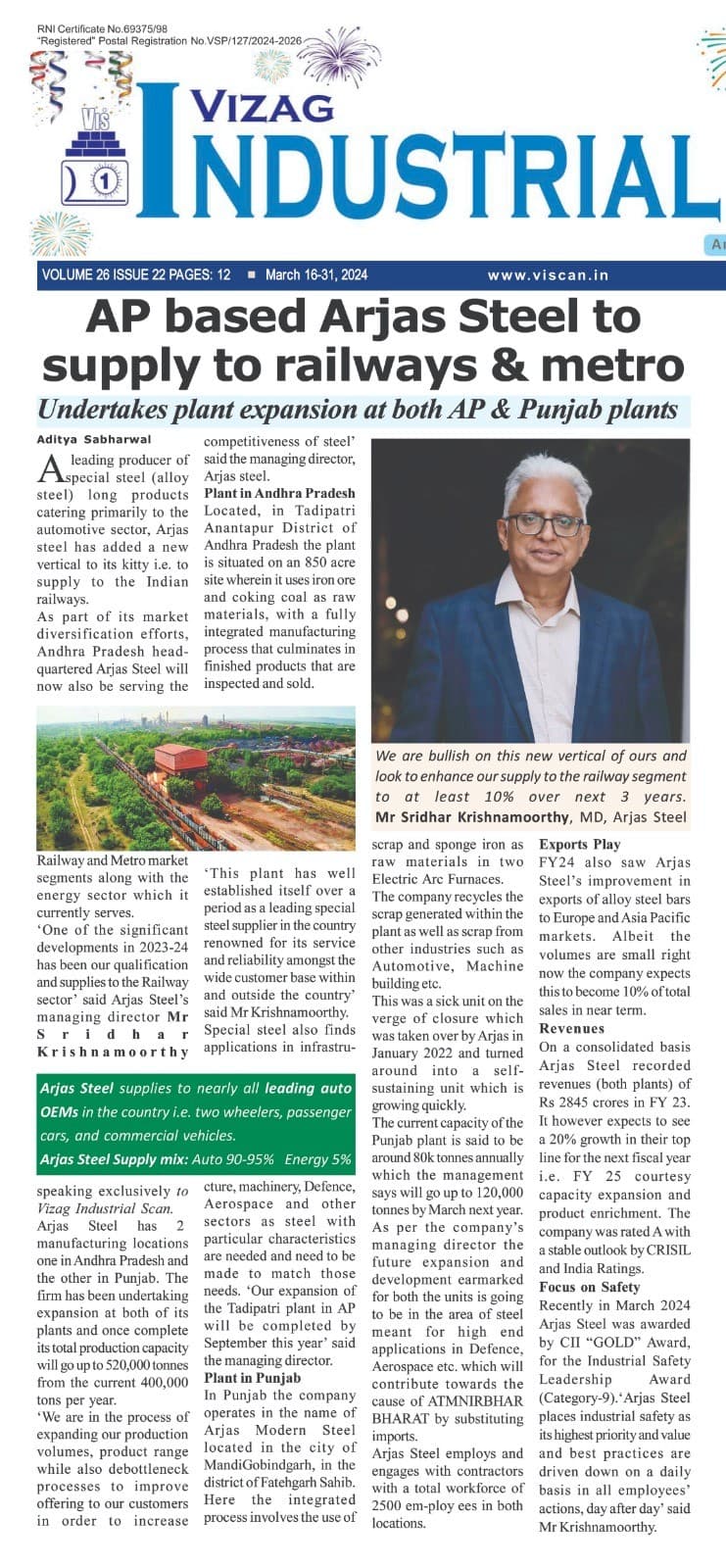

Arjas Steel P&L
which website is this sir?
Hi, did you get any insights why Promoters invested 20% own, and not make 100% subsidiary of Sandur Manganese? Thanks.
Not sure but I would see it as a positive sign that the promoter is putting in his personal cash
Ok. Thanks for the revert.
Sandur Q1 FY25.pdf (1.6 MB)
Q1 Result update
Appointment of new CEO and COO. Highly experienced, 30+ years, and have previously worked in industry giants.
Overall the results look decent to me. Looks like they haven’t mined to full capacity. I have 2 questions , would be great if someone can help me understand this
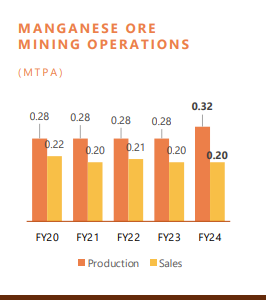
a) Manganese ore inventory build up: Based on the below chart from the investor presentation seems like they are adding to Manganese inventory every year. Any sense why that maybe happening?
b) The realization for Iron ore has is down by 22% ( this is surprising to me or maybe I am missing something)
Full presentation was a delight to go through. Between the lines read this about appointing professional management.

Disc. Invested and Not an Advice.
yes, i have been positively surprised with the way the company is going from strength to strength and building multiple blocks for business and expansion and also professionalising things inline with the scale of the company.
Agree! In terms of governance and ways of working they punch way above their size. The management is super impressive
The global manganese market is on a significant upward trajectory, fueled by the escalating demand for steel across construction, infrastructure, and automotive sectors. Its critical role in enhancing steel’s hardenability and tensile strength positions manganese as a cornerstone in steel production, capturing a substantial market share. Emerging economies are witnessing a boom in construction and infrastructure projects, further amplified by the automotive industry’s quest for high-strength steel. The burgeoning electric vehicle sector is spurring demand for manganese in lithium-ion batteries, opening new avenues for market expansion. The Asia-Pacific region, marked by rapid urbanization and infrastructural advancements, dominates the market. Market segmentation reveals alloying additives and silicomanganese as prominent segments, owing to their critical application in steel manufacturing and battery production. Despite facing challenges like environmental concerns and regulatory policies, the manganese market is poised for substantial growth, underpinned by its vital role in steel production and burgeoning battery technology applications.
What is Manganese: Manganese is a grayish-white, usually hard & brittle metallic element that resembles iron but is not magnetic.
Application of Manganese
Company name: Sandur Manganese and Iron Ores Limited(“SMIOR") for future ready!!!
The company has expanded beyond mining operations to include the production of Ferro Alloys, Coke, and energy.
SMIOR has 110 MT iron ore reserves, 17 MT Manganese ore reserves, 3rd largest manganese ore mining company in India, and 1999 hectares of mining area.
Mining Manganese and iron ores from two mining leases located in Sandur (Karnataka)
Fully mechanized iron ore mining contributes to higher margins.
The company has set up a hybrid renewable energy plant (42.9MW) in an SPV to cater to the growing energy needs of its ferroalloys.
Two waste heat recovery boilers with a cumulative capacity of 32MW set up to generate clean energy.
Key Milestones for the FY24:
Financial:
FY23 FY24 Q1FY25
Revenue in Cr 2185.01 1334.80 624.73
EBITDA in Cr 451.62 402.80 214.00
% 20.67% 30.18% 34.26%
PAT in Cr 270.79 239.50 144.49
% 12.39% 19.05% 23.13%
EPS in Rs 101.23 14.80 8.92
Strategic business acquisition of ARJAS STEEL is a real help of SMIOR:
ARJAS Steel is among the top 5 players in this very specialized steel manufacturer in the industry.
The 80% of the company stake has been acquired by SMIOR and 19.12% by BAG Holdings Private Limited in April 2024.
Arjas is valued at an enterprise value (EV) of Rs.3000 crore. After the acquisition, combined value of SMOIR and ARJAS is expected to be Rs. 15000 Crore.
Revenue will be reflected in 6 to 7 months in the account book of SMOIR.
Key highlight of ARJAS:
Reg good Corp Gov: Except for the 20 pc they seem to have bought in Arjas, when the listed company could have easily bought the entire company.
I guess that’s one yellow flag.
Bag Holding is promoter company
Evaluating the opportunity but way steel and iron or prices are crashing and further pain ahead till china stabilizes…feel that PAT will only be declining till fy 26
Recently, SMIORE has expanded its operations to include ferroalloy production, coke manufacturing, and power generation. They’ve also integrated downstream, aiming to become a more vertically integrated player in the steel and energy sectors. This diversification helps mitigate some of the cyclicality associated with raw material markets like manganese and iron ore.
Let’s break down the significance of each operation:
The synergy
QIP to raise 1000 crores.
With long term debt of less than 100 cr, I think all of these proceeds shall go to Arjas as production ramp up in mining business are opex heavy and does not require any significant capex.
Hi Himanshu, thanks for sharing. So, in that case we can consider as a big positive for Sandur in the days to come?
A good article to know about Arjas steel’s business and both past as well as expected revenue:
Arjas’s PnL synopsis from a rating agency’s report dated May 31, 2024 (link):
@yogansh:
1- Would appreciate if you could share your views on how the Arjas acquisition by Sandur changes the profitability more than sum of the parts. IMO, paid amount seems to be slightly above par (from EV/EBITDA perspective) when compared to Tata Steel and JSW Steel.
2- How the balanc sheet will evolve post acquisition? I see they intend to do a QIP of 1000 Cr. ; proposed NCD of 450Cr. ; and Proposed Term Loan of 1200Cr.