Raymond reality - High ROCE Demerger play

Hey everyone,

I’ve been digging into Raymond Realty (NSE: RAYMONDREL) since it spun off from the parent company, and I think it’s an interesting one for us to discuss. We often find some hidden gems in demergers, and this one has a few things that caught my eye.

What we have here is a company with a massive, valuable land bank that’s now shifting gears to a more aggressive, asset-light growth model. It’s a pretty unique setup.


1. A Bit of Background

So, Raymond Realty is the real estate division of the Raymond Group, which started back in 2019 to make the most of their land in Thane. To really unlock its value, they demerged it, and it started trading as its own company on July 1, 2025.

How they’re playing it:

They’re not your typical developer that buys up land and sits on it. Their plan is to be asset-light, focusing on Joint Development Agreements (JDAs).

  • The Cash Cow: They’ve got a huge 100-acre piece of land in Thane that’s already being developed. This is what’s bringing in the money right now.
  • The Growth Engine: All their future plans are pinned on the “JDA Led Capital Light Business Model,” mostly around Mumbai.

Who’s in charge:

Gautam Singhania is the chairman, and he’s been the driving force behind this move. The day-to-day is handled by Harmohan Sahni, the MD & CEO, who’s been in the real estate game for over 30 years. It’ll be interesting to see how they manage their money as they grow.


2. What’s Happening in the Market

The real estate scene in India has cleaned up a lot since RERA came in. People are more confident about buying, and even with interest rates creeping up, the demand is still there.

RRL is all in on the Mumbai market, which is a beast of its own.

  • Thane: This is their turf. It’s a fast-growing area with a ton of new infrastructure coming in. They’re a big deal there, claiming that one in every three homes sold in Thane is theirs.
  • Going Premium: Their projects in Thane, and the new ones planned for Bandra, Wadala, and Sion, are all in the premium and luxury space. These buyers aren’t as worried about interest rates.

It’s a tough market, though, with big names like Godrej, Oberoi, and Prestige all competing for the same deals. But having a clean slate and a well-known brand gives RRL a foot in the door.


3. How the JDA Model Works

The JDA model is a smart way to grow without needing a ton of cash. Instead of buying land, they team up with landowners.

  • The Developer’s Job: They handle all the headaches—getting approvals, building, and selling.
  • The Landowner’s Job: They bring the land to the table.
  • The Deal: They split the profits or the finished properties. This means they can get projects off the ground much faster, which leads to a much better Return on Capital Employed (ROCE). RRL is hitting a 26% ROCE, which is way above what the traditional guys are doing (6-18%).

But there’s a catch:

  • You’re relying on your partners, and things can get messy if there are delays or disagreements.
  • The profit margins on JDA projects are usually a bit lower, but you make up for it by doing more projects with less money.

From what I can see, RRL is using its brand to get a bigger piece of the pie in its JDA deals.


4. The Numbers

RRL is still in its early days, but the numbers are looking pretty good.

  • Booking Value: ₹2,314 crore
  • Revenue: ₹2,313 crore
  • EBITDA Margin: ~20%
  • Net Debt: -₹233 crore (They have more cash than debt)
  • ROCE: 26%

How they stack up against the competition:

Company Market Cap (₹ cr) Net D/E ROCE (FY25) P/NAV (Est.)
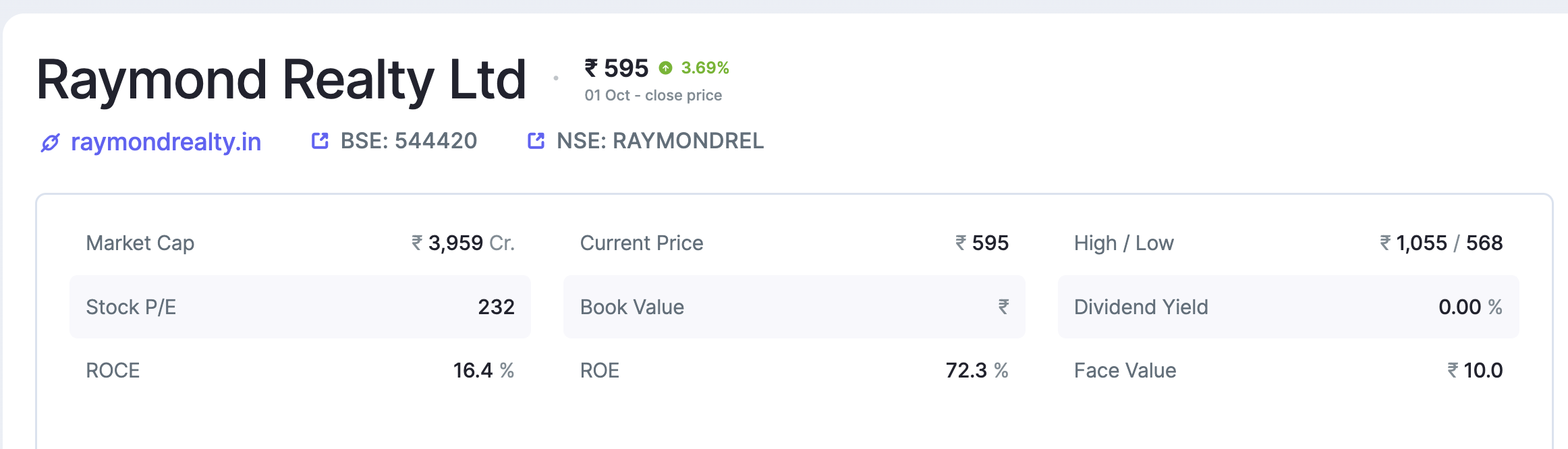
Raymond Realty ~4,240 Net Cash 26% ~0.6x
Godrej Properties ~86,300 ~0.4x ~15% ~1.4x
Kolte-Patil ~4,950 ~0.3x ~18% ~0.8x

Export to Sheets

What’s it worth?

Let’s break it down:

  1. The Thane Land: This could bring in ₹25,000 crore in revenue over time. After costs and discounting, it’s worth about ₹4,500 crore today.
  2. The JDA Projects: These could generate ₹14,000 crore, with RRL’s share being around ₹11,500 crore. After costs, that’s worth about ₹1,955 crore today.
  3. Cash in the Bank: They have ₹233 crore in net cash.

Total Value = ₹4,500 cr + ₹1,955 cr + ₹233 cr = ~₹6,688 crore Value per share = ~₹1,006

With the stock trading at ~₹638, that’s a 37% discount to what it could be worth. The market is clearly worried about whether they can pull it off.

What could happen?

Scenario What it means Value per share (₹)
Bear Delays, weak sales, lower margins ~₹750
Base They deliver as planned ~₹1,006
Bull They’re faster and more profitable than expected ~₹1,250

Export to Sheets


5. The Technicals

The chart is showing some promising signs after the big drop since it listed.

  • The Bottom Is In? The stock seems to be building a base. The selling has dried up, and now it’s a waiting game.
  • Double Bottom: There’s a clear “Double Bottom” pattern around the ₹611-₹625 level, which is a classic sign of a reversal.
  • Momentum Is Shifting: The RSI is showing a bullish divergence, which means the selling pressure is easing.
  • The Big Boys Are Buying: There have been some big volume spikes on green days, which tells me that some institutional investors are quietly buying in.

6. The Risks

  • Can They Deliver? This is the big one. They’ve done well in Thane, but can they handle a bunch of new projects all at once?
  • All Eggs in One Basket: They’re only in the Mumbai market, so if there’s a slowdown there, it’ll hit them hard.
  • Interest Rates: If rates go up too much, it could hurt the housing market.
  • Partnerships: JDAs can be tricky, and a bad partner can cause a lot of problems.

7. My Take

I think Raymond Realty is a bet on the management’s ability to execute. They have a great setup with a debt-free balance sheet and a huge discount to their potential value.

The market is giving you the high-growth JDA business for free right now because it’s worried about the risks. If they can start launching their new projects and show some strong sales numbers in the next 6-12 months, I think we’ll see a big re-rating.

What to watch for:

  1. Sales Numbers: They need to get their annual sales up from the ₹2,000-2,500 crore range to over ₹4,000 crore after the new projects launch.
  2. Cash Position: They need to stay debt-free. That’s their superpower.

What do you guys think?

  1. Is the management team ready to handle this kind of growth?
  2. Is the Raymond brand strong enough to compete with the likes of Oberoi in the luxury market?
  3. Is the current discount fair, or is the market missing something here?

Disclaimer: I own this stock. Please do your own research.
11 Likes

Also Recently Nippon India bought 1.86% stake in Raymond Realty https://www.valueresearchonline.com/stories/226075/nippon-india-small-cap-fund-4-stocks-bought-july/

3 Likes

Agreed.

Bull case

if we take management guidance for FY26,

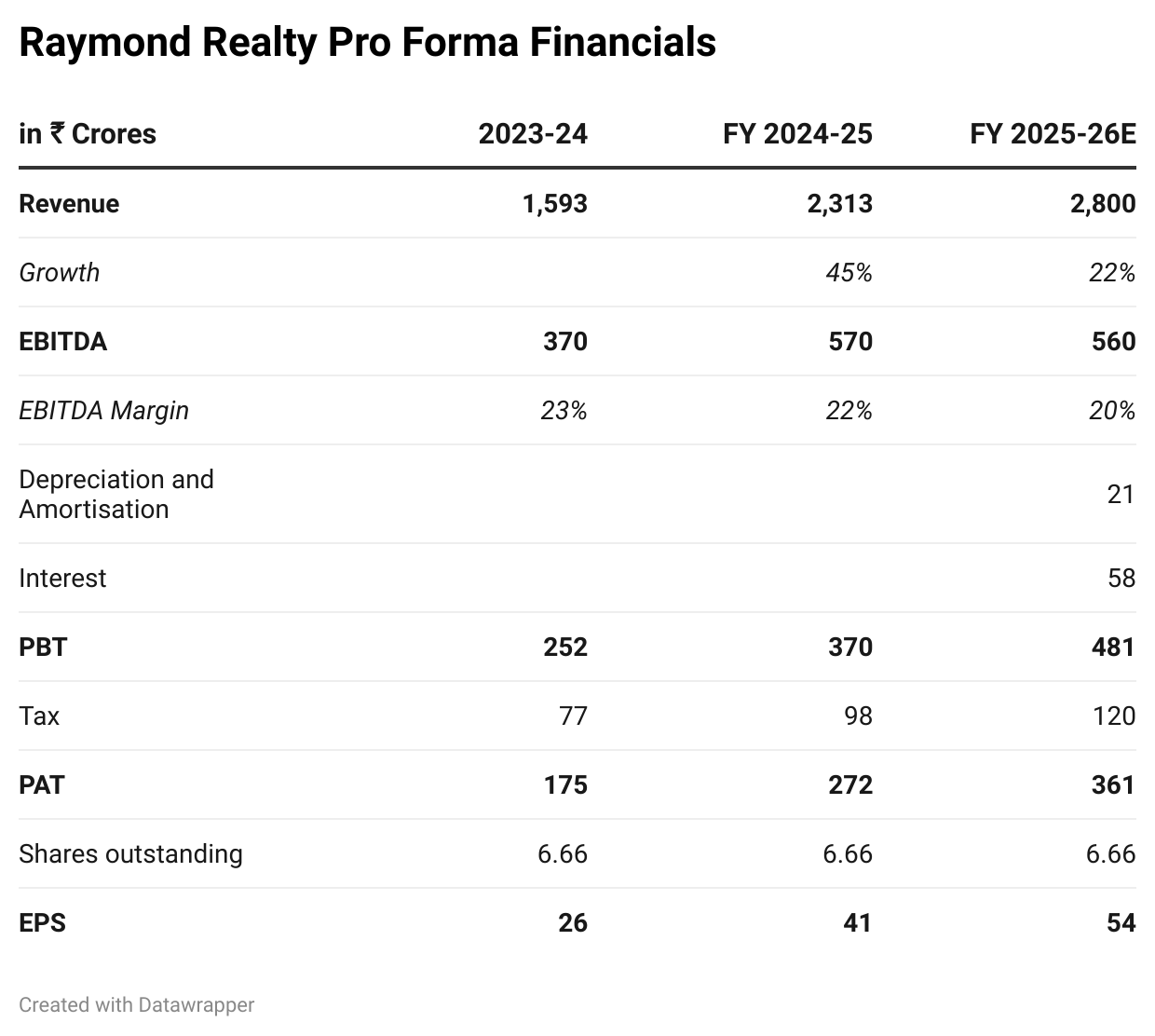
Revenue - 2800cr
EBITDA (on 20% Margin) - 560 cr
Interest Expense - 58cr (Run rate q1fy26)
Depreciation - 20cr (Run rate q1fy26)
EBT - 481cr, PAT ~360cr

EPS of 54, at CMP of 630, available at ridiculously low 11 P/E

This thing is a screaming buy

I’ve checked as much guidance as I could, and so far the verdict is that mgmt has delivered on guidance.

in july 2024, during their Q1 FY25 Results, they guided >20% Revenue Growth and >20% EBITDA Margin.

At FY25, Revenue was INR 2313 cr, up 45% (compared to INR 1593cr in FY24)

I had the chance to speak with the CEO and CFO during the recent Arihant Capital conference and they reiterated the guidance of 20% growth in revenue and 20% EBITDA Margin and was quite confident about it.

While I have my skepticism after thee Q1 numbers that came in at INR 400cr due to lower inventory, I still think if the revenues remain flat (unlikely situation - given the current macro outlook)

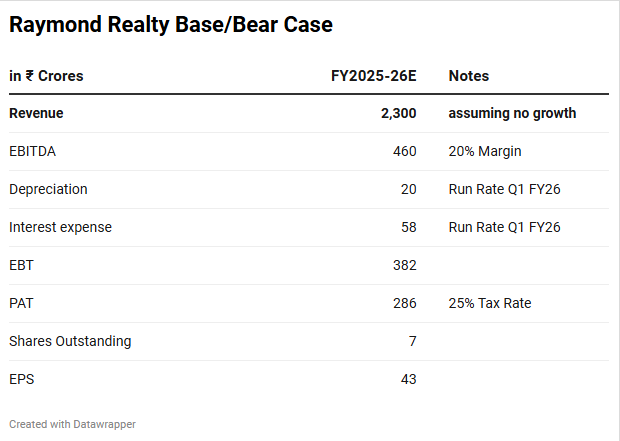
Bear case could look something like -

Revenue - 2300cr (assuming no growth)
EBITDA - 460cr (20% margin)
Depreciation - 20cr (rr q1fy26)
Interest expense - 58cr (rr q1 fy26)
EBT - 382cr, PAT ~286cr
6.66cr shares outstanding

EPS of 43, CMP of 600 → available at a forward P/E of 14. Still a bargain. I think the problem is due to the presentation of numbers.

"The discrepancy is likely due to the accounting treatment of a discontinued operation following a corporate demerger.

Pursuant to the approval of the Composite Scheme of Arrangement by the Hon’ble National Company Law Tribunal, the Realty business of Raymond Limited was demerged into a separate entity, Raymond Realty Limited, with effect from April 1, 2025 - the appointed date for the demerger.

It is important to note that prior to the demerger, the Realty business formed an integral part of Raymond Limited. Hence, in the consolidated financial statements for the period preceding the demerger, its results were presented as a discontinued operation in the Raymond Limited Annual Report FY24-25. Following this demerger, the financial results of Raymond Realty Limited from April 1, 2025, onwards are reported independently.

Prior to the demerger, Raymond Realty Limited operated as a wholly-owned subsidiary holding Ten X Realty Limited, which housed the operations of the Address by GS - Bandra project. The appointed date for the demerger was April 1, 2025. As of this date, the entire Real Estate business is now housed within Raymond Realty Limited."

Which is why FY24 numbers on several screeners like screener.com or even the audited financial statements are not representative, and as a result the PE looks extremely high

I’ve also been tracking the holders of Raymond Realty, especially mutual funds who got Raymond Realty shares for their holding in Raymond Ltd.

Tata Value Fund is restricted from holding stocks that have a very high trailing P/E, so understandably they will sell regardless of what the actual economic reality is.

Nippon Small Cap Fund seems to be holding on.

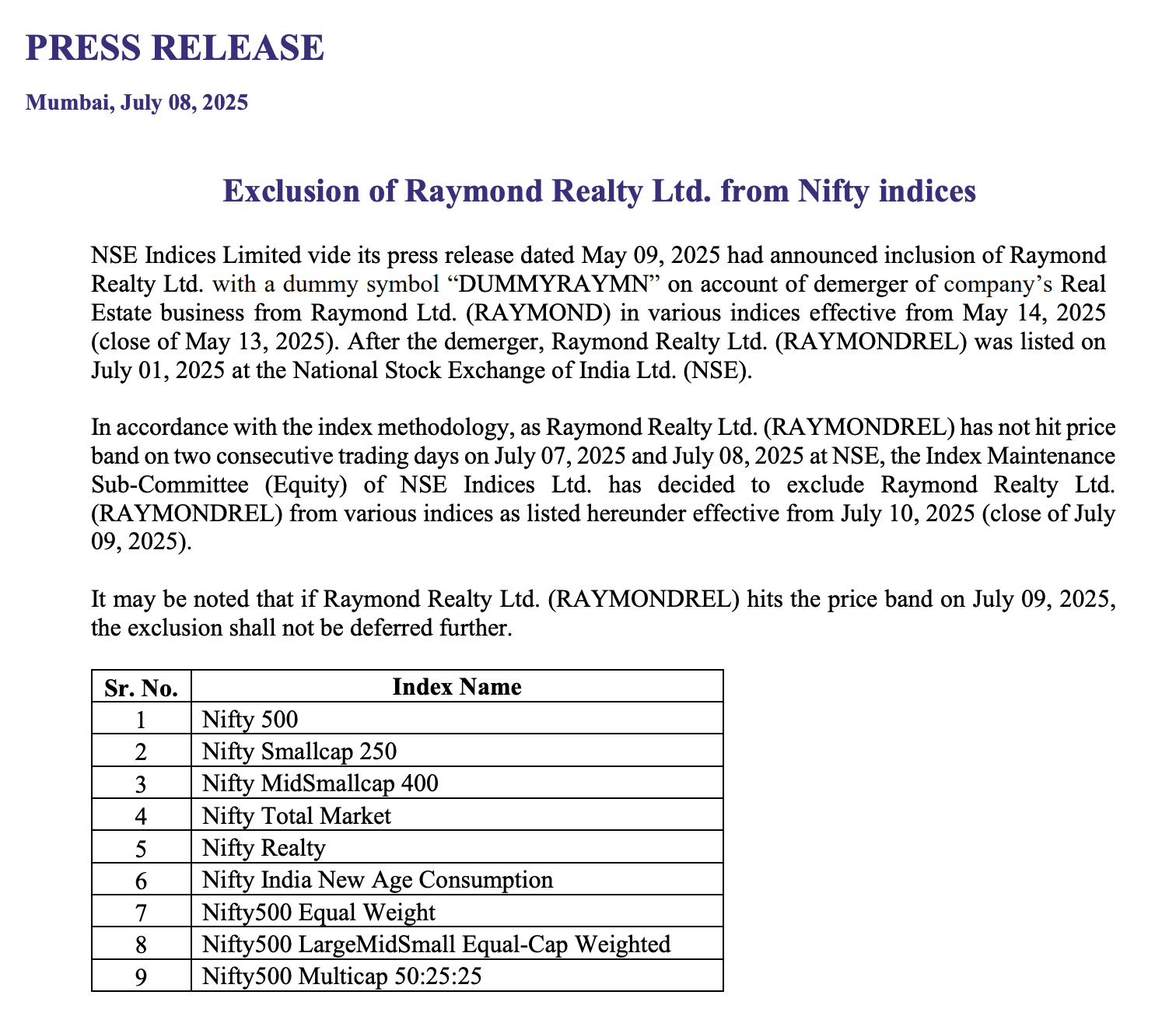
The other funds, were mostly holding Raymond Realty due to their initial holding in Raymond Ltd, and have had to sell out of their holdings due to exclusion of Raymond Realty from certain indices.

https://www.niftyindices.com/Press_Release/ind_prs08072025.pdf

I think its only a matter of a few quarters before the price moves closer to its fair value, as echoed by remarks on the earnings call

Disc - I’ve been buying from the 800 levels, and made a big purchase at 600, so the average is at 650.

8 Likes

More on the Raymond Realty Valuation

Raymond Realty is by far one of the most interesting special-situation opportunities in Indian equities. It’s the closest to buying a company for 50 cents on the dollar. And if this plays out, it would make many investors pleased that value investing is very much alive and works.

TLDR Summary at the end if you don’t want to read

Quick review of the financials

Note: these are pro-forma financials that I was able to reconstruct, adjusting for things like accounting treatment of discontinued operations, demerger effects etc but they represent the financials on a like-for-like metrics, so they will not always match with published figures

FY 2025-26E numbers are based on management guidance

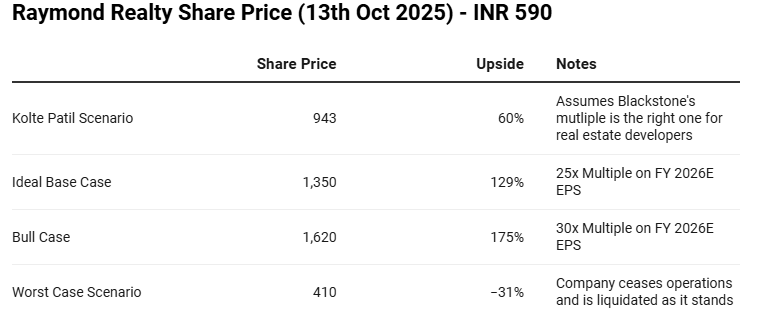
Bear case could look something like -

Valuation

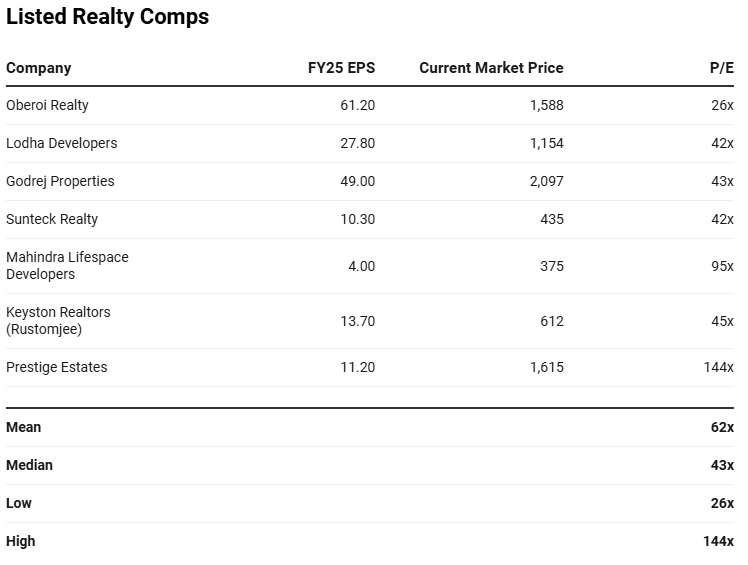
Indian Realty Peers Valuation

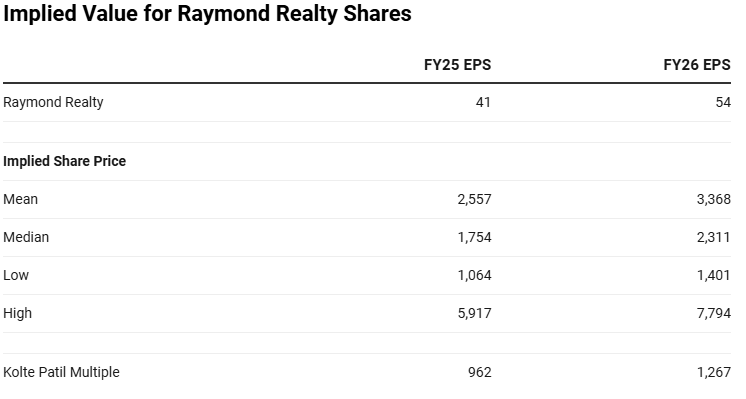
Kolte Patil Developers received a takeover offer at INR 329 per share, with an FY25 EPS of INR 14, that sets the P/E at 23.5x

These multiples imply the following values for Raymond Realty

Spinoffs and demergers have a huge amount of selling post listing, largely institutional selling, which has been a widely studied phenomenon, and nobody else puts it better than Joel Greenblatt in his book

Additionally, due to what the accounting standards allow, and prior corporate structure as explained above, the P/E multiple looks artificially high, and does not accurately represent the true earnings of the company. So the stock wouldn’t even show up on most investors’ stock screeners.

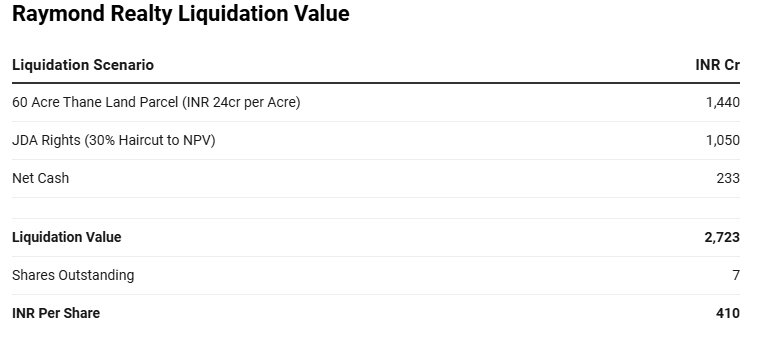
Liquidation scenario

Now, let’s think of absolute worst-case scenarios, where the company ceases to operate for whatever reason and now has to liquidate.

Here’s what they own


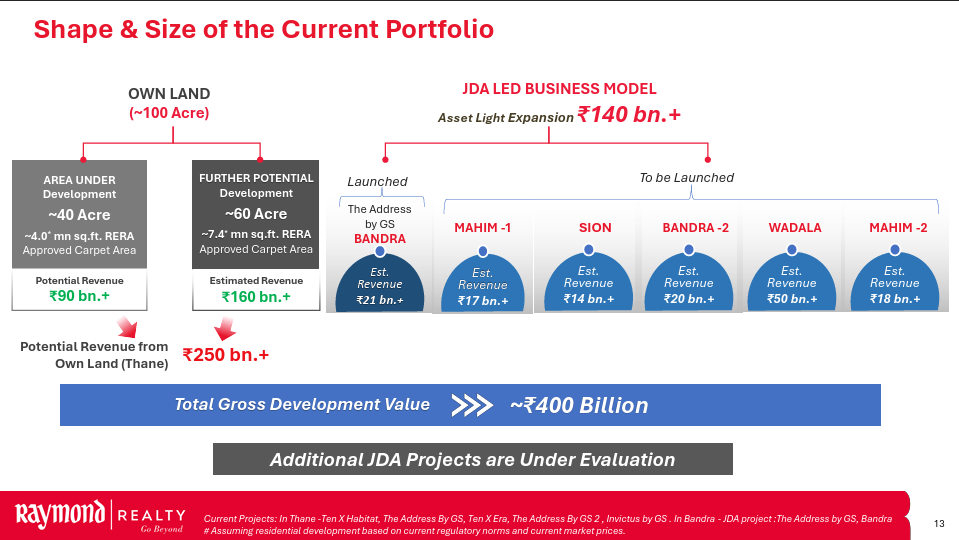
They own a 100-acre land parcel in Thane, of which they have sold 40 acres (not exactly). Leaves them with about a 60-acre land parcel with 7.4mn sqft RERA-approved carpet area.

Based on listings in the area, purely the land alone is worth more than INR 23-24 cr per acre; the land parcels are worth INR 1380 - 1440 cr

They also have rights to the joint development agreements (JDAs), which they have paid for, with a Gross Development Value of 16,000 crore. Assuming that these JDAs were underwritten with a 20% EBITDA for Raymond Realty, the EBITDA for Raymond Realty from these JDAs to be executed over 5-7 years is approx INR 3200cr, so if we discounted this at a discount rate of 13%, we’d get an NPV of INR 1500cr. So on liquidation, they can transfer these rights to another developer for 1050cr, taking a 30% haircut on this.

They have a net cash surplus of 233cr (cash - all the debt)

Putting it together

Catalysts

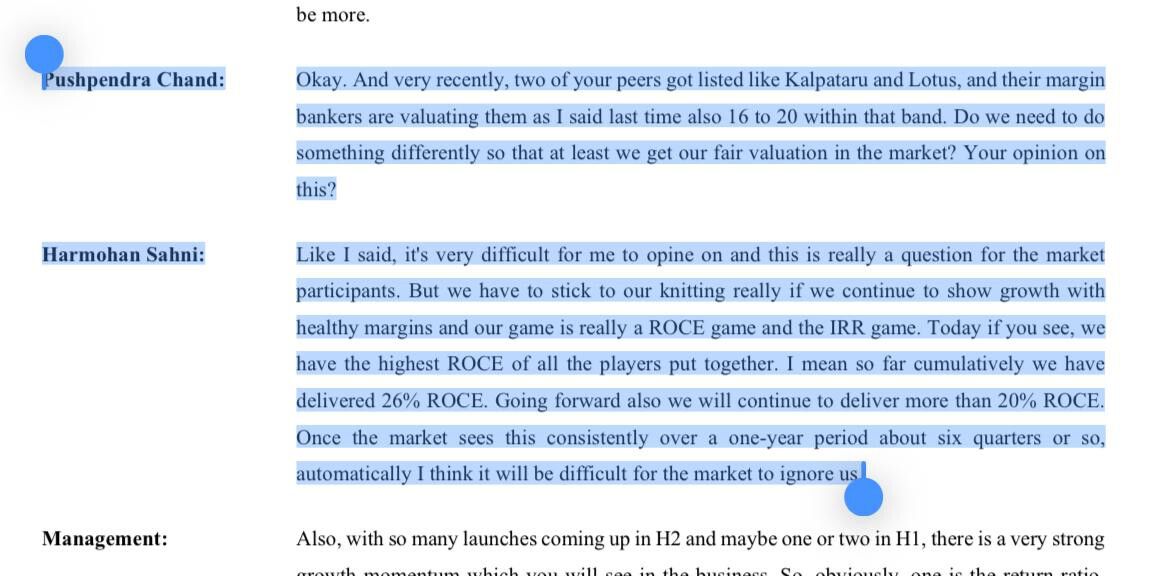
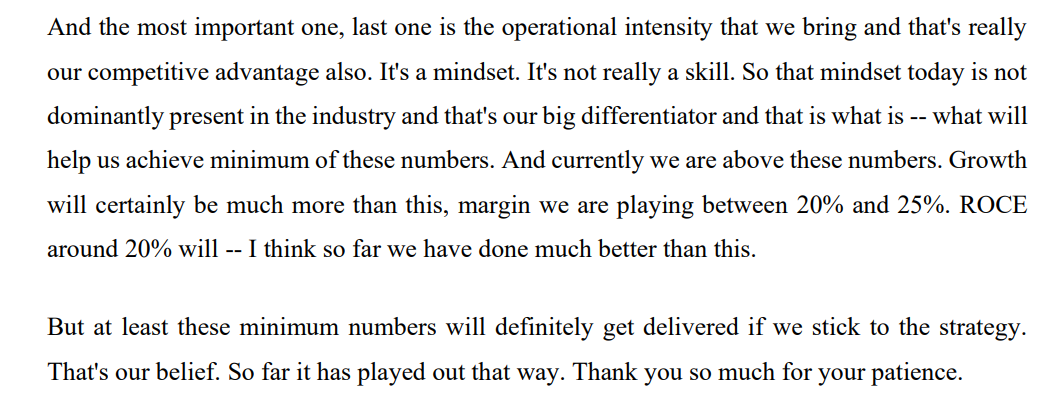
  1. As the CEO Mr Sahni said in the Q1 FY26 Earnings call,

But we have to stick to our knitting really if we continue to show growth with healthy margins and our game is really a ROCE game and the IRR game. Today if you see, we have the highest ROCE of all the players put together. I mean so far cumulatively we have delivered 26% ROCE. Going forward also we will continue to deliver more than 20% ROCE. Once the market sees this consistently over a one-year period about six quarters or so, automatically I think it will be difficult for the market to ignore us.
So, continued execution and delivering on guidance would make it very difficult for the market to continue discounting Raymond Realty to its peers.
Once the company can fully publish its full-year results as a standalone company, it would reflect better, purely from a restating of the accounting numbers that are presented in financial results and stock screeners that would pick this up.

  1. While Raymond Realty is a pure play real estate company, Raymond has now turned its focus towards engineering. However, Raymond continues to be a part of the NIFTY Realty Index, whereas Raymond Realty was excluded. So if Raymond Realty is picked up by the indices that it was excluded from, there’s the potential for shares to appreciate, with the stock seeing inflows.
  2. Institutional selling pressures come down - most passive mutual funds and index trackers have sold out, and I would assume the arbitrageurs have exited their positions, so maybe once the Q2 FY26 shareholding pattern comes out in October/November 2025, we can see the evolution of shareholding to get an idea of the holders
  3. Analyst Coverage

TLDR: Price Targets

Disclaimers:

Not Financial Advice
I own the stock and look to purchase more

7 Likes

@abhisr points out several items to be examined - which are quite valuable

Revenue Recognition

In real estate—particularly housing projects—revenues are typically received in advance, often in instalments from booking tills possession. However, accounting recognition occurs only after the final sale. In contrast, commercial real estate projects usually generate revenue post-completion in the form of rentals (Nirlon or listed REITs being good examples), unless the project follows a pure EPC model. These projects, however, require significant upfront investment in land and construction (unless the land is pre-owned or the arrangement involves rental sharing). For this reason, companies in this segment can provide clear revenue guidance for the upcoming year.

Thus, the key question when assessing a company’s real estate business is whether the revenue stream is one-time, cyclical (linked to project completion), or recurring (as in commercial properties, which can later be monetized through REITs).

Raymond Realty prepares its accounts under Ind AS, which are converged with IFRS (specifically Ind AS 115 – Revenue from Contracts with Customers, equivalent to IFRS 15)

From the Information Memorandum
pg 135

“Revenue from real estate property development is recognised over time from the financial year in which the agreement to sell is executed. The period over which revenue is recognised is based on the entity’s right to payment for performance completed. In determining whether an entity has right to payment, the entity shall consider whether it would have an enforceable right to demand or retain payment for performance completed to date if the contract were terminated …”

Revenue begins once a registered agreement to sell is signed with the buyer.

Recognition proceeds over time in proportion to construction progress / satisfaction of performance obligations, provided Raymond Realty has an enforceable right to payment under RERA-compliant sale agreements.

In the Information Memorandam Note 1.14

The progress towards satisfaction of performance obligation is measured using input method, based on proportion of actual cost incurred to date to the total estimated cost.

Raymond Realty uses a percentage of completion method to recognise revenue proportional to the costs incurred. So if they sold a flat for ₹200 to be delivered in 5 years, total project cost of ₹100, and in year 1 they incur ₹20 as costs, then they recognise 20% (₹20/₹100) of the total revenue in year 1, i.e, 20% of ₹200 → ₹40

This is the standard practice for Real Estate developers in India and globally

To answer the first question, the revenue is not cyclical, one-time, or linked to completion, but rather based on the progress they make in completing the project. Cash is also collected from customers in a structured way over the course of the project, not just as a one-time payment on delivery, as is the practice with most real estate developers.

Land bank

Their gross development value is split in the following way -
Own land

  • 25,000cr from the 100 acres in Thane
  • 9000cr from 40 Acres area under development → 4m sqft RERA carpet area, 3.61m sqft sold, 5746cr revenue recognised, with 0.39m sqft remaining to be sold.
  • 16,000cr from 60 acres to be developed 7.4m sqft of RERA approved sqft

Currently, they plan to expand with JDAs, rather than buy land and management has reiterated that "All the new projects that we have signed, the JDA projects are all in the range of 20% to 25% IRRs.” in Q1 FY26 earnings call

Current JDA Pipeline: ~INR 14,000 crore GDV; Raymond Realty share ~INR 11,500 crore; to be delivered over 5-6 years.

To check their track record - we can look at Address by GS in Bandra, which was their first JDA

Address by GS in Bandra - Tower A
Total Project Cost for Tower A was estimated to be around INR 90cr (only construction cost - since its a JDA, they did not bear the cost of land)
blob:https://maharerait.maharashtra.gov.in/2824a40c-c39d-4268-ade1-f518e7877142

Tower A has 88 apartments approved, approximately 103,000 sqft RERA approved, they have sold 45207 sqft. Based on the project sales, they have sold at INR 37240 per sqft, Roughly 168cr of booking values.

They have sold 49% of their inventory within 1.5 years of launch. Assuming they are able to sell the rest of the inventory, the Total Tower A project yields them 384cr total inflows. as per their published figures, their share is 80% of revenues, so that gives them ~approximately 315cr of inflows against a total project cost of 90cr.

This exercise is just to get an understanding of how they are currently executing on their JDAs

I think that answers both the considerations provided by abhisr

Would love to hear your thoughts

8 Likes

Results out for Q2

Very good set of numbers in my opinion
Guided revenue of 400cr this quarter, and delivered 700cr. On track to do 2300cr revenue run rate but can definitely achieve 2800cr FY26 revenue as per guidance with new launches in H2FY26

1 Like

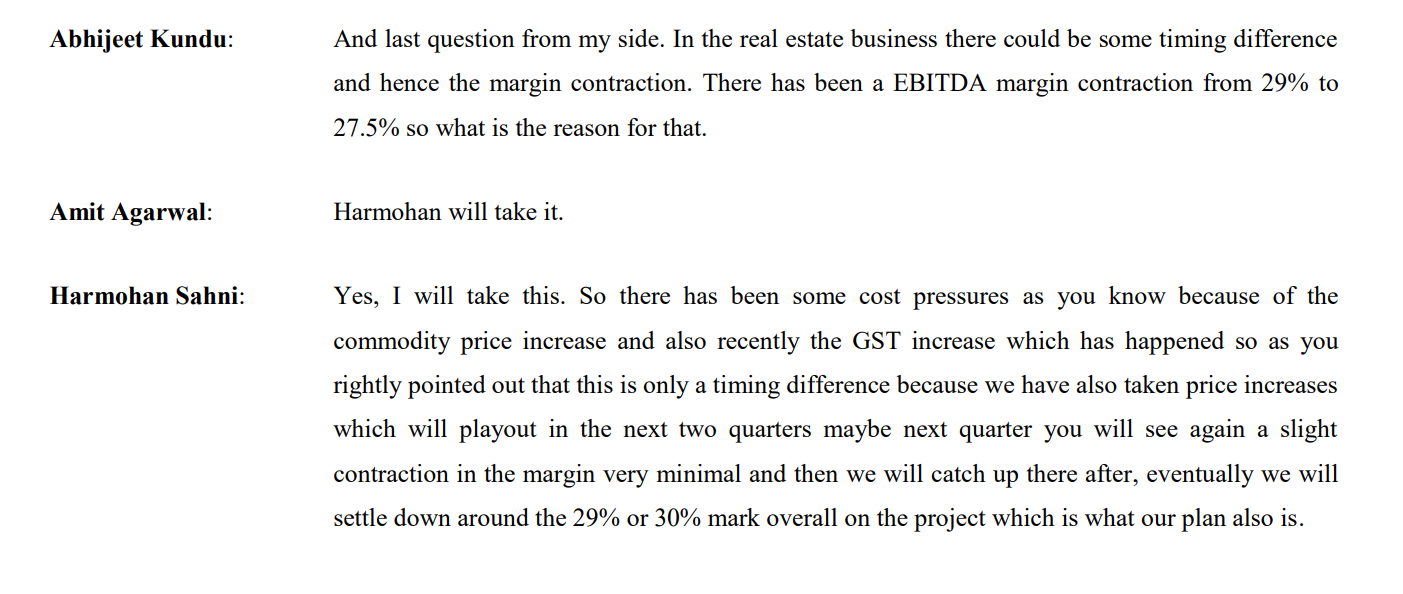
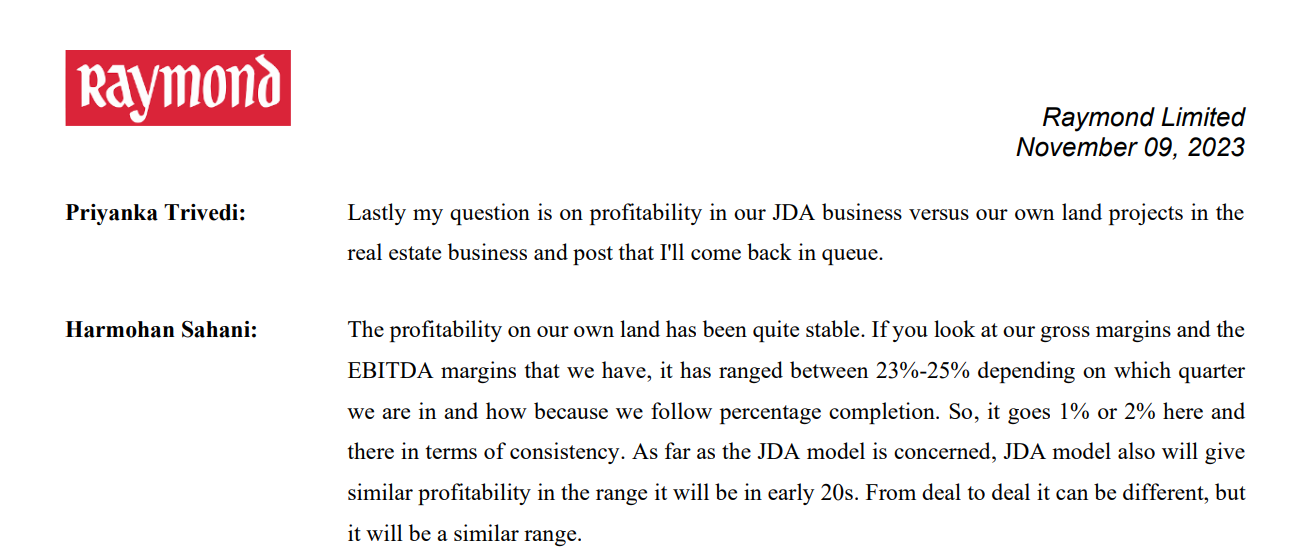
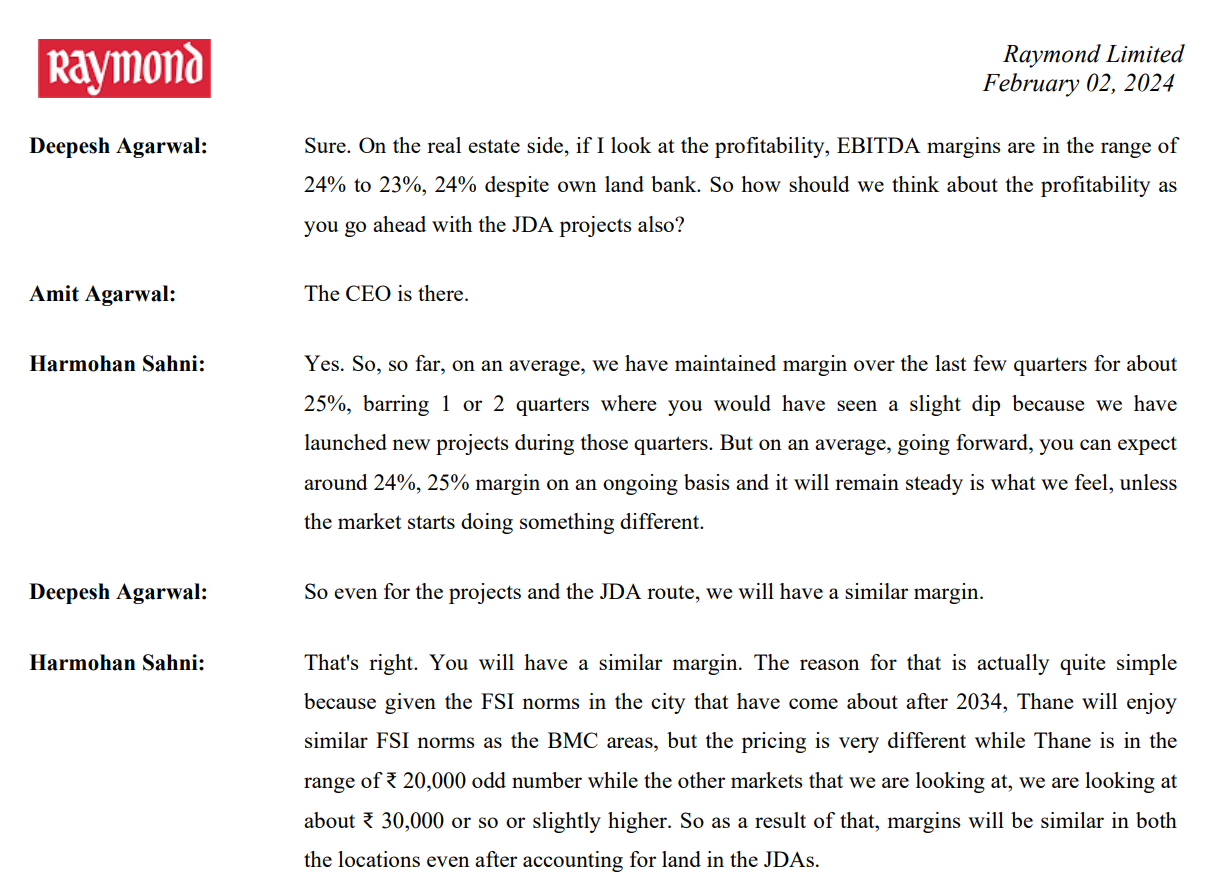
I remember from a year or two ago, the management used to say that the EBITDA margins for reality division is around 25%

But now it’s at 15%. Does anyone know more about this?

1 Like

Yes, now they are guiding for ~20%. I think increased corporate overheads for a standalone listed company could be a factor in reduced margins. On this front when the business reaches a bigger scale we could see some margin improvement. Also, some costs getting recognized upfront in the P&L which is leading to this reported 14.3% number.

Attaching some excerpts from old transcripts where specific guidance regarding margins was given.

August 2022

July 2024

2 Likes

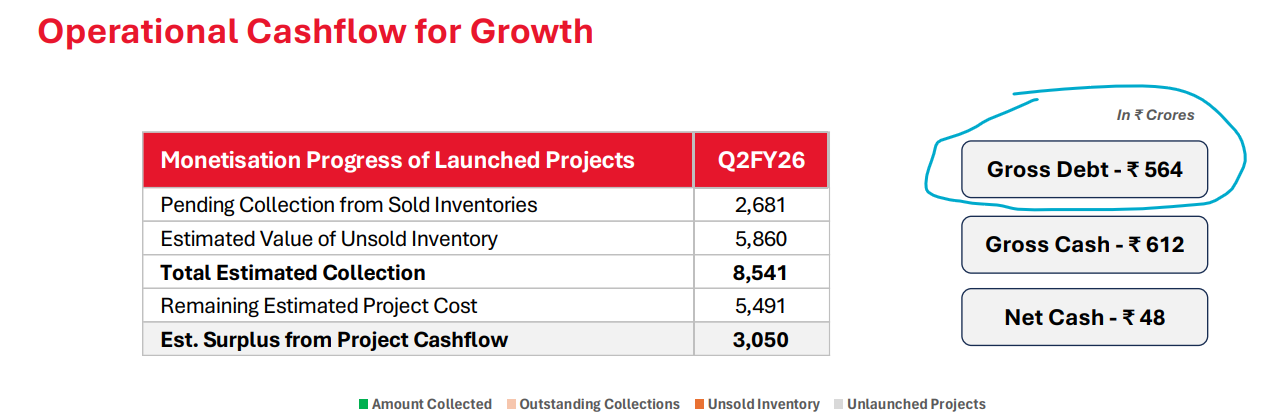
They claim a gross debt of around Rs550Cr but they are paying an interest of around Rs26cr per qtr , their income statement and balance sheets are most tricky to understand, (Sucheta Dalal’s video on Raymond is must watch), but on a high level, this stock is undervalued in my estimation.

1 Like

Based on my understanding, the margin contraction is likely due to the launch of two new projects on their Thane land, as highlighted in the investor presentation. Currently, sales appear to be on the lower side for these projects, probably because they were only recently launched. However, I expect margins to normalize by Q3 and Q4 as bookings pick up and the projects progress to the next construction phases. Considering these are premium developments, improved realizations should also support margin recovery in the coming quarters.

3 Likes

over the call today, Many questions were on margins why it turned to 13 % over 20 % estimated guidance.
20 % is average of all to understand in better way, EX: 100 flats, 70 sold in a year @ 1 cr later over time on unsold unit are sell at higher prices 2 to 3. CEO said they have already sold good unites at higher prices vs launch offers. over all it is will be a great story just matter of time.

Some great thing to highlight is : Next Q3 and Q4 launches or 5000 crs, at least we take 13 % each then 350-400 crs + pending payments. CEO was very confident and very calm.
14000 from JV
26000 from one land parcel . Great story a head.
Baised and invested

https://raymondrealty.in/investors/concall-audio-recording/fy25-26/

Here is the link for the concall

6 Likes

As management reiterated on call, their guidance of 20% EBITDA margins are on a blended basis, meaning, a lot of the costs will occur in earlier quarters but for the full financial year .theyexpect to have an EBITDA Margin of 20%. Quarter to quarter results may not depict accurate picture due to the nature of the real estate development business where there are certain upfront opex and will realise revenue later

:building_construction: Raymond Realty Ltd – Investor Conference Trigger & Growth Outlook

Date: November 10, 2025
CMP: ₹580–₹630 range
Market Cap: ~₹4,000 Cr
Event: Anand Rathi “Annual Flagship G-200 Investor Summit” – 13th Nov 2025
Venue: Taj Santacruz, Mumbai


:small_blue_diamond: Key Development

Raymond Realty Ltd (post demerger from Raymond Ltd) announced its participation in the upcoming Anand Rathi G-200 Investor Summit, where top management will engage in one-on-one and group meetings with leading institutional investors.

The company will present its Q2 FY26 and H1 FY26 performance, highlighting:

  • :bar_chart: Total Income: ₹706 Cr vs ₹589 Cr (YoY +20%)
  • :money_bag: EBITDA: ₹101 Cr vs ₹95 Cr (YoY +7%)
  • :dollar_banknote: PAT: ₹70 Cr vs ₹79 Cr (Q2 FY25) – marginal dip due to timing of new launches
  • :building_construction: Collections: ₹409 Cr | Booking Value: ₹455 Cr | GDV: ~₹40,000 Cr
  • :gem_stone: Debt-free with ₹48 Cr net cash surplus

:small_blue_diamond: Management Commentary

MD Harmohan Sahni reiterated that:

“Q2 was in line with expectations as new launches were planned for H2 FY26. The company anticipates robust sales and operational growth in the second half.”

This aligns with earlier guidance that Q3 and Q4 will see multiple project launches, including Chembur and Thane expansions.


:small_blue_diamond: Why This Matters

  • Post-demerger re-rating potential: Pure-play real estate company with ₹40,000 Cr GDV and strong balance sheet.
  • Institutional attention: Participation at the G-200 summit could attract fresh fund inflows and improve visibility.
  • Land bank value: Estimated land assets exceed ₹5,000 Cr, while current mcap is just ~₹4,000 Cr — clear value gap.

:small_blue_diamond: Technical Snapshot

  • Strong base forming near ₹580–₹600.
  • RSI trending upward (40→50); MACD nearing bullish crossover.
  • Breakout confirmation above ₹667 could open ₹720–₹750 short-term, and ₹800+ by December if institutional sentiment strengthens.

:small_blue_diamond: Investor View

Temporary weakness post-Q2 results is driven by sentiment, not fundamentals.
With new launches, institutional visibility, and improving margins expected in H2, Raymond Realty remains undervalued relative to peers like Oberoi Realty and Sunteck.

Soon they will present q2 to build confidence and add new recognised investor.

5 Likes

How are you saying that the land bank value exceed 5000 cr?

Can you please explain

1 Like

Realistically of the 100 acre land bank in Thane,

They still have approximately 60 acres left that’s currently not being developed or hasn’t been sold

Based on property listings in the area, at the lowest the land is worth 23-24cr per acre. Given the proximity to Pokhran Road and Viviana Mall, it could easily be worth more. So I’d probably say the land bank is worth INR 1400cr

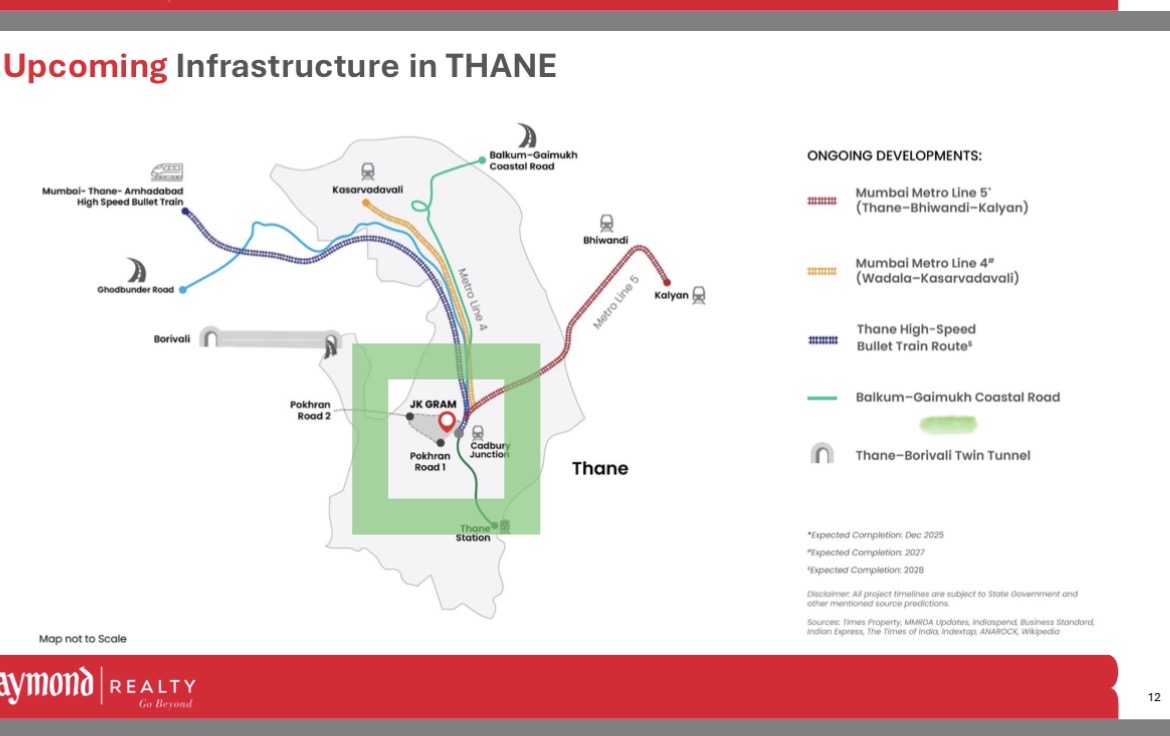
What’s more interesting is the real option like nature of this Thane land. Connectivity between Thane and Mumbai is already quite good - commuting between the city approximately takes 45mins to an hour - both by car and public transport and this is expected to get better with the Thane-Mumbai High Speed Rail that’s expected to come in by 2028.

Cherry on top of the cake - look at the location of the


land parcel

4 Likes

BKC 2 and Wadala to be launched in Q3 and Q4

They have some additional inventory in Thane

1 Like


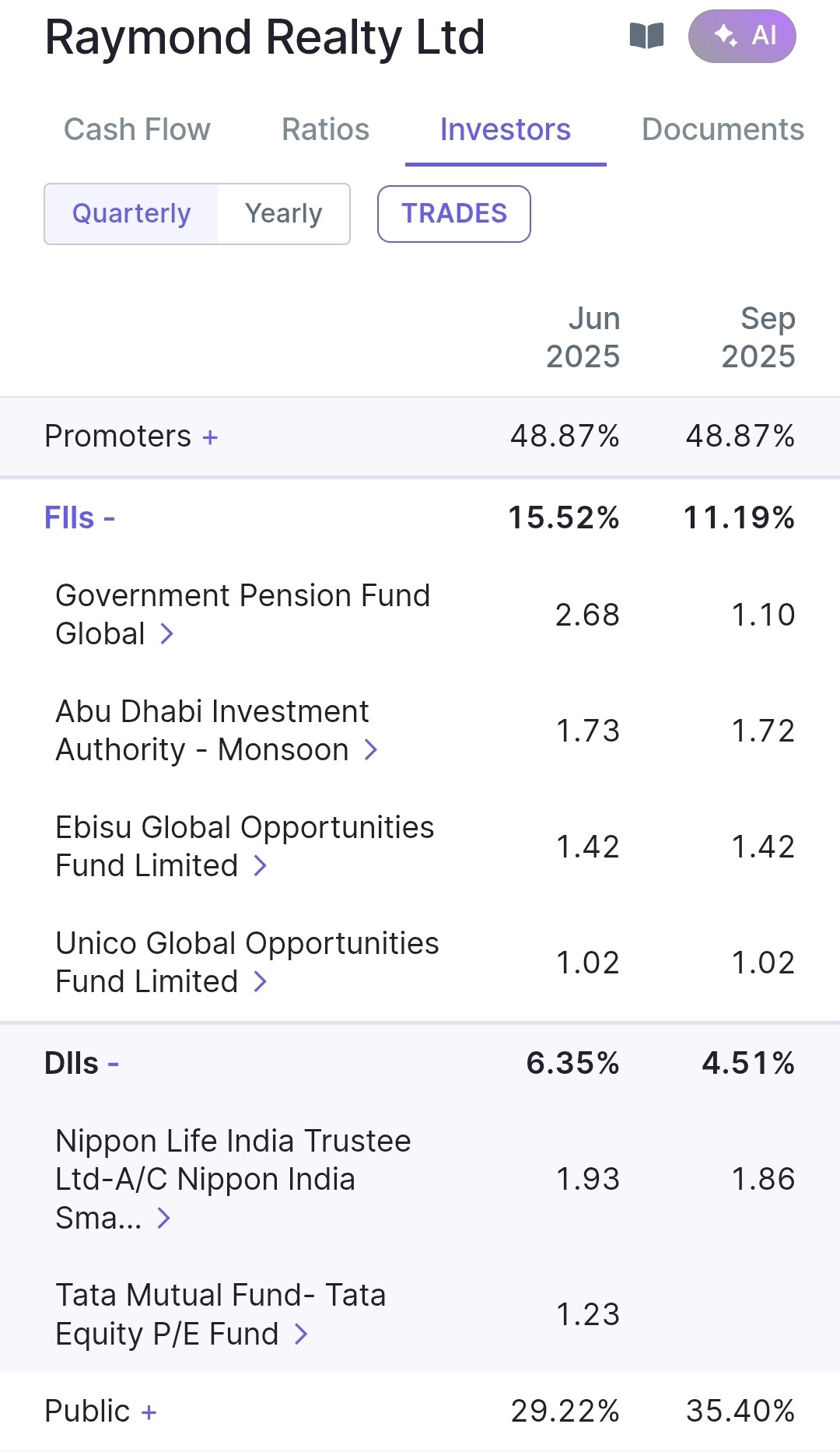
Can anyone explain why institutions are offloading stake?
Also in this thread someone mentioned they are debt free company but I can see borrowings in screener.

Disc: tracking with no position

If you dig Investors presentation Raymond was part of index post demerger it is mandate to sell if it is out of index so that’s is why they are selling and over supply reason drop of shares . Once it is stable it it be big.

Based on the latest market data (as of November 19, 2025), here is the analysis of why the stock is falling:

1. The “Out of Index” News (This is crucial)

You are likely hearing news about the MSCI India Small Cap Index rebalancing, but this specifically affects the parent company, Raymond Ltd, not the separate Raymond Realty stock.

  • What happened: In the November 2025 review, global index provider MSCI announced that Raymond Ltd is being removed from the MSCI India Small Cap Index.
  • Effective Date: This change is effective from the close of November 25, 2025.
  • Why it causes a fall: When a stock is removed from an index, “passive funds” (like ETFs) that track that index are forced to sell the stock to adjust their portfolios. Traders often “front-run” this by selling early, driving the price down before the actual date.

2. The Status of “Raymond Realty”

Raymond Realty (the separate listed real estate entity) is not the one being removed from the MSCI index right now. However, it is falling for its own reasons:

  • Nifty Index Exclusion (Old News): Raymond Realty was excluded from Nifty indices back in July 2025 (shortly after listing) because it didn’t meet specific trading criteria. This is old news and not the main reason for the current drop.
  • Income Tax Survey (Recent News): A major reason for negative sentiment around Raymond Realty is the Income Tax Department survey conducted at its offices in late September/early October 2025. Uncertainty regarding the outcome of such regulatory actions often keeps investors nervous and depresses the stock price.
  • Group Effect: Since the parent company (Raymond Ltd) is under pressure from the index exclusion, negative sentiment often spills over to group companies like Raymond Realty.

Summary: Which “Raymond” is affected?

Entity Index News (Nov 2025) Primary Reason for Fall
Raymond Ltd (Parent) REMOVED from MSCI Small Cap Index. Forced selling by funds due to index exit.
Raymond Realty (Real Estate) No new exclusion (Left Nifty in July). Income Tax Survey fallout & negative group sentiment.