
This website shows that Carborundum universal is supplieng to Bloom energy. I’m not sure if this is a reliable source or not. Correct me if I’m wrong.
Sai Life PE 62, Market cap/Networth 10, Market cap to cash flow 67, EV/EBIDTA 32, ROCE 14%, Promotor stake 35% and CDMO is a lumpy business, stock is priced to perfection
I feel valuation is not always just the TTM P/E. Doing so ends up in a lot of value traps. The differential insight can only come from looking at capabilities that aren’t captured in the balance sheet as intangibles. That’s what tells us about the longevity and durability of one’s moat and a bulk of the valuation actually comes from these two (how much can the earnings grow AND for how long) than what the company did in the past alone (while it still matters). Its the growth and longevity that are primary drivers of valuation (see how a growing annuity is valued vs a lumpy one-time cash flow for eg.)
Most of the winners for me in the last couple of years have come from this approach and I have bought 50 P/E+ consistently in this period (Wocky, Shaily, Axiscades etc) and have had 2x-4x in few of these even when market did nothing since Sept ‘24. A business like Sai isn’t as lumpy as the other CDMOs. It has no commodity business which can drag while another molecule or two is growing. It is not reliant on one or two molecules. It is 100% innovator business. Doesn’t mean it wont suffer from lumpiness - but at least it will not be as lumpy as the others.
Take this for eg. The biggest molecules for Sai are Qulipta and Blujepa (in the last 2-3 qtrs that is). In Feb exports there is no Blujepa and still IDRx-42 made up for it. In Mar (20 days data only) there is neither Qulipta or Blujepa and yet Tyvaso and Quviviq have made up for it and for this quarter as a whole, none of the molecules are > 20% (Still this is the best quarter almost for Sai already if you remove Tradipitant from Q2 since this was from earlier quarters but shipped later)
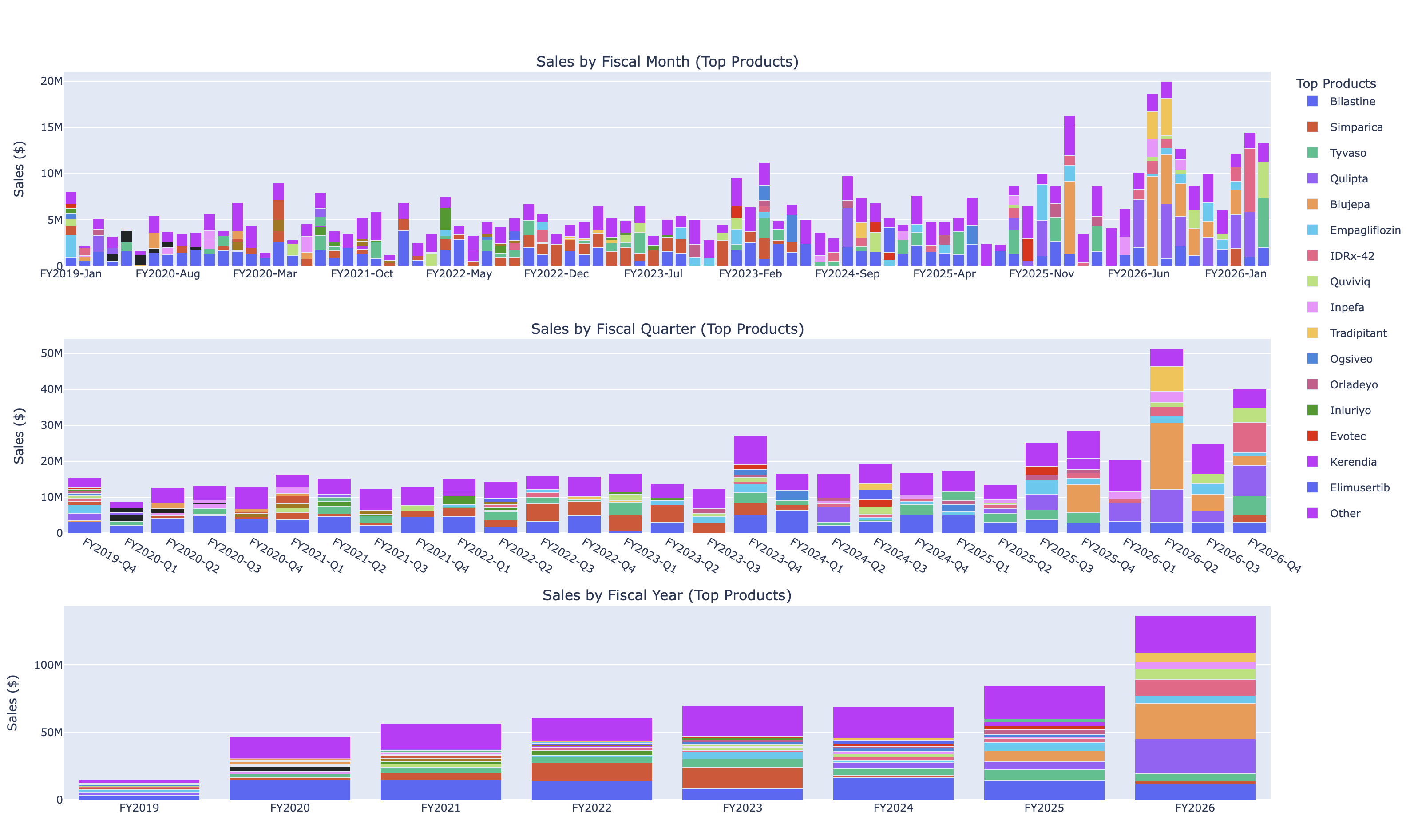
Even this doesn’t cover the work they are doing for numerous innovators every month and how complex such of those chemistries are and how capable some of those molecules are in clinical trials. Do check out Sai thread and I have covered in depth some of these.
My pf is filled with high P/E stocks - Aeroflex, TD, Mtar are all 60 p/e or higher. I have seen how markets react in times of crises - capital seeks comfort in businesses that have good earnings visibility and relatively undisrupted cashflows and these bounce back durably after a market-wide correction. I have made mistakes of buying 12 P/E stocks only to see them derate to 8 P/E in such times even though they have strong counter-trend rallies that end up being bull traps.
This is of course not the only way to invest - its a way of protecting one’s capital and one of the important things in the market to know are when to protect capital and when to attempt growing it aggressively. Sometimes even protecting capital yields decent alpha by simply not losing and sometimes gaining. This strategy will not work as well in a roaring bull market and I am aware of it quite well. We are nowhere close to a roaring bull market at present.
Appreciate your detailed reply phreak, its all about your strategy you follow in different market conditions. Problem with high growth and high PE stocks is these may go in price or time correction once growth moderates and stock price comes to mean valuations. Timely exit is also important as any bad news is known at last to retail investor. There are very few business with consistent 20% plus growth.
Congratulations for new ATH, here fight is to limit losses. Conviction is getting tested on daily basis. ![]()
![]()
This small paragraph talks hell lot of experiene and not sure how many understood the power of this. In the recent past, i have taken time out, read more, introspected my past way of investing and used lot of AI to understand better. This paragraph is a good summary of my learnings. But knowing and practicing this is another level. Thanks for re-iterating this for me.
Have not seen an update in a while from you Phreak.. Really looking forward to one.
I don’t have much to add so haven’t written anything. I continue to stay invested in the same businesses. I do have some things to say on the topic of AI from a technical, business and philosophical perspective as I have done here few times before. So continuing on those lines - feel free to skip the sections you don’t like. However, I think to understand my overall perspective, its important to know where am coming from. I don’t use AI to write so you won’t find the familiar “that’s not a trend, its a phenomenon” template of hype.
I have been immersed in AI, using at various levels and forms (claude, claude code, within phreakonomics using local LLMs, building mcps, organising knowledge bases in obsidian and so on), fine-tuning models (a 9b param model - nothing much to speak of), building agents (similar to claude code, but for 3d printing along with son), tweaking ways to run local models (using mlx-vlm, llama.cpp playing with turboquant and other kv quants, dflash and speculative decoding, obsessing on throughput token/sec without foregoing quality too much).
As a big fan of running local LLMs for a few years now, I can finally say we are really getting somewhere. My API costs have come down drastically from its peak because of the same and I can say the quality of local models is now so good that I am finally able to parse earnings PDFs locally within few mins at zero cost and its 95% accurate across pnl, bs, cf and segment data.
Few of the other things I use on phreakonomics - summarising announcements, scoring them and surfacing the important ones on a daily weekly basis (across categories like order wins, acquisitions, risks and disruptions, business updates etc), recording and transcribing (using parakeet and diarization pipeline), scoring and summarising conference calls and extracting guidance, synthesising sector level knowledge, generating business synopsis using ARs, transcripts and ppts, extracting business specific kpis from ppts, quick ways to track and compare earnings and so on. All these can be done today using a local LLM.
Even generating an exhaustive investment report using all these pre-digested inputs can be done locally in < 5 mins. The general idea is to organise things into information, insight, knowledge and wisdom hierarchy so that its easier for you to get access to anything you want quickly and also allow these as inputs to a LLM like Claude using a mcp which would give a way, way richer experience at way less token usage because the information hierarchy is pre-digested and allows for what’s important to rise up naturally.
I wouldn’t like to think am alone in this as is clear by the growth of anthropic and openai revenues. People are building all sorts of useful and useless things with AI. There are people building things of very high value with limited shelf life (because invariably margins will get razed to the ground and moats destroyed) spending a bomb on API costs. Anthropic doesn’t have compute to cater to its growth while OpenAI’s brash risk-taking promises to pay off big next year. Data centers are becoming the most crucial in all this because pretty much everything is running on supply shortage one after the other, from gpus, memory, photonics, cooling and power infra. It appears to be similar in size and scale to the railroads capex.
As an investor, its a once in a lifetime opportunity to benefit from but also one to be wary of since railroads capex in the US was one with a lot of bankruptcies but the public did benefit from all the railroads built. But it did play out over decades and the bankruptcies came in the 3rd or 4th decade. So we might still be very, very early in the cycle.
AI is a 5 layer cake - with application, models at the top and the chips, infra and energy below it. We would like to think the guys at the top would accumulate most of the value and so far it appears to be so - with OpenAI and Anthropic garnering values in 100s of billions with Anthropic reported valued at $1 trillion in pvt. markets. Following this, there is clamour for soverign models and soverign AI apps and India AI mission trying to promote these ventures. I am however somewhat skeptical of these because the open weights models coming out of China are so good and have no strings attached. A lot of the AI compute doesn’t need SOTA models - you dont need Opus to summarize things or generate reports - a Deepseek v4 flash can do it at a fraction of the cost. Even what sonnet does, a Deepseek v4 pro is able to do at a fraction of the cost ($25 vs $3.87/million tokens - and discounted at $0.85 currently). I do however see the point of sovereign data centers though, if not sovereign models as these deals may not last forever. But its undeniable that 60-70% of the work can be done by open weights benchmark equivalents to SOTA models of last year.
This also makes older GPUs like the H100 or even the A100 lot more valuable and I can see from what neoclouds are charging that annual rental for a year now covers what the card cost back in 2020. Even otherwise, they are able to cover the currently elevated cost as well within 2 years and these cards can be relevant for 7-10 years though accounting depreciation might be for 6 years (Because models keep getting efficient and your mundane information crunching tasks can be done even better than they can be done today).
India I think has a substantial edge in all this - while we don’t have an edge on models, applications and memory/logic chips, we do have decent trained labour in electricians and plumbers (both in great shortage and paid upwards of $200k/yr) and a lot of the DCs are becoming modular where they can build offsite and transported in containers, we have engineering capability in energy and transmission and electrical equipment. We have precision engineering capability to build liquid cooling components and build assemblies. We don’t particularly have issues with the US govt. and can get access to cutting edge Nvidia chips and neoclouds can be built here with companies serving the models that can cater to the 60-70% of the AI compute with open weights models. This is a substantial part of the pie. With middle-east facing security threats to their infra, our defence capability and connectivity and energy costs also makes us attractive to hyperscalers. I find it a bit irritating when I see people write us off in AI. I feel we have a big role to play.
Anthropic is the one which is high-flying with the highest risk at this point. They absurdly provoke everybody from their own customers to the govt. and while they have a great product, they have got crucial decisions on investments wrong and unfortunately, though they are correcting it now and it might be too late as its not easy to put up DC capacity. They are bidding up existing capacity which means we will continue to see deterioration from their models as they try to protect margins which are already non-existent. A quick comparison between what you get for a $20/mo pro vs what $20 can buy your in anthropic sonnet/opus API will tell you they are losing 5-10x on this sub. They have however built good apps and idiotically also leaked source code for it (for claude code at least). It is anyway unnecessary as its trivial to trick claude code into using a deepseek or a local LLM by setting base url and key and passing model name. So there is zero moat in claude code harness unlike what people think. Only people for which these are indispensable are the ones working in the cutting edge of drug discovery, cybersecurity or quant trading where the money lost/gained can be substantial and worth it paying hefty sums for enterprise access to Opus 4.7 or Mythos.
While I personally like to be on the cutting edge of tech for the sheer joy of it, it is also unsettling how good the models are getting. I find it interesting that communism vs capitalism is playing out the way it is. Chinese labs sharing knowledge and giving the world open weights models and huawei not looking for 70% margins like nvidia and cheap solar power is giving a run for the money of capitalists. I think China can really make a mockery of pricing like they have done in ev/solar/mining/chemicals/plastics/electronics etc already and that’s what we need to watch out for.
Disc: I am invested in the space through multiple businesses
@phreakv6 It’s fascinating how you manage such a concentrated portfolio and churn them, mostly at the right moment. Perhaps, the deep research you do gives you that degree of conviction.
I still remember you getting out of Wockhardt last year when you felt the valuation gap had closed and probably the differentiated insight was becoming common knowledge - and it was the right call in hindsight. I’m again surprised to see no mention of Axiscades in your recent portfolio disclosure. Ofcourse it’s not trading cheap, but if the management projections hold true (which they seem to be in track for), I feel there is a lot of upside. Is it something similar to what you did in Wocky that made you exit the position? Don’t know of anyone else that has done deeper work on Axiscades - hence would love to hear your take on it.
Hi @phreakv6 , I am invested in Aeroflex too. Have you got a chance to read about Thermax data centre liquid cooling solutions?
Posting a few snippets:
This is the concall transcript of last concall. They have won an international and one domestic order for their liquid cooling solutions and has indicated that they will ramp it up and do capex.
Other snippet is a brief description of their liquid cooling solutions which claims that it saves 80% water.
Thermax is a giant when it comes to industrial cooling solutions across the globe, also at much better valuations and better looking chart i.e. not very extended one.
Only issue is DC cooling will be just one part of many things they do, so rerating may not be as good as it happened in case of Aeroflex.
The above simple buildup show that Aeroflex baking in too much too soon? I booked out Aeroflex on the above basis..


