Natco Pharma: Focusing On Complex Products

Thanks for sharing your thoughts @madhavojha. Here is my analysis:

Revlimid sales will decline as patent expires at end of CY25 and so sales and PAT will decline in FYe26. Management has guided for PAT of ~1250 Cr in FYe26 on sales of ~3550 Cr. Revlimid sale price per unit and margins will decline much further for FYe27 as competition sets in and price erosion happens.

But there are five factors might help alleviate this decline:

(i) while margins decline, market share of Revlimid innovator Bristol Myers Squibb should go down as quotas are no longer applicable. This can lead to increased volume for generic players like NATCOPHARMA, thereby offsetting to some extent the decline in margins.

(ii) successful launch(es) of the many first to file approvals (sole and joint) that the company has, including Olaparib, might help offset this decline

(iii) successful launch of Semaglutide in India

(iv) Their agrochemicals business turns profitable,

(v) with cash reserves ~3500 Cr a good acquisition should be EPS accretive. The average return on equity (RoE) of Indian pharma companies is ~13% while FD rates are say 6%. In that case an average acquisition might boost PAT by 7% of 3500 Cr = 245 Cr which corresponds to EPS of ~13.

In any case there is likely to be very significant volatility/lumpiness in sales/profits as some drug in their current portfolio wanes and then it takes time for a new launch to gain traction. Over a longer period also there will be significant volatility/lumpiness in sales and/or profits as existing products face price erosion and new launches take time to ramp up. Overall, to me the three scenarios are:

(a) In the bear case scenario, none of the above 5 factors fire and EPS drops to 70 in FYe26 and 50 for FYe27.

(b) Baseline is EPS of 75 in FYe26 and further decline is arrested due to one/two upside factors playing out leading to EPS of 75 in FYe27.

(c) Bull case scenario would be that three/four of the above 5 factors play out favourably leading to EPS of 80 in FYe26 and rebounding to 105 in FYe27 (i.e. to FYe25 levels).

It seems to me that the management has a good reputation for integrity and that gives me much more comfort than the above scenario-based projections. Would be happy to hear other people’s thoughts and/or observations.

Disclosure: invested and possibly biased.
10 Likes

Thanks for sharing your analysis @sheekhuj. Below is my detailed investment thesis explaining why I decided to exit the stock and book a loss.

I have a few concerns regarding the sustainability of the outlook you’ve shared.

  1. The agrochemical segment is highly dependent on agricultural seasonality and remains cyclical in nature.
  2. Dr. Reddy’s and Zydus Lifesciences are leading the race for semaglutide.
  3. The launch of Olaparib is subject to regulatory approval.
  4. The cash conversion cycle remains high, which could hinder future growth and operational efficiency.

FY25 FINANCIAL METRICS
Revenue: ₹4,430 Cr
EBITDA: ₹2,196 Cr
Net Profit: ₹1,883 Cr
P/E Ratio: 8

Segmentation: Core vs. Windfall Earnings

Revlimid (Windfall):

  • Revenue: ₹2,215 Cr
  • EBITDA: ₹1,912 Cr
  • Net Profit: ₹1,573 Cr (71% margin)

Core Business:

  • Revenue: ₹2,215 Cr
  • EBITDA: ₹638 Cr
  • Net Profit: ₹300 Cr (13% margin)
  • Note: Crop protection segment is cyclical and currently operating at a loss.

Basic Valuation (SOPV):
Revlimid (5× P/E): ₹7,865 Cr (Windfall Earnings)
Core Business (20× P/E): ₹6,000 Cr
Implied Valuation: ₹775 per share

Future Outlook:
With the Revlimid patent set to expire in January 2026, the company’s high-margin (71%) earnings are expected to transition into a lower-margin (13%) core business. Most of the post-2026 operations will depend on this structurally weaker and cyclical segment.
Management has guided that future sales are expected to decline.
While any acquisition could potentially boost the top line, management has neither provided a concrete plan nor shown progress toward executing one.


Note: The Hepatitis C segment, particularly Sofosbuvir, was the major contributor to the 2017 windfall. This was similar in structure to Revlimid in FY24–25 — a single product causing an outsized surge in operating performance.

If history repeats itself, Natco might take another 2–3 years to reach its all-time high again, as earnings return to normal after the one-time boost.

Two situation can make NATCO outperform in future:

  1. FDA approval of blockbuster drug
  2. Strategic acquisition
5 Likes

Natco has earned around 3500 cr PAT (approx) from Revlimid . If this kind of one off boost does not improve stock performance, I am not sure what will.

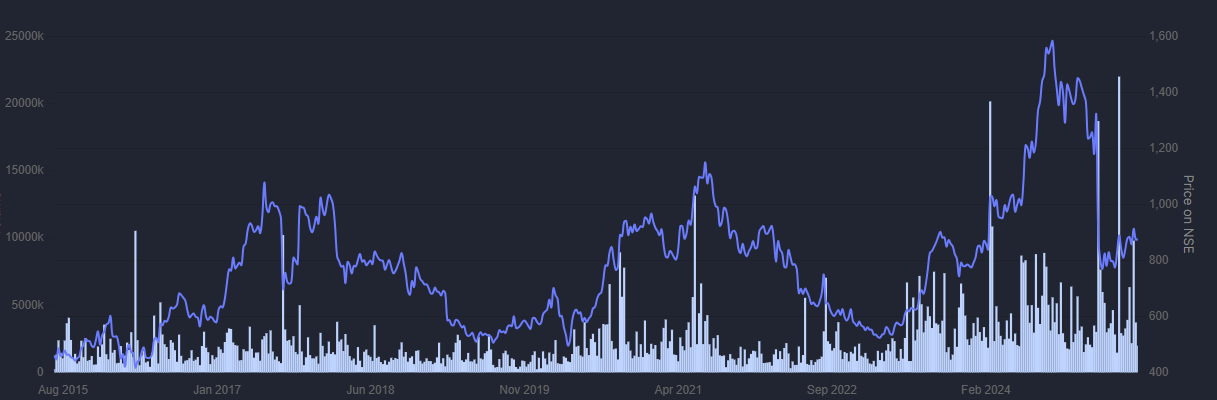
I think market expects better performance from base business, but Natco has not shown improvements in their base business, in fact it has deteriorated in the last 4/5 years. Market give more valuation (e.f PE) to business which grows consistently over a period of time (like domestic focus pharma companies), and less to one off kind of income (like Revlimid). They have been talking of agro business improvement from few years now, but it is still not meaningful (talk continues…).

If the acquisition improves base business, market may like like it, but if they invest good portion of that in another one off kind if future payoff, then stock is unlikely to move upwards.

Note: Invested for last 5 year hoping that Revlimid may boot it. Revlimid came and going off, but natco price is where it was few year back. Existed most of the position.

7 Likes

It would be help if more information shared on SSGR. How to calculate it ? when to use it for effecient? when to not to use it?

A detailed post on SSGR by Respected Dr. Vijay Malik Sir.

https://www.drvijaymalik.com/self-sustainable-growth-rate/

it did bouned back. Semaglutide news and action is still awaiting. It would be very interesting to know more detailed roadmap on agro chemical and usage of cash on book.

1 Like

What impact can Wygovy potential do for Natco

https://www.business-standard.com/markets/capital-market-news/natco-pharma-soars-after-mylan-settles-ozempic-patent-dispute-124100700638_1.html

Natco outperforming the market recently…Looks like many long term holders have ditched this share, which is very unfortunate…
Rajeev N is an excellent leader and navigating this company to the best of his ability. He does not over promise…He hasn’t wasted the cash mountain that they have on acquisitions for the sake of it..he wants to get it right - better to be late if there are no suitable companies
They are investing in other niche companies (CAR-T and other) which is good.
I am still accumulating..

8 Likes

Institutional investors are treating Natco as a cyclical stock - well documented that they tend to sell with spurt in growth that happened a few times now - flu medicine in 2017 (?), then Copaxone, and now revlimid…agri bet is a failure so far - not a big deal
They have decent pipeline in the near future (carfilzomib ,pomalidomide, obesity drugs, ibrutinib etc)..+ they will almost certainly will have new products in the coming years…

They are looking for acquisitions which is probably aimed to keep their profitability more stable/non-cyclical…this acquisition when it happens could be a trigger for re-rating…

In my view, the most important criteria for Natco is the management Rajeev N - he is reliable and does not overpromise…

Natco is very cheap - PE ratio of 12(approx), plenty of cash, you get growth for free..

Having less institutions in the share register is a not a bad thing necessarily…

6 Likes

modestly valued pharma manufacturing company

6 Likes

2000 cr acquisition

4 Likes

My collab with chatgpt.. needed to understand what the deal is..in essence it is something like an open offer to the non promoter shareholders of Adcock Ingram to buy their stake with a bit of fresh issue as well..
Interestingly a Chilean pharma company had offered to buy adcock ingram in 2013 for about 1.2 billion usd but it was a stock + cash offer which was opposed by some of the minority shareholders. Bidvest group consequently increased their holdng in Adcock Ingram to 35% then and now holds about 65%..
They, bidvest, are still waiting to see quality returns from their investment although i think this company does dole out dividends to placate the dissapointed shareholders..good to know they are not cashing out and have put their hat in the ring to see where this partnership with natco takes them…

I would have thought natco would have wanted majority stake …why stop at 35%

7 Likes

Assuming a PAT (Profit After Tax) of $50 million and Natco’s stake at 35%, Natco’s share of PAT would be $17 million (approximately ₹140 crore). Additionally, they will receive dividends, so it’s reasonable to estimate that Natco could achieve around ₹150 crore PAT from this investment annually.

The good part is that this will be accretive to their base business, enhancing its overall value. While it is likely to positively impact the core business, we still need to observe how this benefit materializes over time.

2 Likes

https://www.fiercepharma.com/pharma/viatris-beats-novo-semaglutide-patent-feud-clearing-hurdle-potential-wegovy-generic

Such wins may pave the way for a Wegovy settlement which is pending unlike Ozempic, unless Natco’s partner is finding merit in continuing litigation for an earlier approval of its generic and consequent launch

3 Likes

  • Natco Pharma has a cash reserve of about ₹3,500 crore.
  • It will invest around ₹2,000 crore to acquire a 35.75% stake in Adcock Ingram at (15x PE) (they intend to take Adcock Ingram private).
  • The main purpose of the deal is to enter the African pharmaceutical market.
  • Adcock Ingram reported about ₹4,500 crore in revenue and ₹385 crore in profit last financial year.
  • It is the second-largest pharmaceutical company in South Africa.
  • If the deal goes through, Natco is expected to receive ₹137 crore annually as share of profits.
  • This could contribute approximately ₹2,000 crore to Natco’s market capitalization (assuming a 15x earnings multiple on earning contribution).

Disc: I have already exited the position. The earnings impact from the deal appears low to moderate. Going forward, Natco’s key catalyst remains FDA approvals.

11 Likes

Unless I’m mistaken. I think it must be 0.3575 * 385 = 137 cr/year which translates to ~2000 MCap (at 15x earnings).
They are going to take the Adcock Ingram private and the 35.75% of profits will be added to Natco books.
Can someone else validate this? This is my understanding as per the concall.

3 Likes

Thank you for the clarification. I’ve updated the post accordingly.

1 Like

With nothing much to look forward to in the present and having consumed the princely dividend of Rs 2/- per share one begins to gaze at the crystal ball of opportunities falling under Natcos lap in the medium term as there seems to be little respite in the short term, whatever was there has been sucked by the Trump Tariffs, so with what should we remain positive??

  1. The promoter management tried hyping up the 33% significant minority stake acquisition in branded low margin generic manuufacturer in south africa as being a pièce de résistance purchase but market immediately perceived it to be a damp squib (now natco will get a taste of its own medicine, how it feels to be a minority shareholder in a non perfoming company :grinning_face:). One can try to be optimistic about it and put it amongst the basket of eggs in terms of mid term opportunities.

  2. Domestic Semaglutide opportunity… by 2030 it is estimated that even if 50 lakh Indians are prescribed this wonderdrug the annual revenue potential could be north of 18000 crores INR
    Assumptions being 50 lakh patients, Monthly cost at Rs.3000/- and the same would be prescribed for a 12 monhs period. How much share can we expect Natco to garner?

  3. Pomalidomide Settlement in USA could again be in the lines of Lenalidomide because both the patents were with Celgene and one can speculate that the settlement terms would be similar. I am speculating that the patent expires in 2031 so Natco should start selling in 2027. This could be a mini gRevlimid opportunity for Natco from 2027 - 2031.

  4. Semaglutide (Ozempic) sales in USA… the motherlode of opportunity awaits Natco Pharma and its partner Mylan… again based on the patent expiry in USA one would expect mylan to start selling generics by 2028. and in time even Wegovy settlment can be expected although the patent holder has a longer patent in Wegovys case and that is why perhaps it is holding out presently from settling.

  5. Acquisition opportunity. Rs1500 crores + whatever comes in this year + a 20% increase in Authorized Capital means the astute Mr. Nannapaneni Jr is contemplating another bigger piece de resistance. One can only hope its a majority stake this time.

  6. During this phase (2025 - 2030) maybe, just maybe ,the sinking stuttering still birth? for lack of other idioms, crop health division starts doing a significant annual topline of 500 crores and contributing to the net profits as well.

  7. NRC 2694A novel drug is undergoing phase II trials both in USA and in India. A success in these trials will definitey create excitement in the stock. Expect Natco to rope in a marketing partner for regulated markets and do the domestic sales themselves, if, it sees the light of the day.

  8. That blood clot removal drug Apixaban, breast cancer fighting Olaparib, Leukaemia drug Ibrutinib are all billion dollar plus revenue generating patent protected medicines for which Natco has either F2F or tentative approvals. The others in the para iv list as on date are also money spinners in their own right. A couple of them fruictoning would be conceivable and expected as well given Natcos past track record.

It may be a prolonged consolidation phase for Natco now and with 30% plus retail shareholders the patience will be thin and we could remain under the cloud, below the 200DMA and so on and so forth for many days. However, we should not lose sight of the whys that attracted us here and I find periodical review and recital of the same extremely therapeutic to hold on to this miserable wretched stock that is not perfoming for a good 9 years… the next headline, a decade of non performance?

34 Likes

Based on the information from Bristol Myers Squibb (the maker of both drugs), Revlimid is a significantly larger drug in terms of worldwide revenue.

Revlimid (lenalidomide): Generated $5.8 billion in worldwide revenue in 2024.
Pomalidomide (Pomalyst/Imnovid):Generated $3.5 billion in worldwide revenue in 2024.
While both Revlimid (lenalidomide) and Pomalidomide (Pomalyst) are immunomodulatory drugs used to treat multiple myeloma and are chemically related to thalidomide, there are key differences between them:

Potency: Pomalidomide is considered more potent than Revlimid, which is why it is often used for patients who have already developed a resistance to Revlimid.
Mechanism of Action: Although they share a similar mechanism of action, Pomalidomide has a higher potency against the cereblon protein, leading to different degradation kinetics and gene activation profiles. This is why it can still be effective in patients whose disease has progressed on Revlimid.
Treatment Line: Revlimid is a common first-line therapy for newly diagnosed multiple myeloma patients. Pomalidomide is typically used as a second-line or later treatment for patients with relapsed and refractory multiple myeloma, especially those who have already been treated with both Revlimid and a proteasome inhibitor.

Semaglutide launch in India: Natco Pharma is handling the manufacturing of semaglutide:

The company is using a two-part approach:

  1. API Manufacturing:The company will be producing the API(Active Pharmaceutical Ingredient) for the drug themselves, in-house. This is the core component that gives the drug its effect.
  2. Fill and Finish:They have a partnership with another company to handle the “fill and finish” part of the manufacturing. This process involves putting the finished drug into its final form, such as in vials or pens, and packaging it.

By doing this, Natco Pharma believes they can maintain a competitive advantage in the market.

Novel NRC 2694:A novel drug is a new medicine that has not been previously approved or marketed in the United States. The term “novel” is used to describe a drug that contains an active ingredient that the FDA has not previously identified or approved.

The drug approval process:

After Phase II, a drug must successfully complete more hurdles before it can be commercially launched:

Phase III clinical trials: If Phase II results are positive, the drug would need to undergo extensive Phase III trials. These typically last one to four years and involve thousands of patients to further confirm efficacy and monitor for side effects.
Regulatory submission and review:Following successful Phase III trials, the manufacturer submits a New Drug Application (NDA) to regulatory bodies like the U.S. Food and Drug Administration (FDA). This review can take 6 to 10 months or more, depending on the complexity of the drug and whether it receives an accelerated review pathway.
Manufacturing and commercialization: After regulatory approval, the company must ramp up manufacturing and establish its commercialization strategy before the drug is available to the public. This process can take over a year.

Given the current Phase II status and the multi-year process that typically follows, a commercial launch would likely be several years away, contingent on all subsequent trial and approval steps succeeding.

Disclaimer: Trying google search to know about these drugs. Simply done copy and paste of what I think is useful for forum. Holding Natco pharma from 812 levels and keenly watching the Rajeev commentary.

6 Likes

Company: Natco Pharma Limited
SATYA VANI NANNAPANENI (Promoter Group) SOLD 23000.0 shares, value Rs. 1.972 cr (Rs. 857.39 / share) through Market Sale

Any member can help me assessing any reasons for this sale? Seems like a negative trend will continue for this?
