
Hi did you ever get a reply regarding your queries? Is there any more information regarding this particular individual investor?
1 Like
Yes they replied
Quote
" Mr. Jay Daga is not the part of Mallcom’s Promoter family. Mr. Daga, acquired the stake in company almost 11 years back from our outgoing foreign collaborators and is known to us as an investor in PPE domain.
Yes, we are aware that Mr. Jay Daga is associated with M/s AB Holdings and the association with AB Holding as stake holder in Mallcom safety is purely on bringing business on board for Mallcom Safety . "
Unquote
3 Likes
Found this post by Vector Consulting - How they have helped Mallcom transform operational efficiency
2 Likes
Q2 results
- EBITDA Margin: 7.1%, lower by 513 basis points; Primary reason for margin decline is Higher cost of goods sold, largely due to higher import content in raw material (up to 25% from 15%) and adverse currency fluctuations (dollar and euro appreciation).
- Management expects the margin decline to be a temporary one-off. They are negotiating with vendors and customers and aim to recover to the original 13%-14% EBITDA margin level by the end of Q4 FY26
- Branded business is showing a much better outlook. The domestic market growth was temporarily impacted by customers pausing purchases due to expected GST cuts, but a revival is expected in Q3
- Strategy continues to focus more on emerging markets (Middle East, Africa, South America) over the slower-growing European markets.
- Demand has slowed down in the European and US markets due to overstocking and economic situations. The strategy is to become a manufacturing partner for major global brands rather than acquiring brands in Europe
- The initial 20% growth target for FY26 is now more challenging, but the company is still pushing for it, hoping global headwinds turn into tailwinds
- FY26 CapEx is expected to close at around ₹30 crores (additional ₹8 crores in H2). FY27 CapEx is projected to be between ₹10 crores and ₹20 crores
- Commenced commercial production at Sanand and is fully operational; incurred 100cr on it; with up to ₹10 crores earmarked for new dipping lines and knitting machines. The stabilization of new product lines (PU gloves, helmets, PVC gumboots) is taking time due to new technology and materials, but the expectation is to run the current two lines at capacity within the next six month; Depreciation for the new Sanand unit will be approximately ₹50 lakhs per month, starting Q3
3 Likes
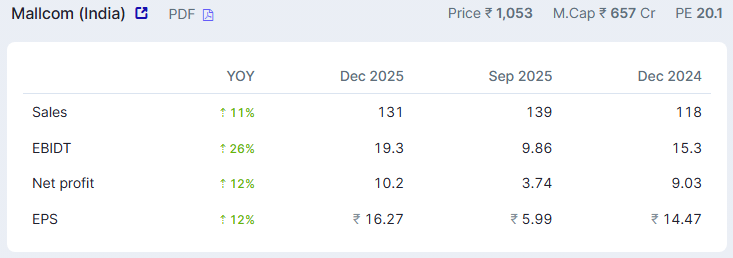
Con-call summary:
-
The company reported a 27% year-on-year (YoY) growth in EBITDA, driven by better realizations across key product categories and a shift toward value-added products.
-
EBITDA margins improved by 100 basis points YoY to 14.7%. This was supported by stable raw material prices, favorable exchange rates in exports, and cost optimization initiatives.
-
Finance costs increased due to working capital funding for new facilities and the removal of government export subventions, though some subvention has recently been reintroduced
-
Domestic sales grew by approximately 20%, significantly outpacing export growth. This was aided by recent GST rate rationalizations on select PPE categories, making products more affordable.
-
A higher contribution from safety shoes, which are among the company’s top-margin products, positively impacted the quarter’s results
-
The Sanand facility in Gujarat and the industrial shoe unit at Chandipur, West Bengal, are now fully operational. Current utilization for newer units (Sanand and the safety shoe unit) is around 40% to 50%. Management targets reaching 80% to 90% utilization by March 2026. The Sanand facility is projected to reach an annual turnover of INR 100 crores at full capacity.
-
Two synthetic glove lines are currently running at 50% to 70% capacity. Additional lines have been ordered and are expected to be installed by Q1 FY27, with a long-term plan to reach 6–7 lines.
-
Mallcom aspires to achieve a top-line growth of at least 20% over the next 2–3 years. For FY26, the company expects at least double-digit growth overall.
-
Management expects to maintain sustainable EBITDA margins in the range of 13% to 15% and target PAT margins between 8% and 9% as new facilities scale
-
The company is shifting toward a 50-50 ratio between branded and white-label business (previously 35-65), with branded sales showing higher growth.
-
While Europe and North America have been slow, the company is optimistic about potential breakthroughs in Russia and Argentina, as well as benefits from the proposed India-EU Free Trade Agreement
-
The company is expanding its reach in the Middle East (UAE, Saudi Arabia, Qatar)
-
Recent launches include a new range of mid-tier helmets, lightweight sporty safety shoes, and in-house manufactured PU gloves
2 Likes
Overall, the con-call looks encouraging. Growth in EBITDA and margin improvement show that better pricing, value-added products, and cost control are clearly working. Strong domestic growth, helped by GST rationalisation, is a positive sign and reduces dependence on slower export markets.
The ramp-up of new facilities (Sanand and safety shoe unit) is a key trigger. Current utilisation is still low, but if management executes well and reaches targeted levels by FY26, operating leverage should kick in meaningfully. Safety shoes and branded products seem to be driving margins, which is a healthy shift.
Near-term risks remain around higher finance costs and slow demand in Europe/North America, but diversification into the Middle East, Russia, and Argentina looks sensible. The move towards a 50:50 branded vs white-label mix should support better margins over time.
Overall, execution on capacity utilisation and working capital discipline will be crucial to sustain 20%+ growth and maintain margins in the guided range.
Disclosure: Invested from lower level, no transaction in last 30 days