
Izmo announced a major breakthrough in silicon photonics packaging, solidifying India’s position in advanced semiconductor integration.
5 Likes
Is it a lab-based breakthrough, or is it fully commercializable at the current stage? Are there any patents involved? If knowledgeable boarders tracking the company can explain.
2 Likes
I have tried something on izmo with the help of multiple bots..okay ?
Their recent annoucement on data center-focused photonics packaging platform made me curious and decided to study after holding izmo for 3 years  ..I continue to hold it from lower levels.
Overseas revenue remains a concern, though I’m unsure if this is also true for other IT exporters. IZMO is still a very small and can not be compared with other IT companies. They’re good at making presentations and announcements and it could be a risky bet.
For me, since I entered at lower levels, the risk feels manageable. Still, I’d say please DYODD. I’m just a learner and open to inputs from experts here.
Key Points
- FY26: ~250 Cr expected, with legacy auto at 240 Cr and izmomicro contributing ~10 Cr from early prototyping.
- FY27: Projected 350-400 Cr, with legacy ~270-300 Cr and izmomicro ~80-100 Cr if commercialization starts.( If and How remains, if they will go with Licensing / IP-Royalty Model..which looks quickest model for revenue because manufacturing will require hyperscalers , they too need 2-3 yrs with 100-200cr capex) key anouncements to check are MoU,partnerships with industry leaders.
- FY28: Management targets 500 Cr (30% CAGR), with legacy ~300 Cr and izmomicro ~200 Cr driving growth.
- Izmomicro Breakthrough: Legitimate high-density silicon photonics platform (32-channel, <2 dB loss), positioning Izmo as a pioneer in India.
- Delivery Potential: Could add 200-450 Cr by FY30 via licensing (40-60% margins) or manufacturing, but hinges on hyperscaler partnerships.
- Market Fit: Aligns with $9B+ silicon photonics market by 2030 (25-29% CAGR), fueled by AI/data center demand.
- Risks: Execution delays, competition from Intel/Broadcom, and unverified overseas revenues (~72% of total) pose challenges.
- Valuation Impact: Izmomicro success could re-rate valuation to 5-9x sales; failure limits growth to legacy’s ~15% CAGR.
Detailed version
A. Legacy Business: Automotive visual content (3D car configurators, virtual showrooms, e-retailing tools). Clients- global OEMs (e.g., Toyota, Ford, Hyundai) and dealerships.
Footprint: ~70-75% revenues - US & Europe via subsidiaries like IZMO Inc. (US) and IZMO Europe.
Historical concerns persist around limited visibility into subsidiary cash flows and customer verification, with intercompany transactions ~40% of revenues.
Financials (as of Aug 27, 2025):
- Q1 FY26: Revenue ~57-57.5 Cr (+19% YoY), EBITDA 8 Cr (~15% margin), PAT 6 Cr (~10% margin).
- Q2 FY26 (preliminary): Revenue 59 Cr (+31% YoY).
- H1 FY26: ~116 Cr revenue.
- FY25 (actual): Revenue 210 Cr, EBITDA margin 16%, PAT margin 9%.
- Debt-light balance sheet: Net debt near zero (D/E ~0.1), cash reserves ~50 Cr.
Historical Concerns:
- Revenue quality: Analysts note declining debtors turnover (3.5x in Q1 FY26), slower overseas collections. Client concentration: Top 5 clients ~50% of revenue.
- Growth historically muted, tied to cyclical auto/OEM IT budgets (~12% global CAGR for automotive software to 2030).
Competitive Positioning: Competes with Unity Technologies (3D tools), ZeroLight (virtual showrooms), and Autodesk (CAD). Edge in cost-effective solutions for mid-tier dealerships, but lags in AR/VR.
Client Concentration :
| Metric | FY25 Estimate | Risk Level |
|---|---|---|
| Top 1 Client Revenue % | ~20% | High |
| Top 5 Clients Revenue % | ~50% | Medium |
| Overseas Dependency | 72% | High |
B. FY28 Guidance
Management Guidance (FY28): Targeting 500 Cr revenues (2.5x vs FY25’s 210 Cr) and 75 Cr EBITDA (~30% CAGR). Confirmed in Q1 FY26 investor presentation.
Drivers:
- Expansion in automotive digital content (ongoing OEM contracts, e.g., EU expansions).
- New bets in semiconductor & photonics (izmomicro division).
Board Take:
*** Legacy business alone likely to deliver 300-350 Cr by FY28 (15% CAGR).**
- Incremental growth must be powered by izmomicro breakthrough.
Macro Context: Global automotive digital market ~12% CAGR to 2030, boosted by EV personalization. Risks include auto budget cuts or currency fluctuations (70% overseas exposure could add 5-10% revenue boost from USD/EUR strength).
Growth (Projection):
| Segment | FY25 (Actual) | FY26 Est. | FY28 Target | Key Driver |
|---|---|---|---|---|
| Legacy Auto | 210 Cr | 240 Cr | 300 Cr | OEM contracts, EU expansion |
| Izmomicro | 0 Cr | 10 Cr | 200 Cr | Photonics commercialization |
| Total | 210 Cr | 250 Cr | 500 Cr | 30% CAGR |
C. Izmomicro – Silicon Photonics Breakthrough
Announced (Aug 21, 2025): Developed a high-density silicon photonics packaging platform (32-channel fiber I/O, <2 dB insertion loss, 70 GHz RF integration). Operates from Bangalore’s Class 1000 Cleanroom. Among first Indian firms at this density level.
Photonics Usage: Enables parallel data transmission for high-bandwidth AI/cloud needs; minimal signal loss better than industry avg. (3-4 dB); supports co-packaged optics (CPO) for latency reduction in data centers.
Applications: AI data centers (e.g., Nvidia GPU interconnects), cloud infra, telecom 5G/6G.
Global Silicon Photonics Market: $2.65B (2025) → $9.65B (2030), 29.5% CAGR. Drivers: AI data center capex >$500B by 2030, with photonics share of 10-15%.
Commercialization Pathways
Scenario A –
- Manufacturing / Productization: Produce packaged modules for OEMs/data centers.
- Comps: Inphi (acquired by Marvell), Broadcom.
- Revenue : Direct sales. Time: 3–5 yrs (prototype Q4 FY26, qualification FY27, revenue FY28+).
- Potential FY30 : 250–450 Cr if scaled with 2–3 hyperscaler/telecom clients.
- Risks : Capex-heavy (100-200 Cr needed), global competition (Intel, Ayar Labs).
- India edge : PLI scheme subsidies (up to 50% capex).
Scenario B –
- Licensing / IP-Royalty
- Model: License packaging IP for royalties (2-5% of ASP).
- Comps: ARM (royalties ~$2B/yr), Rambus.
- Revenue: Upfront fees + ongoing royalties. Time: 2–4 yrs.
- Potential FY30: 75–175 Cr annual. Upside: Asset-light, 40–50%+ EBIT margins.
Competitive Landscape:
Leaders include Intel (Optane), Broadcom (VCSELs), Ayar Labs (CPO).
No partnerships announced yet; management hints at pilots with global chip firms—watch for MoUs in Q3 FY26.
R&D: FY25 spend ~20 Cr (10% of revenue); expected to double in FY26.
Comparison:
| Model | Example Firms | Revenue Scale (Global) | Margins | Izmomicro Potential (FY30) | Time to Scale |
|---|---|---|---|---|---|
| Manufacturing | Inphi, Broadcom | $500M-$2B | 15-25% EBIT | 250-450 Cr sales | 3-5 yrs |
| IP Licensing | ARM, Rambus, Synopsys | $1B+ | 40-60% EBIT | 75-175 Cr royalty | 2-4 yrs |
D. Valuation View
Current Market Cap (as of Aug 27, 2025): ~900 Cr (stock ~640, ~4x FY25 sales). Post-izmomicro announcement surge ~50%.
Legacy Business Only: Valuation multiples limited (2–3x sales, ~15 P/E). Market skepticism around overseas revenue quality persists.
Izmomicro Success:
- Manufacturing path: Adds 250–450 Cr topline; re-rating to 5x sales (like Broadcom photonics).
- IP Licensing path: Royalty-driven; premium multiples 9x sales (like ARM).
Peer Comps:
Indian deep-tech (Tata Elxsi ~4x sales);
Global photonics (Inphi pre-acq. ~7x sales).
Valuation (FY30, Adjusted for H1 FY26 Momentum):
| Scenario | Revenue (Cr) | EBITDA Margin | Possible Multiple | Valuation (Cr) |
|---|---|---|---|---|
| Legacy Only | 550 | 15% | 2-3x Sales | 1100-1650 |
| Manufacturing | 750-950 | 20% | 4-6x Sales | 3000-5700 |
| IP Licensing | 600-700 | 40% | 8-10x Sales | 4800-7000 |
E. Board Takeaways
Revenue Quality Check Needed: Overseas revenues diligence priority—verify customer concentration, cash flow trails (e.g., via subsidiary audits). Q1 FY26 debtors decline signals risks.
Izmomicro = Key to Growth: Legacy cannot deliver guidance alone. Photonics platform is core bet.
Strategic Choice: Decide early whether to invest in capex-heavy manufacturing (leverage PLI) or position as IP/licensing house (asset-light, higher margins).
Upside Optionality: IP model may deliver smaller topline but 2x valuation premium (comparable to ARM, Rambus).
Execution Risk: Commercialization timelines uncertain (2–5 yrs). Partnerships with hyperscalers, telecom OEMs, or global chip firms decisive. Milestones: Prototype validation Q4 FY26, first partner FY27.
F. Risks
- Technology: Integration challenges with hyperscaler systems (e.g., Nvidia compatibility).
- Competition: Deep-pocketed rivals (Intel’s $10B+ R&D vs. Izmo’s 20 Cr).
- Execution: Delays in commercialization; no partners yet.
- Macro: Auto slowdowns or photonics oversupply from China.
- Currency/Regulatory: INR volatility; changes to PLI scheme.
3 Likes
There are US companies with the best RnD team working on photonics solutions with fund raises reaching in the 100s of millions of dollars and they still have not come up with a commercially viable solution.
I wonder how they plan to compete and commercialise. It is not as easy as they make it seem.
5 Likes
Thanks @Aloysius_De_Sa for raising query…there are commecial products and similar products like IMEc’s which are licensed.
I am no domain expert though.. i tried to run along with public data and bots again..here is what i get.
US Photonics R&D and Izmo’s Claim
-
US R&D: The US leads silicon photonics with ~$792B in 2024 R&D (74% private), driven by AI, data centers, and telecom(Intel, Cisco, GlobalFoundries, and startups like Ayar Labs)with commercial products (e.g., Intel 400G transceivers) since the 2010s, but high-density, low-loss solutions face challenges like crosstalk and thermal management.
-
Izmo’s Breakthrough: Claims a high-density silicon photonics platform (32-channel fiber I/O, <2 dB loss, 70 GHz RF)—credible and advanced for India, aligning with next-gen AI/telecom needs. Not revolutionary but significant, matching global research trends (e.g., Imec’s 32-channel filters).
-
How Good?: Specs are strong (<2 dB loss better than 3-5 dB industry avg., 70 GHz supports 400G+ links), its not yet validated with hyperscaler testing. Success hinges on partnerships, no MOU/JV announced yet.
-
Commercialization: Two paths—manufacturing (3-5 yrs, ₹100-200 Cr capex, competes with Intel) or IP licensing (2-4 yrs, 40-60% margins, like ARM). Risks: competition, delays, Izmo’s limited semi experience. India’s PLI scheme aids cost-competitiveness.
-
Commercial Product Examples:
- Intel 400G DR4 QSFP-DD Transceiver: 4-8 ch (scalable to 32 via arrays), ~1-2 dB loss, 50-100 GHz bandwidth, used in data centers since 2020.
- Cisco 400G QSFP-DD Coherent Optics: 32+ channel capable, <3 dB loss, high-speed RF for telecom networking.
- Broadcom PAM4 DSP Transceivers: 32 channels in co-packaged optics, <2 dB loss targets, 50-70 GHz, deployed in hyperscalers.
- Imec 32-Channel WDM Filter (Research): Licensed, not fully commercial, <1 dB loss, high-density, similar to Izmo’s platform.
-
Who Can Fabricate High-Density Silicon Photonics:
- GlobalFoundries: US-based, $3B investment for advanced photonics fabs, supports high-density packaging (e.g., 32+ channels).
- CompoundTek: Singapore-based, dedicated 8” CMOS foundry (<90nm-180nm), fabricates high-density PICs with fast turnaround (2 months for MPWs).
- STMicroelectronics: Europe-based, 300mm fab in Crolles, produces 200 Gbps/lane photonics with TSV for high-density integration.
- SiEPICfab Consortium: Canada-based, includes 17 companies and 6 universities, offers 200mm-compatible processes for high-density photonics prototyping.
- Intel and TSMC: US/Taiwan leaders in high-volume photonics, capable of 32+ channel, low-loss modules, but focus on proprietary designs.
The claimed breakthrough isnt a new microprocessor/CPU/special chip…but like i said, IZMO is good at annoucement/presentation…this too can be so…till we hear more from them on MoU/JV.
1 Like
In my opinion, the details shared are too few and seem designed to create a buzz rather than provide details of the applications/planned products. Further, growth in their core business has not been keeping up with the guidance (including the Frog data platform, fundraise for the same also did not materialise and has been deferred till it scales more). I find it a little hard to believe and would want to wait to see the actual products and users for Izmo Micro.
Disclaimer : biased/past shareholder, sold recently
6 Likes
I found a presentation by IITm professor for product lauch:
2 Likes
Thanks for this. I hear you but apart from what i mentioned below, Izmo was never a semi conductor company to begin with.
They are free to venture in semis and its great but its very hard to picture them reaching world class standards ( even if not revolutionary) in a few months after launching. Now I hope what they claim is true as that would be a breakthrough not for Izmo but even for India, its just that commercialization is very hard and we dont know how theoretical is their solution anyway. There still is commercialization and development risk
4 Likes
Sharing some risks and concerns:
- Izmo previously ventured into the defense sector with Hughes Precision Manufacturing but faced corporate governance and disclosure issues. SEBI found their claims about the subsidiary misleading: in 2017-18 disclosures, Izmo classified Hughes as a wholly owned subsidiary, but it was actually not, as Izmo did not hold majority shares or control over Hughes. Although the promoters (e.g., Sanjay Soni and Shashi Soni) are the same and Hughes is a privately held entity, this misrepresentation led to regulatory scrutiny and penalties for violating disclosure norms.
- Longstanding regulatory non-compliance matters, including securities suspension on regional exchanges (CSE) since 2014, raise governance concerns.
- Promotors share holding % in Izmo is 35% , no skin in game.
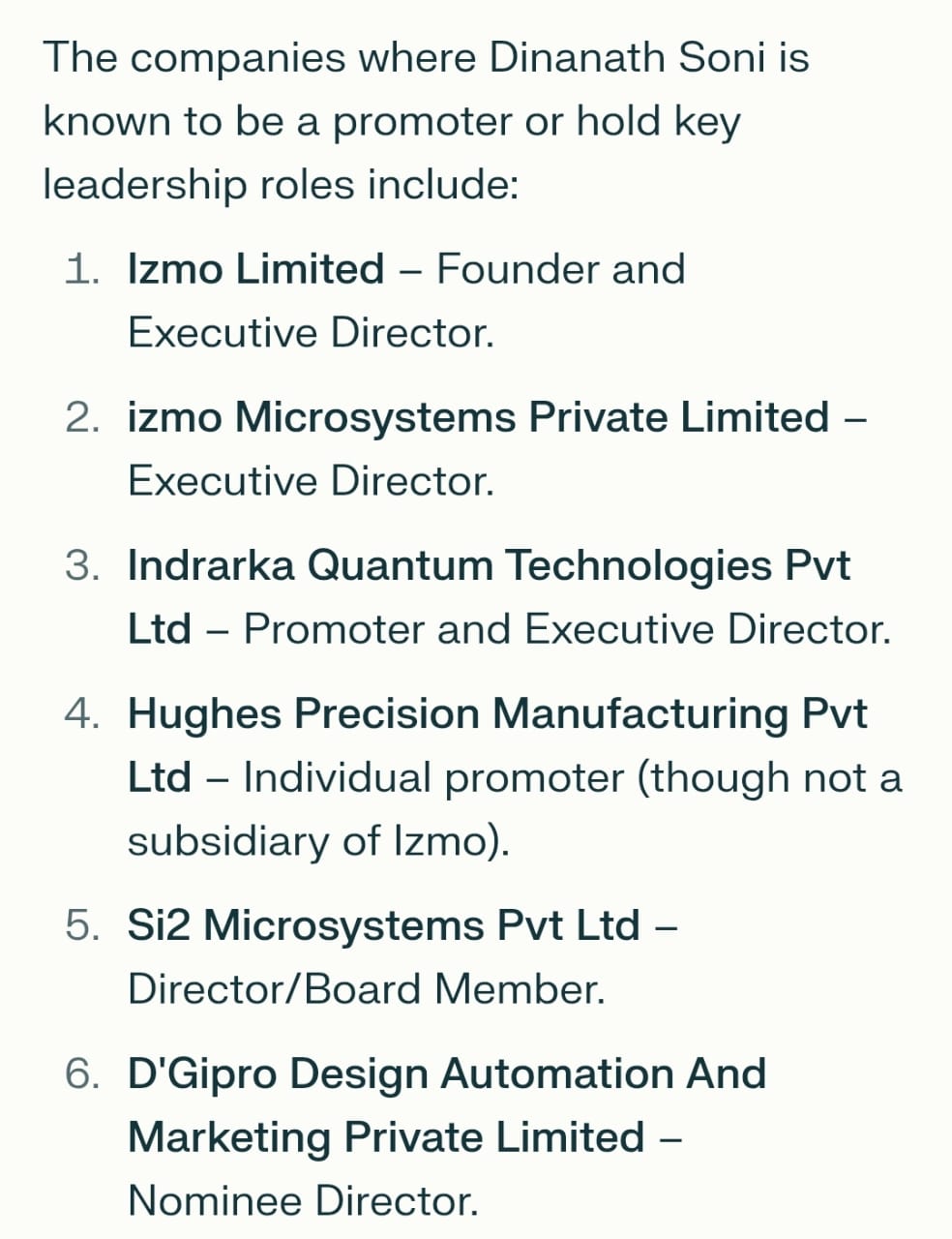
- Holds key position in multiple companies, Izmo microsystems is subdiary of izmo, others are not.
- IIT Madras signed ₹1 crore licensing agreement (18th Aug 2025) with Indrarka Quantum Technologies Pvt. Ltd. for the commercial deployment of the Silicon Photonic QRNG.
7 Likes
I’ve been digging into the buzz around IZMO on social media and forums. For three years, I’ve pondered one big concern: are their overseas revenues legit, or just a facade? I also tried looked into governance and growth prospects, cross-checking with multiple sources. again ran my thoughts on multiple BOTS (can be biased though, i am newbie at such analysis and learner), Here’s what i came across :
- Overseas Revenues (~78% of 225 Cr FY25): USA (~62%, 140 Cr via Izmo Inc., FrogData) and France/EU (~16%, 37 Cr via Izmo France, Groupe Izmo) drive most revenue. Real clients (e.g., Winner Ford’s $400K profit boost, MADA partnerships) and French filings confirm ops. USA scale might be hyped via marketing, but fraud risk is low. Sustainable, though churn-prone.
- Governance Concerns & Verification: SEBI fined IZMO 5 lakh in 2022 for misrepresenting Hughes Precision as a subsidiary—resolved, no ongoing penalties. CSE suspension (2014) was a legacy issue, fixed via compliance catch-up; no impact on BSE/NSE trading (e.g., 1,223 on Sep 24, 2025). ESM Stage 1 (Aug 2024) caps volatility at 10%, typical for microcaps. Soni family’s ~35% stake (Kiran Soni ~16.2%) shows skin in the game, but multi-roles (Dinanath in 6+ entities) raise conflict flags. FY25 audits clean, Q1 FY26 compliant.
- Subsidiary Claims & Growth Impact: Only IZMO Microsystems (100% owned) is a true subsidiary; Indrarka Quantum is “sub-like” via family control. Affiliates (e.g., Hughes, Si2) risk related-party scrutiny, potentially delaying semi/quantum capex. Yet, family ties fuel synergies (e.g., photonics breakthrough, IIT Madras deal), supporting 30% CAGR to 500 Cr by FY28.
- Growth Guidance & Achievability: Targeting 30% CAGR to 500 Cr by FY28. PLI 2.0, NQM, DRDO pilots, and Geronimo acquisition drive semis (40% CAGR), quantum (50% CAGR), and auto (20-25% CAGR). Good fundamentals (ROE 22%, debt-free, 40% FY25 profit growth) make it achievable, but transparency gaps could spark audits or shorts.
- IZMO: Facade or Plausible? No facade—has real ops (client case studies, French filings, audited ARs) rule out shell concerns. USA revenues may overstate scale, but they’re legit (e.g., FrogData site lists First Team Auto Group & its COO Ashton Lewis Jr. quote, Case studies republished by PRWeb, AutoSuccess, WardsAuto. Products like analytics dashboards, SaaS for dealersr active). Family opacity invites FUD, but India’s semi/quantum boom makes IZMO a solid bet if they tighten disclosures ?
I have attached details. Thoughts?
IZMO concerns.docx (22.8 KB)
D- Holding.
3 Likes
It’s great to be on VP, where we dig deep together!
Thanks to a fellow member’s nudge, I looked into IZMO’s past allegations to understand the promoters’ history—because history often repeats. IZMO showing resilience since 2009. what do we call such promoters Are they just survivors, smart, cunning or is there more we don’t see?
I am holding it, its risk free to me, so I might be a bit biased.
2009 Blog Allegations In 2009, some blogs claimed IZMO overcharged US auto dealers for unfinished software (like delayed portals and SEO tools), using endless R&D in Bangalore to boost Indian revenues on paper while delivering little. Promoters were called out for messy accounting and acquisitions (e.g., a 2007 portal) to hide failures. This hit during the 2008-09 financial crisis, when US auto sales dropped 21% (GM/Chrysler bankruptcies, 2,000+ dealers closed) and the Dow fell 54%, erasing $11T globally. IZMO’s early US push struggled in this chaos. The blogs stopped abruptly after May 2009, likely due to whistleblower caution. These issues echo today’s governance and revenue concerns, but IZMO’s audited growth (revenue up 4x since 2020 to 234 Cr in FY25) shows they’ve bounced back in the digital auto boom.
Concerns and Outlook Concerns: Governance has hiccups—a 2022 SEBI fine (5 lakh) for mislabeling a subsidiary (Hughes Precision) and a 2014 CSE suspension (resolved, no BSE/NSE issues). The Soni family’s roles in 10+ companies raise conflict risks. Overseas revenues (78% of 234 Cr FY25, USA 145 Cr) might be overstated with marketing hype but both USA/FRACE ops are legit(Third-party estimates from PitchBook, Tracxn, Growjo, etc. broadly align with IZMO’s audited ARs for US revenues. No major discrepancies—established…yet !!) . The 2009 claims fuel doubts, adding to microcap risks: low liquidity, volatility, low FII trust (4.18%), and potential audits slowing semi/quantum plans.
Growth: same as last post’s growth guidance.
What else might IZMO be hiding? Thoughts, VP folks?
3 Likes
Some more factors that one needs to ponder about:
Bulk of its revenues and profits come in from International Markets. But the US books of accounts are not audited.
Relative short span of time in which they have achieved technological breakthroughs in photonic chip packaging solutions. Too good if they have achieved such technological difficult achievements in just one year. But it makes you wonder.
Genuine potential of their Auto images business esp in the age of AI. The mgmt had put up a note regarding the same earlier. But proof of the pudding will be whether they are genuinely able to deliver topline growth. Especially adjusted for aquisitions.
1 year back the main story was stake sale in Frog Data. This keeps getting postponed for some reason or the other.
While the co may have made some genuine achievements the management will eventually have to demonstrate it in terms of financial performance.
Time will tell.
5 Likes
Company has both potential and issues. Management is not very concerned on corporate governance and loose in their talks and guidance. Frogdata stake sale and it’s potential growth trajectory is one such example. They keep shifting goalposts.
They have vision, but execution is somewhat lacking. Disclosure standards are poor. How can a company with such diverse portfolio claims to be operating in a single segment? Thier stock photo business is totally different from the software business for dealerships. And photonics business is also totally different. They simply need to do segment reporting of accounts as they segment in the investor presentation.
I hope they can raise their corporate governance and disclosure standards to create trust in investing community.
Investor relation and corporate governance is as much a part of business as is product development and sales for a listed company.
Press releases can create excitement, but it can only be sustained through performance and high standards of governance.
The sooner they realise and act on it, the better for both management and investors alike.
6 Likes
Good analysis of the provisional achievements made by the company, the same is evident in the price action too. Quality is lacking in terms of CG and confidence in disclosures.
1 Like
We have to understand that Izmo is a small-cap stock. When we look at the world of small-caps, there are bound to be concerns and imperfections. The same is with Izmo.
In a recent interview of Sanjay Soni, I noted two points.
First - He refrained from giving any guidance in terms of numbers for the silicon photonics business. While he sounded bullish, he was careful about setting expectations.
Second - He mentioned that the silicon photonics technology was under development at IIT Madras for 10 years. It’s certainly not something that has cropped overnight. Now they have the license to monetize the technology.
From various posts of IIT Madras, it also seems clear that they have a deep engagement with Izmo. That’s the source of all the R&D and innovation.
Having said that, my stance would be “Cautiously Optimistic.” Would look at averaging up once the idea/story translates into some initial numbers.
3 Likes
Thank you to everyone for their valuable inputs shared on IZMO Ltd. over the last few years on this thread!
Taking a step back and looking at the big picture for a moment:
(1) the company was not able to generate high earnings growth from its legacy business (which btw I also question in today’s day and age as OEMs and many other industries that IZMO is exposed to integrate AI in various forms)
(2) therefore, the returns have been quite disappointing (I mean returns on capital)
(3) sure, because of a higher multiple we have been able to see a meteoric rise in the stock price, but that too was less driven by quality of earnings and more by anticipation of monetisation of FrogData etc
(4) Quality of management: over-promise and under-deliver seems to be the theme here (plus the corporate governance and other issues highlighted by others in the thread)
(5) Balance sheet: rising intangibles definitely questionable (this does not appear a SaaS company to me at all)
Now, keeping these in mind, I am skeptical about their pivot into semis and their SiS packaging business because of no real past experience in this space (only tie up with IIT-M perhaps a green flag). I am no expert in the field, but what I could find is IZMO will stack up against US companies such as Lumentum, Juniper, Marvell that are spending huge sums on capex and have years of execution to back it up.
Disclaimer: All opinions are personal and meant for discussion purposes only. Not SEBI-registered or offering investment advice.
3 Likes
Be careful.
2 Likes
“izmo Microsystems Recognized as Key Packaging Partner in India’s National Silicon Photonics Mission”.
Official Government Link: https://www.pib.gov.in/PressReleasePage.aspx?PRID=2255322
Earlier announcements.
| Date | Announcement | Purpose |
|---|---|---|
| Feb 11 | Q3 Results | Prove operational excellence (70% EBITDA growth) |
| Feb 17 | Investor Presentation | Show segmental transparency, izmomicro scaling |
| Mar 9 | Defence “Entry” | Create market excitement about new vertical |
| Mar 16 | European Partnership | Validate technology globally, show partnerships |
| Apr 1 | Defence “Ongoing Supply” | Reveal actual execution — revenue already flowing |
Looks promising. Potential is visible but All depends on execution. Once the growth is reflected in Q3-Q4 results, this stock could see good rerating.
4 Likes
As of now, this company is more like a new startup trying to do multiple things and trying to solve hard problems. It will take significant amount of time for these recent development to impact the topline in a meaningful way. TAM is very good and growing and the demand is there. The only thing that matters now is how quickly they are able to execute things. They will required huge funding too for capex soon and after than at least 2 years for capex execution.
If everything goes well, this will be discussed everywhere in next 3-4 years.
6 Likes
My views on IZMO:
-
Dwarfed marketcap wrt TAM, so asymmetric payoff (this seems to be more of a VC-like investment opportunity)
-
Located at a chokepoint of its value chain; no domestic competitors + no commercial production capacity as of now
-
Low to no replaceability: import competitiveness less likely - semiconductor transport is very costly + silicon photonics packaging is used in defence so it may become ‘national infrastructure’, circumventing the tech is not possible - packaging is the necessary next step post-fabrication and silicon photonics is frontier packaging, and tech/regulation barriers to entry are very high (IZMO is sole player, has sole rights over IITM research, no other Indian institution is doing research on it + import of knowhow is very difficult)
-
Current valuations of 29 P/E at 0D/E are primarily because of execution questions - sample tests successful, factory yet to be made ++ intended equity dilution for capex for the project
-
Management has historically demonstrated the ability to circumvent stringent regulations and manufacture international grade tech at scale/commercialise a technology, for instance management’s other company ‘Hughes Precision’ is India’s only NATO-grade small ammunitions manufacturer. Indian Army has listed its factory as critical to national infrastructure. So, management has ties with defence already, and main usecase of silicon photonics is in defence/deeptech
-
IZMO also has other business verticals, FrogData itself had a (reported) ~$100m valuation a year or so ago (that valuation didn’t sustain, but either way IZMO’s current market cap is ~₹1400cr and it has other legacy businesses)
Main issues are:
- Corporate governance and protection of shareholder interest: company hasn’t declared a dividend for >15yr, public holds ~65% stake (but promoter has been buying recently), promoters have fallen into trouble in their other ventures and once, misrepresented Hughes Precision as being a subsidiary of IZMO which it was not
- Incoming equity dilution worth ~200cr
- Execution questions (main risk taken for asymmetric payoff)
But if execution pans out, then equity dilution, valuations etc. may not be much of a worry because stock will significantly rerate purely because of the sector it is in.. So, the stock can’t be reasonably priced by valuation metrics in my opinion, it is completely a VC-style investment
7 Likes