Thanks for the detailed perspective. I agree with an important part of your point, particularly around the difference between structural steel fabrication and full EPC/EPIC capability.
I am not an engineer, so I looked at this question more carefully after reading your comment. My understanding is that Interarch is not trying to become an L&T/Worley/Saipem-type EPC company.
The company’s stated objective appears to be narrower.
Interarch is trying to move from conventional PEBs into heavier and more complex structural steel packages, particularly for data centres, high-rise buildings, semiconductor/electronics facilities, renewable manufacturing and other large structures.
Management itself has described the new plant as a facility for heavy structures used in data centres, high-rise buildings and certain large structures.
So I think there are two separate questions here:
- Can Interarch execute the entire EPC project? . Probably not, and that isn’t what I understand the company to be claiming. For a large process plant, refinery, petrochemical facility, offshore project, nuclear project etc., there are multiple layers:
Pre-FEED → FEED → detailed engineering → procurement → fabrication → construction → installation → commissioning
Companies such as L&T and global EPC players can take responsibility for much larger portions of that chain.
Interarch’s current business model is different. Its strength is more around:
Structural design/engineering → fabrication → supply → erection/project execution
That distinction is important.
- Does that mean Interarch has no opportunity in these projects?
I don’t think so.
A large project does not necessarily have to be awarded to one company for the entire EPC scope.
A large data centre, semiconductor plant, airport or industrial building can have multiple packages and contractors.
Interarch can potentially participate in the structural steel package without being the EPC contractor for the entire project.
In fact, management has explicitly said that the company sees demand in data centres, high-rise commercial buildings and other non-industrial buildings, and that it had previously been cautious about taking such orders because it didn’t have the required heavy-structure plant.
Where I agree with your comment
Your point about engineering capability and skilled manpower is important.
Capacity alone doesn’t create a competitive advantage.
A new factory can be built relatively quickly. Building a team that can consistently design, fabricate and erect complex structures is a different matter.
Interestingly, Interarch’s management has repeatedly made this point itself.
In the May 2026 concall, management said that before bidding for high-rise buildings, data centres and lithium battery plants, the company needs to have the required design engineering, manufacturing and erection capabilities in place. It also talked about investing in better software, hardware, skills, manufacturing capability and erection capability.
The company has also been adding engineering capability, including plans for engineering offices in Bangalore and Kochi.
So I agree with you that:
“Capacity alone is not the moat.”
But I would challenge one point
I would be careful with the statement that “it is a commodity business” without defining exactly which part of the business we are talking about.
If Interarch were simply buying steel, cutting it, welding it and selling fabricated steel by weight, I would agree that the business would be much closer to a commodity fabrication model.
But that isn’t quite how Interarch describes its offering.
The company says its model combines design and engineering, manufacturing, supply, erection and project management. Its technical manual also describes the structures as being designed, engineered and fabricated in-house.
There is also an interesting example in the company’s older project portfolio. Interarch has executed complex structures involving multi-level warehouses, large-span structures, industrial buildings and projects requiring heavy cranes and specialised structural designs.
So I wouldn’t automatically classify the entire business as commodity fabrication.
However, whether the new heavy-steel business deserves a higher-quality multiple than conventional fabrication is a question that still needs to be proven by actual economics.
That is where I think your comment is particularly useful.
So I would change my original thesis slightly
After your comment and after checking the management commentary, I would frame the opportunity more cautiously.
Instead of saying “Interarch is entering a huge new heavy structural steel market and can capture the entire opportunity.”
I would say “Interarch is expanding from conventional PEB into heavier structural steel packages, where it hopes to participate in the growing demand from data centres, high-rise buildings, semiconductor/electronics facilities and other large structures. The opportunity is real, but the extent of the competitive advantage is still unproven.”
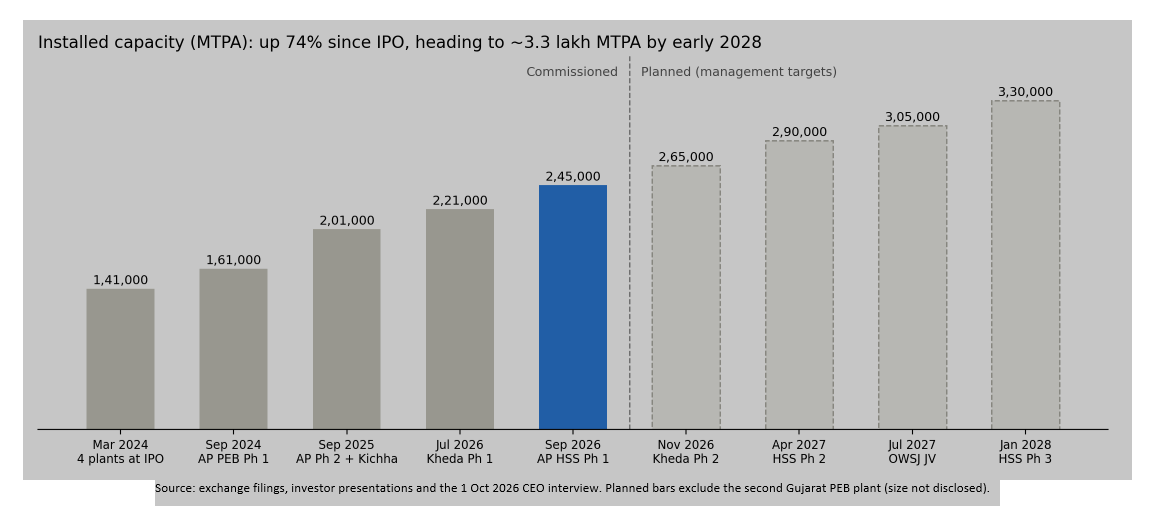
The important question is therefore not whether Interarch can add 80,000 tonnes of heavy-steel capacity. It can. The question is whether it can build enough engineering capability, skilled manpower, customer relationships and execution track record to keep those tonnes occupied at attractive margins. The next few years of order wins, utilisation and margins should provide the answer.
Thanks for your valuable input. Your perspective is very helpful. I’m still learning about the technical side of this industry, so any further views, corrections or different opinions are most welcome.