@Dhruv_Galada
I agree that if they increase prices from current levels, it still would be relatively cheaper compared to alternate fuels. The only question to consider is - What if competition offers gas at lower prices than IGL? If people are getting something cheaper than 2.40 per kg then why would they opt for 2.40 per kg gas from IGL considering that its cheaper than petrol? Comparison with other fuels becomes an irrelevant point. Also government’s stance is not in favour of price increase. They are more interested in reducing prices for consumers. So there are high chances that prices won’t improve. It would be interesting to see how this actually plays out. I am not overruling being wrong here because this field is such that things are hard to predict.
Now I am not sure how much competition IGL actually has. The competition has to scale up to the level of IGL (pipeline/volume wise) which may take some time and IGL may get some rope. Does anybody have an idea on competitors? The data on competitors distribution network (pipeline in kms ) or their volumes or their sourcing arrangements would give us a good idea where IGL stands.
On point 2, there will be benefits with natural gas coming under GST but this benefit applies to all competitors out there. If prices reduce then this benefit will be more than offset.
A thought to ponder?
The higher multiples ( PE) over the last decade was due to the constant Free Cash Flows and Geographical area expansion due to low cost Gas. In other words the input costs are more are less constant due to domestic Gas availability. The recent developments suggest the change of input costs towards International Gas spot Prices. So the main concern will be unpredictability in future cash flows due to the linking of Spot Prices. I believe the the structure moving towards the commodity nature, similar to OMCs.
As of Now, the APM ( domestic ) share is about 62% as per the reading on Business line article last week.
My doubt is will the Monopoly status in Geography areas will compensate the uncertainty in Gas prices?
I believe the valuation is attractive, but it will not reach the previous higher multiples. As the market likes the constant Free Cash Flows over uncertain higher and lower cycles, this is an interesting Case Study, worth tracking.
IGL has done very well over the years in not only scaling up its operations but also managing its finances well. However as of today we are on tricky juncture as the government wants a level playing field with Pvt CGD players as well as cheaper Gas for the consumer. Political considerations will play an important part here. Whether or not people will shift to any other fuel is out of question all together because somebody who has bought a CNG car to be used at taxi will drive it for full 15 years as the cost of PSV license is also very high and he would need to recover that. As far as price increase is concerned, I think they will have been told by the political bosses to go slow on the increase and wait for Delhi election outcome before raising prices in Delhi. That means the stock could trend lower or underperform the market till february 2025. Disc- Invested 3% of PF in the fall,raising funds to increase to 10% of PF over next 3 months. OK with no or negative return for next 6 months.
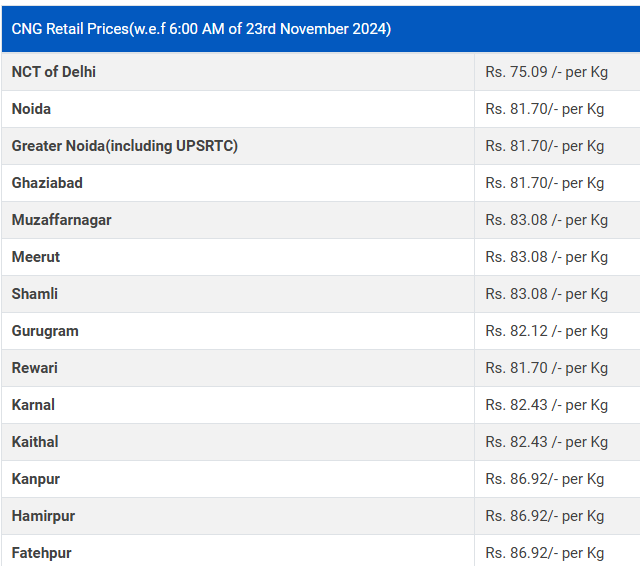
See below the price differential in CNG over the cities served by IGL.
The price difference between diesel and CNG is relatively small, typically around ₹3-5. If there is any further reduction in APM gas prices, igl may face challenges in maintaining pricing power to implement further price increases.
Look at the difference in this way… Who are the main consumers of automotive CNG gas—Cab operators—Diesel Cab services are not allowed in Delhi and with 10 year ceiling for Diesel vehicles in NCR,no Cab operator is going for diesel vehicles soon. Maruti/Honda are not offering any diesel vehicles in their portfolio. The stock has moved up very smarty in last 30 days and has recovered all the price lost due to the knee jerk reaction. My view is that it will now be a consistent compouner of 10-12%, factoring in complete abolition of sunsidised gas by the government. The 20-25 PE which it used to command earlier will may never come. REC/PFC/COAL india type of stock. The question of level playing field with other pvt. CGD players is not there beacuse land has become exponentially expensive in and around Delhi. Anyone deciding to set up shop will be atleast 20 years behind. On any Sunday check out the queue at IGL gas station in Delhi,it takes atleast 30 minutes to get the tank filled. Disc- Invested during the fall,-3% of pf,could not scale up because the stock moved up too fast too soon. Contrarian views are welcome.
As expected, profits are down. QoQ PBT down by about 200 crores and PAT down around 150 crores. Given Q3 probably didn’t see full impact of the APM allocation changes, this may get worse in Q4, albeit slightly. Also, natural gas prices have firmed up in Dec/Jan and I am not sure to what extent IGL is passing on the price hikes. At current price, valuations are not stretched, but no great value either. My view is that it’s still at a 1-year forward PE of around 23-24X, a bit more if we consider Q4 PAT as the go-forward normal. Price hikes are probably key to rerating, which in the current macro scenario seems quite unlikely.
Another lesson learnt here - should book out profits completely when regulatory changes are anticipated and can hit hard. It’s not been a bad investment, but could have done much better if I had pressed the trigger earlier.
Surprisingly strong results - not sure how they managed that. Volume increase has helped, but given the APM allocation cuts, I wasn’t expecting this. Wonder how they pulled it off!
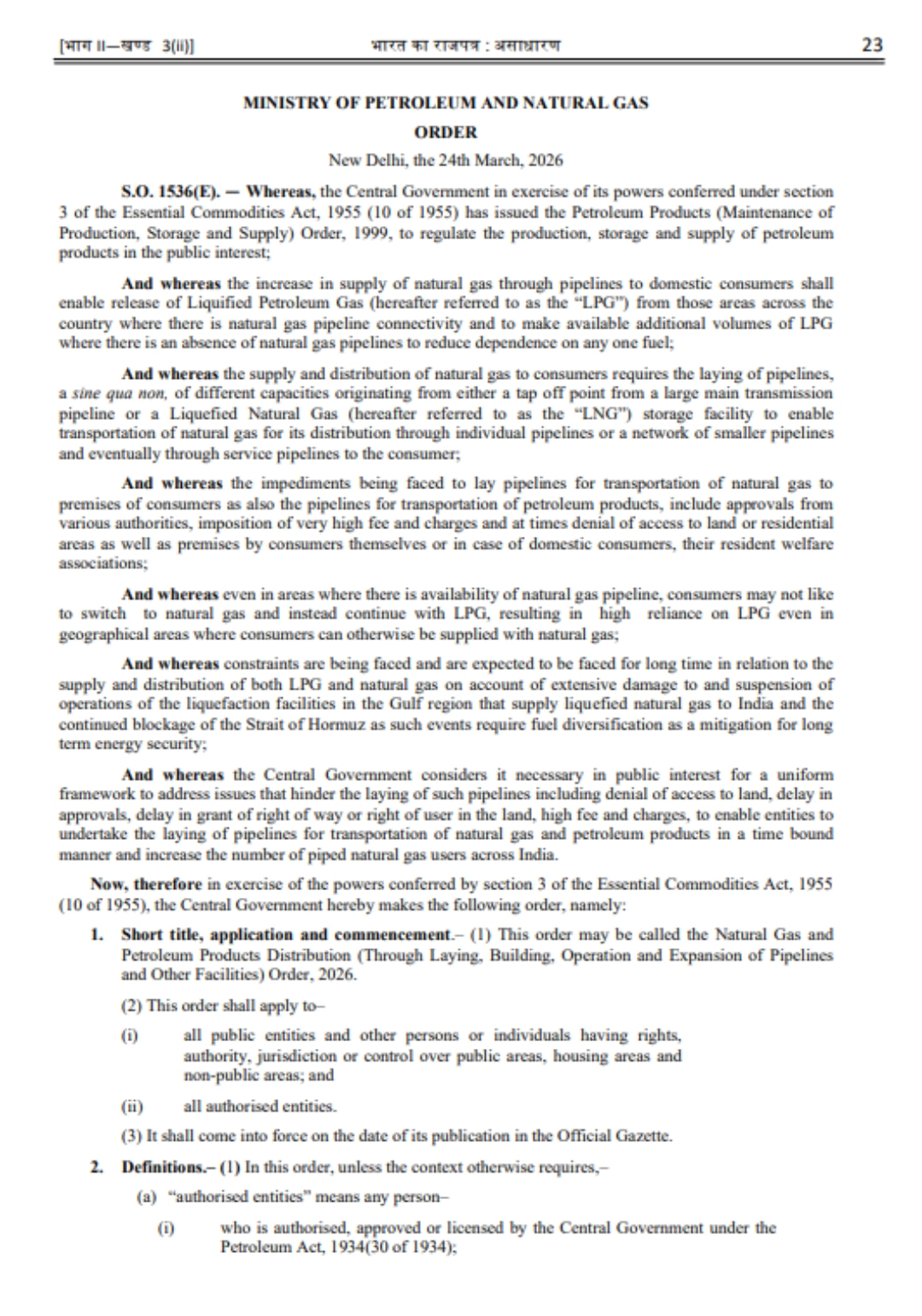
Biggest issue is cost of LNG. LNG is going to increase as % of total gas which is being purchased at high prices (USD 20/ mmbtu) which is higher than the price of PNG being sold. So even CGD companies will have under recovery similar to OMCs.
Profits of CGD companies will decline in Q4.. wont be surprised if they go into losses
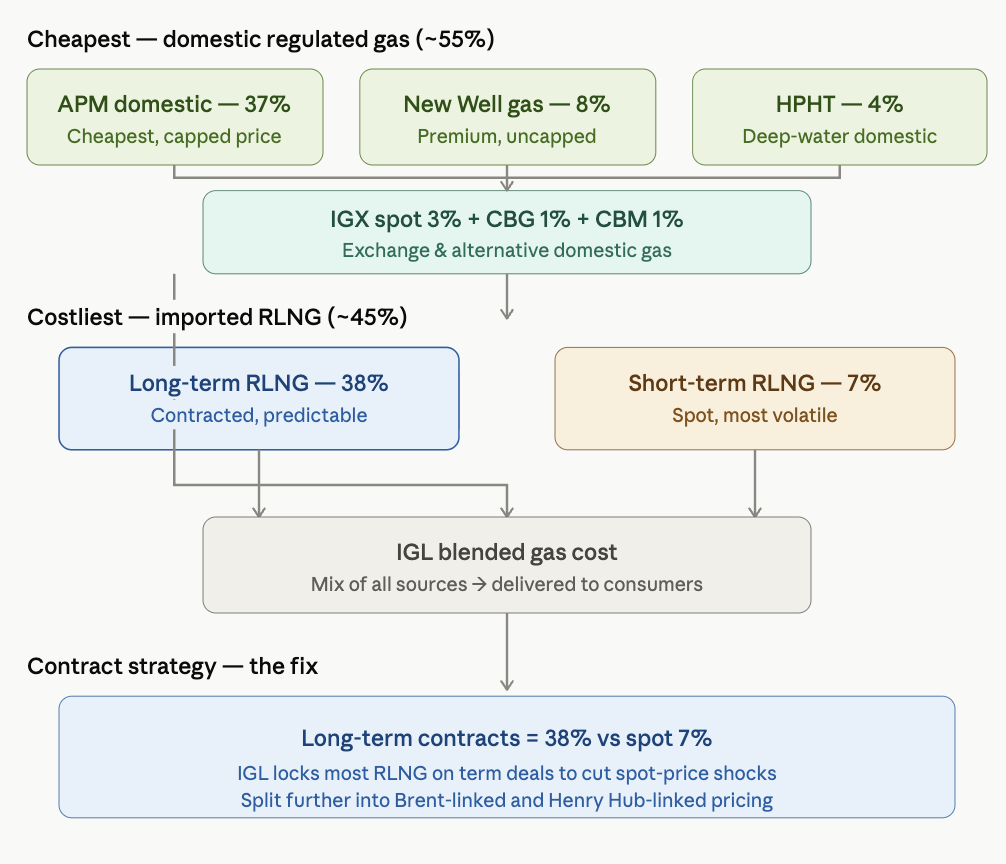
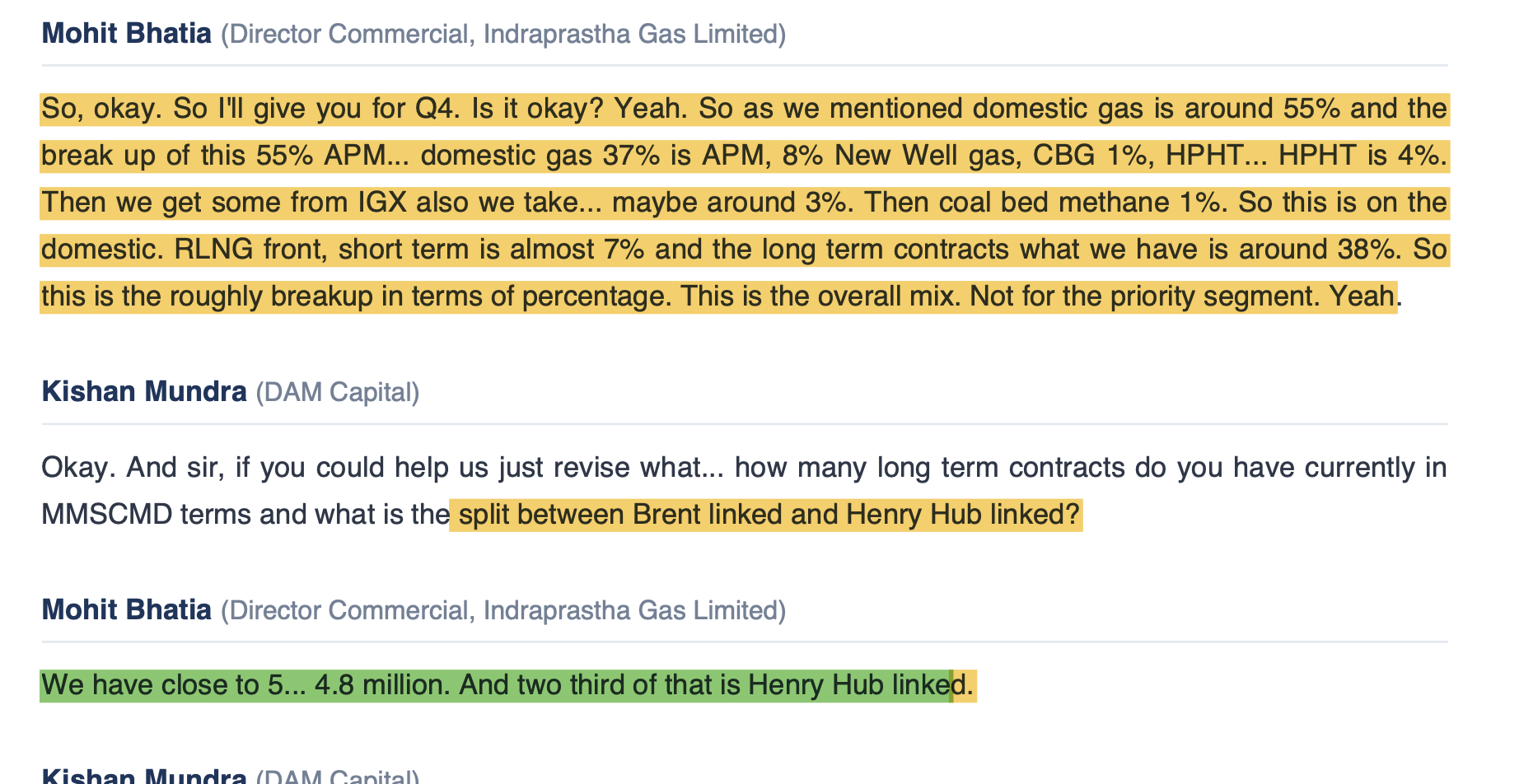
Here’s the nuance that matters for the investment view. Long-term contracts solve the volatility and availability problem, but not necessarily the level problem. It depends on the pricing formula — which is exactly what the analyst in your transcript was digging into with the Brent-linked vs Henry Hub-linked question:
If the contract is Brent-linked, IGL’s cost still floats with crude oil. So when crude rises steadily, a long-term Brent-linked contract gives smoother, more predictable pricing — but it’s still expensive. It removes the spikes, not the underlying crude sensitivity.
If the contract is Henry Hub-linked, the cost tracks US natural gas prices, which often move independently of crude — a genuine diversifier that can be cheaper when oil is high. CONCALL TRANSCRIPTS- 2/3 rd is Henry-Hub Linked