I wrote down my thoughts on how competition could evolve in a post-coupling world. it may be a bit verbose. Apologies for that.
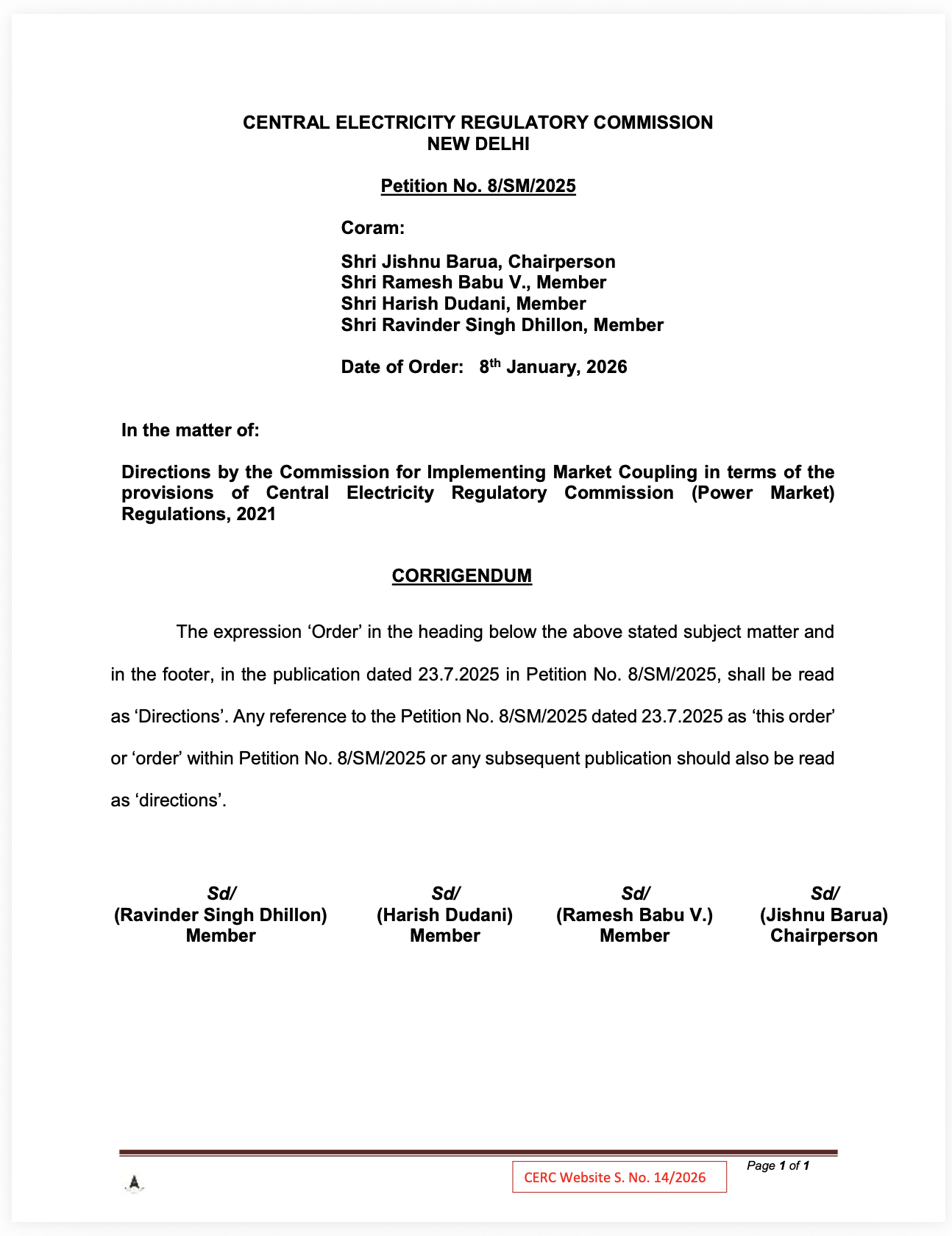
Let us assume that market coupling is implemented across segments such as DAM and RTM. In such a scenario, the liquidity and network-effect moat of IEX largely disappears. The central question then becomes how competition reacts once this structural advantage is neutralized.
I have attempted to think through this using basic game-theoretic reasoning, though my understanding may be imperfect.
Industry Structure and Economics
The power exchange industry has a few defining characteristics:
At the industry level
- High entry barriers, since becoming an exchange requires CERC approval
- High exit barriers, since exiting also requires regulatory approval
At the customer level
- Low switching costs for buyers and sellers of power
- Negligible marginal cost for exchanges to serve incremental customers
Once market coupling is in place, exchanges lose the advantage of liquidity concentration. The remaining competitive levers are therefore limited to:
- Pricing
- Product and technology
- Service quality
- Balance sheet strength and cash reserves
Which Levers Are Likely to Be Used?
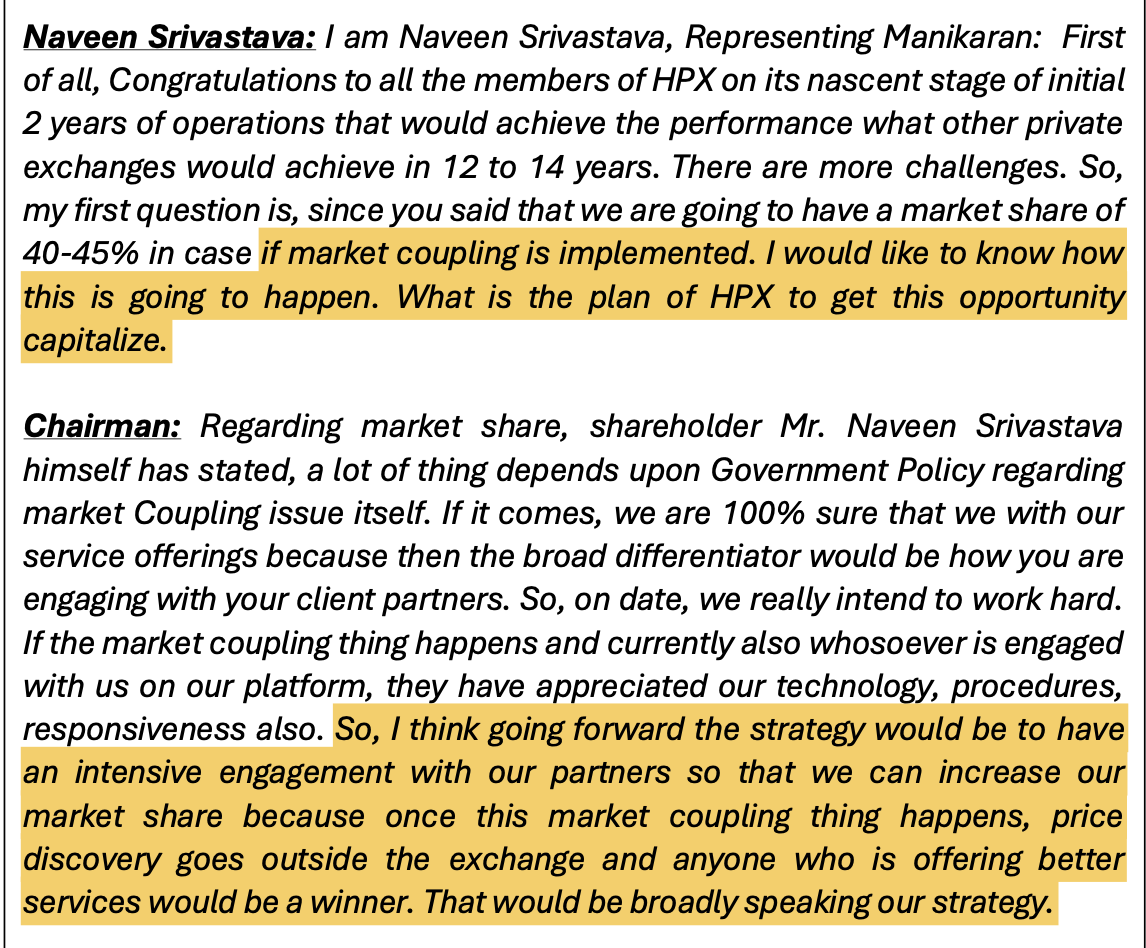
Rather than speculating in the abstract, it is useful to look at stated strategies. The chairman of HPXIL, in the AGM transcript, explicitly mentioned that their post-coupling strategy will focus on product, technology, and service quality.
Source: https://www.hpxindia.com/downloads/Sixth_AGM_Tanscript_23_24.pdf
This naturally raises two questions:
- Is the product or service quality of competitors already superior to that of IEX?
- If we conservatively assume the answer is yes, can IEX realistically bridge that gap?
Role of Balance Sheet Strength
This is where balance sheet strength becomes relevant.
| Company |
Cash Balance / Investments |
Comments |
| IEX |
~₹1,700 Cr |
As of Sept 2025 |
| PXIL |
~₹200 Cr |
FY24 revenue ₹63 Cr, PAT ₹22 Cr |
| HPXIL |
~₹215 Cr |
FY25 revenue ₹40 Cr, PAT ₹10 Cr |
If competition is centered on technology and service quality, IEX clearly has the financial capacity to close any reasonable gap. A strong balance sheet also serves as a deterrent against aggressive pricing wars.
Based on this, one could reasonably conclude that customer churn driven purely by product, technology, or service quality differences is likely to be limited.
Given that the industry has only three players, with one being clearly dominant, the market could evolve into a form of cooperative competition. A useful analogy is telecom, where consolidation eventually led to a small number of stable players (after the brutal pricing war). Another is cement companies in certain micro-markets.
A Potential Fifth Competitive Lever
However, there may be a fifth lever available to competitors that is not available to IEX: shareholding structure.
HPXIL Shareholding Dynamics
HPXIL is promoted by entities such as PTC, BSE, ICICI, and several power producers and buyers including Greenko Energies, Jindal Power, Manikaran Power, SJVN, REC Limited, and certain state DISCOMs.
Source: https://www.hpxindia.com/downloads/Sixth_AGM_Tanscript_23_24.pdf
Notably:
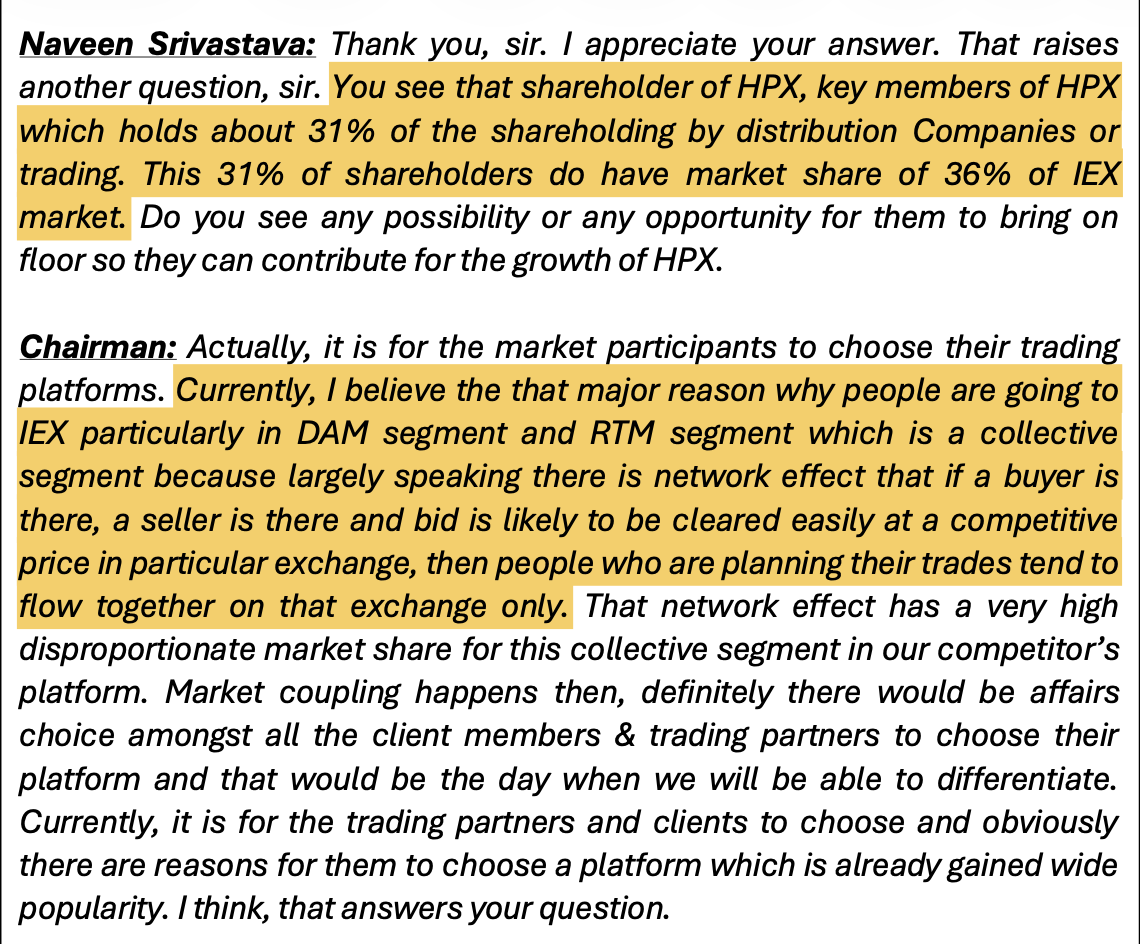
- Shareholders representing 31 percent ownership of HPXIL account for roughly 36 percent of IEX trading volumes
- PTC alone contributes about 10 to 12 percent of IEX volumes
- Due to regulatory limits, shareholders with stakes above 5 percent cannot trade on their own exchange
At present, the primary reason these participants do not migrate volumes is inferior price discovery on non-IEX exchanges. This is especially visible in DAM and RTM, where price discovery is concentrated on IEX.
PXIL Shareholding Dynamics
PXIL’s shareholders include entities such as Power Finance Corporation, NTPC Vidyut Vyapar Nigam, Gujarat Urja Vikas Nigam, MP Power Management Company, West Bengal DISCOM, Tata Power Trading, GMR Energy, and JSW Energy.
While public data on the share of IEX volumes attributable to PXIL shareholders is unavailable, it is unlikely to be insignificant.
Both HPXIL and PXIL also have plans for future IPOs. This creates an incentive for their shareholders to strengthen the exchanges’ trading volumes ahead of listing.
Why Market Coupling Changes the Equation
Today, volume migration is constrained because price discovery is weak outside IEX. Market coupling directly addresses this constraint.
Once price discovery becomes exchange-agnostic, the easiest and fastest way for competing exchanges to gain volume may be to encourage their shareholders, particularly those below the 5 percent regulatory threshold, to route trades through their own platforms.
This dynamic is largely independent of pricing, product quality, service levels, or balance sheet strength.
Potential Volume Migration Scenarios
Assuming DAM and RTM contribute roughly equally to total volumes, the following scenarios appear plausible:
| Scenario |
Expected Volume Migration |
| S1: No coupling |
Nil |
| S2: Coupling in DAM only |
15 to 25 percent |
| S3: Coupling in DAM and RTM |
30 to 50 percent |
The critical question is which of these scenarios the market is currently pricing in. Unfortunately, there is no clear way to know with confidence.
Closing Thought
All of the above reasoning could be flawed. The future is inherently difficult to predict, especially in a regulated market undergoing structural change. However, the shareholding-driven volume migration channel appears to be a material risk that is not fully captured when analysis focuses only on pricing, technology, service quality, or financial strength.
I am not able to figure out how IEX management will be able to mitigate this. Open to hear the views of fellow members.
Disclosure: Invested. Although my brain is telling me the negatives, my gut is telling me to go ahead. This is going to be a good learning experience for me. Hopefully not a costly one.
Disclaimer: Not a SEBI advisor.