Below is a clean, investment-oriented interpretation of the uploaded newspaper article and its direct relevance to IEX’s business model and long-term moat.
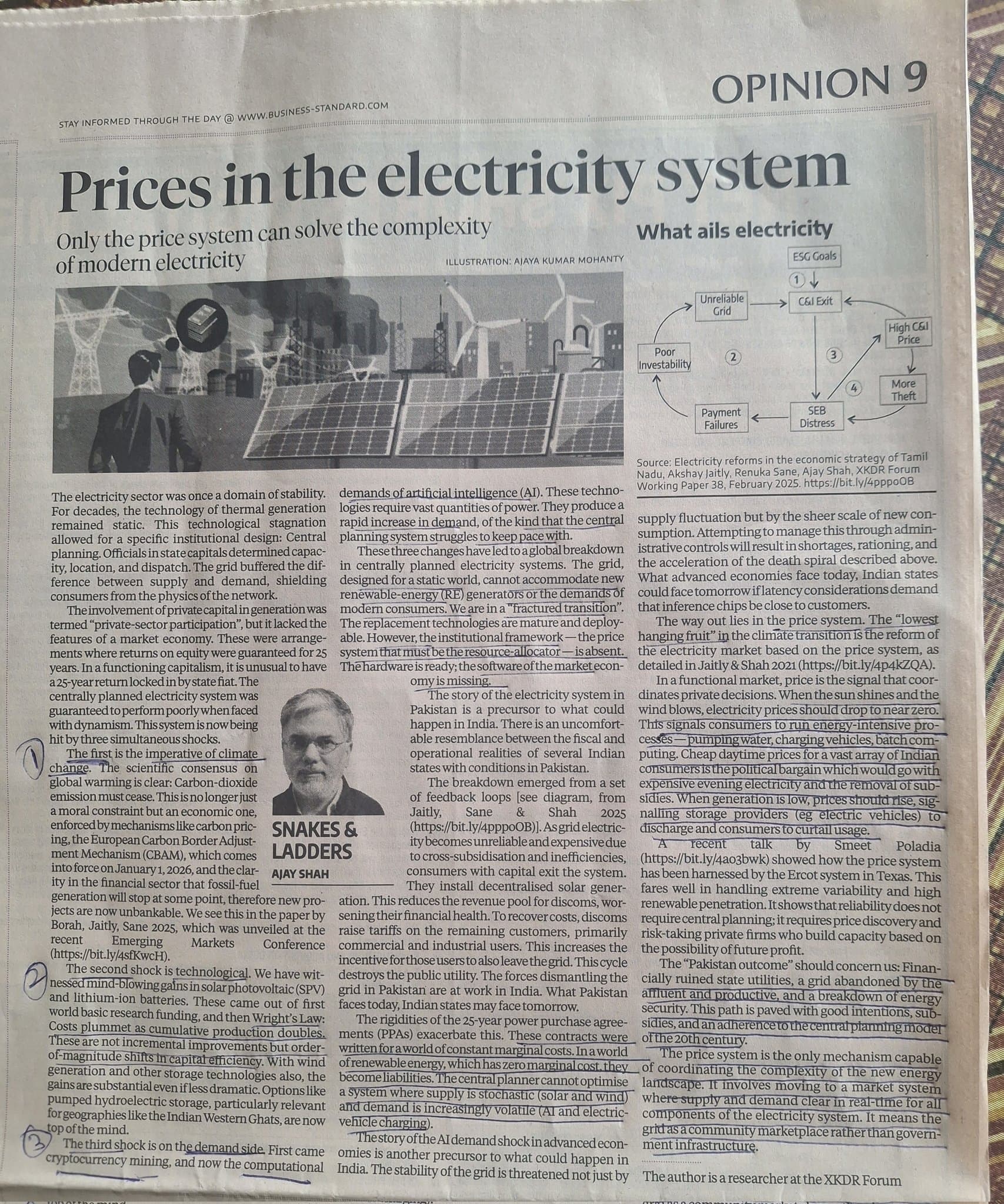
1. What the article is fundamentally saying (in simple terms)
The article’s core argument is:
In a modern electricity system dominated by renewables, only transparent market-based price signals can manage complexity.
Key points made in the article:
-
Earlier electricity systems were stable because coal + long-term planning + fixed tariffs dominated.
-
The transition to renewables (solar, wind) has made electricity:
- Variable (supply fluctuates hourly)
- Decentralised
- Harder to manage through central planning alone
-
When prices are distorted or suppressed, systems break:
- Payment failures
- Utility losses
- Theft
- Underinvestment
- Grid stress
-
Examples cited (implicitly/explicitly):
Pakistan, Texas power crisis, Indian DISCOM stress.
-
The conclusion:
Price discovery through markets, not administrative control, is the only sustainable solution.
2. Why this article is highly relevant for IEX (big picture)
This article is not about IEX directly, but it strongly validates IEX’s core thesis.
IEX exists precisely to solve the problem described:
| Problem described in article |
What IEX does |
| Renewable supply is variable |
Real-time & day-ahead markets |
| Central planning fails |
Market-based price discovery |
| Subsidised tariffs distort signals |
Competitive bidding |
| Demand-supply mismatch |
DAM, RTM, TAM, DAC |
| Grid instability |
Short-term balancing via exchanges |
The article is essentially an academic / policy endorsement of power exchanges.
3. Key themes from the article → Direct IEX linkage
A. “Only prices can solve complexity”
- Renewables make supply unpredictable.
- You cannot centrally plan every fluctuation.
IEX relevance:
- DAM & RTM allow hourly and sub-hourly price discovery.
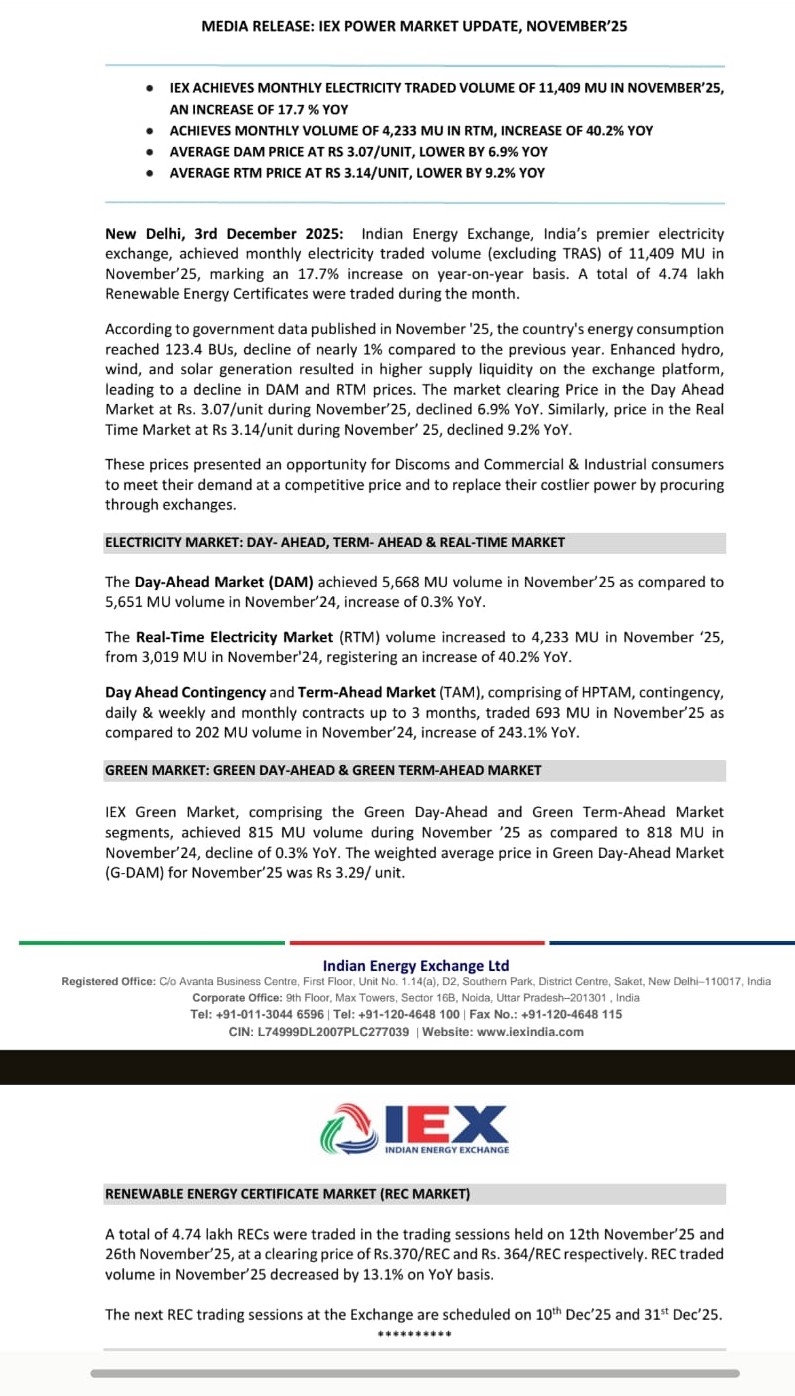
- RTM becoming larger than DAM (as you’ve observed) is exactly this transition in action.
Investment implication:
Structural tailwind for RTM volumes → monopoly product for IEX.
B. “Suppressing prices creates hidden damage”
The article explains that keeping tariffs artificially low leads to:
- DISCOM losses
- Deferred payments
- Theft
- Underinvestment
IEX relevance:
- Exchange prices reveal the true marginal cost of power.
- LPSC rules + URS mandates push surplus power onto exchanges.
- DISCOMs increasingly rely on exchanges instead of opaque bilateral deals.
Investment implication:
As regulators accept market prices, exchange liquidity must rise, not fall.
C. “Central planning breaks down with renewable penetration”
The article highlights:
- Solar midday oversupply
- Evening shortages
- Curtailment risk
IEX relevance:
-
Explains why:
- Daytime prices collapse
- RTM volumes surge
- Need for Peak DAM / Peak RTM (which IEX has already petitioned for)
- BESS arbitrage markets become essential
Investment implication:
IEX is positioning ahead of the curve (Peak markets + BESS integration).
D. “Markets are needed, but must be well-designed”
The article doesn’t say markets alone are enough.
It says:
- Design matters
- Price signals must be trusted
- Governance must be strong
IEX relevance:
Investment implication:
Market coupling risk is long-dated and execution-heavy, not an overnight disruption.
4. How this strengthens the IEX investment thesis
Structural, not cyclical, relevance
The article makes it clear:
- This is not a temporary phase
- It is a permanent shift in how electricity systems work
That directly benefits:
- Exchanges
- Price discovery platforms
- Short-term balancing mechanisms
IEX sits at the center of this architecture.
5. What this means for key IEX debates you are tracking
| Debate |
Article’s implicit stance |
| Market coupling |
Risk of over-centralisation; caution needed |
| RTM vs DAM |
RTM must grow as variability rises |
| Long-term PPAs |
Insufficient alone in renewable era |
| Power derivatives |
Needed to manage volatility |
| BESS + peak markets |
Inevitable evolution |
The article supports IEX management’s narrative, not contradicts it.