Indian Energy Exchange (IEX)

Thanks Keshav.
I’m still learning some aspects of this vast subject, so please consider this analysis with a grain of salt.

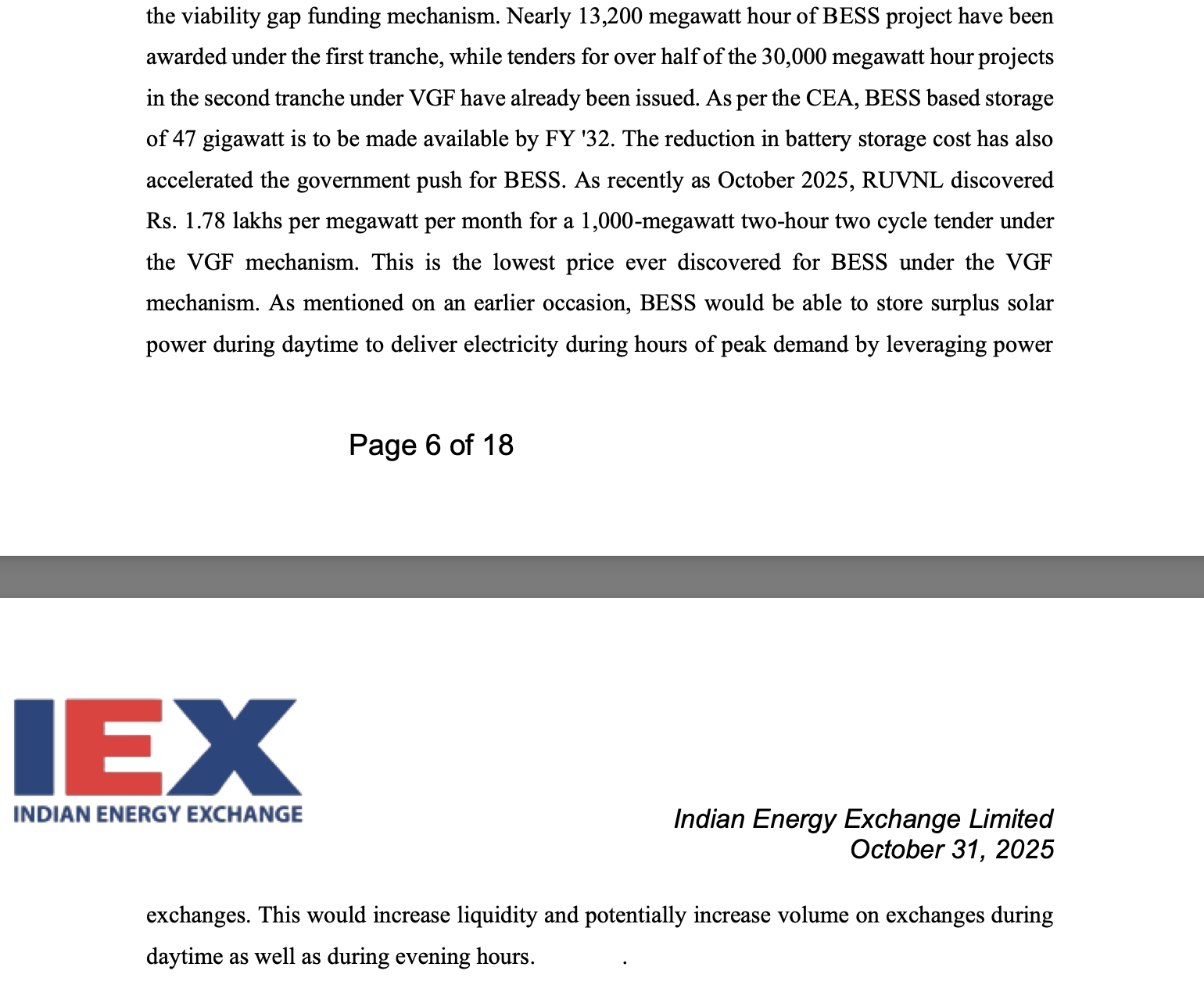
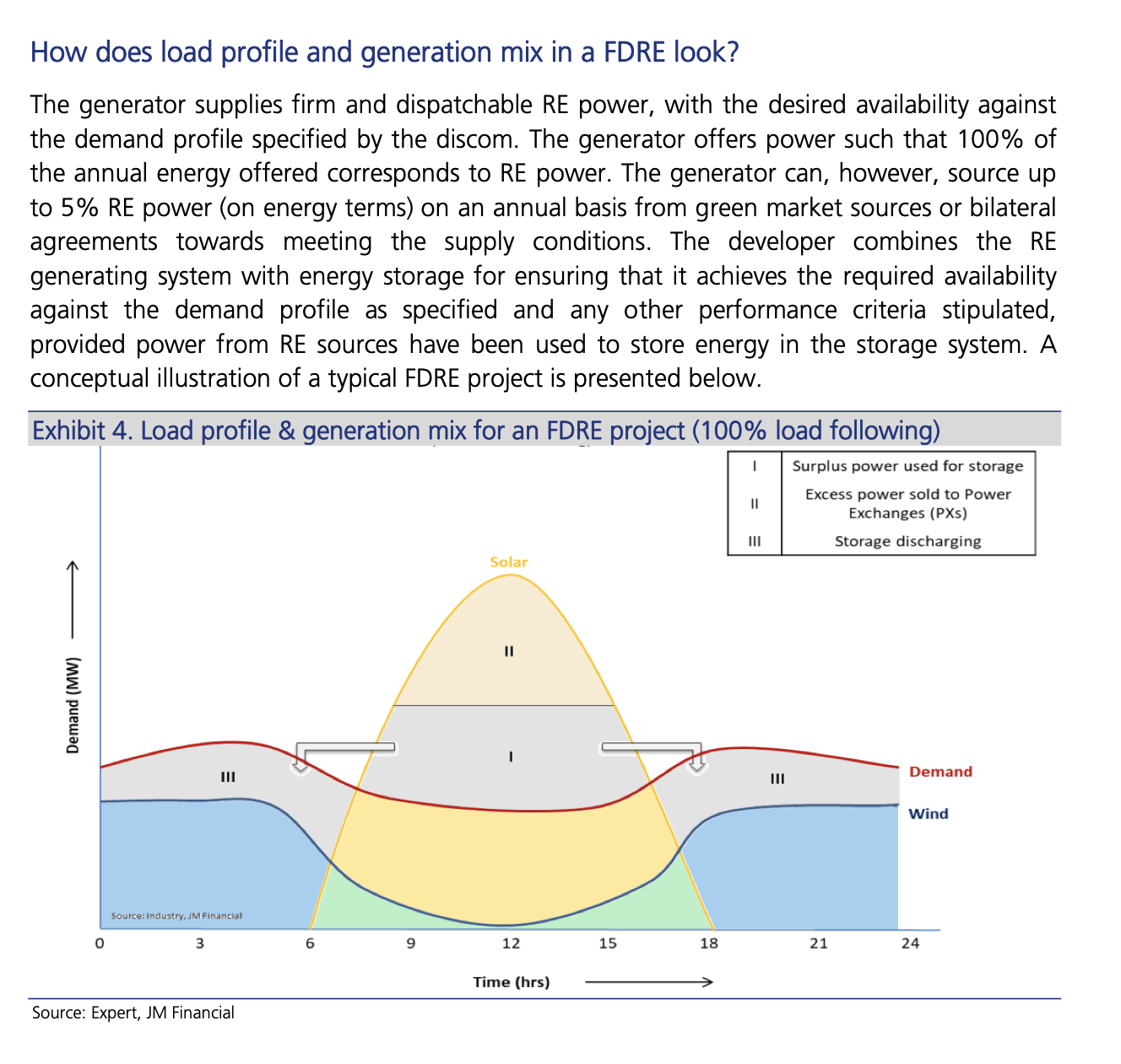
From what I have studied so far, BESS would increase trading volumes on exchanges as BESS operators look for arbitrage opportunities. They can buy surplus power at cheaper rates and sell at higher rates during demand peaks (toward evening - this too however is not a given). Another positive for RTM is that it’s difficult to forecast weather with zero error, thereby resulting in more last minute balancing trades. My guess is that trading velocity in RTM would increase substantially once more FDRE/BESS/Hybrid plants comes online.

IEX management has spoken about this in the recent concalls (no quantification provided though)

Re valuation - I’m not concluding that valuation is in a “screaming buy” zone. My assessment is purely based on the 10 year, 5 year median EV multiple. I have not done any detailed calculation or modeling on the business valuation. Hope this helps.

2 Likes

I’m an MBB consulting working heavily on RE projects.. all sorts of BESS deployment (FDRE, RTC, bla bla) will only increase volumes on exchanges. If you look at mature markets of EU, a large chunk of procurement of electricity happens via exchange. We are far away from that.

This will only amplify as transmission network strengthens (lower losses → lower landed cost).

8 Likes

Just a hypothesis : What if Adani buys IEX ? They are already into Power and Renewable energy. Is there any motivation / benefit for them to own a power exchange or does any law prevent them from owning it as it allows them to influence the pricing.
It would be definitely worth watching the policies of CERC post such event :smirking_face:

1 Like

Yes there is a regulatory cap on % of share a participant can hold in energy exchange.

3 Likes

Our client actually wanted to set-up their own exchange because a large chunk of their small supply chain partners were finding it hard to decarb.. we cited the 25% / 49% shareholding restriction post which the enthu of the client died.

I don’t think it’s easy to shake IEX’s dominance. It’s not just market coupling. There are intermediaries in the market (Manikaran, etc.) who have built their excels and softwares on top of IEX’s interface.. clients are used to IEX’s workings.

As consultants, we also just say that yeah - IEX has the most volumes.. hard to see why all of the above will change post market coupling.

5 Likes

Rajiv Thakar’s view on IEX elobrated in the unit holder meet on 22 Nov -
The discussion regarding investment in IEX (Indian Energy Exchange) focused on the underlying business, regulatory challenges, and the fund’s investment actions.

Rationale and Business Outlook (The Bull Case)

The speakers highlighted that IEX has been the dominant player in the electricity trading space. The need for electricity trading exists because the predictability of power generation has reduced due to intermittent sourcing from solar and wind energy.

  • Long Runway: The underlying business of the exchange seems to have a long runway.
  • Shifting Landscape: The traditional long-term Power Purchase Agreements (PPAs) are gradually losing dominance to traded power.
  • Operational Challenges: Trading is necessary because generation occurs across long distances (east to west) and timing matters (e.g., a big spike in demand late evenings when residences light up, versus excess solar supply in the afternoon).

Regulatory Impact and Fund Action (Market Coupling)

A significant factor discussed was the prospect of market coupling, which the regulator had been considering. Market coupling aims to force the same price to be available on multiple exchanges, or ensure the end clearing price is the same regardless of which exchange handles the transaction.

  • Notification and Sell-off: A notification was released stating that market coupling is supposed to begin on 1st January 2026. This announcement caused a big sell-off in the price of the stock.
  • Investment Opportunity: The fund managers used this sell-off as an opportunity to buy some more stock.
  • Skepticism on Implementation: The speaker expressed strong doubt that coupling will be implemented by the proposed date (1st January 2026), noting that developing the necessary software is complex. They mentioned uncertainty regarding who the software vendor would be, and the specifications, process flows, user access, and testing required.
  • Uncertainty Remains: It was noted that uncertainties will remain concerning whether market coupling will ultimately happen, when it will happen, and how it will affect market shares.

Additionally, there was mention of a SEBI order alleging insider trading against some individuals who traded futures contracts after attending the meeting where the coupling decision occurred, but this factor was noted as being “outside the company itself”.

9 Likes

They recently bought 5% in IGX through Adani Total

1 Like

Next hearing on Jan 6, 2026.

Market Coupling Now Looks Tainted: SEBI Order Names Author of the Market Coupling Decision in Insider-Trading Case

The developments around IEX, CERC, and SEBI have taken a dramatic turn.

During the latest hearing at the Appellate Tribunal for Electricity (APTEL), IEX argued that the Market Coupling order itself is compromised because SEBI has named the very author of that order in its insider-trading investigation. If true, this undermines the merits, motives, and credibility of the entire policy exercise.

IEX highlighted that SEBI’s interim findings link certain CERC officials to an insider-trading scheme that generated ₹173 crore in illegal gains, timed around the 29% single-day crash in IEX shares following the coupling order.

APTEL, for its part, has noted that it is fully empowered to examine issues of corruption and emphasised that regulators must avoid even the appearance of wrongdoing. With the author of the coupling order now under a cloud, the entire process risks being viewed as tainted.

At this point, the issue goes beyond a policy debate. It strikes at the heart of regulatory integrity.

Should the allegations be proven, APTEL has strong grounds to pause, revise, or even overturn the coupling decision.

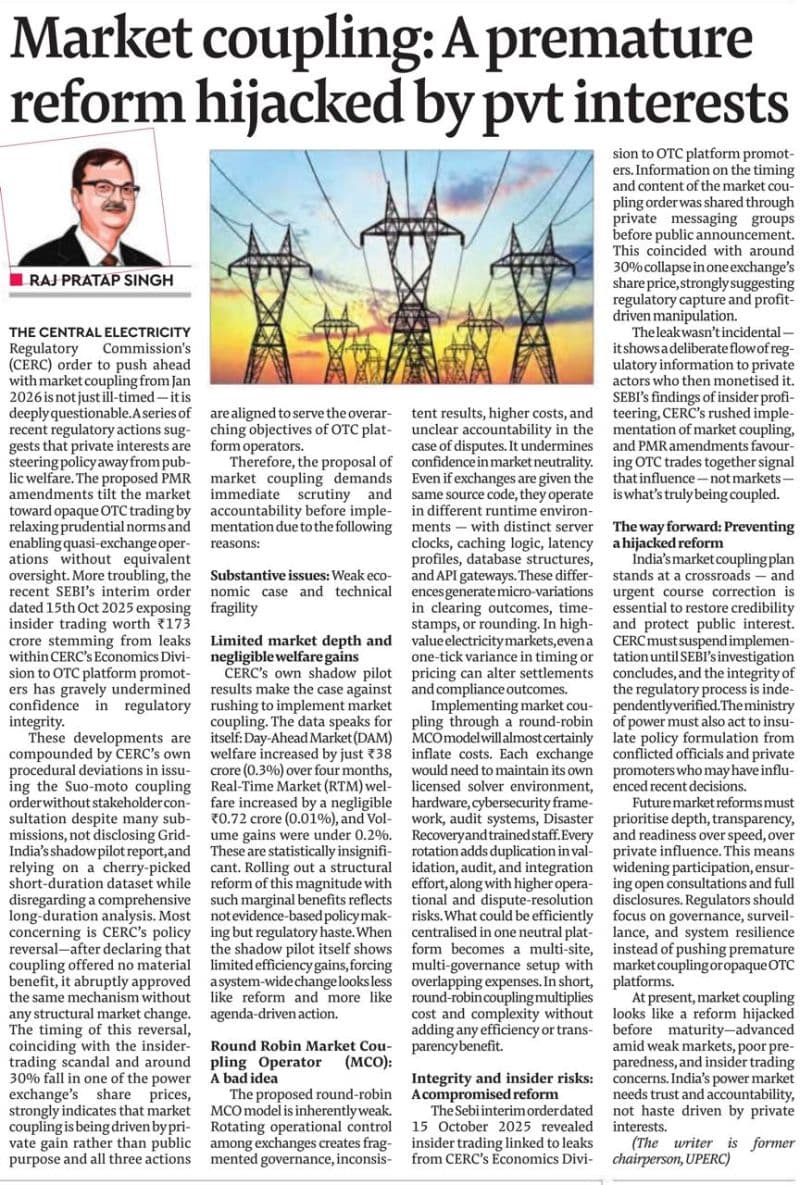
It is also not surprising that respected sector experts and former regulators have raised red flags. Raj Pratap Singh, retired IAS officer and former SERC Chairperson, has publicly argued that market coupling is unsuitable for India’s power market structure, anti-competitive, and value-destructive. (see attached news article

Adding to the concerns, Rajeev Thakkar of PPAS noted during the unitholders’ meeting that no one yet knows whether the extremely complex software stack required for coupling is even ready. Critical questions remain unanswered:

  • Who is the software vendor?
  • What are the specifications and market-design parameters?
  • What is the business-process flow?
  • Has user testing been done?
  • Are participants onboarded?
  • Is the system audit-certified for a January 2026 go-live?

There is still no clarity.

Taken together, the allegations, the technical uncertainties, and the strong objections from former regulators cast serious doubt on both the motivation and readiness of the market-coupling push. For now, the case for coupling appears weaker than ever!

Disclaimer: Invested, biased.

8 Likes

Unfortunately no Government or Gov-Related-Entity will accept wrong doing in decision making process. The orders once made are never rescinded. As it will lead to difficult situations at poll-booths and fodder for opposition.

Not as a political insinuation - but as a practical case in hand - the demonetization drive of 2018 was the opposite of success, RBI documents reveal that >99% of the currency came back into formal channels. We can debate about the true intentions or grey-matter thereof - but wont help, with the difficulties the people and businesses felt.

Again - this is just a reference to say that Government decisions are never rescinded. An investor shouldn’t bank upon it.

As mentioned elsewhere, Electricity in India, is currently viewed on par with Oil-Gas. One Nation One Price will be an overarching factor in taking decisions.

It is true, that implementation aspects are a suspect as of now as PPFAS notes.

At most the concerned officers will be posted to place, where water supply never reaches, forget electricity. Or the concerned will be promoted to a division where Archives are kept.

Market - did not react to this supposed positive news today.

3 Likes

As i am not invested in IEX i can make below arguement against the former regulator’s opinion..it could be bias in favour of coupling.

  1. Benefits are real, not zero Pilots showed 114 crore annual savings + lower price swings. Scaled up, RTM alone can save 5,000+ crore/year. Small in 4-month pilot = big when run 365 days.
  2. Not rushed — 18 months of prep Feb 2024 pilot order → June 2025 Grid-India report → July 2025 final order. Staff paper in 2023 invited comments. Phased rollout (only DAM from Jan 2026) = cautious, not reckless.
  3. Breaks IEX monopoly, not helps OTC Coupling hurts IEX (98% market share) the most — that’s why its stock crashed 30%. OTC players made money by shorting IEX, but coupling itself levels the field for PXIL/HPX, not OTC.
  4. Scandal is separate from the reform Leak happened, officials suspended, SEBI/CERC probing. One bad apple doesn’t make the whole reform rotten. Europe runs coupled markets smoothly for years.
  5. India needs this for 500 GW renewables Fragmented bids = inefficient grid use. Coupling = single price + deeper liquidity = must-have for future green energy.

Bottom line The article uses a real scandal to kill a genuinely useful reform. Coupling might not be perfect Yet. but delaying it keeps bids fragmented/grid inefficient and slows India’s power market growth.

Why wouldnt they Fix the leaks rather simply throw away the reform ?

IMO such articles doesnt make coupling case any weaker. Implementation might be delayed, PPFAS i think isnt betting on coupling.

D - Studying.

2 Likes

In Europe, different markets/countries are coupled through market coupling. CERC has proposed to couple exchanges - which is quite different.

IEX was not able to get a stay on the earlier order by CERC in today’s hearing. Hence I would not look at today’s hearing as positive to IEX. It is neutral at best.

One can argue on the merits and de-merits of exchange coupling, but we as investors are best served by looking at it’s impact on the business and evaluate our options.

Disc - invested. I believe the market has over reacted and there are still many challenges before coupling is implemented, but I could be proved wrong.

2 Likes

I have to respectfully disagree with your points. Here’s why:

1. Benefits are overstated…

The pilot data itself shows minimal gains. Over four months, Day-Ahead Market welfare increased by only ₹38 crore (0.3%), Real-Time Market welfare by ₹0.72 crore (0.01%), and volume gains were under 0.2%. These numbers are statistically insignificant. Rolling out a nationwide market coupling reform with such marginal benefits reflects regulatory haste rather than evidence-based policymaking.

2. Not rushed? Still questionable…

The Grid-India shadow pilot report was not disclosed, and the decision relied on a cherry-picked short-duration dataset while ignoring a more comprehensive long-term analysis.

Most concerning is the policy reversal: after initially declaring that coupling offered no material benefit, CERC abruptly approved the same mechanism without any structural market changes.

The timing of this reversal coincided with the insider-trading scandal and the roughly 30 percent fall in IEX’s share price, suggesting that the move may have been driven more by private gain than public interest and aligned with the objectives of OTC platform operators.

3. Coupling hurts IEX, not just levels the field

Yes, the mechanism reduces IEX’s dominance, but it disproportionately benefits OTC players and smaller exchanges while punishing IEX, which built the market infrastructure.

4. Scandal is not separate??
The insider trading is directly linked to the reform. The leaks involved the exact timing and content of the coupling order. Trading gains coincided with IEX’s price crash, and the author of the order has been named by SEBI. This questions the integrity of the policy itself.

5. Coupling is not essential for renewables??
Grid efficiency can improve through better intra-day and real-time dispatch within the existing exchanges. Coupling adds high complexity, operational risks, and costs with little proven benefit.

Think of it like stock exchanges: we don’t couple NSE and BSE just to harmonize prices. Each has its own systems, clearing, and participants, yet the markets function efficiently.

Similarly, coupling PXIL, HPX, and IEX is not strictly necessary; the exchanges can already manage bids and liquidity effectively.

11 Likes

please clarify this, Are you trying to say IEX is working hard to broaden its TAM contracts, Green RTM offering and expecting strong growth in IGX and ICX markets and then first coal exchange also in pipeline, And this is what PPFAS is betting on? Or there is something else you want to convey here? Will be really helpful if you can elaborate this, Thanks.

Hi guys, I don’t know if the following has been discussed before or not and I apologise if it has been already done

The European power markets also has a market coupling system (Nord Pool) which was introduced back in 2010. It has been 15 years and even in advanced markets of Europe,the RTM segment still hasn’t faced the coupling wrath. What I understand from this is that it’s really difficult to implement coupling in the RTM segment. Even a more technically advanced Nord Pool has not implemented it in it’s geography. (Even after considering the fact that Nord Pool couples multiple exchanges in multiple countries, 15 years is a long time)

I am not saying the Indian markets cannot implement coupling in the RTM segment. But to expect it anytime soon would be less realistic.

Also, like the major concern is IEX losing market share. But since the industry is rapidly growing, here’s my POV

98% share of 100 is 98
70% share of 150 is 105

So even if market share sheds by 28 percentage points, the pie is capable enough to grow to an extent that still results into increased revenues.

Disc : Invested, constitutes 80% of Equity Portfolio, lol.

16 Likes

All your points look logical to me. Market Coupling Efforts could be huge & complex and derived benefits in comparison could be very low.

This approach of authority in coming up with policies to benefit certain organization/exchange/player and damaging its own reputation is a self goal in my opinion!! More mature, transparent, data driven and honest approach would have been better.

Disclosure: No investment in IEX.

2 Likes

‘IEX is a probablistic bet for us’ Raunak Onkar

4 Likes

Wouldnt coupling reduce overall reliability for users as it stands today. Suppose today IEX with significant investment in IT is offering a reliability of 99.9%. Even if MCO offers equally good reliability, just doing this sequentially across two IT infras would reduce reliability to 99.8% (99.9%*99.9%). Does CERC paper corrects for this reduction in their gain of 0.3%?

2 Likes

‘Board of Directors of Indian Gas Exchange Limited (“IGX Limited”), an associate company of Indian Energy Exchange Limited (“Company”), at its meeting held on December 02, 2025, has provided its approval to start the process of Initial Public Offering (“IPO”) of the equity shares of face value of Rs. 10 each of IGX Limited. The IPO will be undertaken by way of an offer for sale by certain existing and eligible shareholders, subject to market conditions, receipt of applicable approvals, regulatory clearances and other considerations.’

2 Likes

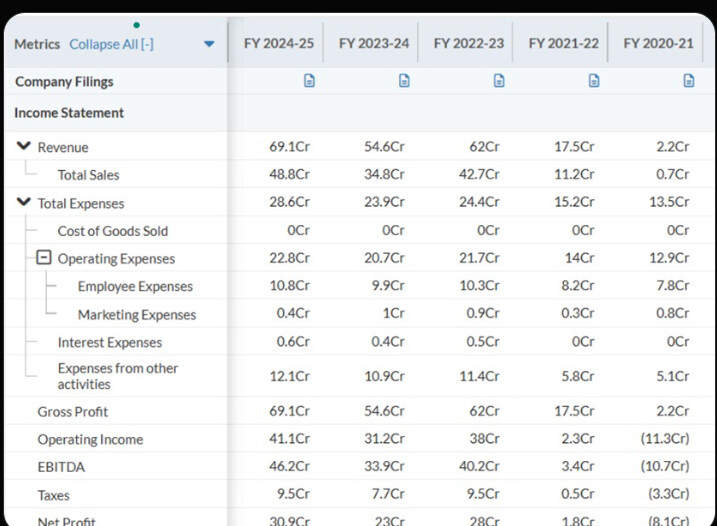
IGX P&L

Source:
https://x.com/bastionresearch/status/1996127533050593626?s=20

3 Likes