My two cents..
I may be wrong..i dont own stock.just.tracking..
No promoter
No Skin in the game.
In a war against a regulator,it s the regulator who wins mostly.
So risk reward of this scrip in not favourable to retail share holders.
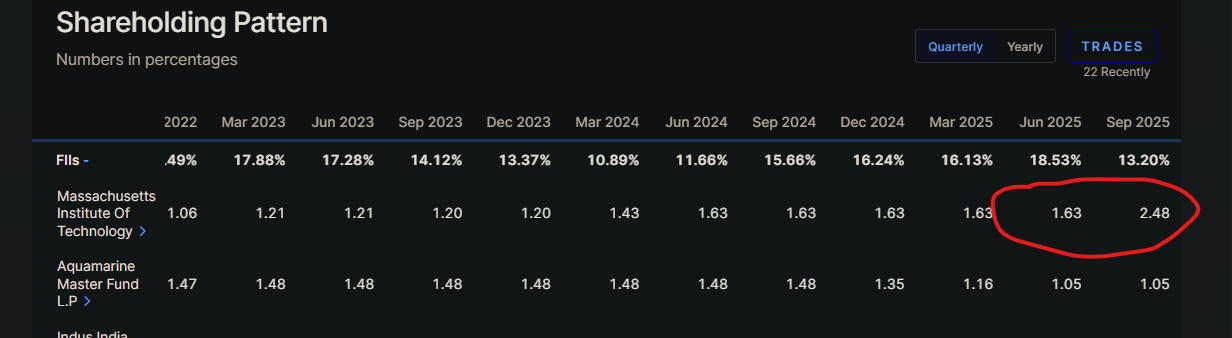
while there was significant FII dumping during the crash, one known FII actually increased its stake significantly (Indian Energy Exchange Ltd share price | About Indian Energy Ex | Key Insights - Screener) :
(Disc : not invested but interested)
That’s an attempt to oversimplify things. In such businesses there are generally no promoters due to regulations but that does not necessarily mean business can’t do well.
I dont know much about this market coupling issue and still trying to understand.
But earlier IGL has won the battle twice in HC and SC against regulator in 2015. IGL got hammered by 40% in 2012 due to this regulatory intervention and recovered the lost mkt cap only after 2 years in 2014. Now stock is 9X in 11 yrs.
Another instance (involving IEX) where the final verdict went against regulator.
Disc: IEX is part of my portfolio
So far I understand that the CEO called the unfavorable CERC decision ‘surprising’- which usually means that IEX is very likely to challenge the order even though the CERC will predictably use the ‘monopoly’ and ‘fairness’ argument in its defence.
Or probably IEX management is in wait and watch mode and would consider legal action strategically only subject to actual order implementation, which most people believe would get delayed?
That said, can someone share any update if IEX has either already taken action to challenge the CERC order or is planning to do so?
There is nothing new in the post below, it is just to reflect how I used to think in the past.
I used to track IEX during 2019 as I was impressed with business of exchanges, where you have:
- Monopoly or duopoly
- Healthy return ratios
- Infinite return on capital, on incremental profits, as incremental capex requirement is virtually zero after you stablize.
The problem is that all market participants know these characterstics and when that’s the case you get valuations (30x+ PE multiples) which in my narrow mindset,did not leave any margin of safety.
IEX is a company that changed this view point for me. Basically, a company that looks overvalued, can continue to remain richly valued if :
- It can grow at healthy pace and
- Continue to remain dominant in its business.
The investors who are married to low PE ratios (as I used to) as a first filter for their investment, remain perplexed as to why such companies trade at high valuations , and continue to do so.
Look at the below table, IEX today is trading at a multiple higher than what it used to trade in FY19, despite the recent hammerage due to regulatory hurdles.
Why? Because the business has grown at healthy CAGR of 17% over last 5 years and it continue to remain dominant. Off course the market also plays its cycle, sometimes being too pessimist and sometimes too optimist, but for the matter of this discussion, I have that aside.
| Figures (Rs Cr) | EBITDA | Cash | Market Cap | EBITDA Multiple |
|---|---|---|---|---|
| FY19 | 200 | 500 | 4000 | 20 |
| FY25 | 450 | 1500 | 12000 | 25 |
An investor who has an hard coded formula of not paying more than a typical multiple (e.g. 20PE, like me in the past), irrespective of the growth prospects the company has in the future will never touch it, while the stock will continue to generate wealth for its owners.
So, does it mean that above is inferior style of investing? Off course not. One has to stay within his circle of competence in investing. If you dont understand growth, or cant value growth, its fine.
However, the day you think you can gauge a company’s growth with high probability, probably you should value that growth in valuing a company.
Probably, I am talking in the lines of Prof Bakshi’s write up “What happens when you buy quality”, a must read for any investor.
Apologies for big rant, in my next post I will talk about what I think about IEX today.
Taking it ahead from my last post. IEX is at the forefront of regulatory turmoil, and we dont know what will be its fate.
The regulator wants to implement “Market Coupling”, that may challenge dominant position of IEX.
Is it a fair demand from the regulator? Does it solves a problem that market participants are facing?
The answer to my limited understanding is no. Why? Because I think IEX is generating enough liquidity and efficient price discovery, that probably cannot be materially improved with the new regulation.
However, today the questions that investor face are:
-
Will IEX loose its monopoly due to this regulation? What can be the impact of Market coupling order passed by CERC?
-
Is the regulation passed intentionally with the motive of weakening IEX? Will CERC continue with similar regulations in future?
-
Will other exchanges start pricing war going forward? Will IEX has to participate in it to remain relevant?
The answers to these questions are not easy, and that’s why investing always remains interesting and difficult.
Lets look at few examples of what happened in past in similar kind of situations:
- When NSE was the monopoly in stock exchanges, Regulator (SEBI) created regulation of only one weekly expiry in F&O, that helped BSE gain market share from 1% to 30%.
- The rates charged by GSPL for using its pipelines were reduced by 50% by the regulator, when it was thought that GSPL is obscenely profitable.
- PNGRB continues to reduce cheap gas allocation to MGL / IGL, probably because these companies are extremely profit and regulator want to reduce their margins.
- SEBI introduced commodity transaction tax in 2014, as it thought there was too much speculation in commodity markets, and volumes at MCX reduced significantly for extended period of time.
So, the business of IEX is vulnerable to regulation, and it has to take the pain , if that is how regulator wants to play. The point is whether IEX will remain relevant and continue to dominate even after adverse circumstances.
Positives
-
The long term tailwinds are in favour of growing short term power market and that is very well articulated in IEX investors presentation. If IEX remains relevant, it will take its share.
-
According to IEX management, TAM market is very competitive with all 3 exchanges haviing similar market share, but there is no price war there.
Assuming IEX can handle the challenges, I see high probability of it doubling its profitibility by FY30. And this growth can come without much efforts, as short term power market (RTM /DAM/ TAM) is just 7% of the total power market, and is set to increase in future.
If that happens , what multiple you want to assign in FY30, rests with you as an investor.
| Figures (Rs Cr) | EBITDA | Cash | Market Cap | EBITDA Multiple |
|---|---|---|---|---|
| FY30E | 900 | 2500 | ? | ? |
| FY25 | 450 | 1500 | 12000 | 25 |
Disclosure - Interested, studying, no positions yet
Did some quick research, could find proper example of market coupling only in EU where the dominant players retained leadership even after coupling while some small share was captured by other players. Currently the market seems to have beaten down IEX forecasting both loss of market share (say a 10-15% loss) and contraction of margin profiles due to loss of price discovery moat. I don’t think both will happen at the same time assuming that IEX has better features/services, if competitors undercut on prices IEX loses market share, if IEX matches competitors IEX retains market share while contracting margins. Please help me understand if this assumption is wrong, not sure how deep IEX features/services are and how hard are they for competitors to replicate.
After market coupling each exchange will get the same share of volumes as they collect (so if IEX is collecting 90% of bids, IEX get 90% volumes as well). With the above understanding, the only reason for competitors to shift will be price sensitivity, unless competitors build better features/services over and above what IEX offers.
Disclosure - Interested, studying, small tracking position
Understanding Market Coupling and Its Impact on Power Exchanges
There’s been a lot of talk around market coupling lately, and many investors are confused about what exactly changes for IEX once it’s implemented.
Here’s a simple explanation.
What is market coupling?
It means that all power exchanges (IEX, PXIL, and Hindustan Power Exchange) will continue to take bids from buyers and sellers as usual but the price discovery part will now be done centrally by a new body called the Market Coupling Operator (MCO).
How will it work?
- Each exchange collects buy and sell bids independently.
- Once bidding closes, all bids are sent to the MCO.
- The MCO combines these bids and calculates one uniform market clearing price (MCP) for the country.
- The MCO then tells each exchange which bids from their platform have been cleared at that price.
- Finally, each exchange settles payments for its own participants.
Example: If a buyer from PXIL is matched with a seller from IEX, the two exchanges handle the inter-exchange settlement between them.
So, the MCO does only price discovery, while financial settlement remains with each exchange.
What changes for IEX?
- IEX will lose its independent price discovery advantage as all exchanges will now have the same market price.
- Liquidity and efficiency will still matter, but the differentiator will shift to customer service, reliability, and tech platform quality. This is what CMD IEX had to say when asked about IEX’s USP:
Source: Latest concall
Invested, biased.
With market coupling, IEX loses its strong moat and could see negative impacts on market share, margins, and growth. Due to a weaker business model, it can also lose its high valuation multiple.its a permanent problem that can’t be recovered, but TAM is huge and other new ventures look bright.
Disclosure -waiting for better valuation
What is fair valuation you think , currently it as 26 PE
The current PE is based on historical earnings, which have been artificially inflated by a monopoly moat that is now permanently under regulatory threat (market coupling). The impact of market coupling is a Permanent Problem—it is set to erase the dominant network effect and switching costs.
Therefore, the correct way to think about valuation is this: Future earnings will be fundamentally smaller (due to lower market share and margins in a duopoly structure)
well i dont know how deep will be the effect of problem will be but we will see it in next year.