IDFC First Bank Limited - First Bank Preference for Long Term Investors too?

32000 cr loans matured in one quarter after 31st Mar 2025, when loan book was 2.33 trillion.

Proportionately, ~37000 cr loans would have matured in one quarter after Q2 FY26, when loan book was 2.67 trillion.

Also, loan book grew by ~13000 crore in Q3 FY26. Thus the total disbursements in Q3 FY26 would be est. 37000 cr + 13000 cr = 50000 crores.

What you are looking for is the spread of the loan book.

Spread = yield of the loan book - cost of funds

Yield of the loan book = Interest earned by loan book in Q3 / Average loan book of Q3 = 8776 / 273003 = 3.2% in quarter (12.85% annualized)

Cost of funds in Q3 = 6.11%

Thus spread of the loan book in Q3 = 12.85% - 6.11% = 6.75%

However, this is the spread of the entire loan book, and not the spread of ~50000 crore loans disbursed in Q3. The entire loan book will have a high proportion of low yielding and low churn assets like Home loans, Car loans, CV loans, etc while the quarterly disbursements will be dominated by high yielding and high churn assets like two wheeler loans, personal loans, microfinance loans, etc.

My rough estimate would be that the spread for Q3 disbursements would be roughly 10% - but yeah, thats an estimate. Thus Q3 disbursements will be earning gross margins of 5000 crores, while 1060 crores (19% of Q3 Opex) is spent to source those loans as sourcing fees. Obviously - these loans can be quite profitable, if credit costs are controlled.

4 Likes

Yes, about that!

A difference of about 10 bps is okay because I like to take as much figures from audited statements (even with limited review)

Yeah, of which ~ Rs 36,000 is replacement of maturing book and an incremental ~ Rs. 13,000 crores.

This can be verified from an analysis of the figures from the presentations. From my analysis it is not like what you expect.

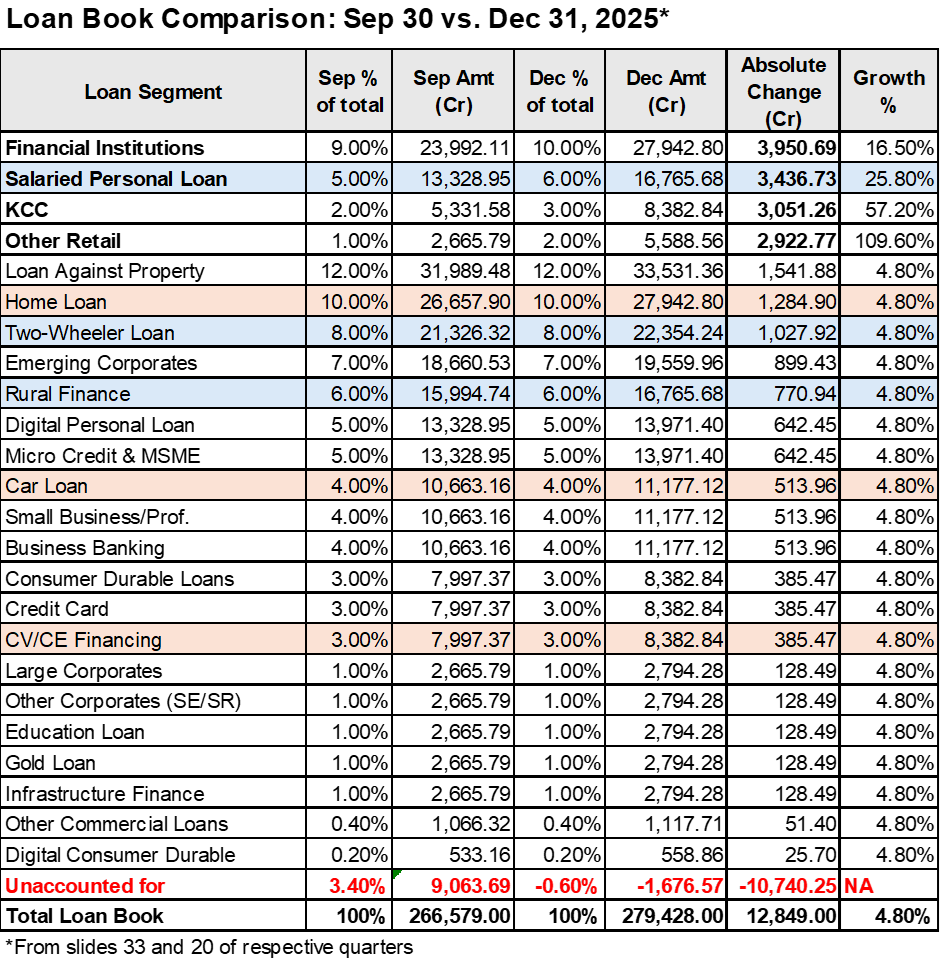
The Sept 2025 and Dec 2025 presentation on slides 33 and 20 respectively, give a loan break-up of the loan book. Of the “high churn” assets only “Salaried Personal Loans” grew its book much high by 26%. Two wheeler / Rural Finance (I guess Microfinance) have grown in line with the book. The biggest growth outside of that growth came from “Financial Institutions” and KCC (which I find carries a ~ 7% yield).

A comparison of the Loan Segments / their composition and q-o-q growth extracted from the presentation is given below

So it is clear from the above that the low yielding assets have mostly grown in line; not all high yielding assets have shown well above average growth, and some low yielding assets have shown very high growth - all on net fresh additions to loan book.

P.S: I also noted that the figures in Q2 FY 26 did not add up to 100% by 3.4%; which is very large (about 70% of total net fresh additions to loan book)

1 Like

Your analysis shows that the net additions to the loan book of 13000 cr is an even mix of low yielding and high yielding loans.

But the larger portion of disbursements is the churn portion of 37000 crores, which naturally would be mostly high churn and high yielding assets.

Forgot to add, that, insiders will know it first.

1 Like

If so, then the share of high yielding and low yielding in the overall mix should change; it hasn’t except for Salaried Personal Loan. It could only then be that the fresh additions to maturing high yielding assets were repriced higher.

Since all banks have same impact on treasury operations as most bonds are considered HFT for SLR and CRR requirements, hence almost all banks have this feature - it’s not fair to say that idfc will manipulate C2I based on treasury gains as it’s applicable to all banks. And bond price movements are same for all.

Key observations to note :

  1. RWA ratio reducing every quarter, would recommend you to look at past ratio too…it’s not that easy to change and shift the loan portfolio…also not , your yield on assets are increasing and cost of funds are decreasing because ur NIM is increasing(which means ur risky assets are increasing) while u r also decreasing risk weight on loan book - this is not even remotely possible for any bank to do.

If ur risk weights decrease - ideally ur NIM should fall even with cost of funds falling b cause ur yield on assets falls drastically

  1. fee and other income gain and treasury income gain - are not projected properly - I would link fee income with disbursements and treasury gains with interest rate cycle - better to keep treasury gain at same as last year or minimal increase…it looks way too out of the world..as if they have become investment banker sorts

  2. what’s the rational of opex growth? How have you calculated it? It seems arbitrary - b cause 45% of opex is linked to disbursals…the more they disburse, the more they spend…it’s growth cannot be half of loan growth(considering employee cost also grows every year)

Looking at the way you have build excel - you seem to be a practical person and very hands on with numbers, and I am sure you will able to understand what I am trying to say here.

Great workings :+1::+1::+1:

I did a similar exercise in past, I have already posted my excel in this forum, you can review it too. I did it in dec 2023.

2 Likes

I have projected 15% growth for Fee & Other income, while loan book is growing at 20%. I think I have been conservative and actual growth could even be 30%. Let me explain why.

On the liabilities side - IDFC does zero fees banking. What happens to Fee income when IDFC starts charging fees for various services like other banks do?

IDFC also doesn’t make cross-selling efforts so far. I have a savings account with IDFC and no one has called me to cross-sell insurance or mutual fund or kids account or anything else so far. I also have an account with HDFC and I get weekly cross-selling calls. What happens to IDFC Fees income when they start cross-selling like other banks?

The Fees & Other income of IDFC is slightly higher than 2% of assets right now. This is class leading - most banks have it at 1.5% of assets. I will argue that IDFC can still raise it to 3% of assets or higher.

Why is it that IDFC alone can reach such high Fee income? Because it has the most granular assets and granular liabilities among all major banks. You can raise the 1 trillion deposits from a million customers or from 1 lakh bulk customers - IDFC has chosen the former path. You can disburse 1 tillion loans to a million customers or to 1 lakh customers - Against IDFC has chosen the former path. This means higher Opex upfront to build a granular scalable business model - but huge profits downstream.

Why can IDFC have such large number of both liability and asset customers, while other banks can’t? Because its a Fintech in its operations. Its highly digitized, allowing it to serve millions of customers every month, like no other established bank can (because they are stuck in old processes and systems). Bajaj Finance may be the only exception - they are as digitized as IDFC in their operations.

what’s the rational of opex growth? How have you calculated it? It seems arbitrary - b cause 45% of opex is linked to disbursals…the more they disburse, the more they spend…

Opex growth will keep falling, due to various reasons mentioned below

  • Liabilities side - CD ratio has fallen from 140% to 93%. By end of FY27, CD ratio would reach around 85, after which deposits only need to be grown at the same pace as loans (right now deposits are being grown at 25% while loans are being grown at 20%) - which means lesser opex for deposit mobilization.
  • Assets side - increasingly more and more loans are being sourced by branches. Branch sourcing of loans is growing at 35% to 40%, while loan book is growing at 20% (as per Q3 earnings call). This means lesser payouts as sourcing fees and commissions.
  • New businesses - the scorching 100% growth in credit cards, fastag, gold loans, transaction banking, etc will keep moderating and fall to 20% over the medium term. Opex growth at 20% growth will be much lower than opex growth at 100% growth.
  • Fixed costs - lots of investments into Technology infrastructure, branch infrastructure, etc will keep moderating as they mature.

Can IDFC grow its opex at half the rate of business growth? On the long term, then answer would be No. But in the next 3 years, the answer will be Yes, simply because of base effect - the Opex is currently inflated due to various factors enumerated above.

If ur risk weights decrease - ideally ur NIM should fall even with cost of funds falling b cause ur yield on assets falls drastically

In 7 years since merger, IDFC has brought down its cost of funds by 150 bps relative to mid-tier banks. In Q4, management guided another 15 bps fall in cost of funds - that means 165 bps reduction in cost of funds relative to mid-tier banks.

If IDFC can bring down its cost of funds by 165 bps in 7 years when its CD ratio was between 140 to 100 (and it was forced to grow its deposit book at a scorching 35% cagr), cant it bring its cost of funds down further by another 80 bps to 100 bps in the next 3 years when its CD ratio is between 90 to 80 (and deposits only need to grow at 20% cagr)?

If cost of funds can be brought down by 80 bps to 100 bps - cant 30 bps to 50 bps be passed on in the form of less risky loans - thus achieving 50 bps higher NIM and lower risk weighted assets at the same time?

That also brings out another question - Among mid-tier banks, why is IDFC alone able to bring down its cost of funds in a relative sense? Because it gives fintech kind of differentiated experience to its customers. I have been a customer of IDFC bank for 9 years and I had to visit the branch only twice - once at the time of starting the account (even this is digital nowadays), and once to make a demand draft. IDFC doesn’t call me and disturb my peace unnecessarily. And their digital experience is superior to the other banks that I have accounts with.

I did a similar exercise in past, I have already posted my excel in this forum, you can review it too. I did it in dec 2023.

I couldnt find it. Pls share the link.

A general comment I have on IDFC Bank analysis is this. IDFC is trying a build a very unique and differentiated model vis a vis other banks. Its a combo of Bank liabilities (low cost of funds) + NBFC assets (granular high yielding loans) + Fintech operations (cost efficient and highly scalable operations) - the best of all 3 worlds.

If one analyses IDFC like any other bank - then one would be led to wrongly assume that Fee income can only be max 1.5% of assets (No, for IDFC it can go to 3% of assets), cost of funds wont reduce like it hasn’t reduced for other mid-tier banks (No, IDFC has been reducing cost of funds and will continue to reduce cost of funds), highly granular loans and deposits are not scalable (No, IDFC has tech-based model that is highly scalable), RoE for mid-tier bank cannot go above 15% (No, IDFC is going to surprise on this front IMHO - it is likely to generate super-normal profits and returns), etc etc.

The con of this highly differentiated model is that it comes with huge upfront costs to build it up - and that’s exactly what we have seen the last 7 years. But then I believe that the model is close to start bearing huge profits going forward. In summary - I think that IDFC needs to be analyzed like a Fintech, and not like a bank. Vaidya has somehow failed to communicate this - its his biggest failure in the last 7 years.

7 Likes

Every industry keeps evolving. When HDFC came in 1990s, there were a huge number of PSU banks and old generation banks - at least 50 to 100 scheduled banks were operating then, in what was a tiny banking industry by today’s standards. HDFC disrupted the Banking industry in 1990s, by offering superior branch-led customer service in the era of PSU banking. It was not that there was no competition - the competition was intense then too. Its that HDFC came up with a differentiated model.

IDFC is disrupting the Banking industry today - by offering branch-lite Fintech kind of banking. Other banks are burdened with legacy processes and systems and organizations which are trained on those legacy processes and systems. They will find it hard to adapt to the new kind of banking.

Will IDFC be successful - we will have to wait and see. But what is clear is that IDFC is doing a differentiated disruptive model.

5 Likes

Great Replies as expected.

given the nature of opex and the projections in your sheet - i dont think this C2I can be achieved as per your projections…

with almost 95%-99% certainity - i can say that tier 1 will go down below 13% after Q1 results and by september or december results - we would have seen another round of funding.

but i like the way you think, and i would be very hapy if IDFC is able to achieve whatever you have projected.

some of my past posted links

This below post also has the workings which i did in February 2023, it has actuals till December 2022. Idfc continues to raise funds as projected in this sheet.

3 Likes

Thanks for sharing. It’s great to hear multiple perspectives.

1 Like

This is quite an interesting observation. Seems smart money is accumulating while retail is getting impatient

Best reply I have seen in a long time on this thread.

In summary, Idfcfirst bank is a bank for liabilities and Fintech for building asset side.

It’s cost are higher and front loaded due to granular approach taken. But, bigger profits.

4 Likes

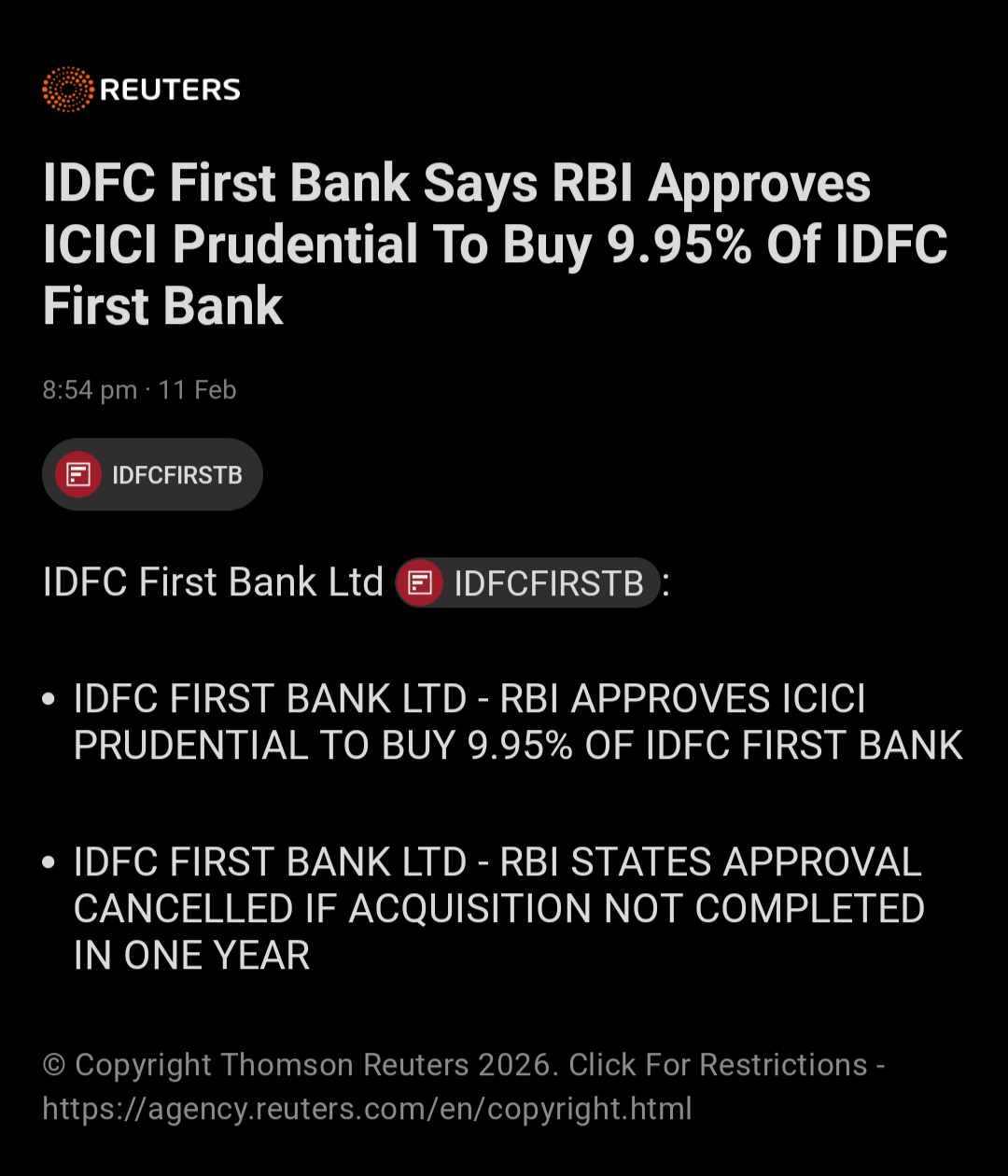
Big news but kept it low key….

9.95% stake icici prudential to buy in a year

4 Likes

Great News…but going by past track record one obvious question comes to mind..will the stake be bought through open Market or it will be a QIP again? Though at 1.5 PBV it will be better than the last one ?

Regards

2 Likes

This is a normal regulatory process in the MF industry. They got approval for 7 other banks as well. It expires in one year, and needs reapproval post expiry.

1 Like

Think it is kept on standby for the next capital raise by end of next year..:frowning: Its a two edge sword..good for long term

1 Like

I’m wondering how will acceleration in white collar jobs layoff impact retail focused banks like IDFC. Wouldn’t it be prudent to start focusing on Corporate Credit at this juncture? Your thoughts please

1 Like