IDFC First Bank Limited - First Bank Preference for Long Term Investors too?

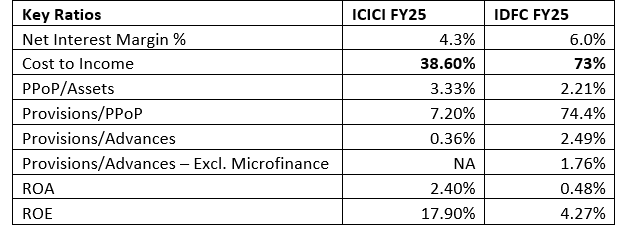
ICICI/HDFC banks have a different business model / product mix, where they operate at 4-4.5% NIM and credit cost around 0.5%; whereas IDFC First bank operates at 6% NIM and expected credit cost of around 1.7-2%; So the higher NIMs, to a major extent, are compensated by higher credit cost. FY25 was an aberration due to Microfinance issue and credit cost peaked to 2.5% (credit cost was 1.76% excl. MF which is as per the model/expectations).

Here is the comparison of key ratios for FY25:

Source – Investor Presentations

There are 2 key aspects that needs close monitoring and tracking, as highlighted by the other forum members:

  • Elevated cost-to-income levels - As guided by IDFC management, the cost to income ratio shall gradually come down in the coming years due to economies of scale; planned to improve to ~65% by FY27
  • Large equity base and fund-raise – IDFC First bank has inherited large equity base as part of merger and multiple fund-raises for growth in the last 5 years resulting in further dilution and a very large equity base. With the recent 7500crs fund raise, the equity capital may touch around 8500crs (from 7300crs in Mar’25). What it means is, with the current net worth of ~45000crs (post-fund raise), the bank needs to generate ~4500crs PAT to achieve ROE of 10% and ~6700crs PAT to achieve ROE of 15%..

Discl – Invested for long-term, not a buy sell recommendation.

10 Likes

Hi Ravi, I see from your comments that ypu are very hopeful. I have invested in idfc in past at around 30 levels when c2i guidance was 55% by Fy25…somewhere in FY22, VV changes the fwd guidance to 65% nad pushed the target to FY27. I exited the next quarter in fy22-23when this guidance got changed because based on projections of achieving 65% c2I, bank ROE was capped at 13% and ROA could never cross 1.3-1.4…hence the jump in valuation could never come. Though I exited at handsome gains of mid 60s due to sheer luck may be…but in order to project C2I, we need to look at composition of opex…don’t go by VV words…look at what’s being reported, you will notice that opex has major portion in other expenses - and those other expenses have major expenses of another other expense - for which VV never gives explanation… As small search will give you answers on how VV raises liabilities and assets from market (the growth which he keeps talking about) he pays alot to DSA agents and when this growth in loan book slows, the C2I also comes down due to other expenses going down.

Based on these things, please be a fair judge of C2I, because just by going thru VVs hopeful stories and back history of Capital First - he will continue to raise capital as keep diluting because ROE will remain capped at 13% of C2I gets floored at 65%, this means any incremental growth in balance sheet will lead to dilution in equity along with jump in C2I.

Hopefuly you will find my old projections in the comments of past which never accounted to MFI stress and hence actual dilution is even more than my projection. I have put out very detailed projections based on what VV use to say.

Every time this bank falls , new set of retail investors like me get hopeful and the cycle repeats.

Regards
Vineet

10 Likes

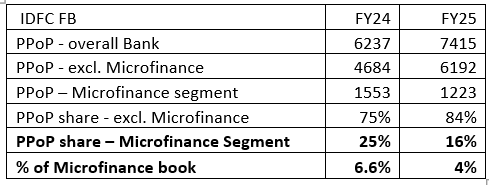
Another key observation - Microfinance (MF) book has been gradually reduced to 4% of overall loan book as on Mar’25 (against 6.6% in Mar’24) due to the conservative disbursals of MF loans. MF is a high yield/margin business and though the loan book was small, the contribution to operating profit was significantly higher (6.6% of MF book contributed to 25% of PPoP in FY24):

The drop in operating profits from high yield MF loans need to be compensated with relatively lower yield non-MF loans. This shall have minor impact to overall operating profits in the short term, until the MF loan book size is rebaselined and stabilized..

3 Likes

If we look at the journey from 2010, some things are common between IDFC FIRST Bank and Capital First. In the beginning, neither of them had a solid base, both had to write off loans, and in both cases the cost-to-income ratio was very high. The difference was that Capital First had smaller scale, whereas IDFC FIRST Bank has larger scale — in terms of both loans as well as cost-to-income.

Vineet ji, what is the reason you are saying that ROE cannot go above 13% and ROA cannot go above 1.4%? Please present some facts to prove your point so that things become clearer.

If VV was able to take Capital First from 2% ROE to 15% ROE — where the cost of funds was 12%, loans were being given at 22%, with 2% gross NPA was 2%, net NPA 1%, and credit cost was 2% —

then today, with cost of funds at 6.5%, why can’t he do even better with IDFC FIRST Bank?

5 Likes

Attached IDFC workings which i did in Feb 2023 - as projected in past - IDFC continues to raise funds as per the model.

This model has actuals till December 22 only, and hence you can compare the projections with actual results posted after that. Also you can compare the fund raises so far.

hope this helps you.
IDFC projections.xlsx (20.7 KB)

1 Like

even if he would have met these projections (though he is far behind), he would still be at RoE of 13% max.

Vineet ji, I carefully reviewed the Excel sheet and only checked three points from Q4FY22, and I found three mistakes:

  1. How did the other income for Q4FY22 become ₹1,599 crore in your sheet, when in the original results it is ₹841 crore?
  2. VV has never said that the credit cost will remain at 1% annually. He has always emphasized the 2-1-2 ratio.
  3. You have taken the wrong NII figure. The NII for Q4FY22 is ₹2,669 crore, whereas you calculated ₹1,750 crore.

After this, I felt reading the rest of the Excel sheet was a waste of time, because your further calculations must have been based on these wrong figures, making them useless.

Sorry, but if I am wrong, please correct me

I think you didn’t read my comment properly, actuals are till December, rest is just projection, which were never met by IDFC and hence it kept on faltering on every parameter. Even at these bullish projections VV wasn’t able to meet over 13% roe.

Gnpa is pegged at 2% and NNPA at 1% as harped by VV since ages ( if you find this bullish - a further increase in gnpa and NNPA will further drag the profitability and hence lower ROE)

I would wish if your would have read my comment carefully - this was prepared dec q3 - the columns in blue highlighted cells are only actuals.

1 Like

When I say prepared in february- it meant it includes dec -q3 actual results

IDFC First Bank, formed by the consolidation of IDFC Bank and Capital First in 2018 and subsequently simplified by a reverse merger with IDFC Limited in 2024, has evolved from an infrastructure-biased lender to a retail-oriented private bank. The bank now offers a comprehensive bouquet of products and services in retail, wholesale, and wealth management with a clear mandate of building its granular liability franchise.

During Q1 FY26, the bank recorded robust growth with funded assets increasing 21% year-on-year to ₹2.53 lakh crore and customer deposits up 26% at ₹2.57 lakh crore. Retail deposits now account for 80% of the base versus merely 27% at merger time, and CASA ratio touched 48%. Borrowings structurally declined to 10% of liabilities from 48% previously, and the credit-to-deposit ratio has relaxed to 93.4% from 137%, indicating a better funding profile. This has come with a consistent downtrend in cost of funds, reducing the premium over peers.

On financing costs, net interest margin softened to 5.71% due to repo rate pass-through and decline in the microfinance business impacting spreads. However, net interest income increased 5.1% year-on-year to ₹4,933 crore, or 11.8% if the impact of MFI is excluded, while fee income increased 8.5% with 91% being from retail segments. Operating expenses moderated to aid for improved efficiency. Profit after tax was at ₹463 crore, rising 52% quarter-on-quarter but decreasing 32% year-on-year, as provisions stayed high at ₹1,659 crore.

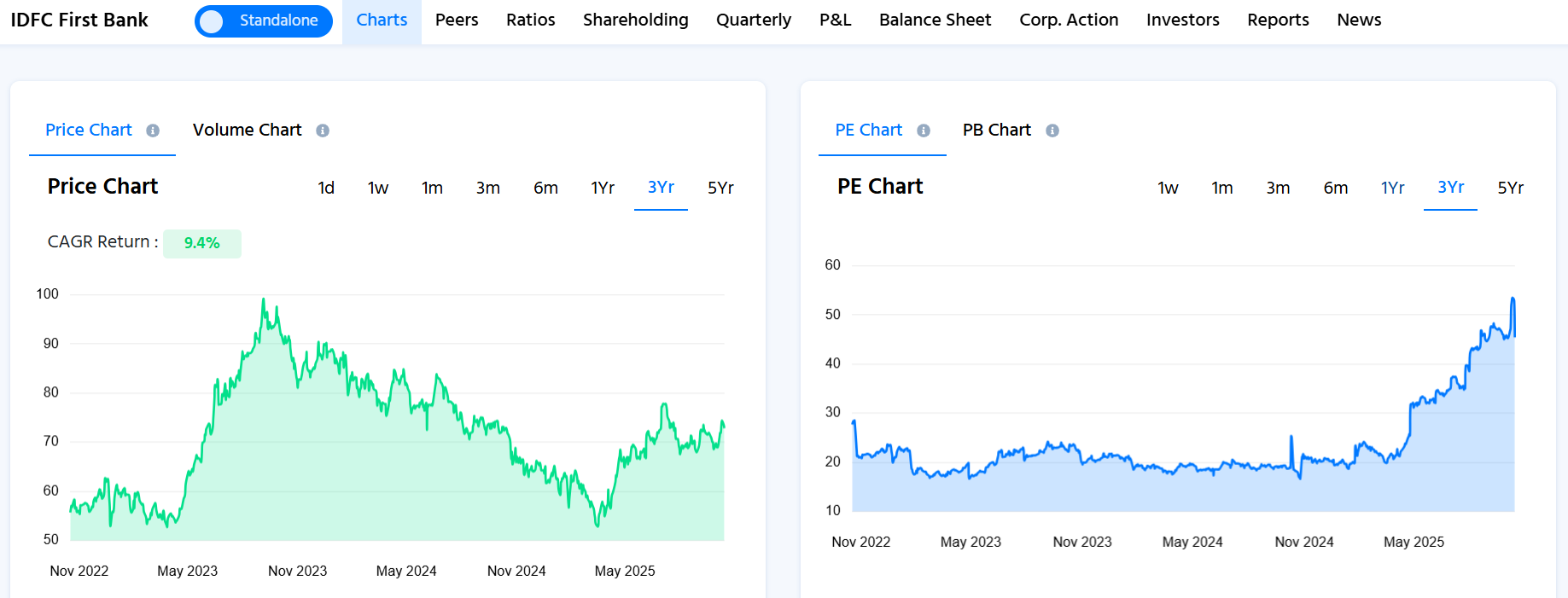
The stock’s return profile shows a mixed trend, with one-year CAGR at -7.5% reflecting weak near-term performance, while the three-year CAGR of 13.9% and five-year CAGR of 17.7% indicate steady wealth creation over longer periods. This suggests that despite recent corrections, the stock has rewarded patient investors over time. On the valuation side, the PE chart remained broadly stable in the 18-22x range for almost two years but witnessed a sharp re-rating from late 2024 onwards, now trading above 45x. Such a rise signals higher market optimism around earnings growth and structural improvements, though it also leaves limited margin of safety in the near term unless profits expand meaningfully

Asset quality remained healthy with gross NPA of 1.97% and net NPA of 0.55%. Provision coverage ratio was healthy at 72.3%. The MFI portfolio contracted 37% y-o-y to ₹8,354 crore, now only 3.3% of total assets, but with better collection efficiency at 99%. Slippages increased to ₹2,486 crore, although management clarified that retail and MSME segments are still robust.

Growth drivers were mortgages, auto finance, business banking, and wholesale loans that together accounted for 82% of overall growth. Wholesale exposures remain to exhibit excellent credit quality with 77% rated A and above, while concentration risks have decreased and infrastructure lending has approached zero to less than 1% of the book. An equity raise of ₹7,500 crore planned will bring capital adequacy to 17.6% and CET 1 ratio to 15.38%.

The President of India (Government) holds ₹4,572.67 crore. The government’s stake started around 3.69%, rose to a peak of 9.11%, and is currently 9.09%, reflecting a substantial and largely stable ownership. Ashish Dhawan’s current holding is ₹634.55 crore, with his stake gradually increasing from 0% to 1.26%, indicating a small but steadily growing position.

Forward-looking, management is anticipating credit costs of 2% for FY26, NIM recovery to 5.8% in Q4 as repricing of deposits filters through, and cost-to-income ratio declining towards 65% by FY27. Credit card and retail liabilities businesses are approaching breakeven, reflecting structural enhancements.

Curious to hear members’ opinions on IDFC First Bank’s recent performance and return trends.Keen to know how others view its strategy, funding profile, and growth drivers.

  1. How do you view IDFC First Bank’s shift from infrastructure to retail lending?

  2. With retail deposits now at 80% and CASA at 48%, do you think the funding profile is sustainable?

  3. How do you interpret the stock’s mixed return trend (-7.5% 1-year vs. +13.9% 3-year CAGR)?

  4. Do you see the high provisions in Q1 FY26 as a temporary factor or a structural challenge?

Which growth segments, mortgages, auto finance, or business banking, will drive the next phase?

3 Likes

Same story repeated - C2I at 73%… For all investors who are invested - please investigate the opex breakup for clarity.

Recent AR will have the March 25 opex breakup…and compare that opex composition with other banks…you will easily find the skew

3 Likes

Market may have come to the conclusion that if loan book growth, 20%, is intact, then other important parameters like CI ratio, NiM, NPA will fall in place with time.

A world class bank with 20% growth trajectory, selling at 60K cr market cap, should be very attractive to long term investors

3 Likes

CI ratio is down from 73.80%, excluding trading gain, in last quarter to 70.90%

Although at snails pace it holds promise.

3 Likes

Their Mortgage and MSME book NPA is trending higher, see the SMA1+2, Gross and Net NPA figures on slides 48, 49 and 50. While these may not be worrying, I wonder why there is an uptrend?

1 Like

Massive amounts going to provisioning as a percentage of Operating profit, compared to other banks.

Q1 FY26: Operating profit (pre-provision) was around ₹1,880 crore; provisions were ₹1,659 crore. Provisioning percentage = 88.2%

Q2 FY26: Operating profit was ₹1,880 crore; provisions were ₹1,452 crore. Provisioning percentage = 77.2%

Massive!

For Kotak Bank…

Q1 FY26: Operating profit was approximately ₹5,564 crore. Provisions surged to ₹1,208 crore. Provisioning as % of operating profit = 21.7%

This is horrible.

4 Likes

What can be the reason for such high provisions?

2 Likes

Provision should be compared with total loan book, not with just the operating profit.
I have not seen the numbers, but may be Kotak one includes their AMC, Insurance profits as well?

1 Like

This is misinterpreted
Usually PCR is on reference of NPA
PCR = (Total Provisions / Gross Non-Performing Assets) x 100

Kotak Mahindra Bank PCR is 77% September 2025

Now comparing with profit make weaker case for IDFC

Have no clue what’s going on with the bank.. expected them to post ATLEAST 100 cr more than last quarter. Results are poor and media announces it as a bumper results! Crazy! Management is not able to manage CI and provisioning is through the roof! This is what happens if you lend based on cash flows which is the most dumbest thing i have ever heard. This bank is good for the long run , but why waste time here if we can put the money as lump sump in any MF and get these returns over a period of 15 years?!

1 Like

refer to this.
Almost entire PPOP is used in provisioning. Still, PCR is low when compared to Icici 83% kotak 78%

Indicates, this trend will continue for the longest time.

1 Like