
Company: [Company Name]
Sector: Asset Management
Basic Details
• Market Cap: ₹ ₹ 1,54,174 Crores
• Issue Price: ₹ 2165.
• Current Price: ₹3137 (as of 23rd Feb 2026)
• Listing Date: 19th Dec 2025
Financial Highlights FY ending 31st March, 2025
• Revenue: Total income was ₹49,796.7 crores, and Revenue from operations was ₹49,773.3 crore (source: RHP)
• Net profit after tax crores: ₹26,506.6 crore.
• ROE: 82.8%
• Debt-to-Equity: No information. May not be relevant in view of the nature of the work of the company.
• Revenue Growth (3-year CAGR): 32.46% .
Business Overview
• What they do:
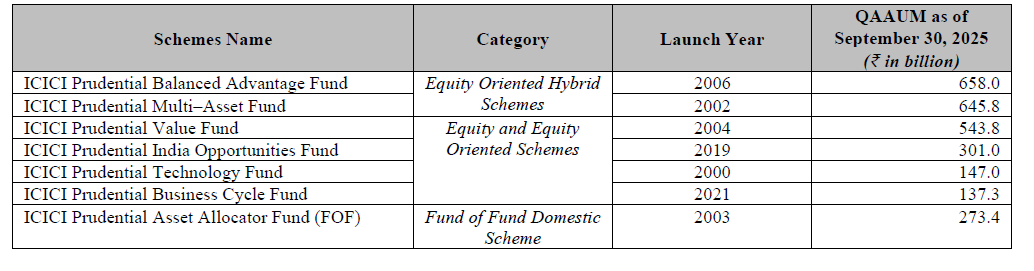
• Key Products/Services: ICICI Prudential Asset Management Company is into offering investments, mainly in Mutual Funds of a large variety, from equity to debt. For example, it has various mutual funds that invest in equity. Its diversified schemes invest in companies across different sectors or across market capitalization. There are schemes that invest based on the market capitalization of the stock are categorized as ‘large-cap’, ‘mid-cap’, ‘small-cap’, and ‘multi-cap’. Schemes that invest across different stocks without differentiating based on the size of the underlying capitalisation are categorized as ‘flexi-cap schemes. Schemes may also be driven by a particular style of investing like value investing focuses on identifying stocks which trade for less than their intrinsic value or dividend yield investing.ICICI Prudential Large Cap Fund is a category leader in large cap schemes. As of September 30, 2025, they have nine diversified Equity and Equity Oriented Schemes and their QAAUM from this category was ₹2,181.4 billion.
Equity oriented hybrid schemes invest in a mix of equity and debt instruments, with the majority of investments comprising equity securities. They also have a multi-asset scheme which invests in at least three asset classes.As of September 30, 2025, they had four Equity Oriented Hybrid Schemes, with QAAUM from this category being ₹1,912.3 billion.
There are also ELSS, with emphasis on equity.
As of September 30, 2025, they had 23 sector and thematic schemes and their QAAUM from this category was ₹1,355.6 billion. Some of their sector and thematic schemes include ICICI Prudential India Opportunities Fund, which is a category leader, with a QAAUM of ₹301.0 billion, ICICI Prudential Technology Fund with a QAAUM of ₹147.0 billion and ICICI Prudential Business Cycle Fund with a QAAUM of ₹137.3 billion as of September 30, 2025.
As of September 30, 2025, they had three, what they call solution-oriented equity schemes, namely ICICI Prudential Child Care Fund (Gift Plan), ICICI Prudential Retirement Fund – Pure Equity Plan and Hybrid Aggressive Plan and our QAAUM from this category was ₹36.9 billion.
As of September 30, 2025, they had one International Scheme, namely ICICI Prudential US Bluechip Equity Fund. QAAUM from this category was ₹32.8 billion.
Their two Overseas Fund of Funds schemes, namely ICICI Prudential Global Stable Equity Fund (FOF) and ICICI Prudential Strategic Metal and Energy Equity Fund of Fund had a QAAUM of ₹1.9 billion.
Debt schemes of the company have also substantive investments. For example, long term debt scheme has ₹104.5 billion. ICICI Prudential Medium Term Bond Fund, had a QAAUM of ₹57.1 billion. As of September 30, 2025, they had one corporate bond scheme and one credit risk scheme, and had a cumulative QAAUM of ₹395.5 billion.
The number of investors is increasing at a heartening rate, which augurs well for the Asset Management companies:
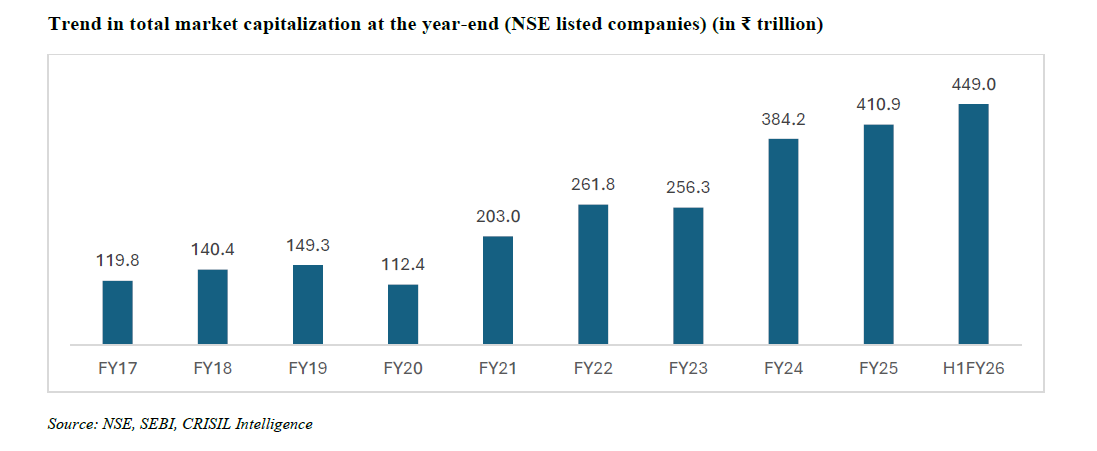
Mobilisation of funds through IPOs is also contributing to the growth of the equity cult.
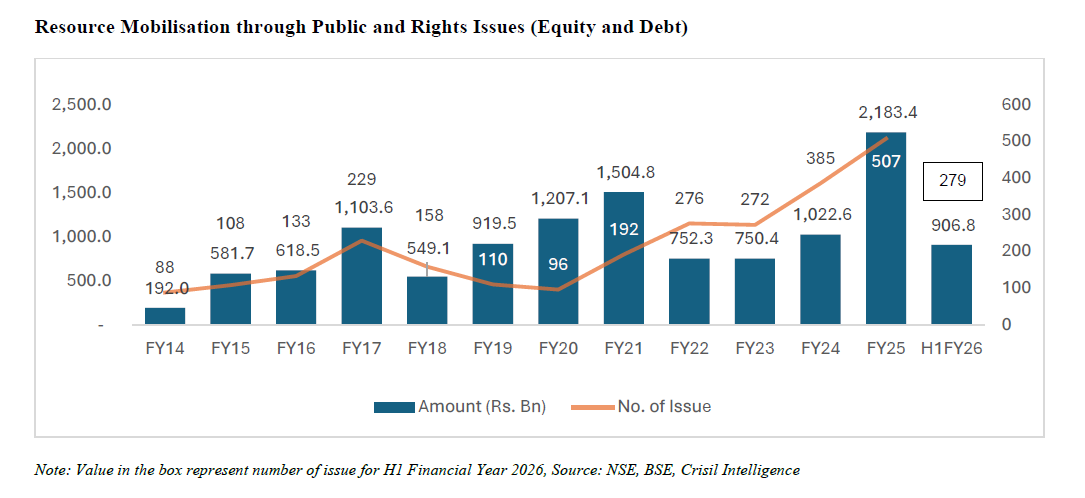
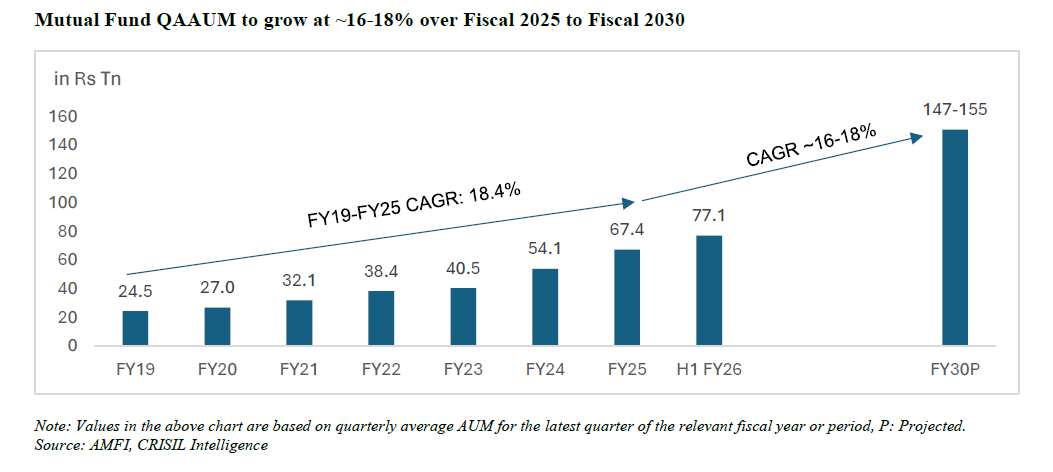
The industry also expects to grow at an exponential rate.
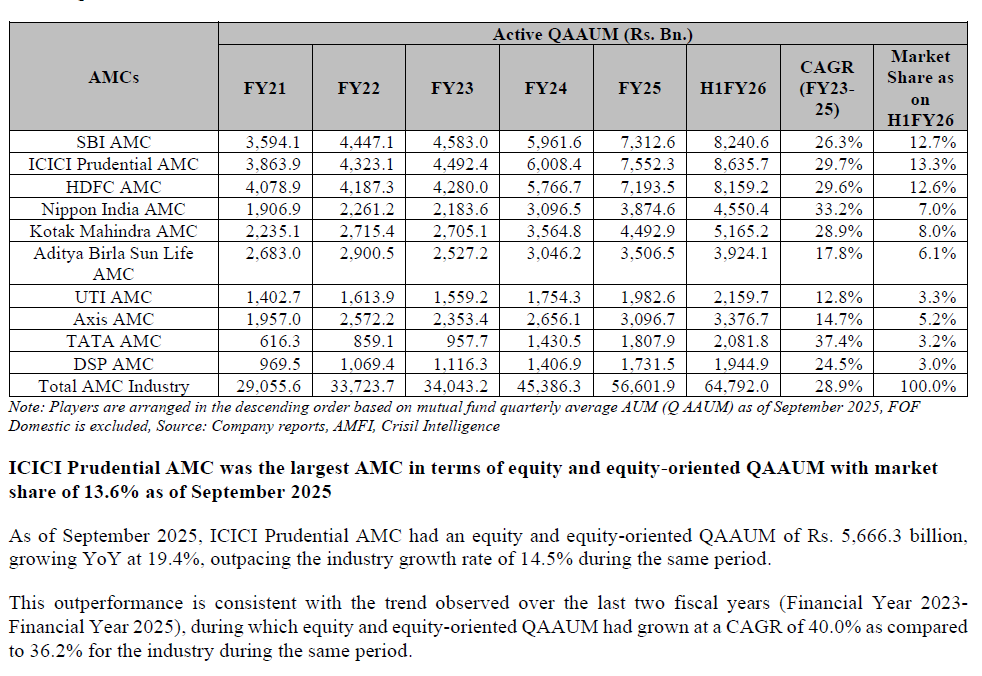
• Market Position: The table will show that ICICI Prudential Asset Management Company occupies a prime place among the asset management companies.
• Key Customers: Apart from the public and the institutions which have invested in its MFs, major institutions also hold shares in the company. For example, SBI Large Cap has 3,424,192 shares, HDFC Large Cap Growth owns 1,371,543 shares, among others. The total shareholding of the MFs comes to 24,449,920 shares.
Management Quality
• Promoter Background: The promoter has more than 25 years of experience and is backed by ICICI Bank.

• Promoter Holding:87.6%
• Key Management: As per the RHP, "We have a professional team of Key Managerial Personnel and Senior Management to develop, execute and grow our business with average experience of over 25 years in asset management services and financial services, as of September 30, 2025, several of whom have been with us or within the ICICI group for a substantial period of time and thereby allowing our franchise to be culture-centric."Senior Management and KMPs
This is what the RHP has to say about its top management:
“Our Key Managerial Personnel and members of our senior management team has been with us for an average of over 11 years and has a total average work experience of 25 years. 11 of our Senior Management and KMPs have worked within the ICICI group for over 10 years.
Our Managing Director and Chief Executive Officer, Nimesh Shah, has been with our Company for over 18 years. He joined the ICICI group in 1993 in the project financing group of ICICI Limited. He has over 32 years of experience in the financial services and asset management sector. Nimesh Shah was awarded the CEO of the Year (India) award at the Asia Asset Management’s 2023 Best of the Best Awards.
Our Executive Director and Chief Investment Officer, Sankaran Naren, has been with our Company for over 20 years and has total experience of over 30 years in the asset management and financial services industry. Sankaran Naren was awarded the CIO of the year (India) award at the Asia Asset Management’s 2023 Best of the Best Awards.
Our Chief Investment Officer of PMS and AIF investments, Anand Shah, has been with our Company for four years and has a total experience of 25 years in the asset management industry. On April 30, 2025, he was appointed as the Principal Officer for overseeing our PMS business.”
Some of the investors enjoy almost an iconic status along with Rajeev Thakkar of Parag Parikh, Prashant Jain of HDFC and a few others like Sunil Singhania, Taher Badshah who are earning a name. Any omission in this list may be attributed to a lapse in memory and not for any lack of regard for any of them who have been inspiration to many.
Investment Thesis My personal experience is that the recent downturn in the markets has persuaded many of us to park at least a part of our capital with mutual funds as some of them were able to keep their heads above water. Most lay investors find the task of going through a mountain of data from RHPs, and keeping abreast of concalls, stock-exchange filings and the latest news daunting. There is always a danger of something being missed. More and more a realisation is dawning that investing in stocks is not a part-time activity, and requires dedication and tireless study.
Though many new asset management companies are carving out their niche, ordinary investor is more likely to favour a few selected asset management companies.
As the tables above show, the investment cult is growing. It can also be assumed that having seen many people burning their fingers in the F&O gambling, more new investors may prefer the MF route.
Positives:
• A trusted brand-name.
• Known investment managers, who are known to have shown sterling results over decades.
• The growing investment cult. Diversion of bank deposits to the stock-market confirms this.
• The asset management companies earn almost passive income, as once an investor starts an SIP, she is expected, and persuaded to continue to do so for long periods. All of this results in fees for the company.
Concerns:
• Investing has inherent risks, and any downturn in the market is known to drive the investors out in droves.
• MFs are not always above board in their selection of stocks and are sometimes known to make dubious investments. For example MFs investing in Lenskart, which was exhorbitantly priced, had surprised many investors.
Frauds by functionaries, front-running for example, or some other incidents of shaking of confidence may spell the doom of any asset management company.
Changes in the government policies, for example, in enhancing the capgains taxes may mar the investment atmosphere.
• Uncertainties in the market, for example, from Trump’s sudden somersaults can’t be anticipated at any given time.
• Market cycles are a given, and already many top investors are talking of single digit growth this and for a year or two ahead. This may be sufficient detterent for the investors, who may seek safer environs, like gold or real estate.
Also, future may increasing trend of investment abroad, bye-passing the Indian asset management companies.
Valuation
• P/E Ratio: 52.6
• P/B Ratio: NA
• The 2026 Q3 results are encouraging:
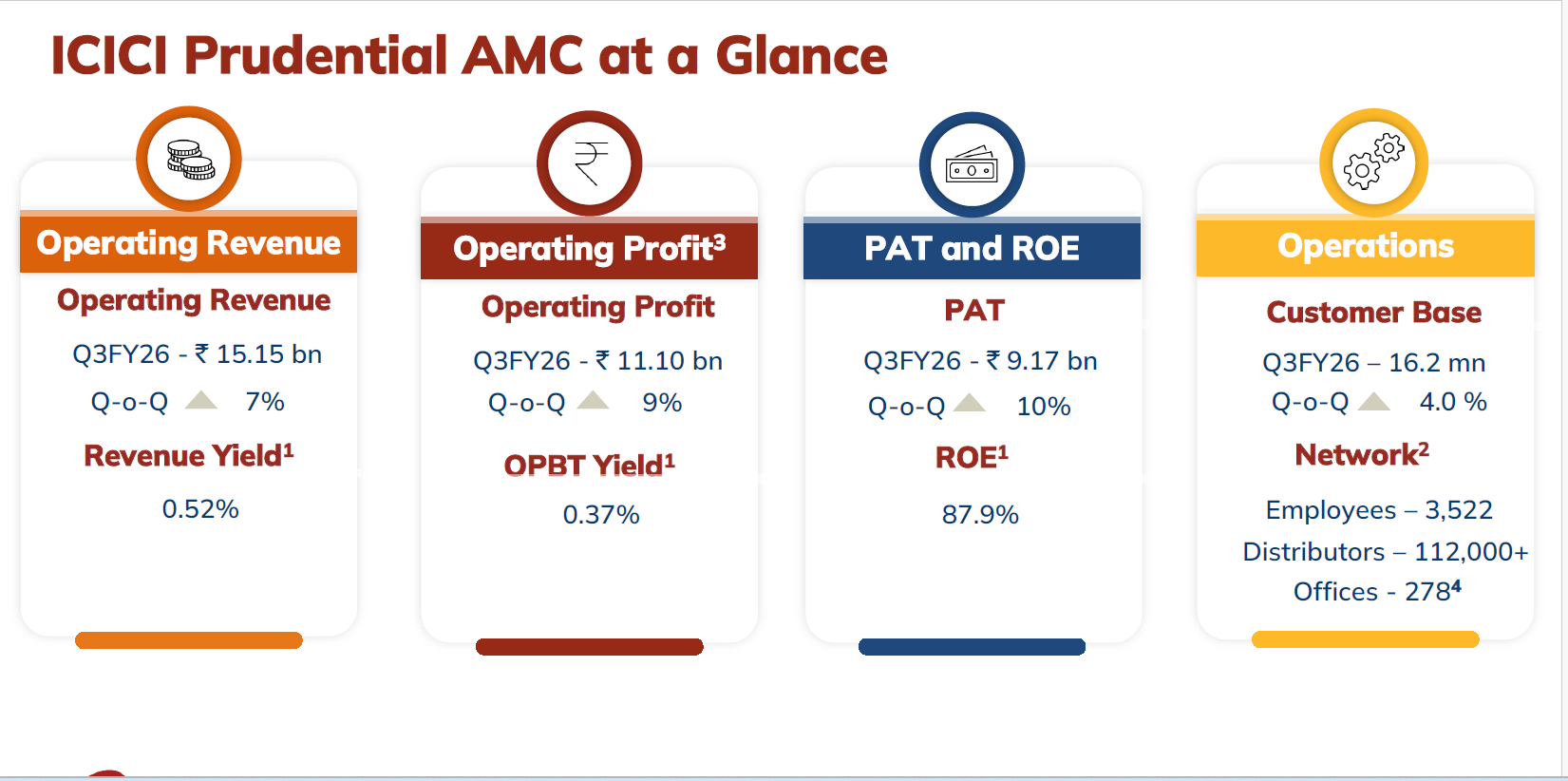
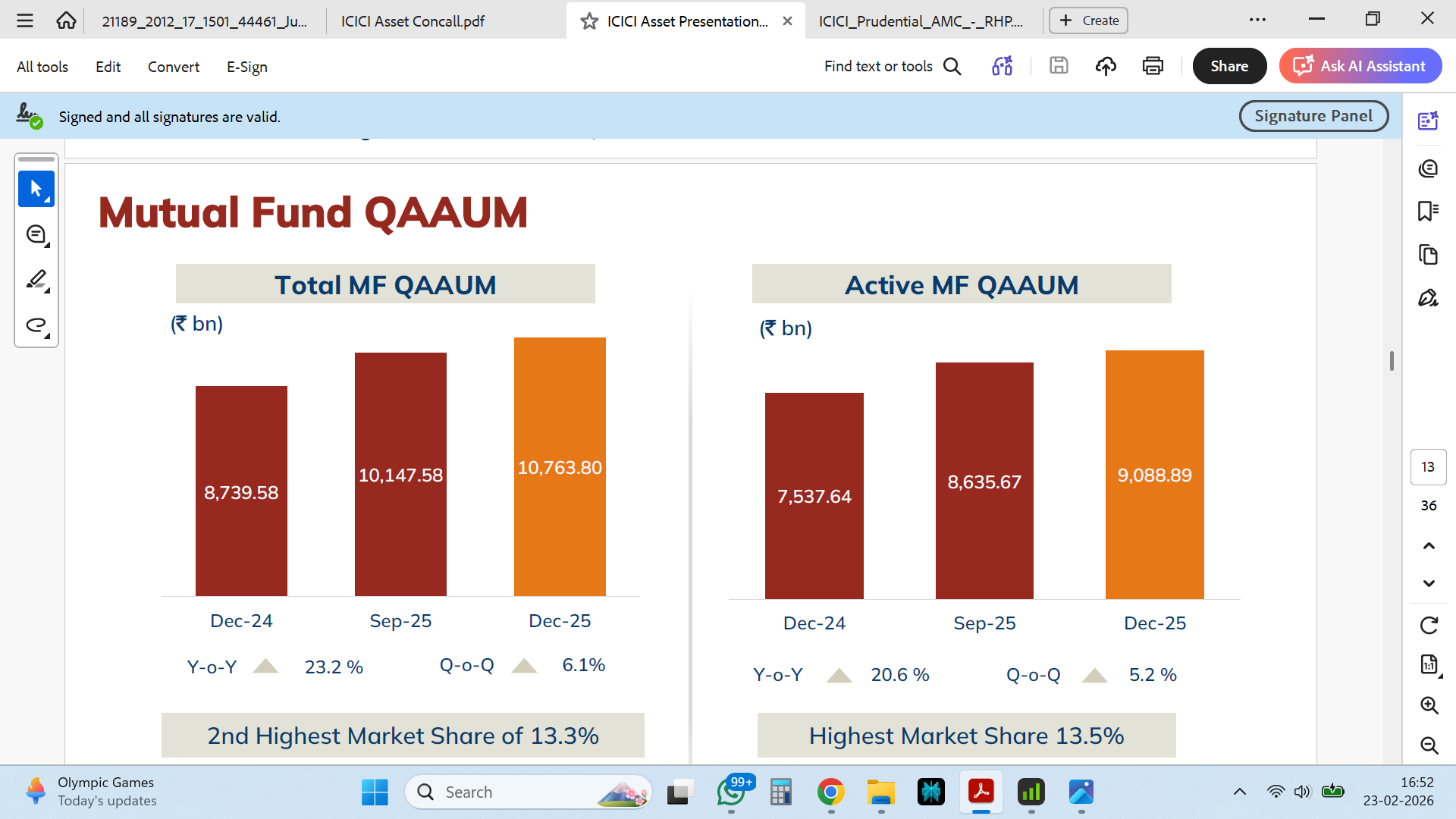
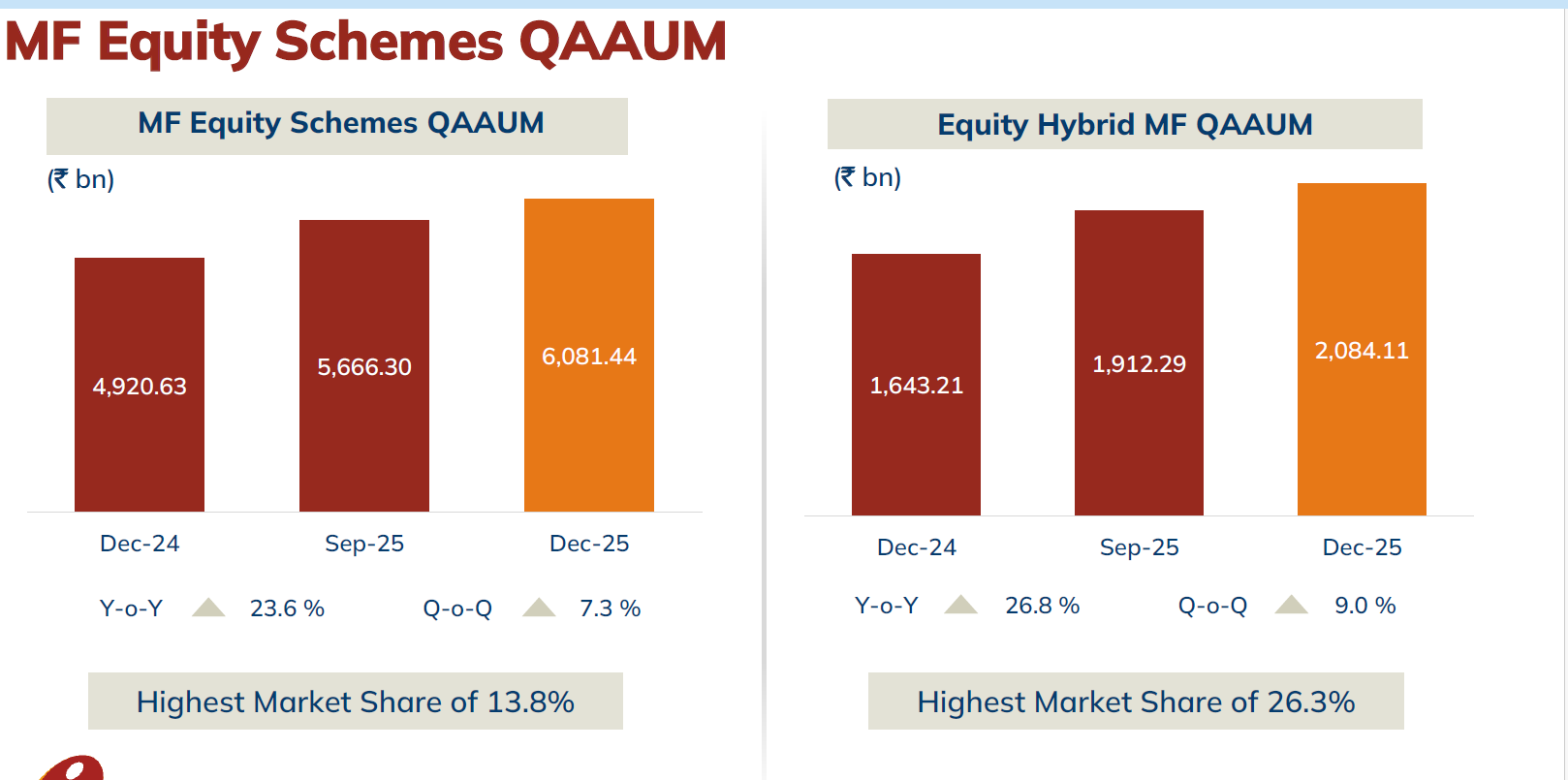
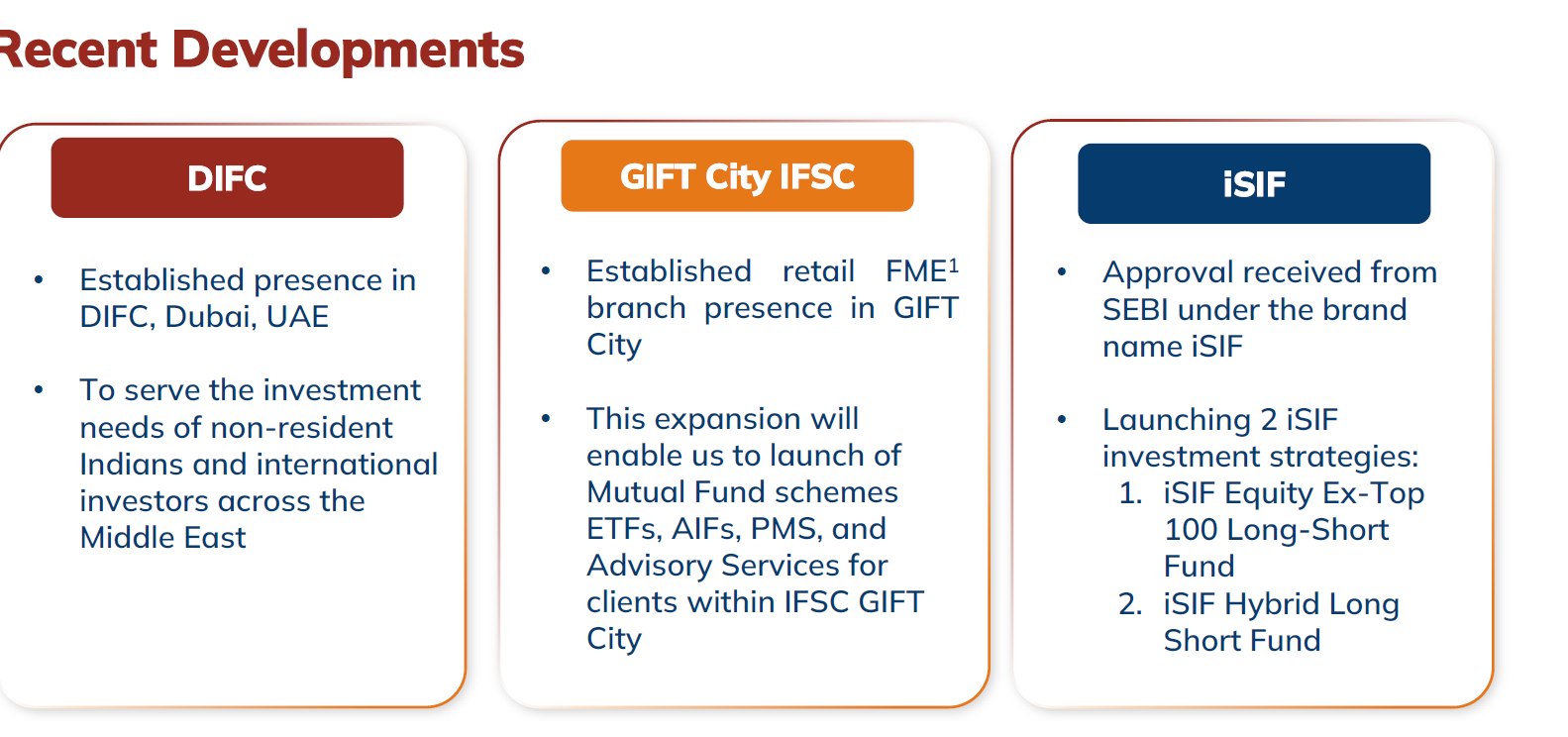
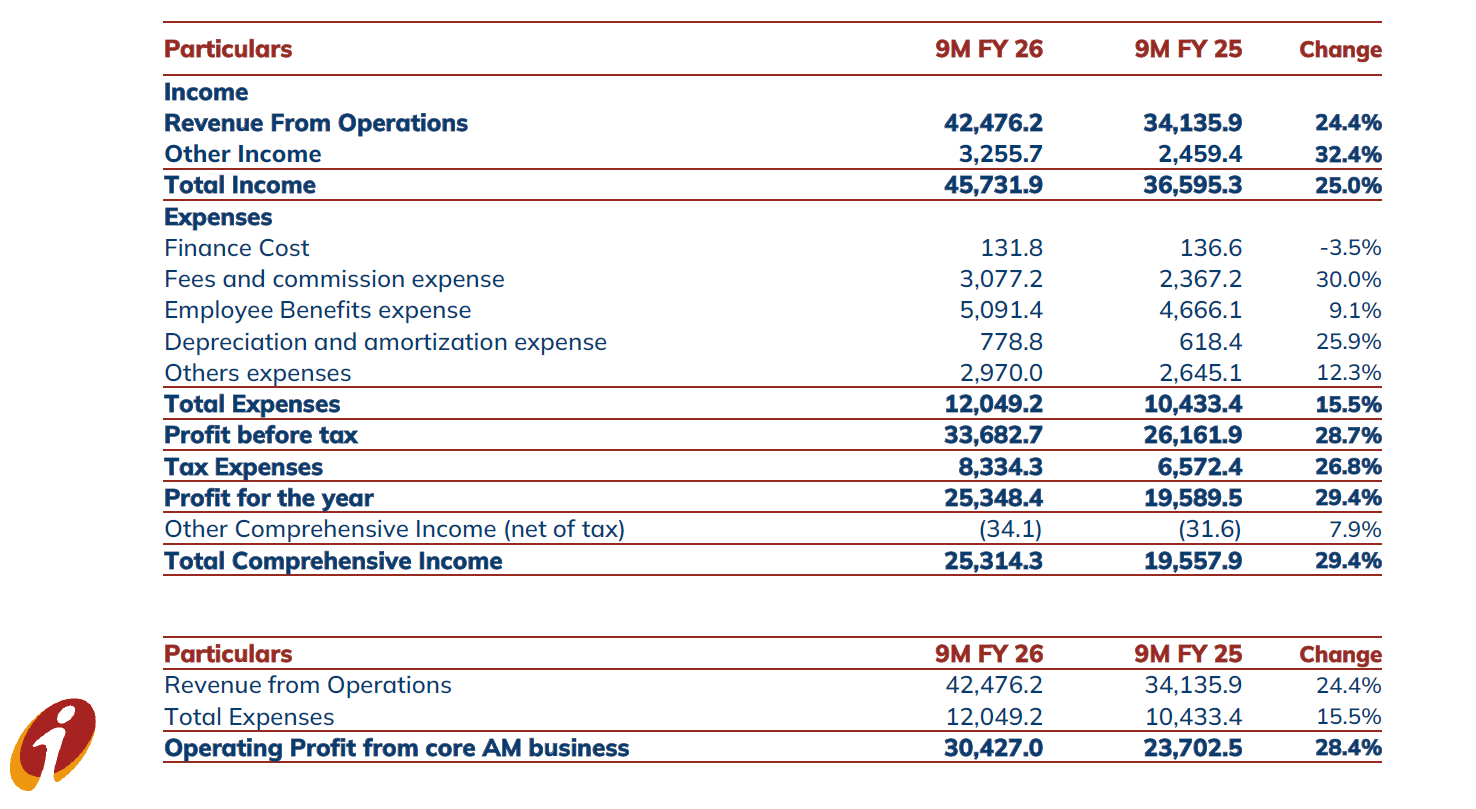
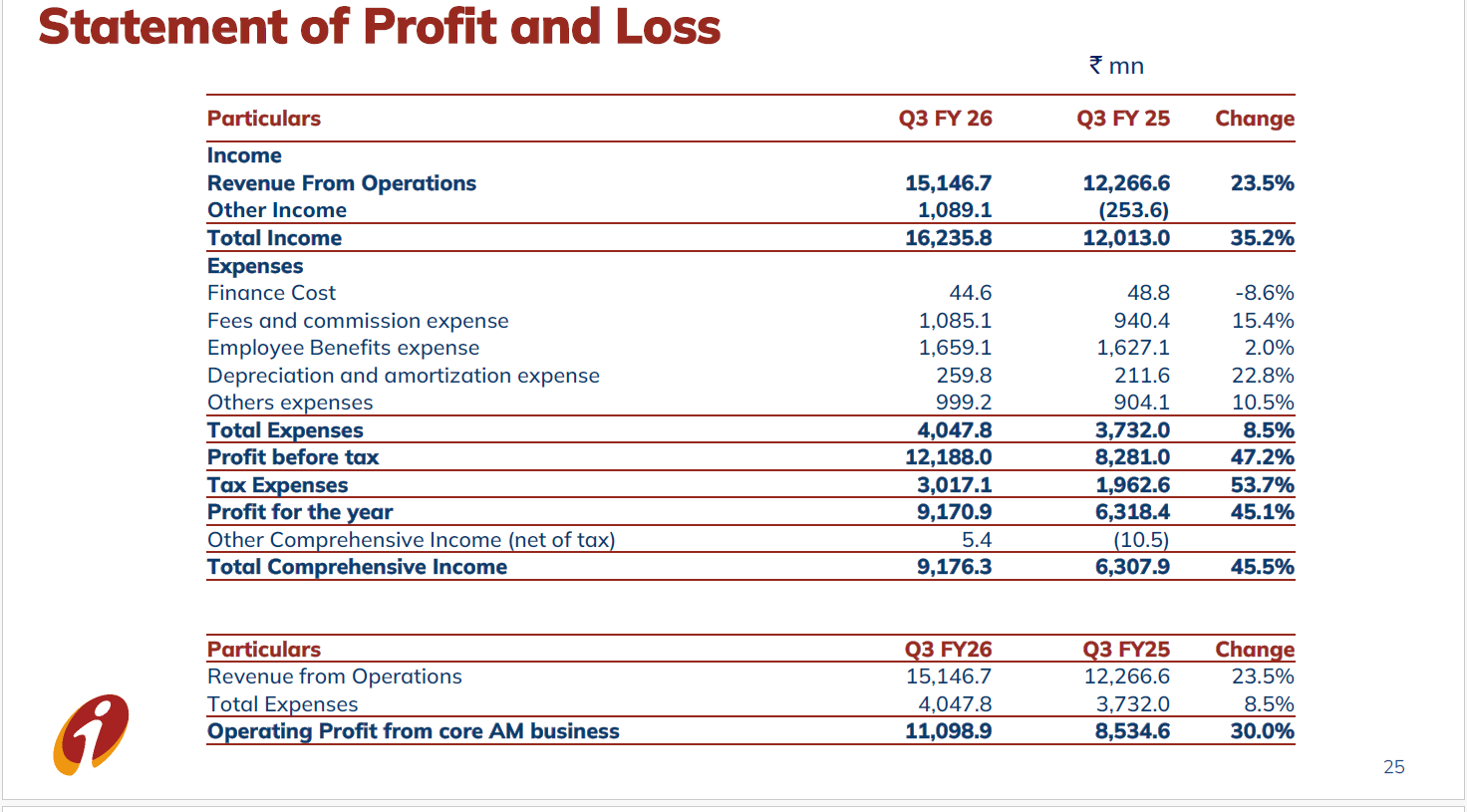
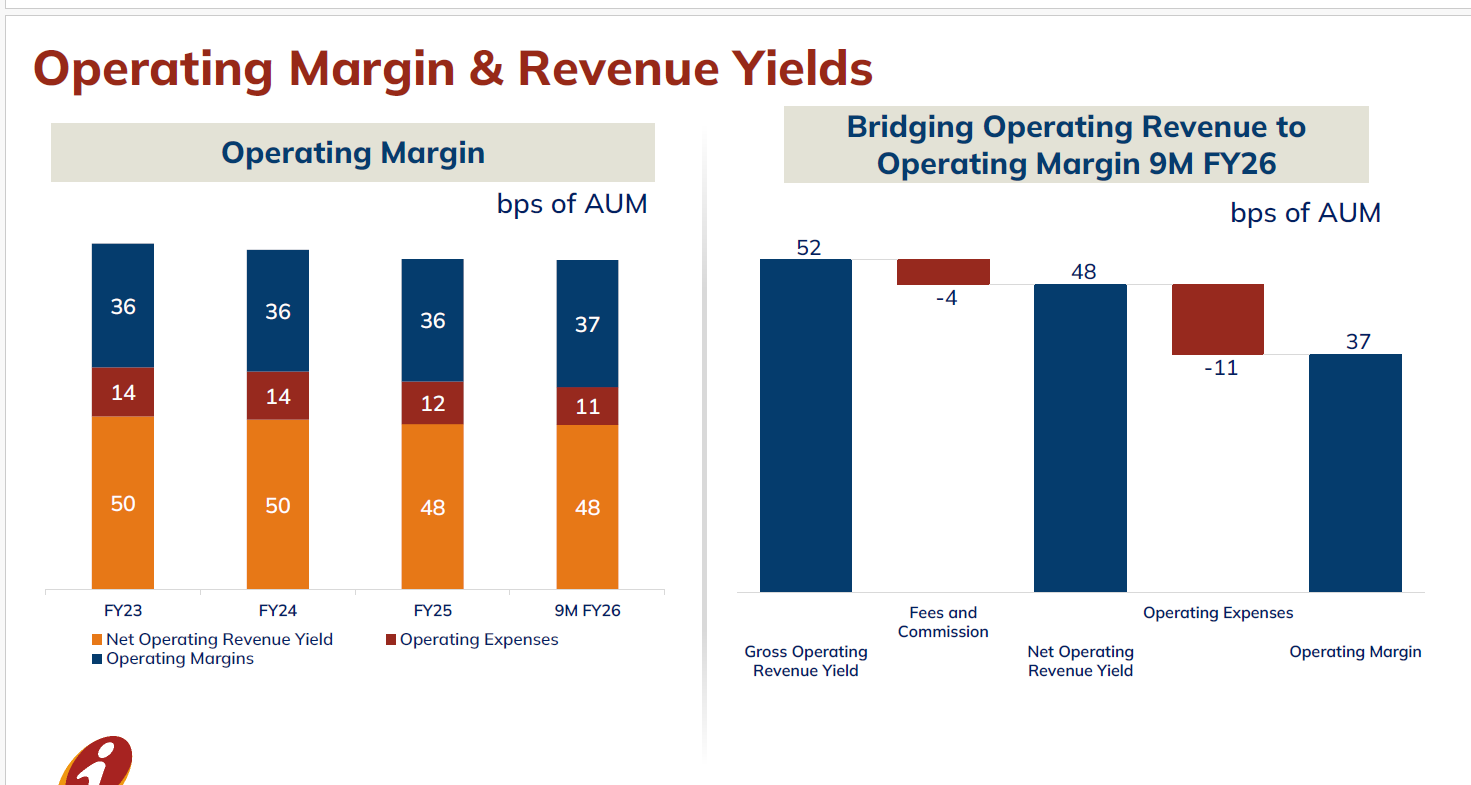
As the company has been recently listed, some of the data may be felt to be an inadequate sample.
• Compared to peers: Market-cap-wise this is larger than peers like HDFC AMC, and Motilal Oswal Financial Service (I have taken these three for comparison for no particular reason), with MCAP of 1,54,826, 1,16,848 and 45,896 respectively. At 52.6, its PE is the highest too among them. ROE of ICICI though is impressive 87.9%, as compared to the other two at, 32.4% and 25.2%. The EPS are 91.6, 18.0, and 9.42. Price to Sales are 31.1, 29.4, and 5.82.
Growth Catalysts
• As already mentioned, the growing equity cult is likely to propel growth.
• Though, investors may despair of equity investments, Asset Management companies are likely to diversify.
•
Red Flags to Watch
• Any of the top investment managers leaving may alarm the investos.
• If it is felt that the investments are made for other than bonafide reasons, the very raison d’être of investing in a mutual fund may be defeated.
•
Disclosures:
Mandatory :Invested in not only ICICI Asset Management, but also in the unlisted PPFAS. Biased towards, asset management companies in general.
Most of the information is taken from the company’s RHP and Q3 of 2026 presentation.
Disclaimer
Small and midcap stocks and recent IPO stocks carry higher risks due to their smaller size, limited operating history. This analysis is for educational purposes only and should not be considered as investment advice. Always conduct your own research or consult with sebi registered financial advisors before making investment decisions.
