HBL Power: Signs of change

My bad - I missed the point, though I was aware of the 20% developmental order rule.

So ~₹1,200 crore out of the ₹5,600 crore CLW tender would be developmental orders. The remaining ~₹4,400 crore should be distributed between HBL, Kernex, and Medha depending on the quoted rates and other factors.

Two more tenders from ICF and BLW are in the pipeline for finalization.

As per HBL’s commentary, the tenders are expected to be decided by the end of March, but it looks like we could see orders coming through by the end of January itself.

As Kernex has received order for more than 2000 cr, it appears order for HBL will be much less. Is it not very unfortunate? The company which has maxm performance as regards completion of earlier Kavach orders, is left with less orders? What are criteria?

3 Likes

not so good news from the company

https://www.bseindia.com/xml-data/corpfiling/AttachLive/74e9e4df-f19c-4bce-9f3d-a058dbad632f.pdf

What is your reasoning behind the above estimates that Kernex will get zero and very less qty in the other two tenders?

HBL latest announcement related to not getting anything in recent Loco kavach orders is a disappointing piece of news.

However if we look only at figures put out by management and actual reported segmental figures,

Segmental results of hbl point to electronics revenue of hbl

Q1 fy 26..180 cr
Q2 fy 26..794 cr

Total 974 cr

Full year figure provided in announcement for fy 26 at 1880 crores.

So in q3, q4 combined

Total execution expected

1880 cr minus 974 cr equals. 904 crores.

Above figure is valid if management does not change estimates provided for FY 26, for Kavach in latest announcement.

Things that can be considered positive going ahead would be

Firstly some kind of defense order announcement.

Any order awarded going ahead in future loco Kavach orders. (Includes orders from other tenders, retendering, etc)

Execution pick up in track, station kavach.

Besides these things, results remain key monitorable.

I do hope going ahead, management is much more communicative, and much more clear and coherent in their communications.

40 Likes

Sir , any idea why the management is guiding for only 1K out of possible 9.5K of yet to be finalized tenders(BLW and ICF and retenders) ?? Is it just another piece of overcautious guidance or something else ?

When a conservative management talks, it’s important you also “read between the lines”. My observations as under:

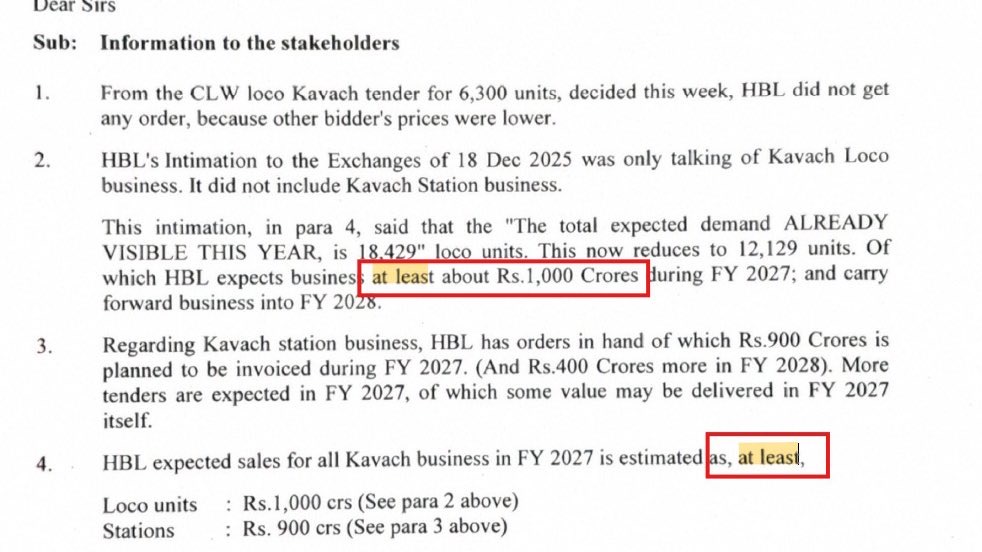
They used the phrase “at least” twice in the notification:

So.. who knows, the actual orders & hence the revenue may turn out to be better than what is perceived right now. :slightly_smiling_face:

Also, when a cautious management capitalises “ALREADY VISIBLE THIS YEAR”, it is important that you notice. They may be hinting that there could be additional demand/ more tenders coming, that is “not yet visible” or disclosed in the public domain.

Yes, I might sound speculative here.. but thats how the game is. You know things.. but at the same time, you never know! :slightly_smiling_face:

The management communication (improving lately) itself is the biggest positive here in my view.. a classic example of cautious disclosure behaviour.

3 Likes

In my opinion there is no reasoning. We are all guessing here. But from HBL letter it is clear that other players are undercutting HBL by quoting low. So technically Kernex can get more orders. But there is also a capacity issue. Railway may not want to put all eggs in few baskets as it is a safety issue. So HBL will get some orders. I don’t know the reason for their higher quote because margin was very high as per Q2 result. Let us wait and see how it unfolds.

5 Likes

These are tender based orders & does not follow the principal of equality. So I dont feel so ,this is going to happen.
They will get orders till the time they have capability n capacity to complete the order

1 Like

One thing which completely baffles me is HBL mentioning in their announcement that “other bidder’s prices were lower”.

Anyone who knows how previous KAVACH tenders were allocated would know that L2 and L3 are given an option to match L1’s price if the Railways wants to distribute the tender among as many vendors as possible. So this can either mean 2 things:

  1. That HBL was either L2 or L3 and that they refused to match L1 price
  2. Or HBL was neither L2 or L3 - this is impossible because there are only 3 approved vendors and even if HBL had quoted the highest price, then they will be L3.

So we can conclude that HBL refused to match the L1 price. We can safely say that Kernex was L1 because they have the highest allocation. If you read the Kernex’s order announcement then the contract is for 3024 sets for Rs 2465 Cr (incl. GST I presume). This is basically Rs 81.5 lakhs per set. What completely baffles me that the price is same as the previous CLW tender and yet HBL refused to match this.

So the question is why did HBL refuse to match this price?

And here I agree with @hitesh2710 bhai that the management should be clear in their communications. They would have known by mid Dec (when they made their previous announcement saying that 18k loco sets are in play) that they won’t be getting any part of the CLW tender. Because cost negotations happen at the time of financial bid opening, which would have happened a long time back.

23 Likes

Just wanted to know this station order of 900 cr + 400 cr, is it including EPC part i.e 30% shared with EPC partner or it is 100% of revenue will be recognized by HBL?

It may not be accurate to assume that HBL refused to match the L1 price. If that were the case, it would be hard to justify, since the L1 price is broadly similar to last year.

My suspicion is that HBL may not have been offered the opportunity to match the L1 bid at all, which resulted in no allocation.

Last year, in the CLW tender, orders were distributed among all three regular bidders. However, at that time, no OEM had Kavach 4.0 approval in hand so Railways went till L3 for distribution of units.

This time, the situation is different. There are now three OEMs with Kavach 4.0 approval and visible capacities. Railways may therefore not have felt the need to go beyond L1 or L2 purely for order distribution purpose, which is logical in my opinion as far as Tendering based procurement is concerned.

That said, these are only inferences. Only management can clarify the exact mechanics.

Management communication is ultimately subjective. Cautious commentary works for some investors, but excessive reliance on wordplay does not always help.

5 Likes

Theoretically, now of the remaining tenders BLW (2679 locos) and ICF (2400 locos), the maximum orders that HBL can get are for ~2400 units.

Here are the calculations and assumptions:

  1. HBL is L1 in both tenders.
  2. Total number of locos in play are 2679 + 2400 = 5079. Of these 80% are for approved vendors which is 4063.
  3. Lets assume that Kernex or Medha is L2 and there is no allocation for L3, like in the CLW tender.
  4. Split between L1:L2 is 60:40. So HBL can get a max of 60% of the remaining 4063 units. This roughly equals 2438.

The calculations are based on the order won by Kernex. 6300 locos were in play, 80% of this is for approved vendors. Which is 5040 sets. 60:40 split between L1 and L2 would result in 3024 sets for L1 and 2016 sets for L2.

8 Likes

A lot of assumptions are being made in various posts.

For purposes of sanity in this thread, please stick to facts and figures as far as possible.

We don’t want a thread based on a lot of assumptions, because after a point these stop adding any value.

51 Likes

Going through the messages in Kernex thread, it is clear that HBL has several things in its favour inspite of losing out in recent Kavach orders. They will have highest margin amongst all Kavach players due to inhouse BIU capacity, which is highest. Players like Kernex will have to obtain it from Wabtech. So we will have to wait for more clarifications from the management preferably during Q3 conference call.

10 Likes

Electronic Fuzes for Dummies

For HBL investors electronic fuzes are often mentioned but rarely explained clearly. Yet, the fuze is one of the most critical, safety-sensitive, and value-dense components in any ammunition. I was speaking with @niraj the other day and between us we could write a series of 2-3 posts talking about the functioning, the market opportunity and the revenue potential for HBL in the coming years. So here goes the first post.

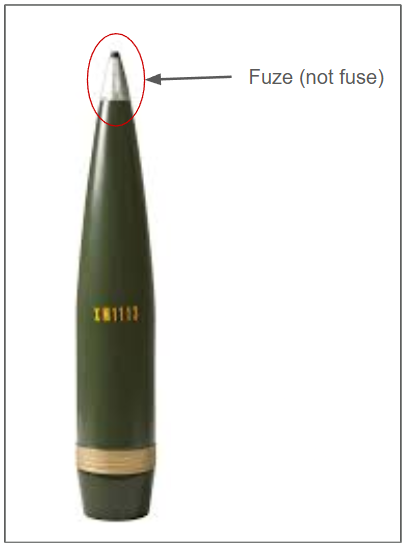
A note on nomenclature: It is spelled as “fuze” and is not to be mistaken for electrical “fuse”, which is a device which breaks an electrical circuit when a high current passes through it. “Fuze” is specifically used for a device which is used inside ammunition.

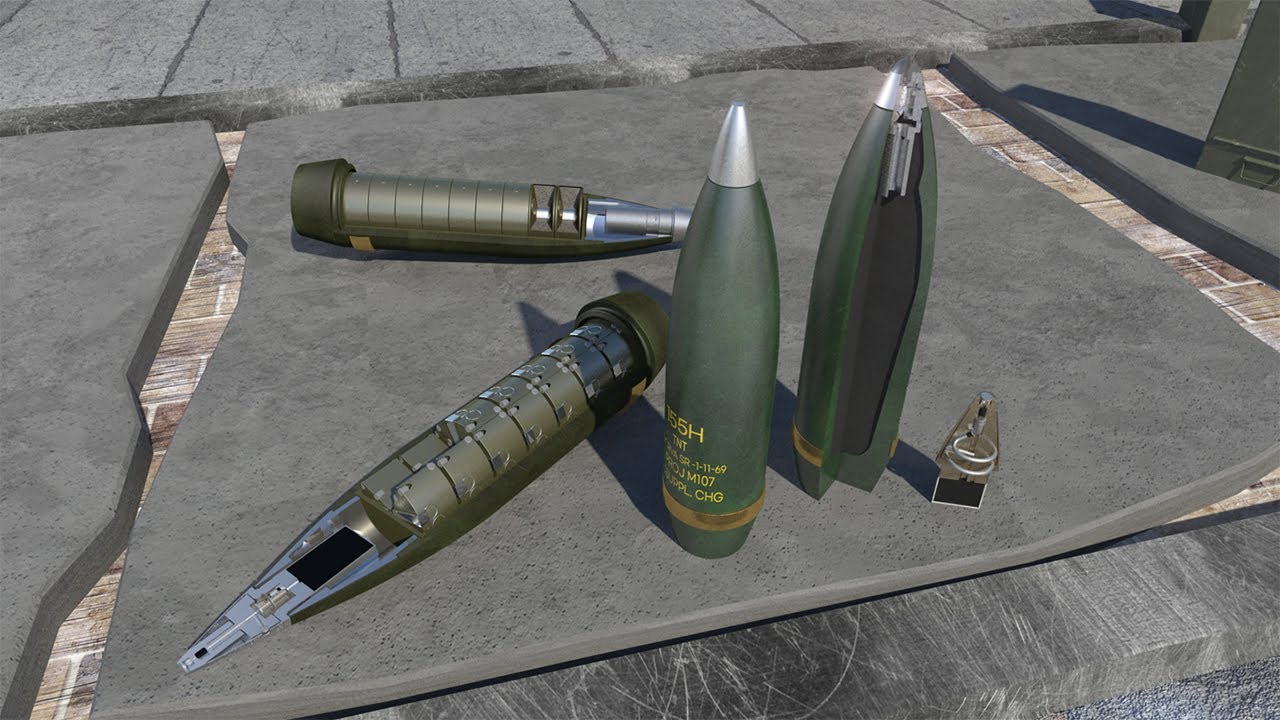
The fuze is almost always located at the top (nose) of any ammunition. Like in this picture of a 155mm artillery shell.

This post is structured into the following sections to build a clear, logical understanding:

  1. What is the fire train?

  2. Why is a Safety and Arming Device (SAD) required?

  3. Mechanical SADs or mechanical fuze functioning

  4. Problems with mechanical fuzes

  5. Why electronic fuzes are better?

  6. Critical items in electronic fuzes: the Micro-Electric Detonator (MED) and ampoule battery - what gives HBL the edge in this?

1. What is the fire train?

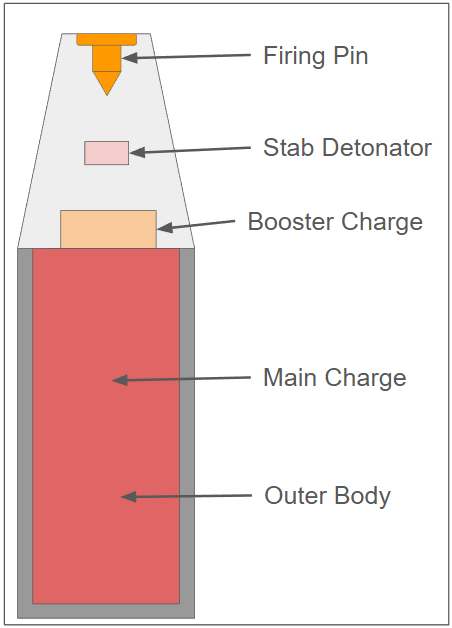
The fire train is the controlled energetic pathway that transfers initiation energy from the fuze to the main explosive charge.

Conceptually, it consists of:

  • Firing pin

  • Detonator

  • Booster charge

  • Main charge

“Charge” over here means explosive. It’s a term used in the defence industry. Here is an over-simplified image of a fire-train:

On impact with the target, the firing pin hits the stab detonator, which is an extremely sensitive explosive. It is sensitive to even tiny amounts of friction, force, impulse etc. So when the firing pin impinges on the stab detonator it immediately detonates and initiates the next explosive in line which is the booster charge which then initiates the main charge. The booster charge is required because the stab detonator in itself is not capable of initiating the main charge. All these elements together are referred to as the “fire train” and it is responsible for detonating the entire ammunition on impact with the target.

Like I mentioned above, the stab detonator is extremely sensitive to friction, impact or force. That is why it is called the “stab” detonator because you are literally stabbing it. If you were to take some of this in your hand and scratch it with your nails then it will detonate in your hand. Even an amount as small as 1 gram of this is sufficient for rupturing the hand and possibly taking off a couple of fingers. The other elements of the fire train - booster and main charge - are the exact opposite i.e. extremely insensitive. You could play hockey with balls made out of those or light them on fire and still nothing would happen. However when they detonate (when initiated by the stab detonator) they will create devastating consequences.

2. Why is a Safety and Arming Device (SAD) required?

Like we have understood above, the stab detonator is the weakest element of the fire-train. Now imagine these scenarios, what should happen to the ammunition if:

  • The vehicle carrying it meets with an accident, lets say a high speed head on collision with another vehicle

  • The personnel handling the ammunition accidentally drops it from his hand

  • There is a fire at the ammunition depot, where a large quantity of this ammunition is stored?

Should the ammunition detonate in these situations? The answer is NO. But the “stab detonator” in all likeli-hood will detonate under these conditions. This is where the safety and arming device (SAD) comes in. SAD is also referred to as “fuze”. We will use these terms interchangeably from here on. The key function of a fuze is:

The fire train must remain safe during storage, transport, and handling — and only become continuous under very specific, verified conditions.

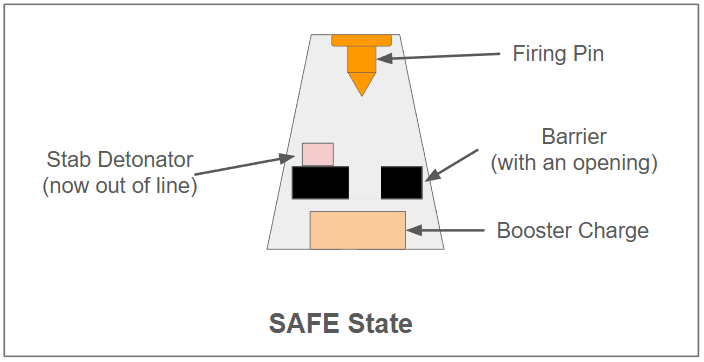
Since the stab detonator is extremely sensitive it is not put inline with the firing pin and the booster. It is kept “out of line”, so that even if it accidentally detonates the rest of the ammunition remains safe. Usually the booster charge and the stab detonator are separated by a metal barrier. The barrier has a small opening and the stab detonator is initially away from the opening. This is called the “SAFE” state.

When very specific, verified conditions of ammunition launch are detected then and only then is the stab detonator brought in line with the firing pin and the booster charge. In this state if the firing pin impinges on it then the ammunition detonates. This state is called as the “ARMED” state. And so these devices are called “Safety and Arming Devices”.

So what are these very specific, verified conditions? The answer is it depends on the ammunition. But for ammunition such as 155mm artillery shell these conditions are “shock” and “spin”. When these ammunition are fired from a gun they go from being stationary to a speed of around 900 m/s in a fraction of a second. The entire ammunition experiences a great amount of jerk or shock. Also when it comes out of the barrel it is spinning at an extremely high rate, around 15,000 RPM!

The job of the fuze is to detect the shock and spin, only if they are experienced simultaneously and of a certain magnitude then “ARM” itself.

3. Mechanical SADs or Fuzes

Historically, SADs were implemented using purely mechanical means, such as:

  • Springs and sliders

  • Rotors and shutters

  • Setback and spin-based mechanisms

These systems rely on physical forces generated during launch to:

  • Remove safety blocks

  • Align explosive elements

  • Enable the fire train

Mechanical fuzes dominated for decades because they were:

  • Understandable

  • Manufacturable with older technologies

  • Relatively low cost

Many are still in service today. You can watch this video to understand more:

4. Problems with Mechanical Fuzes

While proven, mechanical fuzes have structural limitations that become more visible in modern warfare and procurement environments:

a) Limited Precision and Repeatability

Mechanical systems are sensitive to:

  • Manufacturing tolerances

  • Wear and tear

  • Environmental variation (temperature, vibration, aging)

This leads to performance scatter, which militaries increasingly dislike.

b) Constrained Functionality

Adding features such as:

  • Multiple modes

  • Variable delays

  • Environmental discrimination (the very specific, verified conditions) quickly increases mechanical complexity and failure risk.

c) Safety Scalability Issues

As safety standards tighten, achieving multiple independent safety barriers using only mechanical elements becomes bulky, heavy, and expensive.

d) Obsolescence Risk

Mechanical designs are harder to upgrade once fielded. Every upgrade or re-design requires thorough testing in all kinds of conditions and this results in long procurement cycles.

5. Why Electronic Fuzes Can Solve These Problems

Electronic fuzes replace many mechanical decision-making elements with sensing, logic, and controlled actuation.

a) Deterministic Safety Logic

Electronic systems can require multiple independent conditions to be satisfied before arming — not just a single physical event. This dramatically improves safety assurance.

b) Multi-Function Capability

A single electronic fuze design can support:

  • Point detonation (on impact)

  • Delay post impact (if you want the ammunition to detonate after penetrating a bunker)

  • Proximity (detonate in close to the target where a direct hit may not be achievable. E.g. in anti-aircraft or anti-drone ammunition)

  • Time-based functions

This creates platform reuse, a major commercial advantage.

c) Environmental Robustness

Electronics allow compensation for:

  • Temperature

  • Launch profiles

  • Storage aging

Result: more consistent battlefield performance.

d) Upgrade and Differentiation Potential

Software-driven logic allows:

  • Customer-specific configurations

  • Future upgrades

  • Differentiation without full mechanical redesign

This is where margins and long-term contracts often come from.

6. Critical Items in Electronic Fuzes - Where HBL has an edge

Two components largely define the credibility and technical depth of an electronic fuze manufacturer.

Micro-Electric Detonator (MED)

In electronic fuzes instead of the “firing pin” + “stab detonator” combo you have the MED. It is the interface between electronics and booster charge. It is basically a detonator which initiates on giving an electrical input (voltage/current).

Its importance lies in:

  • Extremely high reliability requirements

  • Tight control over sensitivity

  • Immunity to stray energy, electromagnetic interference, and ESD (static electricity)

  • Consistent output over long storage life

Few companies master this well — which creates defensible competitive moats. HBL has successfully developed its own MED.

Ampoule Battery

Electronic fuzes require power — but only after launch. Ampoule batteries play an important role in this. They have the following characteristics:

  • Remain inert during storage

  • Activate only under launch conditions

  • Provide reliable power for milliseconds to seconds

Their value is not in energy capacity, but in:

  • Absolute reliability

  • Environmental stability

  • Zero leakage risk during decades of storage

In-house ampoule battery capability is a very high barrier for entry.

Very few companies supply these 2 components on a stand-alone basis. If you manufacture these 2 then you may as well manufacture the entire fuze. In my knowledge there is only 1 South Korean company which supplied the ampoule battery as a standalone item. And a handful of companies across the world which supply the MED as a standalone item. Having indigenized these 2 components, HBL stands out in the electronic fuze game it is the only Indian company with 100% indigenization.

Over to @niraj to talk about the market potential and potential revenues from electronic fuzes.

58 Likes

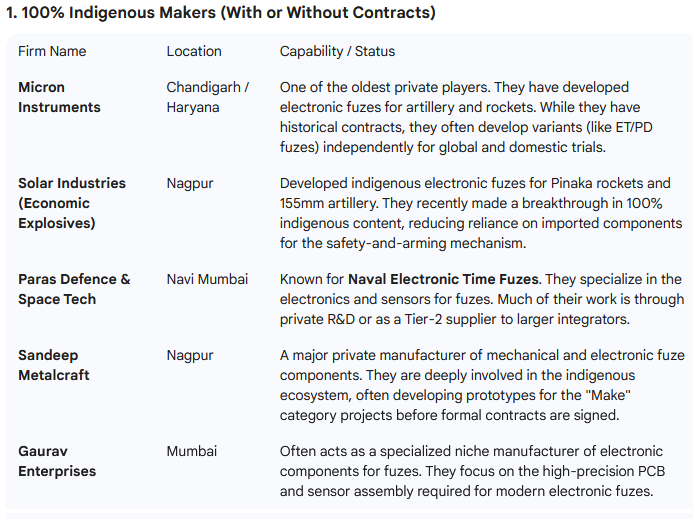
the thing about fuzes is that, there are a number of companies that are now making it and/or making it for others(BEL). Even HFCL maker of optical fibers are into it. And anyone like Adani will also be in it. Adani went all in into automated factory making of bullets, shell casing etc when they saw an opportunity in the way PSUs were using outdated tech.

back to HBL, they may have a good product but the margins are not going to be great because the list of electronic fuze makers that are empanelled and those waiting are large in number.

8 Likes

You have rightly pulled out a list of companies working on fuzes, not necessarily electronic fuzes. Some of them are fuze component makers. You need to dig deeper into specific products that they manufacture, to really know if they can build a 100% indigenous electronic fuze.

Also, the list looks like it is compiled by an AI tool (ChatGPT?). If yes then be wary of information supplied by such tools. Very often it is inaccurate and misses out finer details. And definitely don’t base your investment decisions on them.

Lets go one by one:

  • BEL: In December 2023, the Ministry of Defence signed a ₹5,336.25 crore deal with BEL to supply electronic fuzes for the Indian Army over a 10-year period. They have a tie up with an Israeli company Reshef Technologies. Critical components come from Israel (read ampoule battery, MED and some other stuff). Bharat Electronics and Reshef Technologies, Israel, sign MoA to execute Long Term Make in India contract for Electronic Fuses. Infact BEL & Indian Army were after HBL to procure ampoule batteries from them. The HBL Chairman even mentioned this during the recent AGM. HBL firmly said no and explained that they are in the business of selling systems and not components.
  • Micron: I know this company very well. They have been operating for the past 50 years in fuzes, but all these are mechanical fuzes. Checkout their product portfolio here - I am unable to post their website link because of some technical error with the forum. Here is the broken link microninst(dot)com/services/defence/ . Replace “(dot)” with “.” The “About Us” page on their website says this - “Micron specialises in complete mechanical manufacture covering tool design …”.
  • Sandeep Metalcraft Purely mechanical fuzes. I have visited their factory and know their product line. They mainly manufacture legacy Soviet origin mechanical fuze components and supply them to the ordnance factories (govt owned). Website: sandeepmetalcraft(dot)com (Replace “(dot)” with “.”.
  • Paras Defence & Space Tech: I don’t think they are into artillery or other gun launched ammunition fuzes, where ampoule battery is required. If you can cite some credible sources then that would help. As far as I know they are a “Make-in-India” shop for foreign companies and mainly a system integrator. Please see their latest * investor presentation from June 2025, fuzes are nowhere mentioned.
  • Gaurav Enterprises: Never heard of them. They maybe a component supplier.
  • Solar Industries: Of all the companies that you have listed this one has the financial wherewithal and the right connections to secure orders. However their strength is explosives. Not battery chemistry. If they can source ampoule battery from somewhere then they can definitely make electronic fuzes. They mainly work as a system integrator and procure tech from other smaller companies. The AI tool is possibly confused due to this (and similar) news article - * Solar Group’s Economic Explosives Ltd Creates History With 100% Indigenous 30mm HE Ammo For Indian Navy’s AK-630s! However this was a mechanical fuze. And they possible source components from manufacturers like Micron, as mentioned above.

The list is long, however none of them manufacture their own ampoule battery. And hence won’t be able to compete with HBL on pricing. With imported batteries their pricing will always be higher than HBL. Infact HBL can even eat into the market share of western fuze manufacturers in the global market because their lower cost of manufacturing.

44 Likes

The 2 companies which I forgot to address in my previous post.

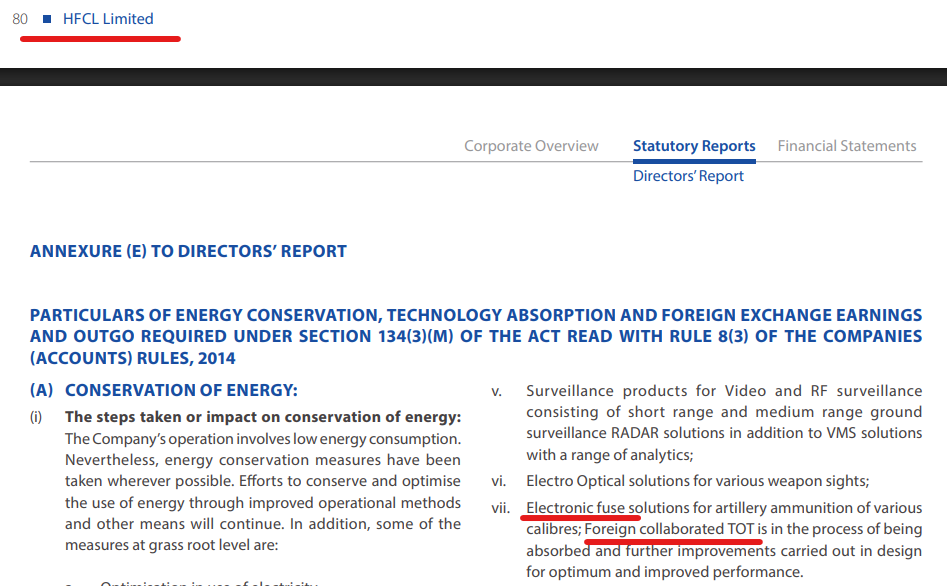
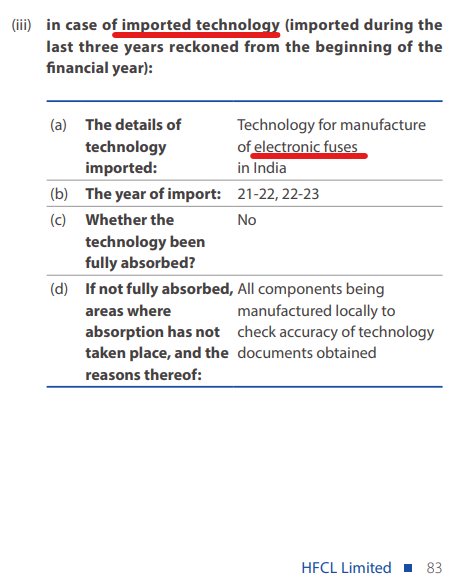
  • HFCL: I have seen their stalls at various defence exhibitions. They have been putting electronic fuzes for 155mm ammunition on display at these stalls, apart from many other products. They have also claimed that they have done trials with the Indian Army. Their tech is a transfer-of-technology from a foreign company. This is stated in their annual report. They are definitely a competitor, just like BEL which has partnered with an Israeli company. Without inhouse components like ampoule battery and MED, pricing will be a challenge for them. Here are screenshots from their FY23 annual report
  • Adani: Adani’s strength is capital and you have rightly pointed out that they have eaten into govt owned ordnance factory’s market share for manufacturing of small caliber ammunition. However none of those ammunition uses electronic fuzes. Having said that, If they decide they can enter any product segment in defence because of their capital. Their approach is to have strategic partnerships with foreign OEMs and leverage their experience in difficult-to-operate industries such as mining, energy etc. to manage large scale manufacturing. But its not just about capital, its about reliability, precision and deep expertise in battery chemistry. Fuzes are safety critical items. A mishap can lead to loss of lives or damage to infra. Batteries used in fuzes need to provide consistent performance even after long periods of storage like 10-15 years. You cannot throw money at such problems and fill the technology gaps overnight. This is where HBL has an edge.
23 Likes

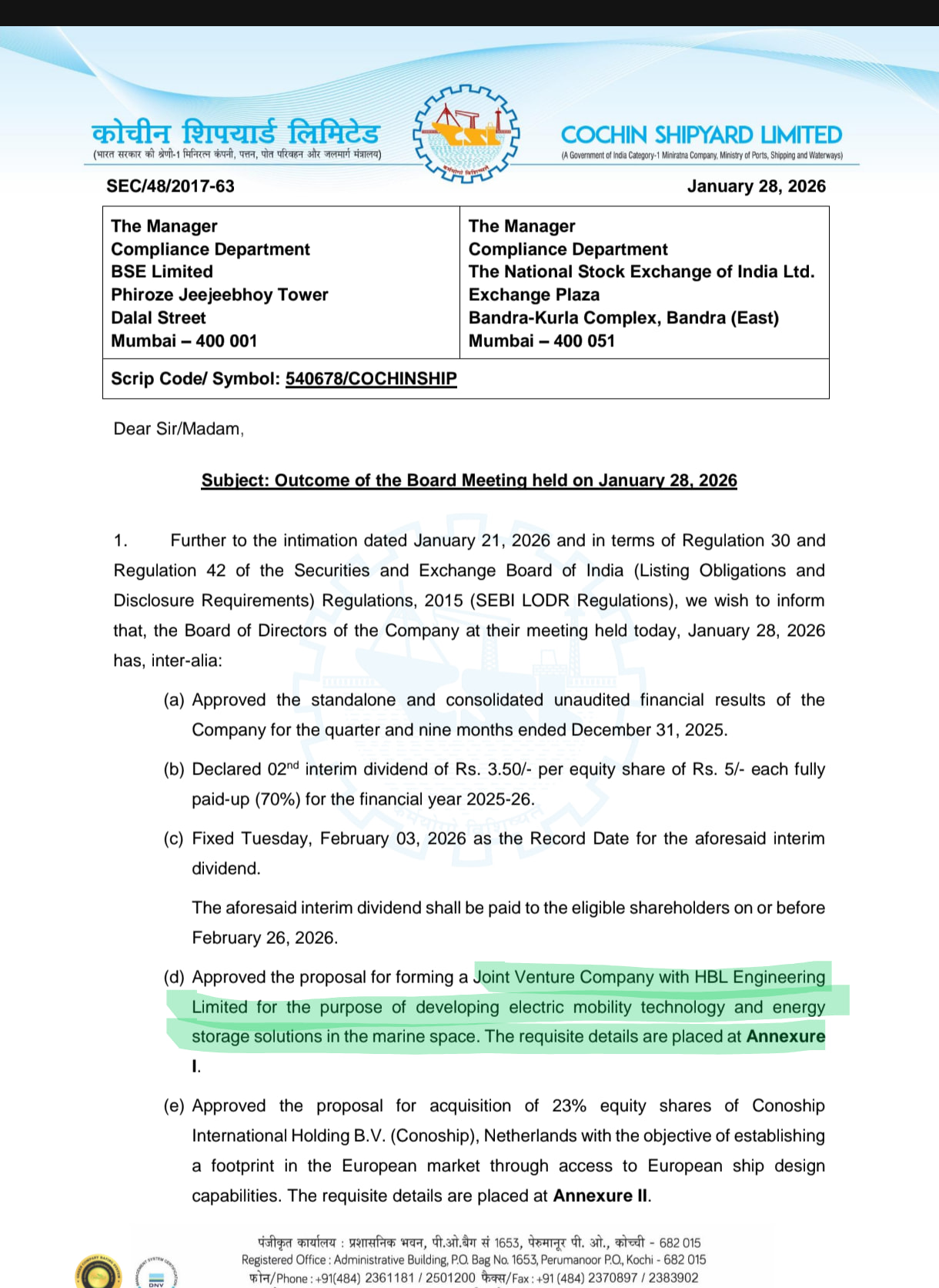
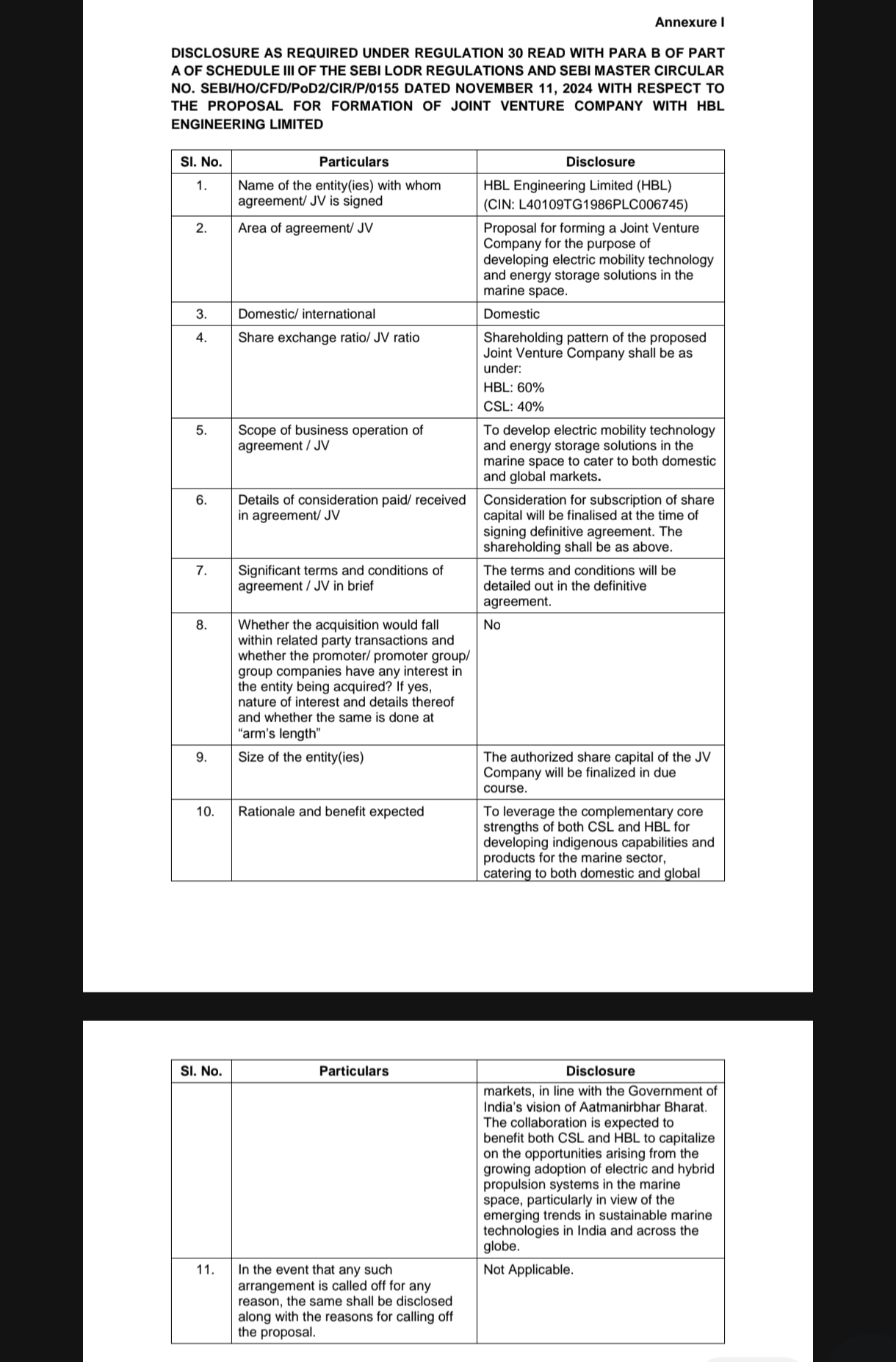
HBL and Cochin Shipyard forming JV for developing electric mobility solutions and energy storage solutions in marine space.

24 Likes