Great articles to read on the web

We can’t access them per se. They are expensive even to some institutional guys. But by reading those free reports, we can think like short sellers and apply our learnings in the Indian context to analyze structural issues in businesses.

My intention was not to promote any firm. I took their framework and sample report from their website which is in public domain and is free.

My rationale for the post was how to think like OWS to identify fundamental business and accounting problems on companies we research on, how to avoid the sell side analysts earnings consensus and when not to believe guidance given by the management.

4 Likes

I feel that their “SHORT FRAMEWORK” is a guide which can help investors identify Business which is declining and/or loosing market share but Market has not yet identified those signals.

I can relate this framework to quite a few Indian companies during 2000-2025, where there were few signs of issues which remained unidentified and suddenly those bad practices were exposed and Stock Prices collapsed. E.g. Satyam, IL&FS, Yes Bank, and many cases which are still there which are protected / hidden currently.

It is not possible for Retail Investors to identify all such Red Flags but such frameworks seem to be useful to some extent.

what is his current market views?

Michael Burry’s market view for 2025 has shifted from bearish bets in early 2025 to a more bullish stance in Q2 2025. He has dismantled his earlier put option positions on major U.S. and Chinese tech companies and rebuilt his portfolio with long equity positions and deep in-the-money call options.

The key sectors he is now betting on include healthcare, consumer discretionary, technology, and selective global e-commerce. His top stock bets in the USA market and globally are:

  • UnitedHealth Group (UNH) – large call option position emphasizing healthcare’s defensive qualities
  • Regeneron Pharmaceuticals (REGN) – biotech leader with a strong drug pipeline
  • Lululemon Athletica (LULU) – consumer discretionary brand with pricing power
  • Meta Platforms (META) – tech platform pivoting to AI monetization
  • Estée Lauder (EL) – luxury beauty brand, with both equity and call option holdings
  • Bruker (BRKR) – healthcare instruments company (direct equity buy)

Additionally, he holds call options on Chinese tech names Alibaba (BABA) and JD.com (JD) signaling a reversal from bearish to opportunistic positions there. He also has positions in ASML (chip equipment), VF Corporation (global apparel), and MercadoLibre (Latin American e-commerce).

In summary, Michael Burry’s 2025 market views show a marked pivot to selective opportunities in healthcare, consumer brands, technology enablers, and global markets with durable competitive advantages and strong balance sheets for stability amid macro uncertainties.

3 Likes

I wouldn’t read too much into Burry’s positions because for one he loves to trade. In March 2025, he sold his entire portfolio and bought 7000 NVIDIA puts whose national value was in hundreds of millions. Liberation day was announced and NVIDIA was down 15% for a couple of days. He sold them for a profit then. Until that quarter, he was bullish on Chinese stocks like JD and Ali Baba. He sold them. In fact she shorted them! Can you imagine? Being long for Q1 and immediately short for Q2!

As of Q2, Calendar 2025, one of the biggest holdings in his portfolio is United Health Group. It prima facie looks like a classic Burry contrarian bet.

Fun fact: Another small, lesser known investor bought United Health Group during the same period. I keep forgetting his name. Some Warren, Warden or something amongst those lines.

My point is, analyzing whether Burry is bearish or bullish through his holdings is useless. He loves to make short term bets and he changes his mind often. Trust me, the first thing I do after every quarter is check the 13-F filings of Scion Asset Management. He will be fully invested in one quarter, buy long calls and be completely sitting on cash the very next quarter with NVIDIA puts.

4 Likes

Such predictions are futile in my opinion. You never know “when” an ongoing uptrend might reverse. Obviously it’s a crowded trade but it’s crowded for a reason and it’ll reverse for a reason too. But till then, smart approach is to keep riding the momentum and be watchful for signs of reversal instead of trying to predict it.

Good Article in today’s Economic Times after long time : It talks about the complete disconnect between Indian market and on the ground reality. It also narrates how the bottom line growth (multifold times) of the businesses was reflected in the markets during 2004-2007. Now there is disconnect between bottom line growth and markets, as market keep moving up without any fundamental improvement in the bottom line. Mainly applicable to Top 500 stocks driven by hope of retail investors through massive SIP flows without any real EPS growth. (This may continue like this for many years but article is quite useful.)

6 Likes

The threat of the bluff is often more powerful than the bluff itself. If people know you never bluff, they’ll run you over. If they know you always bluff, then they’ll call you down light. The optimal strategy is to bluff just enough that they have to respect it. In life, this translates to strategic ambiguity. Sometimes it’s better to let people wonder about your capabilities rather than proving them.

The key is being intentional about what you reveal. Your capacity to bluff is an asset. Don’t waste it on small pots. Save it for the moments when strategic ambiguity can change the entire trajectory of the game.

The second company in a space learns from the pioneer’s mistakes. The last person to make an offer in a negotiation knows everyone else’s range. Sometimes there’s a first-mover advantage, but often the real edge comes from moving last.

once you see life as poker, not chess, you realize something. Chess has a correct answer. There’s always an objectively best move. Poker doesn’t. Poker is about playing your hand optimally given your bankroll, your position, and your read on the table.

This means there’s no universal playbook for life. The optimal strategy for you might be terrible for me. And that’s liberating. Stop playing chess, searching for the “right” move. Start playing poker. Make the best decision you can with incomplete information, size your bets appropriately, and trust the process over enough hands.

20 Likes

Really nice read, thanks for sharing. I’ve made some notes that I would like to share:

Life isn’t chess (fixed rules, perfect information, always a best move). It’s poker (incomplete info, uncertainty, psychology, timing, and risk management). Success comes not from being correct all the time, but from making strategically balanced decisions under uncertainty and projecting just enough ambiguity that others have to respect your moves.

Possibly this is how I would apply this in my Life & Career :)

During negotiations: Keep your range ambiguous; don’t reveal your maximum or minimum immediately. Let people guess your range.

Leadership: Be consistent, but not entirely predictable, retain optionality. Keep some moves up your sleeve.

Personal growth: Stop waiting for the perfect plan or perfect time, which may never come; act, iterate, and adjust. Take action with the best info you have now, adjust along the way. As Bezos says, take action when you are 60% ready, don’t wait for 100%

Process > Outcome: Focus on making the best possible decision with the info you have. Over enough “hands,” good process wins.

Risk-taking: Size your risks relative to your resources. Don’t go all-in emotionally, financially, or professionally unless the pot is worth it or when the stakes truly matter.

Manage energy, money, and reputation like poker chips.

Whatever position you sit (career stage, market timing, relationships) matters as much as what you hold.

Develop emotional intelligence; success is often about people, not just logic.

This “life as poker” mindset is one of the most realistic and empowering mental models I’ve seen. Chess is for perfectionists; poker is for strategists who thrive in uncertainty. Life is too messy for chess :)

Thanks again for a great share :)

11 Likes

Great to hear such words of wisdom. I know how to play chess but don’t know how to play poker. Anyway this post teaches us lot and definitely help me in making informed decisions in future.

1 Like
1 Like

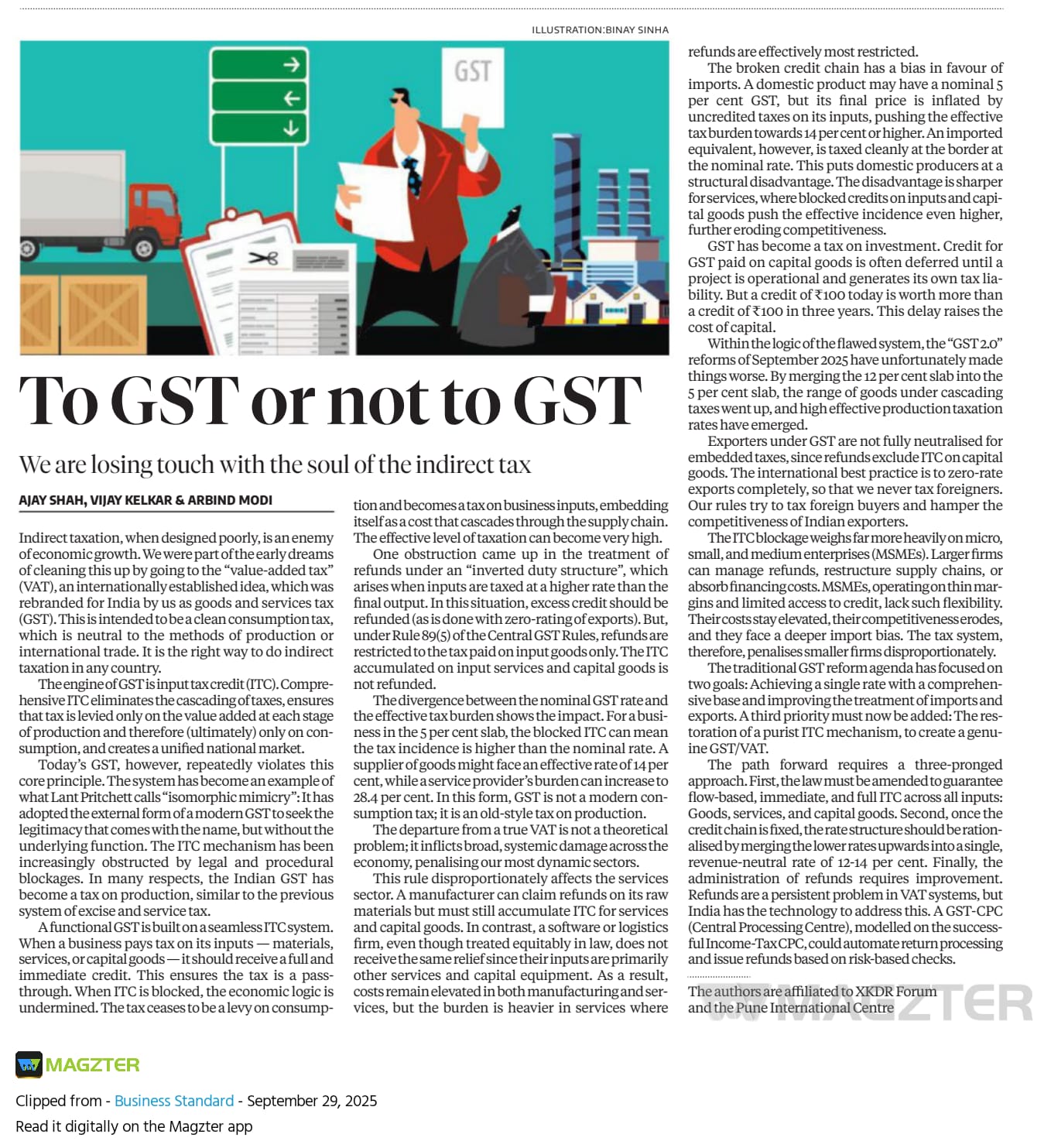
This one from today’s Business Standard, a critique of GST which has degenerated into a tax on production and investment, as opposed to a tax on consumption as it was designed to be. Nicely analyzed

8 Likes

Agree with GST reforms. But for India, GST was required to plug the tax evasion happening in the supply chain especially at the lower ends. Only taxing the consumption wouldn’t have achieved this.

3 Likes
5 Likes
2 Likes
1 Like

Wisdom of Charlie never cease to inspire and educate me. I see him as a wise old sage from our puranas providing us with the blueprint on how to think better, avoid fallacies and lead a better life in this present modern day chaos.

I enjoyed the below video - hope you do too.

6 Likes

excellent, thanks for sharing sch a insight

1 Like

Safal Niveshak: Better Roughly Right Than Precisely Wrong

The article argues that in investing it’s wiser to be roughly right than precisely wrong, warning against false precision. (Precision is often confused with accuracy; a precise number isn’t necessarily useful or correct in uncertain domains like markets)

Businesses evolve with people, competition, and cycles, defeating precise forecasts. So overreliance on formulas risks mistaking precision in messy business environments.

The real edge is “intellectual humility”. Sitting with uncertainty, and leaving room for error via “margins of safety”.

6 Likes
3 Likes