I have a question related to close relatives of “promoters” being classified as “public” holders. As per BSE page ( Shareholding Pattern Public ShareHolder ) Aishwarya Arvind and Lakshmi Kaushik are part of “public” in share holding. However, as per Emudhra’s last annual report in BSE website, on page 323, they have been classified as “key management personnel”. As per SEBI regulation ( SEBI | Securities and Exchange Board of India (Issue of Capital and Disclosure Requirements) Regulations, 2018. ), my understanding is immediate relative of a promoter should be classified as a promoter too. On page 5 we have:
(pp)
“promoter group
” include
s
:
i)
the promoter;
ii)
an immediate relative of the promoter (i.e. any spouse of that person, or any parent,
brother, sister or child of the person or of the spouse);
Can the persons mentioned above be part of “public” in share holding? I am sure I must be missing something. I just wanted to know more about regulations that govern these classifications.
I was casually tracking this stock for a bit. Ended up using them to get a DSC token and while the initial transaction was seamless the support and implementation was really awful. Their execution steps aren’t accurate and customer service calls takes 20/30 mins to reach an agent. Not sure how the enterprise side support is but I think this is important for a company to get right.
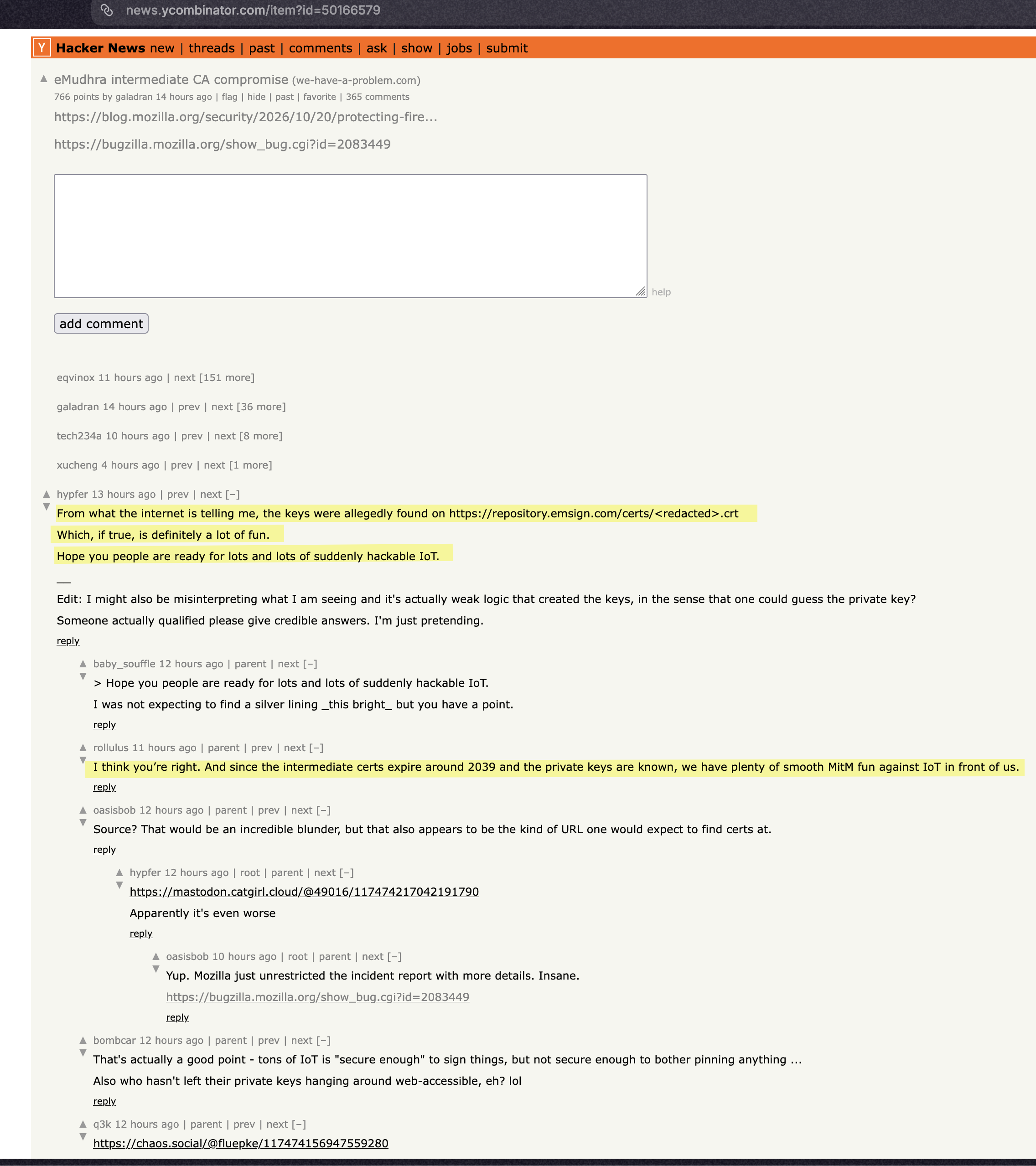
The private keys of eight eMudhra intermediate CA certificates have been compromised. They chain to roots trusted by the Mozilla, Microsoft, Apple and Chrome root programs and by many downstream trust stores.
The eMudhra engineering team appears to be actively responding to the raised issues and conveying the remedies being carried out on the below thread.This is still a developing story, btw.
Disclosure: I was invested for last 3 years. Saw it growing more than 100%, but I didn’t book any profit. I exited fully today with a 5% loss on my actual investment.
eMudhra says the certificate incident affects only about 1% of revenue. Most of eMudhra’s revenue doesn’t come from selling public certificates.(About 65% comes from Enterprise Solutions: software that helps other organisations run their own CAs, manage certificate lifecycles, and secure keys (emCA, CertiNext, emSigner and related products). About 66% of revenue is international.)
That may be true for direct revenue, meaning the public TLS certificates now being migrated or distrusted. But I think it misses where the real exposure is.What these customers are really buying is trust in eMudhra’s cryptographic competence. The failure here wasn’t an obscure edge case. It was a basic key-generation error at the core of Pulbic Key Infra operations, and it went unnoticed for about 18 months. A customer evaluating a vendor to run their internal PKI will reasonably ask: if the vendor got this wrong in its own CA, why trust it with ours?
The best precedent, Entrust in 2024, suggests enterprise PKI customers can separate a CA failure from the software business; Entrust is still a top-ranked enterprise PKI vendor. But Entrust’s issue was compliance; eMudhra’s is a basic cryptographic error, and eMudhra is far smaller and more concentrated. The 1% figure is probably right for direct impact. The real question is whether international enterprise growth slows over the next 2–4 quarters.
Yes, It will affect them I want to accumulate at the right price. I liked the moat in DSC business (high switching cost, regulatory moat), thats where my interest is. Sadly that part of revenue is low.
They are more of a SASS company competing with
CertiNext/emAS: Venafi, Keyfactor, DigiCert
emSigner: DocuSign, Adobe Sign, Zoho Sign
I am not sure if they are a tech first company to compete with such companies. That where my next research direction would be.
The opportunity cost is
Indian digital trust is in the nascent stage (unlike US, AUS, etc), with digital growth this company is well place for the sovereign digital era.
Recent correction gives 20% upside when sentiment return to normal.
Their SASS business is doing well with the growth rates.
I actually need more help in analysing this business further !
Enterprises buy solution for internal certificate/key management, which has nothing to do with trust and reliability of the platform.
To give you an analogy of what they actually sell is like a crane which moves bricks. The error happened in different part of the business where they make the brick. Which is 1% of the revenue.
It affect may sentiment but sales in SASS usually happens non sentimentally.
I am going purely by the techbro outrage on X and which makes it looks bad. Even if Indian Business is largely shielded from the incident, this gives their customers more leverage which translates to lower/no price hikes or additional work at same price. International Expansion also delayed for foreseeable future and will require a lot of investment in PR to get rid of this taint.
Yes, definitely. The incident has negative sentiment even with customers.
We can look out of next quarter result to validate the new revenue addition. The growth is mostly remain intact, given B2B nature. I have seen this in my company.
Every software company has just incidents, people get past it !