Also why is fixed asset shown only as inflows and not outflows - you think they are interrelated?
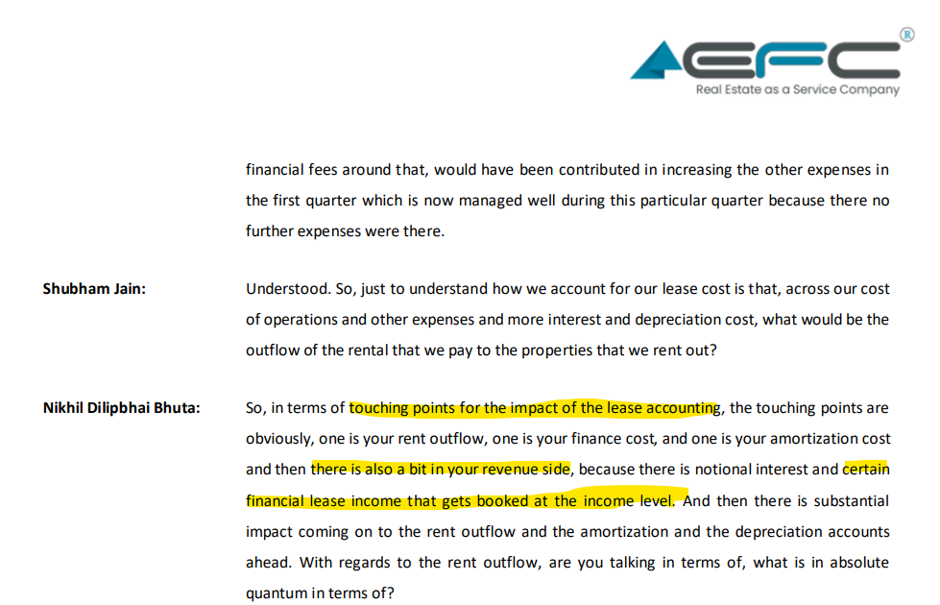
Under Ind AS 116, when EFC signs a long-term enterprise client (e.g., 5-9 years), it classifies the contract as a Finance Lease and recognize the present value of all future rent as revenue upfront on Day 1.
In their Operating Cash Flow statement. There is a massive deduction of 182.81 Cr labelled “Lease receivable recognition (Ind AS 116)”. This is non-cash revenue that heavily inflates their PBT.
Under Ind AS 116, this rent EFC pays to its landlord is not recorded as a simple operating expense on the P&L. Instead, the lease is treated mathematically like a bank loan.
They paid 136.09 Cr in principal and 69.64 Cr in interest for leases, totalling an actual cash outflow of 205.73 Cr (Source: Cash flow statement).
Because total contract value is booked upfront, monthly cash collections bypass P&L revenue to avoid double-counting, going straight to reducing receivables/Current assets.
EFC booked 133.98 Cr upfront in FY25 and 182.81 Cr in FY26. Assuming 5-year leases, physical cash collected this year is roughly ~36 Cr (FY26) + ~27 Cr (FY25) + ~20 Cr (older) = ~83 Cr (This is my assumption).
Actual interest paid to banks for real borrowings was just 30.70 Cr (Source: Cash flow statement)
Reported EBITDA: 468 Cr
Actual Cash Rent Paid: 205.73 Cr
Upfront Revenue: 182.81 Cr
Actual Cash Collected: ~83 Cr
Actual Interest Paid = 30.7cr
Normalized PBT = (468-205.7-182.81+83-30.7) Cr = 131.76 Cr
Normalised PAT for FY26 = 100cr
2 Likes
However, they reported PAT = 235 for FY26. However, if we take PAT=100, at current price PE= 26. Hence, it’s not cheap as optically it looks.
Is my understanding correct?

But this seems to be wrong POV, their maynot be any upront revenue booking —
For Q4 –> Total billed seats (63200) , Avg seat cost ~ 7500 = 144cr which is matching with the revenue of leasing segment .
It seems the business is not generating enough real cash to fund it’s growth, therefore they will have to constantly dilute equity via warrants, preferential issues, or rights issues or raise debt.
From the P&L statement the business looks very attractive, rapid expansion, high topline and bottomline growth. But the underlying fundamentals are very poor. It seems they are caught in a trap (not generating enough cash to fund growth, and cannot slowdown the rapid growth).
Without an asset-light exit vehicle like a Small and Medium (SM) REIT, the business becomes a perpetual dilution machine.
1 Like
Look at their ROW assets (379cr) vs lease liabilities (1100cr). They surely sublease as capital lease (not 100%), transfer ROW assets as other financial assets and recognise upfront revenue.
In Q3FY25 earnings call, they highlighted this.
Their revised Q4 statement says lease receivable recognition as 241cr. It will revise my normalized PAT estimate even below 100cr.
Also check their revised statement, their cash flow statement changed a lot (rise in OCF and decrease in investing cash flow). However, there is no significant change in the Balance sheet or income statement.
I am just trying to say they follow a very aggrieve accounting policy and it should be noted while doing valuation.