Having been an active participant on ValuePickr for over three years, I’ve come to rely on this platform as my primary source for company news and developments. Given the wealth of knowledgeable investors here, I believe we have a unique opportunity to engage in productive discussions about broader market news and their potential impacts on various sectors and stocks. Staying informed about global geopolitical events and their secondary effects is crucial for making well-informed investment decisions.
Objectives
Comprehensive Market Analysis:
Understanding Broader Trends: Delve into macroeconomic trends and their implications on the market.
Sector-Specific Insights: Analyze how specific sectors are influenced by current events and market trends.
Geopolitical Events and Market Impact:
Election Outcomes: Discuss the ramifications of election results on national and global markets.
Policy Changes: Evaluate the impact of new policies and regulatory changes on different industries.
Global Incidents: Consider the effects of international conflicts, treaties, and other geopolitical events on the market.
Second-Order Effects:
Ripple Effects: Explore the indirect consequences of major events on various sectors.
Cross-Sector Influences: Understand how changes in one sector might influence another (e.g., how energy prices affect manufacturing costs).
Informed Investment Choices:
Risk Management: Identify potential risks arising from geopolitical and economic changes.
Opportunity Identification: Spot opportunities created by market fluctuations and global events.
Strategic Positioning: Discuss strategies for positioning portfolios to benefit from or mitigate the impact of current events.
Examples and Case Studies
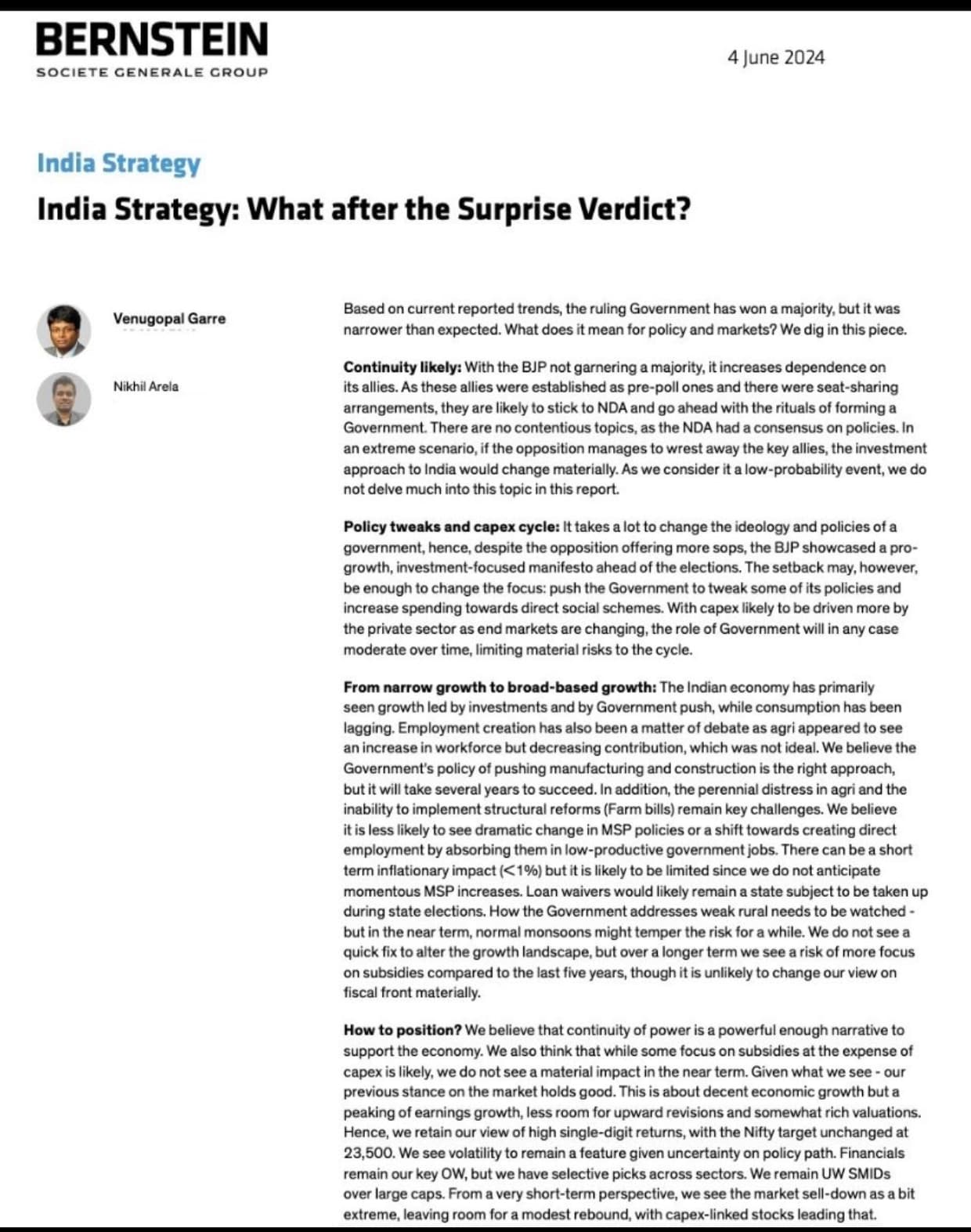
Current Election Outcomes: Analyze the market’s response to recent election results, including potential changes in fiscal policy, regulatory environment, and international trade agreements.
Trade Wars and Tariffs: Discuss the impact of ongoing trade tensions between major economies and their effects on global supply chains and sectoral performance.
Technological Advancements: Explore how breakthroughs in technology are reshaping industries and creating new investment opportunities.
Community Engagement
By fostering informed and insightful discussions, we can enhance our collective understanding of the market and make better investment decisions. I encourage everyone to share their perspectives, news sources, and analyses to contribute to a rich and diverse dialogue.
Let’s leverage the power of our community to stay ahead of the curve and navigate the complexities of the market with confidence and foresight.
PM Gati Shakti Scheme Gives India An Edge Over China-Morgan Stanley
PM Gati Shakti National master plan for infrastructure development brings 16 ministries including Railways and Highways together on a digital platform for integrated planning and coordinated implementation of multi-modal connectivity projects.
It is conceived as a transformative approach for economic growth and sustainable development with roads, railways, airports, ports, mass transport, waterways and logistics infrastructure constituting "7 engines " to pull the economy forward in unison.
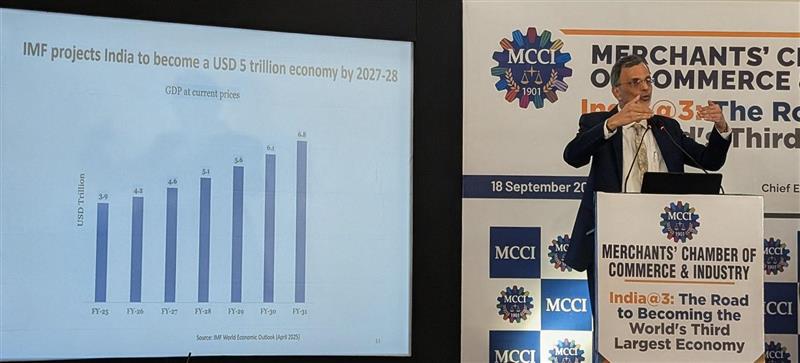
Attended a session today by the current Chief Economic Advisor to PM, Dr. V. Anantha Nageswaran where he revealed about the current macro environment of India.
India’s GDP is projected to cross $5.1T by FY28 and $6.8T by FY31 (The $5T milestone isn’t just a number, it’s India cementing its place as the world’s 3rd-largest economy).
The Jan Vishwas Bill has already decriminalized over 180 provisions, with more in the pipeline (India is quietly dismantling the “license raj” mindset, with trust-based regulation becoming the new governance model).
29 labor laws have been merged into 4 codes, and land digitization is underway (Simpler rules mean fewer compliance headaches and potentially, faster job creation and investments).
Among 18-24 year olds, 85% of extreme addicts face mental distress, and 75% report suicidal thoughts (Tech adoption without mental health safeguards is a ticking social time bomb).
TReDS financing for MSMEs grew from ₹950 crore (FY18) to ₹2.33 lakh crore (FY25), at a 119.5% CAGR (Small businesses are finally tapping big-finance solutions as fintech-led credit changes the game).
43% of new applicants under the White Goods PLI scheme are MSMEs (Industrial policy is no longer just for big corporates, as small firms are entering global supply chains).
Public sector capex doubled from ₹11.1T (FY19) to ₹19.8T (FY26 BE) (The state is betting big on infrastructure, building today to unlock private growth tomorrow).
Highway length grew 1.6x (2014-25), and toll wait times were cut from 12.2 mins to 47 secs (Infrastructure is not just about roads, it’s about reclaiming time, efficiency, and productivity).
There are 144 Vande Bharat trains, 98% rail electrification, and a 4x metro expansion across 20+ cities (India’s transport upgrades are structural and will redefine urban mobility).
Port capacity has doubled (2014-25), and the number of airports has more than doubled from 74 to 160 (Trade and travel infrastructure are scaling, as India becomes more connected with the world).
India’s GDP grew at 7.8% in Q1 FY26 (India isn’t just leading the growth charts, it’s widening the gap with other major economies).
The government has increased the budget for the Department of Agriculture & Farmers Welfare by 5.8x since 2013-14, from ₹21,933.50 crore to ₹1,27,290.16 crore in BE 2025-26 (This substantial investment is fueling rural demand, which is the real backbone of India’s consumption story).
India’s current account deficit (CAD) is at 0.2% of GDP (External balances are the silent strength that shields growth during global shocks).
Rising FDI and deep forex reserves of $694B are proof of confidence in the Indian economy (Confidence isn’t built overnight, these are signs that India is being seen as a dependable long-term bet).
India clocked an all-time high of $825.2B in exports in FY25 (Resilience comes from consistently pushing exports to new highs, a sign of competitive muscle).
India’s external debt is at just 19.1% of GDP with strong reserves (With sub-20% debt and strong reserves, India has breathing space others envy).
GST 2.0 is set to rationalize rates on essentials (Lower taxes at the checkout counter ripple outward, boosting demand, savings, and investments together).
Micro-irrigated farmland has tripled since 2015, and digital tools like AgriStack and e-NAM have lifted maize productivity by up to 71.9% (Agri-tech proves that efficiency isn’t just urban, as farms quietly turn into smart enterprises).
Junk food retail volumes are surging and childhood obesity is spiking (The challenge is clear, India must not get unfit before it gets rich).
India’s “small” businesses are quietly doing big things; 43% of new White Goods PLI applicants are MSMEs, with cluster programs driving +10-15% productivity and +30% turnover (MSMEs are powering supply chains and reshaping manufacturing depth).