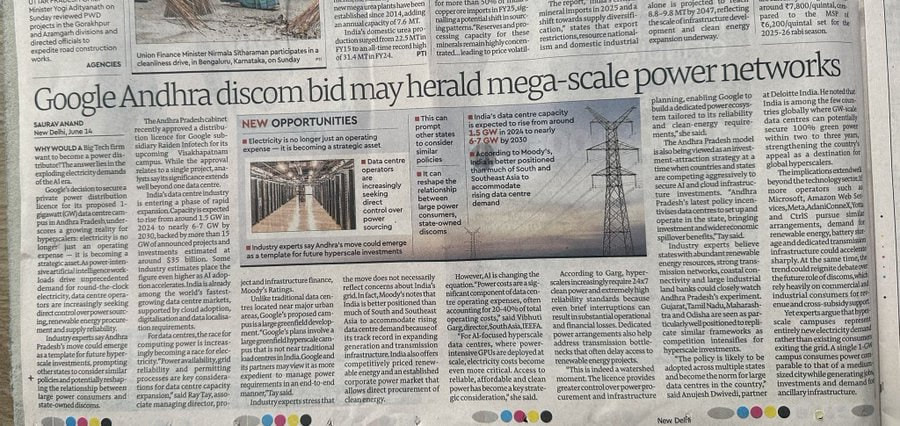
Data Centres Will Be About 3% Of Our Total Power Demand By 2030 - BERNSTEIN
Source:
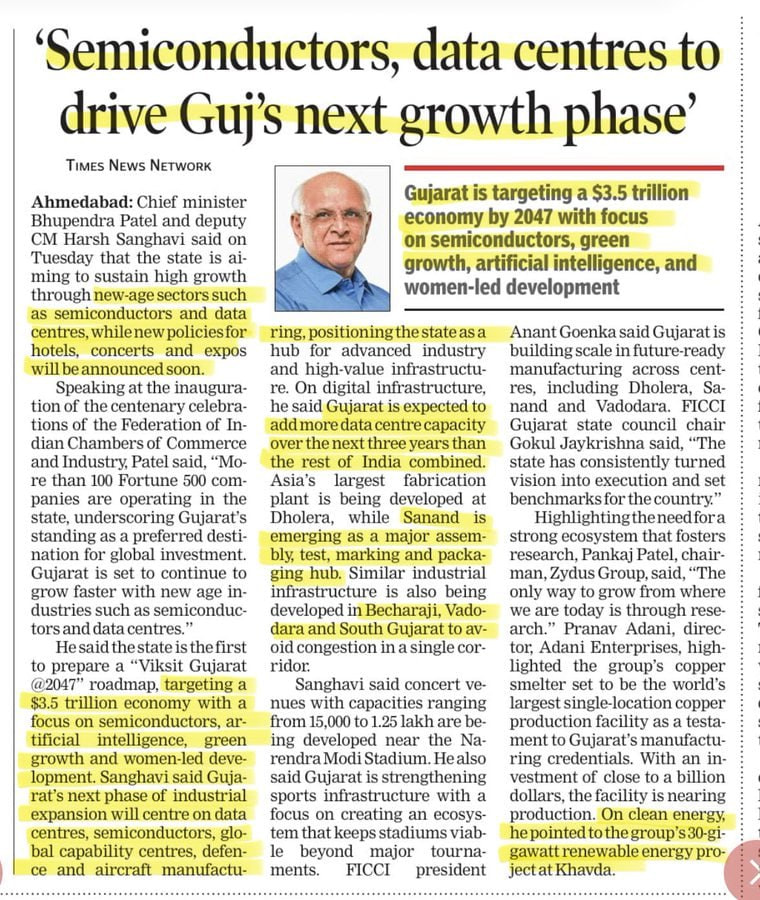
Focus will be on Semiconductor, data centers, AI, Defence, aircraft manufacturing, Global capability centers, and Green growth
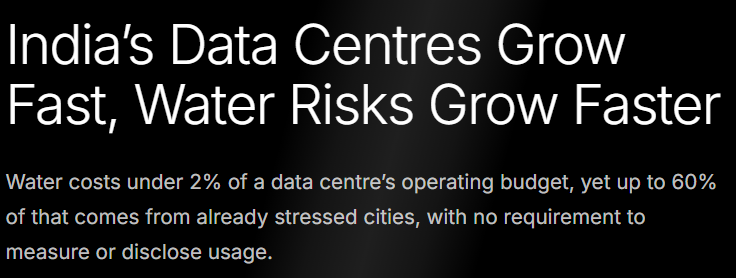
We are again faced with a genuine environment, basic needs vs development issue. We have no data on how much percentage of water do the poor get. Seeing the lines on the taps, it doesn’t seem they get much. I am pretty clear, once water shortage is there, it is those taps that will go dry first. 
Yes, data centers located in extremely water-stressed areas might face higher local litigation, similar to what we’ve seen with beverage bottling plants in the past.
We soon might see a forced shift from evaporative cooling (which consumes massive amounts of water) to liquid cooling or closed-loop systems. These are more expensive CAPEX-wise but essential for long-term sustainability.
And governments might eventually mandate the use of recycled/treated sewage water for cooling to protect the water scarcity issue.
The winners will likely be those who Make Green DC in Zero Liquid Discharge and Renewable Energy early, rather than waiting for the taps to actually go dry.
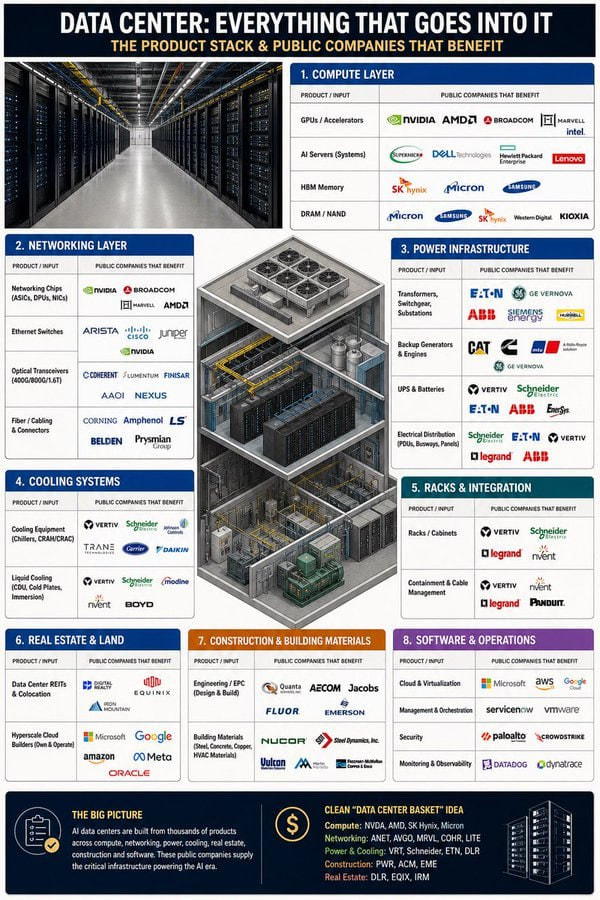
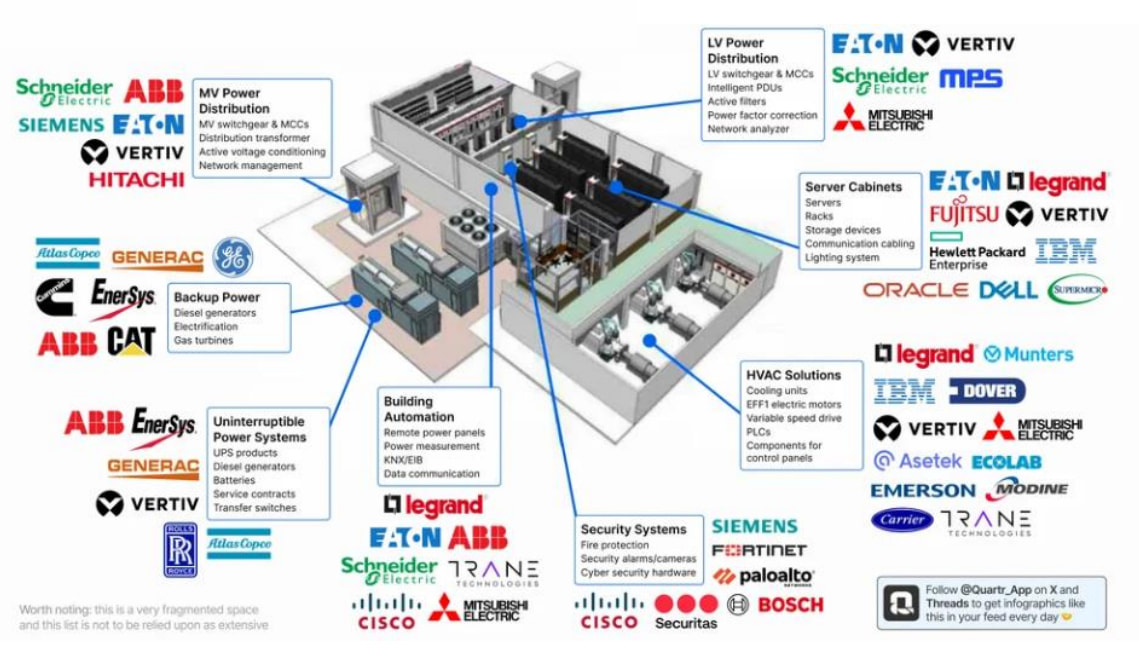
General picture of players involved in data center building.
I am impressed with Atul Rawal’s ancillary ka ancillary theme.
Am I right in thinking that instead of investing in companies that makeAC’s, Transformers etc, one way could be to invest in the companies that produce wires that go into them? I have chanced upon the following, and the list is by no means exhaustive. I have given extracts of their quaterly results in the thread on Ram Ratna Wire.
Ram Ratna Wire
V Marc
Precision Wires, and
KSH International
Of course,there are also other types of wires/cables like those made by Polycab or HFCL/Sterlite Technology.
Yes, it works, but keep in mind that being an ancillary player comes with its own set of challenges like commodity sensitivity.
Most of these companies deal with copper and aluminum. Their margins are often susceptible to volatility in base metal prices. Look for companies that have strong inventory management or the ability to pass on price hikes to their customers.
The second is the B2B vs. B2C Mix, company with a higher share of B2C sales might have better brand visibility and pricing power, while a pure-play B2B company might be more cost-efficient but dependent on large institutional orders.
Just pay close attention to operating margins (as a proxy for their ability to pass on commodity price volatility) and order book growth (for the B2B players).
In every industry , normally ancillaries are squeezed for margins by OEMs. So if short term opportunity is available then it is ok, but in the long run , OEMs make money.
Very important points. Copper and aluminium are riding high. Also, often the OEMs may have arm-twisting power.
Copper price variations are passed back to the buyer - all contracts for copper, transformers, etc have a indexation clause.
Ancillary ka Anacillary - will work when a handful of suppliers serve a large and growing base of customers. NVIDIA is a classic example: one dominant supplier with hundreds of buyers. It generally does not work well in commodity industries where supply exceeds demand or where many suppliers compete for the same B2B customers, resulting in weak pricing power and lower profitability.
In conlusion - going demand and less supply is the key aspects need to check.
Today Black Box has posted an exhaustive presentation on AI opportunity in India.
Checkout the Black Box Ltd threat for more on the company. Black Box: Building infrastructure for the AI revolution - #26 by vivek_17
The trick also is to identify the correct ancillary as you rightly observe. I have too timid and have missed the Sterlite and HFCL shoot out.
this is one of most intriguing news read recently, with a top of the league cutting edge tech company bidding in one the most dull & boring utility industry….It reminds me of a news where, if i am not wrong, us president even asked tech companies to build their own power plants….