
Can you please share the working that how have you determined these Rs 130 Crore? @Abhishek_Somani
EPC income of company is the capex/Project outflow for Franchisees. The EPC breakup is available in their results.
| Setting up of Cinema Fees | Revenue |
|---|---|
| H1 25-26 | 29.86 |
| FY 24-25 | 48.95 |
| FY 23-24 | 27.19 |
| FY 22-23 | 7.25 |
| Older | 17 |
| Total Revenues | 130.25 |
This also includes revenue from screens that aren’t operational yet.
Some important points were raised by @gaurav . Hope people following the company can offer some clarity on them.
Most of this is already answered.
For specific questions you can refer multiple interviews available on YouTube.
| no it’s not, 130 crs does not include any screen that are not operational yet. As per the management, they have recognized partial revenue for 16 screens in the H1 results and now with 13 screens operational in Q3 the capex number of 130 Crs is vey much correct. |
|---|
No, some screens from H2FY25 and H1FY26 whose revenue is booked weren’t operational due to election issues in Bihar will get operational in H2FY26.
So this H2, EPC revenue will be less compared to number of screens that get operational, because revenue for some of them is already booked.
From this H2, royalties will start dominating bottom line.
Also, the company has an order book of 300 screens that are already signed, and franchisee income of approximately ~15 crore has been booked, which is a 100% margin income stream.
In October alone, they signed 22 new screens.
This cannot be included in capex at this stage, as these screens will take time to become operational.
-
So have they changed their accounting policy, last I read in their RHP that they book revenue for epc once the theatre is completed and ready for use. There may be 1 or half months gap in the commercial operations.
-
what is the source of 300 screens non operational franchisee income already recognised as of 30th sep.2025
-
even If I remove 10crs on account of franchisee fee, still it is a capex of 120 crs for the franchisees.
EPC income and Franchisee Income are two different things.
EPC is cinema construction income.
Franchisee Fees (5 Lakh / Screen) is fee income that is one time non refundable, collected on signing the agreement.
So, for example, 22 new screens were signed in October, that means 1.1cr of franchisee fees was collected there and than. But EPC income, however, will start only once construction begins.
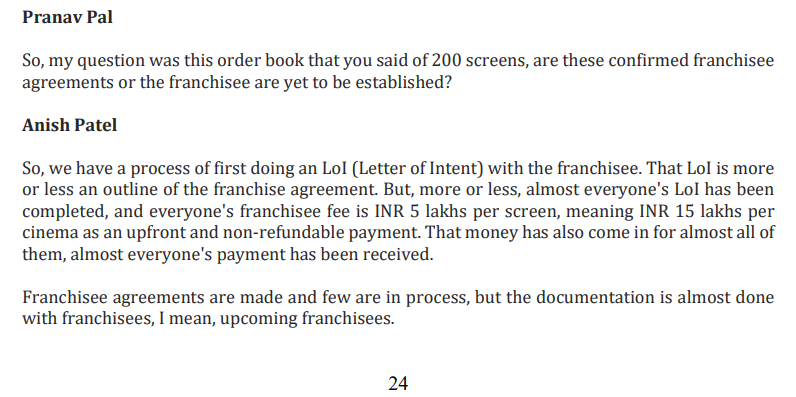
I know very well how franchisee incomes are accounted. The point here is to convert all these statements in meaningful data point and find out what is the total Capex incurred.
this amount is say 10 crs - assuming 200 screens are signed till 30th sep but not operational. This would be even lower if the number of screens signed are less than 200 before 30th sep.
so the total capex incurred is still 120crs.
great summary above. definitely a unique business model. i was trying to go through the RHP and annual report to better understand the mechanics of money flow like who owns what, who incurs what, who gets the money, revenue recognition etc.
there are certain gaps i found which requires further clarifiation from the management.
- as per accounting policy in its annual report and rhp (page 205) revenue recognition of setting up of cinema “The cost of set up is recognized by the company in its books as income on completion of the theater when ready for use”. However in the Nov 2025 concall transcript (page 15) the management said “Yeah. So, what happened currently in H1, we have started 17 screens operational, but we have already ready 16 screens, which we are waiting for the licensing. So, the part revenue is recognized for just 16 screens, which is not operational yet. It will be operational in Q3.” There is inconsistency here. Moreoever here are the numbers for last few years on setting up cinemas - 1H26 ~30cr (from 17 screens), 2025 ~49cr (from 17 screens) and 2024 ~29cr (from 25 screens). Numbers mean that what the management said on concall may be true but accounting policy does not reflect that which raises question on the quality of governance.
- Similarly the accounting policy regarding sale of services is not very clear as to how and where the revenue is recognised for sale of tickets and F&B. “Revenue from sale of tickets and Foods and Beverages is recognized when the related services is provided to the customer. The receipts of the same are received in the bank account of the company and relevant share of the franchisee after deducting relevant expenditure is paid as per agreement between the related parties. Thus the sale of food and beverages is shown as income by franchisee in its books of accounts and GST on the same is paid by them. Income in respect of other related services are recognized on the basis of transfer of risk and rewards as well as passage of title to services.” When one goes through Nov 2025 concall transcript then it becomes clear that the full revenue of sale of tickets is recognised in the company books and franchise share is shown as an expense while revenue from F&B only pertaining to connplex is shown in company books.
- While the company’s position is that recently they have started provding credit to franchisee for setting up of cinema as part of its new business model (page 90 of rhp) as is evident from increasing trade receivables. However, even in prior years it is surprising to see nominal advance from customers disclosed under current liability (page 213 of rhp) - 2025 14lkhs, 2024 2lakhs and 2023 0.4 lakhs.
- If one sees in ageing of trade receivables 2.5crores is outstanding for more than 6 months (page 216 of rhp), why was the company not able to recover its dues from the franchise when all receipts from sales comes to the company first?
- As per nov 2025 concall transcript (page 11) the management says “Yes, mostly. First, all the projectors installed in our cinemas are our assets, even in franchiseoperated locations, and therefore they are recorded in our books. Second, all technical and electronic equipment—such as time-lapse machines, POS systems, coffee machines, computers, and similar items—are also part of our asset base, as they represent our technological investments.” while on page 149 of rhp the company says “Insurance for projectors and LED equipment is not provided by the company directly. Instead, the responsibility for ensuring these assets lies with the franchisees. Each franchisee is required to secure their own insurance coverage for projectors, LEDs, and any other equipment they operate, ensuring that all assets are adequately protected.” If the company owns those assets then why will the franchisee insure them?
- If the company owns the projector and on an average one high end projector costs 28-30 lakhs and low end around 5 lakhs (page 13 of nov 2025 concall transcript); so for 3 screen cinema average cost of projector comes to ~13lakhs ((30+5+5)/3) then plant and machiney should have increasen by 5.5crores (42 screens * 13 lakhs per projector) in years 2024 and 2025. However P&M for projection gross block (page 214 of RHP) has increased from 78lakhs to 86 lakhs. Where are the projectors costs in books of accounts?
- Current tax expenses (excl. deferred tax) as per P&L (page 50 of rhp) for last 3 FY are 677 lakhs, 143 lakhs and 54lakhs where as per CFS (in CFS its net of refund) they are 143 lakhs, 24lakhs and nil respectively. There are material mismatch between taxes as per PL and CFS.
- There are certain projects which are under construction for a very long period and also there are certain projects which has been sub leased by connplex to the franchise (from pahe 152 of the rhp). However with respect to the leases taken by the connplex and sub leased by the connplex, the lease disclosures are not detailed as done by other companies. And why are some projects pending for so long?
Not invested. Tracking. Will see how the above gets refleted in 25-26 annual report. Unless and untill company accounts and management commentary are in sync, there will remain many doubts on the quality of the books of the accounts.
3 Likes
So here it goes.
-
EPC revenue is recognized in stages. A portion is received in advance, subsequent amounts are billed upon achieving specific milestones, and the balance is collected on completion of the cinema construction. In some cases, any remaining dues if left are received later as per agreed terms. There is no inconsistency here, this has been clearly stated.
As per the accounting policy, “The cost of set up is recognized by the company in its books as income on completion of the theater when ready for use.” This is accurate and consistent with the way revenue is recorded.
Moving on to the next.
-
The accounting policy regarding sale of services is quite straightforward. Ticket sales are recorded in the company’s bank account, while F&B sales are recorded in the franchisee’s bank account. There is no ambiguity here.
Perhaps you are looking for this to be stated in very specific wording in a document, maybe drop an email to management.
-
When the company mentions that it has started extending credit to franchisees for setting up cinemas, it simply means they are allowing payments to be made in parts instead of requiring an upfront payment, as discussed earlier in point 1.
“Customer advances” is nothing but that initial part payment.
Also, the data you’ve quoted appears doesn’t capture advances. The correct reference is on Page 212 of the RHP, under Annexure 1.4.
This also represents a float that the company gets to enjoy. -
No, F&B receipts do not come to the company first, as already discussed. Also, trade receivables can arise from multiple sources since the company has several revenue streams.
Coming to the amount you mentioned, the ₹2.5 crore figure represents the cumulative receivables ( >6 months ) over the company’s entire operating history. This is against roughly ₹300 crore of cumulative revenue, which is less than 1%. I think that’s a fairly healthy and decent number. “ Context matters “
-
If the company owns those assets then why will the franchisee insure them ? Seriously? All of these assets are owned by the company & installed at the franchisee’s location, so if any damage or loss occurs, the responsibility lies with the franchisee. Naturally, the party bearing the risk is the one who takes the insurance. It’s fairly straightforward.
-
Total screens added in FY24+FY25 = 42.
FY23 Gross Block = 8.43cr
FY25 Gross Block = 13.87 cr
Net addition in gross block = 13.87cr - 8.43cr = 5.44crIt would be better to ask management how the categorization is being done. This increase in gross block is mostly due to the addition of projectors and related equipment. It’s unlikely they are holding ₹9 cr worth of furniture, so this may simply be a classification issue. There was CWIP during those years as well, which would eventually get capitalized and move into the gross block over time.
-
There is no material mismatch, how can you leave out tax provision from tax calculation,
Tax Liability in FY24 + FY25 + H1 FY26 = 1.43cr + 6.77cr + 4.25cr = 12.45cr
Tax Paid (CFS) = 0.24cr + 1.43cr + 4.25cr = 6cr
Provision for Income Tax (Under Short term Provision) as on H1FY26 on B/S = 4.52cr
So, 6+4.52 ~ 10cr, excluding any refunds.
So if you look at it closely, the majority of the tax liability arose in FY25, and a large part of it was paid in H1FY26. We’ll get more clarity on this in the next annual report, and it would make sense to analyze it in detail then.
-
Enough information has already been provided in the lease disclosures. The amount is mentioned, the tenure is mentioned, the counterparty name is disclosed, and even the contract date is specified. I’m not sure what additional detail is being looked for. I also don’t see any indication of a pending project here.


Final thoughts, most of the observations don’t hold much relevance. A few points may be worth asking management for a more detailed breakup, but nothing appears concerning, inaccurate, or inconsistent.
It’s always a pleasure going through detailed documents late at night. In the process, I also noted a few questions that I’d like to take up with the management.
All thanks to @naman.kumar
6 Likes
Hi .. Thankyou for a detailed post on this company. @RocketMan
However I am unable to comprehend swing in ebidta margins, it was 10% in FY23 and FY24 which increased to 27% in FY25
Can anyone give a detailed calculation on what factors has led to such a sharp improvement in margins?
- Royalty income grows with number of screens, most of it comes to bottom line. So with scale margins improves.
- Also, EPC margin was less earlier as company was establishing itself. They increased EPC margins FY24 onwards.
These were primary two reasons.
4 Likes
Do you have segment wise revenue and EBITDA from FY23 to FY25?
I haven’t done that. My focus is on FY25 and beyond.
1 Like
Major Takeaways from a Call with someone in charge of Capex, Cinema Expansion & Franchise partnerships for Connplex Cinemas in the South– a/o 12/02/2026
Major Takeaways from a Call with someone in charge of Capex.pdf (235.5 KB)
8 Likes
I think that 10cr is for 5+ screens. According to my calculations,
Per Screen Realization
Express → 60L-80L
Signature → 80L-100L
Luxuriance → 150-200L
This wouldn’t be able to sustain in a longer run with same pricing as PVR, this can run for 2-3 years however unit economics will change drastically as soon as large cinema chain enters as competition. Not an easy business to do. Lot of failures in past.