CONNPLEX CINEMA
It’s a recently listed cinema chain with a business model that is structurally different from other listed peers.
The company operates smaller-sized multiplexes (Mini-Plexes), which are ideally suited for Tier-2, Tier-3, and Tier-4 cities, markets that large chains like PVR and Inox have largely avoided due to the unsustainable economics of their big-screen, high capex model in smaller towns.
Even in Tier-1 metros, this model fits well because the higher population density supports small-format multiplex economics.
Royalty-Based Business Model
- All outlets operate on a FOFO model (Franchise-Owned, Franchise-Operated).
- Capex and Opex for each cinema are funded by the franchisee, while the electronics and projector capex is funded by the company.
- Connplex charges a 20% royalty on ticket sales, F&B, and advertisement revenues, with the franchisee retaining the remaining 80%.
Additionally, the company provides EPC services for the construction of cinemas (essentially the capex executed on behalf of the franchisee).
This EPC vertical generates one-time revenue with ~30% EBITDA margins, and the profits are used to fund the projector and electronics capex required to drive recurring royalty income
(Readers are advised to refer to the Investor Presentation and conference call available on the stock exchange for detailed business information. In this note, I am restricting the discussion strictly to the unit economics and capex economics of the company.)
It’s an incredibly fascinating business model, so let me walk you through the numbers.
INDEX
- PROMOTER’S PROFILE
- UNIT ECONOMICS (FRANCHISEE)
- CAPEX ECONOMICS (FRANCHISEE)
- UNIT ECONOMICS (COMPANY)
- EPC BUSINESS & CAPEX ECONOMICS (COMPANY)
- SCALE
- RISK
0. PROMOTER’S PROFILE
Mr. Anish Tulshibhai Patel (Managing Director & Promoter, Age: 44)
- Holds a Master’s in Information Technology & Computer Science; early career in marketing, finance, and quality control in education and hospitality franchises.
- 6 years in entertainment industry; Founder & Director since 2018, appointed Managing Director (5-year term from Sep 30, 2024), overseeing property acquisition, franchise growth, and operations.
- Key awards: FRO SUMMIT (2021), Proper Media (2020), IEDRA Emerging Company of the Year (2023), Gujarat State Brand Leadership (2024).
Mr. Rahul Kamleshbhai Dhyani (Joint Managing Director & Promoter, Age: 45)
- Commerce graduate; started as Marketing Executive with experience in business development, event management, and entertainment.
- 6 years in entertainment industry; Founder & Director since 2018, appointed Joint Managing Director (5-year term from Sep 30, 2024), focusing on market expansion, operational efficiency, and revenue strategies.
- Key awards: FRO SUMMIT (2021), Proper Media (2020), IEDRA Emerging Company of the Year (2023), Gujarat State Brand Leadership (2024).
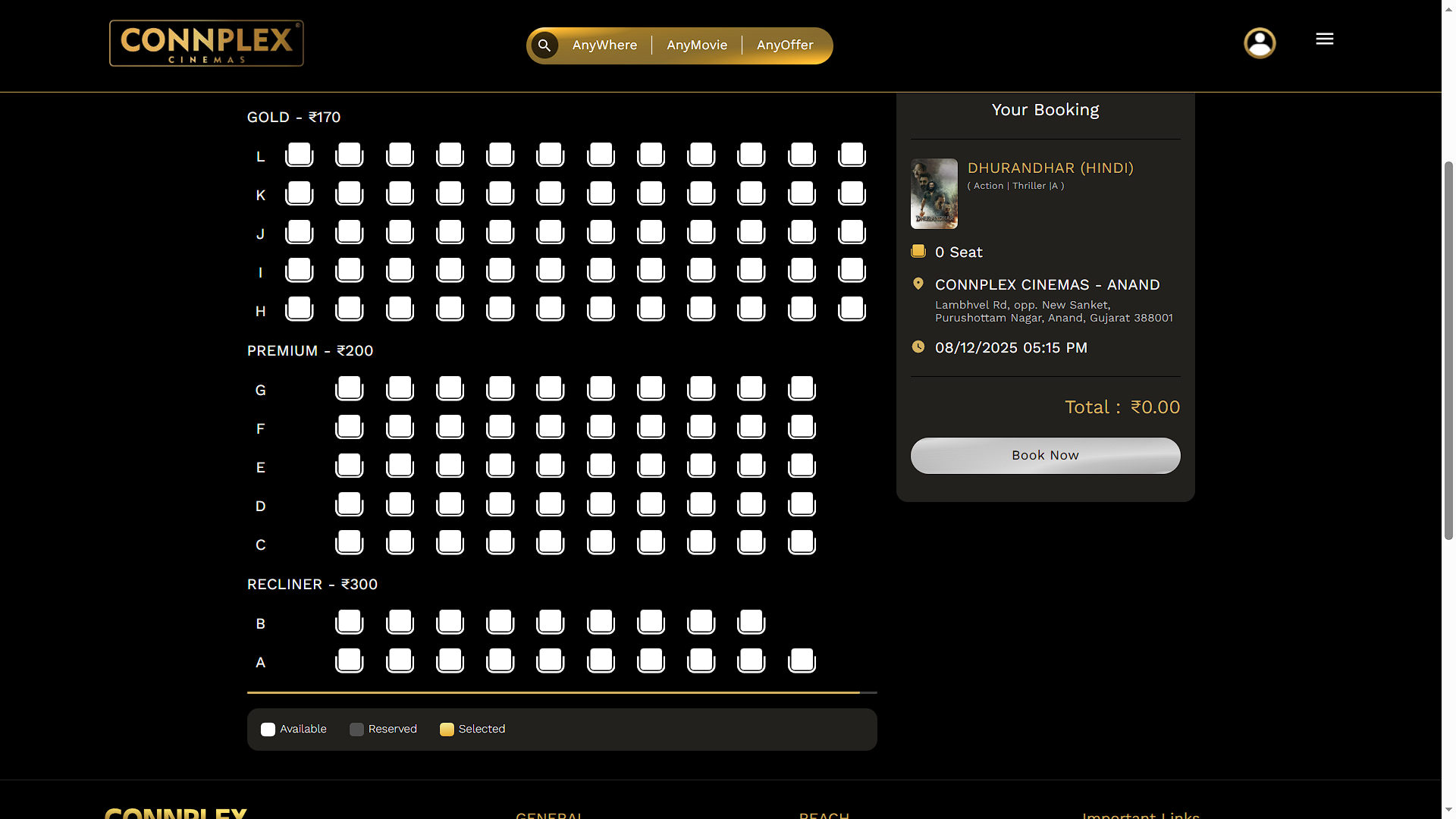
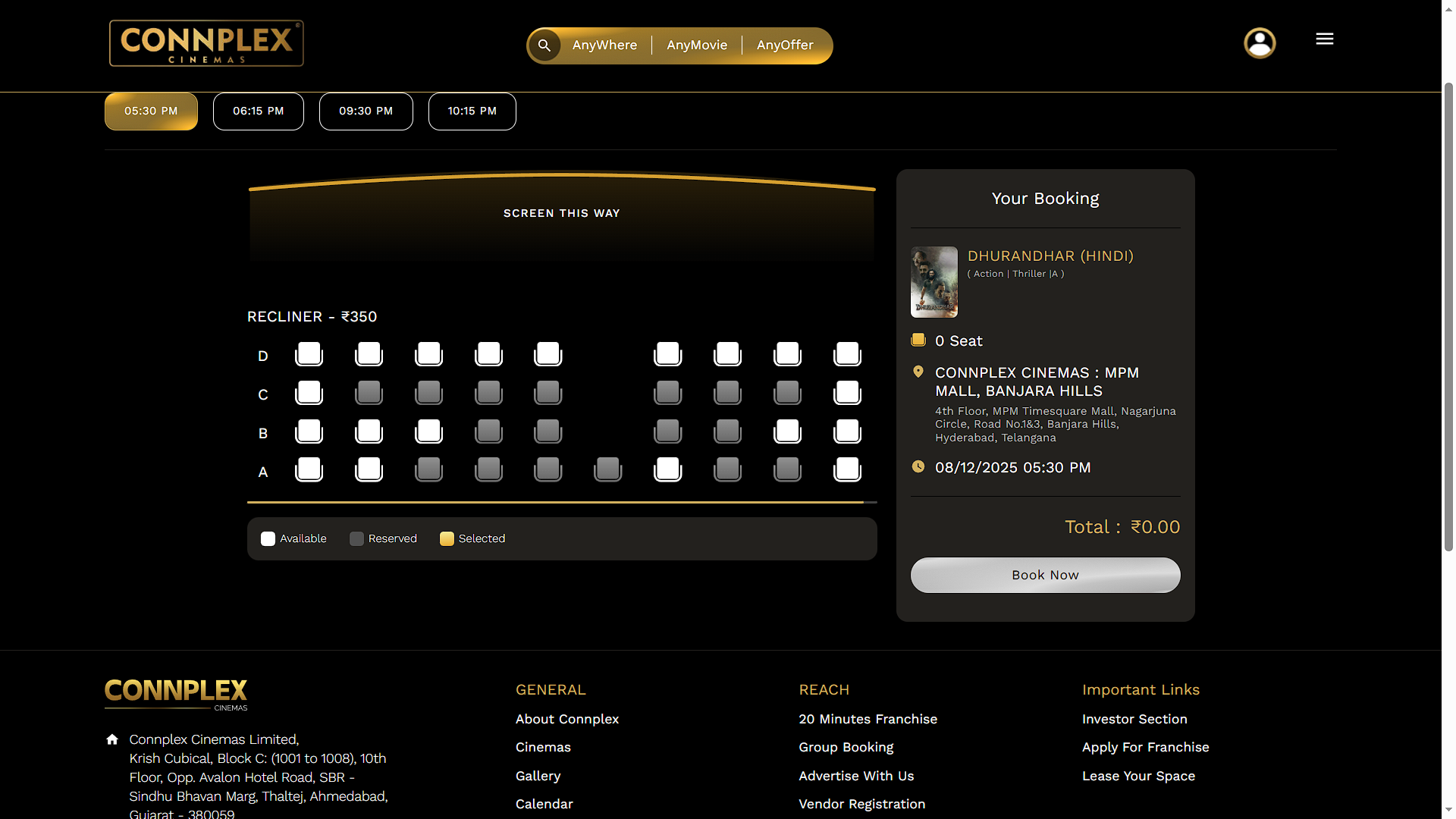
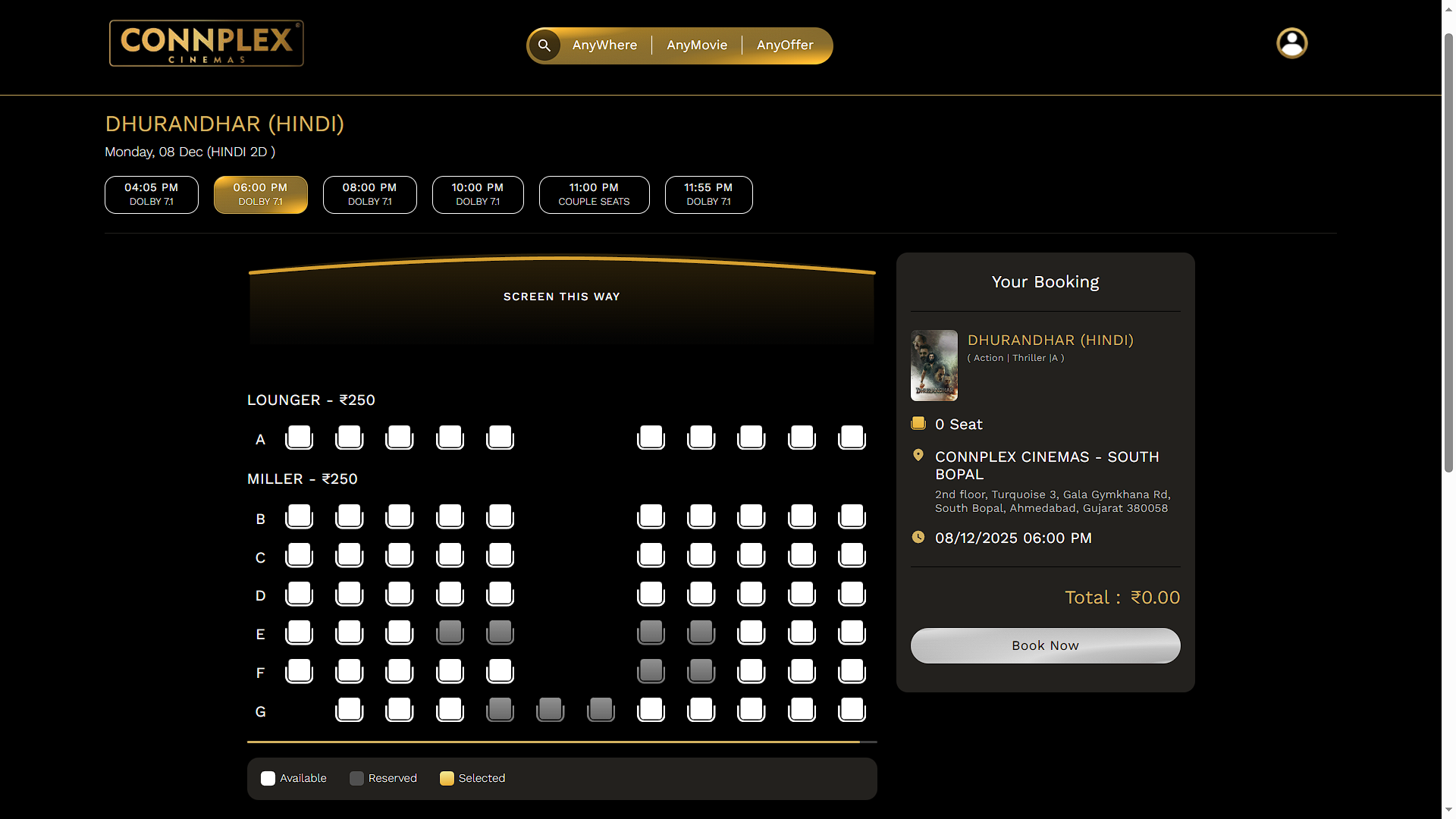
1 CINEMA = 3 SCREENS = 240 SEATS — [ 80 SEATS / SCREEN ]
(#) Variables: All calculations are based on these key variables. Any change in these variables will directly affect the results.
1. UNIT ECONOMICS FROM FRANCHISEE’S PERSPECTIVE
- 240 SEATS ( 1 Cinema )
- 4 Shows / DAY
- 30% Occupancy ( # )
- 30 Days in a Month
240 * 4 * 30% * 30 = 8,640 Seats / Month ( # )
- TICKET PRICE = 300
- 300 - 18% GST = 246 ( # )
- 246 - (Distributor Charge (50%) = 123
- Franchisee Ticket Income = 123 * 80% = 98 , (20% goes to Connplex)
Ticket Income Per Month = 8640 * 98 = 8,46,720
- F&B SPH = 100
- 100 - (5% GST) - (25% COGS) = 72 ( # )
- Franchisee F&B Income = 72 * 80% = 58 , ( 20% goes to Connplex)
F&B Income Per Month = 8640 * 58 = 5,01,120
- PVR generated approx. ₹26.3 lakh of ad revenue per screen per year in FY25. This translates to ₹447 crore across 3,53,870 seats, or roughly ₹12,500 per seat per year.
- For Connplex, I have assumed ₹10,000 per seat per year.
- Connplex also earns convenience fees from platforms like BookMyShow. For simplicity, I have combined (Ad Revenue + Convenience Fees) and assumed a total of ₹10,000 per seat per year.
- Since Connplex operates largely in Tier-2/3 markets, ad revenue per seat may be slightly lower than PVR. Hence, clubbing convenience fees provides a realistic estimate.
- This assumption is supported by my discussion with management; a ±10% variation is possible but unlikely to be higher.
Ad Income + Convenience Fees Per Month = ( [ 80% * 10,000 (PER SEAT ANNUAL) * 240 (SEATS) ] / 12 ) = 1,60,000 Per Cinema Per Month
- Income For Franchisee = 8,46,720 + 5,01,120 + 1,60,000 = 15,07,840 Per Cinema Per Month
Expenses
- Rent + Maintenance = 4,00,000
- Salary = 3,00,000
- Electricity = 1,50,000
- Total Expense = 8,50,000 Per Month ( # )
Total Income For Franchisee Per Cinema Per Month = 15,07,840 - 8,50,000 = 6,57,840
2. CAPEX ECONOMICS FROM FRANCHISEE’S PERSPECTIVE
- Franchisee Fees to Connplex = 5 Lakh / Screen = 15 Lakh / Cinema ( # )
- 1 Cr / Screen Capex (Avg.) = 3 Cr / Cinema ( # )
- Total Investment = 3.15 Cr
ROI (month) = 3.15 Cr / 6,57,840 = 48 Months = 4 Years.
So, the franchisee recovers their investment in about 4 years. After that, they earn profits for the remaining operating period of the cinema, roughly 11 years (15-year life minus 4 years of payback).
3. UNIT ECONOMICS FROM COMAPNY’S PERSPECTIVE
- TICKET ROYALTY = 20 % * 123 * 8640 = 2,12,544 Per Month Per Cinema
- F&B ROYALTY = 20 % * 72 * 8640 = 1,24,416 Per Month Per Cinema
- Ad Royalty + Convenience Royalty = ( [ 20% * 10,000 (PER SEAT ANNUAL) * 240 (SEATS) ] / 12 ) = 40,000 Per Month Per Cinema
- VPF Income - VPF (Virtual Print Fee) is a recurring revenue stream earned by cinema exhibitors for screening movies using digital projectors or LED screens. This is not shared with Franchisee, company makes about 33,000 VPF Income Per Month Per Screen, i.e. 1,00,000 Per Month Per Cinema.
Income for Company Per Cinema Per Month = 4,77,000
4,77,000 / 3 = 1,60,000 is what Connplex earns as a royalty per Screen per Month
~ 20,00,000 Royalty Per Screen Annually
- Opex = Employee Cost + Corporate Cost ( All of which is funded by EPC arm, explained later)
- Working Capital Requirements in Cinema Business = 0, (All royalty income)
- Capital Employed in Cinema Business = 0,
- Depreciation & Interest Cost ~ 0
- Hence the title of the page, Connplex’s Cinema business is near infinite RoCE.
4. EPC BUSINESS & CAPEX ECONOMICS
- Franchisee invests ₹1 crore per screen as capex.
- Total project cost is ₹3 crore per cinema. After 18% GST, the net EPC value becomes ₹2.46 crore.
- The company earns 30% EBITDA margin on this EPC revenue:
30% × ₹2.46 crore = ~ ₹74 lakh. - Additionally, the company charges a ₹15 lakh franchise fee per cinema.
- Total EBITDA per cinema (EPC vertical) = ₹74 lakh + ₹15 lakh = ₹89 lakh.
- The company’s capex requirement (projectors + electronics) is ₹50–60 lakh per cinema.
- Working capital needs arise mainly from:
- Receivables from franchisees for EPC work,
- Inventory of furniture, projectors, and materials for ongoing/upcoming projects.
- Essentially, the EBITDA generated from the EPC vertical fully covers:
The company’s projector/electronics capex,
Its working capital requirements,
A portion of employee and corporate costs. - No business offers “infinite RoCE,” but here one can conclude that EPC income makes the cinema business effectively working-capital-free for the company.
5. SCALE
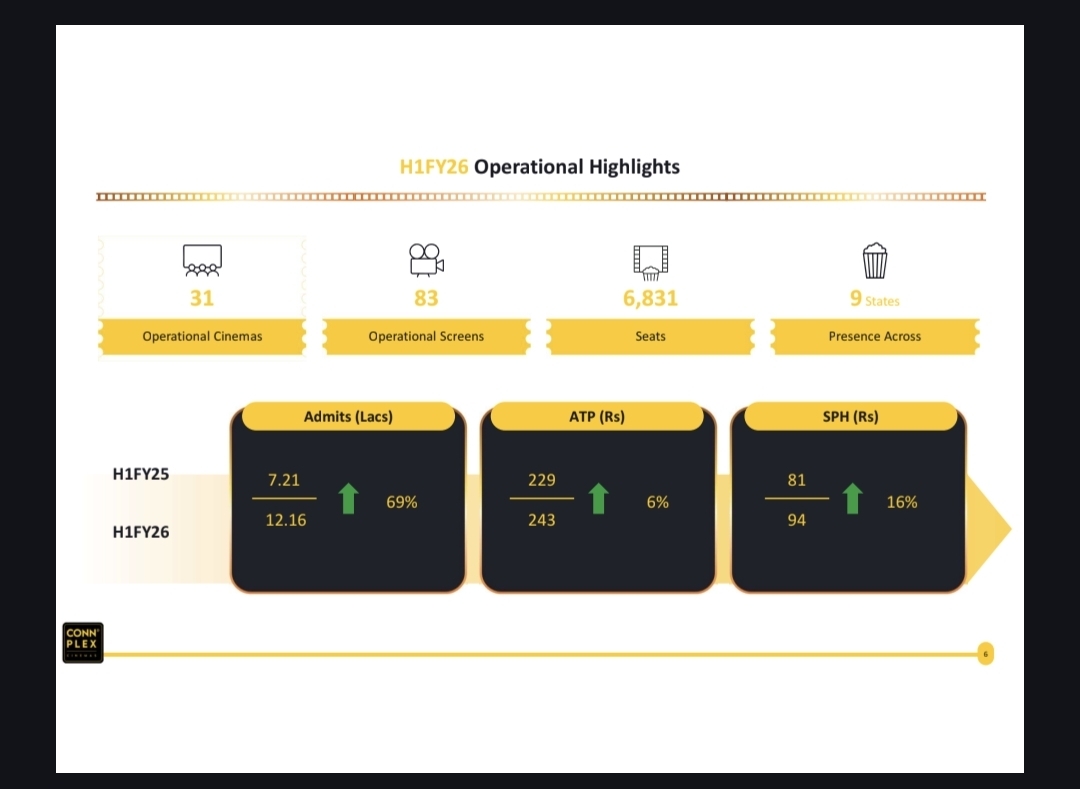
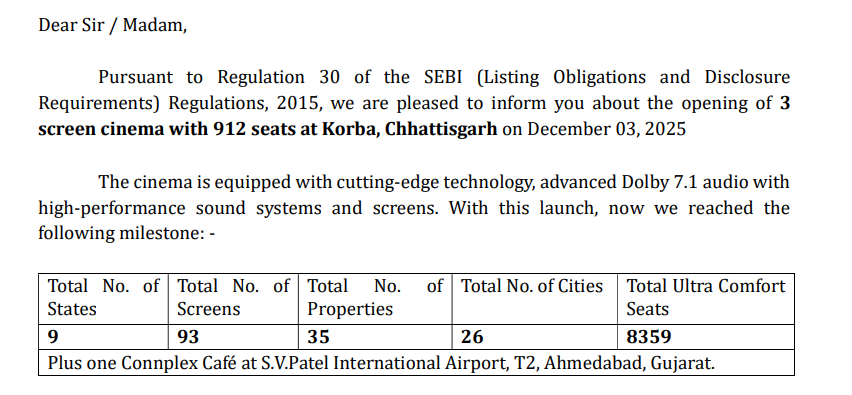
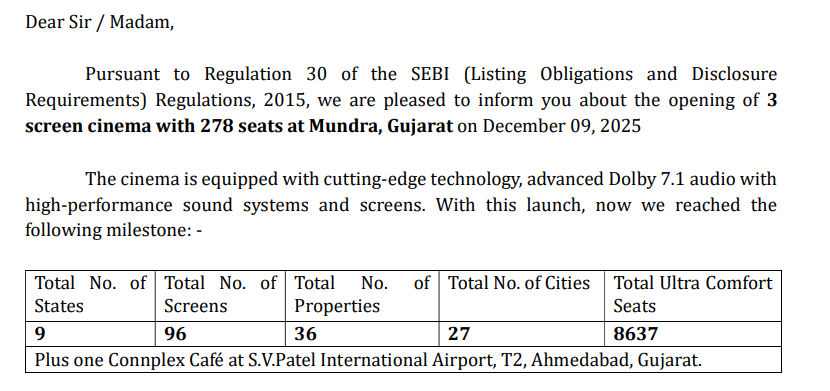
The company has guided for an aggressive rollout of 1,000 screens by FY30. I believe this is achievable given the near-zero capital requirement, strong unit economics, and a highly scalable business model.
So, let’s scale these numbers to visualize the potential of the business.
Royalty Income For 1000 Screens Per Year = 1,60,000 * 12 * 1000 ~ 200 Crores
Remember, this is royalty income, it is largely ~100% margin, recurring revenue, with most of it flowing directly to the bottom line.
Cumulative EPC Income (Ebitda) for [ 1000 - 80 ] Screens (80 already operational) = (89 Lakh/3) * 1000 = 297 Crores
So, company can make ~ 300 crores of cumulative Ebitda in next 4-5 years from EPC vertical.
Assuming 200-250cr only, accounted for any kind of additional operational costs.
6. RISKS
- Recently listed: All calculations are based on publicly available information and management commentary. Key variables may change.
- Execution risk: The company is pursuing aggressive expansion, which may strain operational capabilities.
- Rising competition: The business model is attractive, and new entrants may intensify competition over time.
- Content dependency: Performance is linked to the quality and success of film content an external factor beyond the company’s control.
- Pandemic risk: Any large-scale health crisis remains a terminal industry risk.
- OTT adoption: While OTT penetration is increasing, multiplex presence in Tier-2/3/4 cities is still limited. OTT may not be a near-term threat, though it could become one in the long term.
Read More :
Key Qualitative Differences vs. Competition - CONNPLEX CINEMA - A RETAILER WITH NEAR INFINITE RoCE - #29 by RocketMan
How To Think About Capex Calculation - CONNPLEX CINEMA - A RETAILER WITH NEAR INFINITE RoCE - #30 by RocketMan
If I had to sum it up in a few lines -
What Dr. LaL did for Diagnostics,
What Kalyan did for Jewellery,
Connplex has the potential to do the same for cinemas.
My intention here is simply to explain the business model, outline the unit economics, and help visualize the future potential. I have not made any projections on stock price or valuation multiples, as those are subjective and are left to the reader to evaluate. I also haven’t verified past financials, so please do your own due diligence before investing.
Disclosure : Holding
Disclaimer :
SME stocks carry higher risks due to their small size and limited history. This analysis is for educational purposes only and is not investment advice. Please do your own research or consult a SEBI-registered advisor before investing.