
CONNPLEX CINEMA - A RETAILER WITH NEAR INFINITE RoCE

  1. Cinema Revenue + Franchisee Fees = ₹49 Cr

Given company collects & realizes franchisee fees on signing up, we don’t know how many signings were done in FY25.

Pure EPC revenue would be approx. 42 Cr (assuming)

Raw material cost is ₹22 Cr.

So,

₹42 Cr – ₹22 Cr = ₹20 Cr, which is gross income, not EBITDA.

To set up a cinema, they must also incur other expenses such as contract labor, employee costs, site-related services, etc. Since we don’t have exact numbers, we’ll go with management’s guidance of 30% EBITDA for future, it’s possible they would have made more money here (we don’t know, because they opened 17 screens and 42cr is higher, so part recognition of revenue for screens that are not opened is also present) and revisit this once the next Annual Report is out.


  1. Prior to FY25, the arrangement is not fully clear.

It is possible that, in the early years, some franchisees operated under a revenue-share model (as the business model itself would have evolved in iterations during the initial phase).

On page 218 (F-18) of the RHP, under “Other Operating Income”, there is mention of ₹2.45 Cr of revenue-share income, which supports this view.


Now, calculating based on available data:

  • Ticket Sales: ₹34.97 Cr
  • Distributor Share: ₹14.7 Cr
  • Franchisee Share: ₹19.29 Cr
  • Revenue-Share Income: ₹2.45 Cr

So, company’s net becomes:

34.97 – 14.7 – 19.29 + 2.45 = 3.43 Cr

This is close to 20% of (34.97 – 14.7).


This is definitely worth noting, and I will ask management what the exact arrangement was in the initial years and how it evolved over time.

Going forward, they seem to be very clear (from concall) that every new screen addition will be royalty-based.

2 Likes

Thanks! My sense is that 2.45 Crs is convenience fee, which is being considered in shareable revenue. VPF fee may also be considered in shareable revenue. The only issue is they mentioned in concall that these won’t be shared.
Also, one more point, going forward the capex would be higher considering the investment in projector and screen, as mentioned in RHP.

VPF is not shared with franchiseee.

Capex will be higher because they are now focusing more on Luxuriance format.

But as I said in my original post, most of that’s funded from profits of epc income.

Has anyone been to their property if you have one in your city? Would love to know first hand experience

I personally haven’t been to one. But my friends have been there. They rate it positively.

You can check on google maps for general public opinion across cinemas.

I have been to their cinemas multiple times and it is ver Affordable and are really good.

3 Likes

Few qualitative points on how Connplex is different from other cinema chains –

  1. Low Opex–Capex model
  2. Entirely FOFO (all other chains are either COCO or FOCO), so no lease accounting on the company’s balance sheet.
  3. Royalty-driven income - high margins and predictable revenue streams.
  4. Small-size cinemas, which provide many benefits such as running regional movies, hosting corporate events, comedy shows, etc.
  5. Deeper penetration in Tier-3 and Tier-4 cities, as finding a franchisee partner is easier and competition is minimal. Check their cinemas in Bihar, extremely positively rated vs competition.
  6. Wide F&B menu and better seating experience, all possible because the capex burden is not on the company.
  7. Expanding screen count by the day (no prior baggage), with almost 100 screens operational and 300 additional screens signed.
  8. Focused on innovation, recent patent filing on SpectraX shows out-of-the-box thinking by management.
  9. Great reviews across all cinemas, showing consistency despite franchisee-managed operations, which can only come from standardized SOPs, systems, and processes.
  10. First-mover advantage in the FOFO royalty model; if it scales successfully, it will be tough for new competitors to compete. Having first mover advantage is very important, in tier 3,4 cities if you are the first modernized cinema, competition will think 10 times to open another one (will be consumed in roi calculations).
6 Likes

Expanding on Capex :

Mathematically, I had already made this clear in my original post; I’m just explaining it more verbally, as a few people have asked in DMs.

  • To open 900 screens, the capex requirement from the company’s side will be approximately ~200 crores. (Franchisee’s capex will be ~900crores)
  • EBITDA from EPC for 900 screens should be around ~225 crore.
  • Franchisee fees (non-refundable) for 900 screens will be approximately ~45 crore.

Hence, the funding required for capex is effectively zero, as it will be fully funded through internal accruals.

Where funds may be required is in working capital for the EPC vertical, which depends on the aggressiveness of capex expansion. Higher capex acceleration will require incremental funding, as investments need to be made in inventory (furniture and electronics) and in receivables from franchisees.

Based on current knowledge, subject to change.

3 Likes

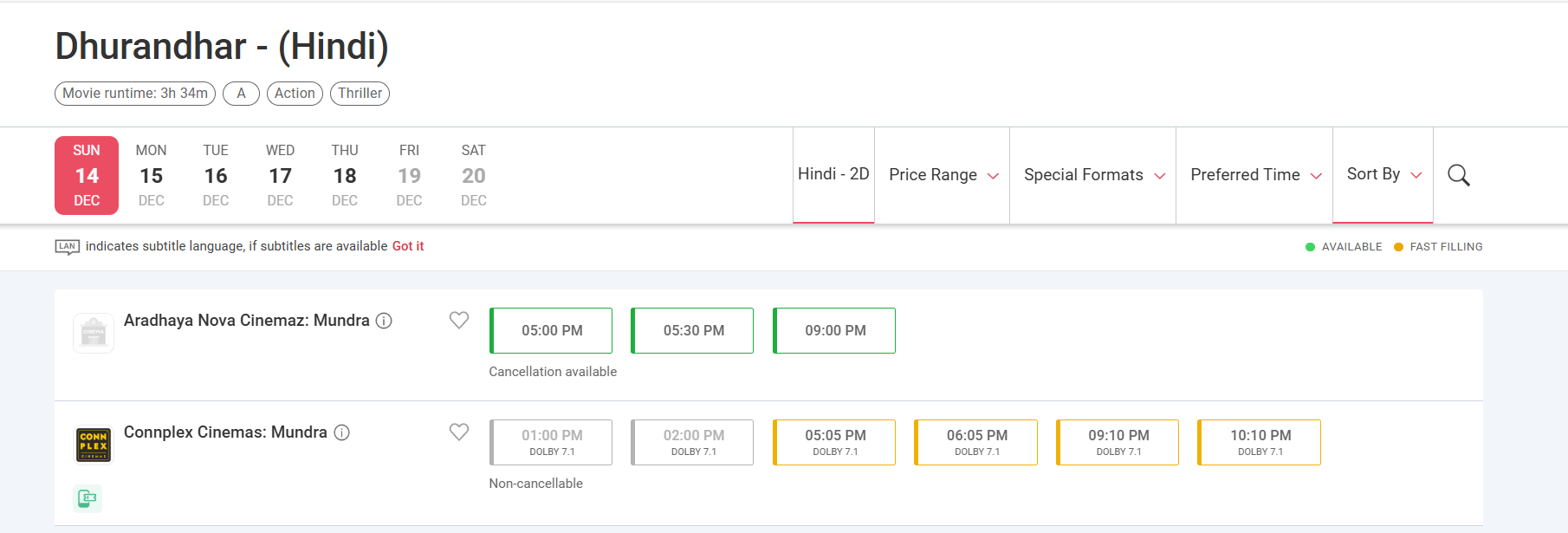
Who says Bihar is poor ? This reflects the ongoing premiumization trend.


This recent opening (9th Dec) in a Tier-3 town (Mundra) is showing strong relative performance.

Tier-3,4 cities with little or no competition is where the company has an edge.

3 Likes

I have been to the Ahmedabad Vaishnodevi location only once.

My observations are as follows:

  1. The sound system is inferior compared to PVR - full capacity theater.
  2. Ticket prices are comparable to PVR but higher than other regional players such as Rajhans.
  3. The theatre is relatively small and does not have a separate exit gate; both entry and exit are from the front.

Because of these factors, we prefer PVR or Rajhans (Rajhans being better than PVR, as they start shows on time). I would personally avoid visiting this multiplex due to the reasons mentioned above. However, it may work well for audiences in close proximity and in smaller towns, where it could be a better option.

Disclosure: No investment.

2 Likes

Company’s business model is better suited for Tier-3 and Tier-4 cities.

In Tier-1 cities like Ahmedabad, large chains already have a strong presence, making it consistently tough to compete with them due to capex differential.

Nevertheless, this does not pose any Balance Sheet risk to the company, given its franchisee-led operations.

The focus should remain on underserved locations.

2 Likes

Isn’t it mandatory to have a separate exit for emergencies?

Typical thresholds (vary by state, but broadly):

  • < 100–120 seats → single combined entry/exit allowed
  • 150+ seats → multiple exits compulsory
  • 300+ seats → exits must be remote from each other
2 Likes

What is SpectraX for which they have filed a patent?

https://nsearchives.nseindia.com/corporate/CONNPLEX_11092025162829_Patent_NSE_Letter.pdf

Not my core competence, try using LLM to understand better.

1 Like

@RocketMan I have a very basic question on the business model of the company. I do not understand it.

If Connplex has to spend 200 crores for 900 cinema screens as capex , it means per screen it has to spend Rs 18 lakhs approx for electronics and equipment. If the franchisee sources electronics directly from manufacturers even at 18 lakhs, all they incur is 18 lakh more but then they don’t have to share royalty fee , F&B income or anything with Connplex. In such a case , what attracts a franchisee to do business with Connplex? I mean it should not happen that just to save Rs 18 lakhs on electronics & equiptment, I end up giving more than 18 lakhs to Connplex in terms of different types of fees every year. I may be missing something here but i dont get this.

2 Likes

First, the cost comes down to ~20 lakh per screen after bulk procurement. Beyond just equipment, Connplex manages the entire operational stack, content selection, content delivery, ticketing, advertising, private bookings, F&B supply chain, branding, and ongoing backend operations. Essentially, all the operational complexity sits with Connplex; the franchisee partner has minimal day-to-day involvement, which is precisely the value proposition.

India already has thousands of single-screen cinemas, but running a multiplex is a very different challenge. If it were easy, operators would scale independently instead of partnering with brands like Connplex and others.

So, this is not just about supplying equipment.

4 Likes

I’ve been following this interesting thread. add to @rocketMan point, Connplex aggregates screens, which gives it significant bargaining power with distributors—unlike single-screen operators who have little say.

3 Likes

Connplex incurs expenditure on Projectors (one DCI projector and two non-dci projectors and SpectraX) and digital screen, sound systems etc. The cost will be much higher than your estimate. The Q2 conference call gives lot of details on this and how the ticket and f&b revenue is recognised.

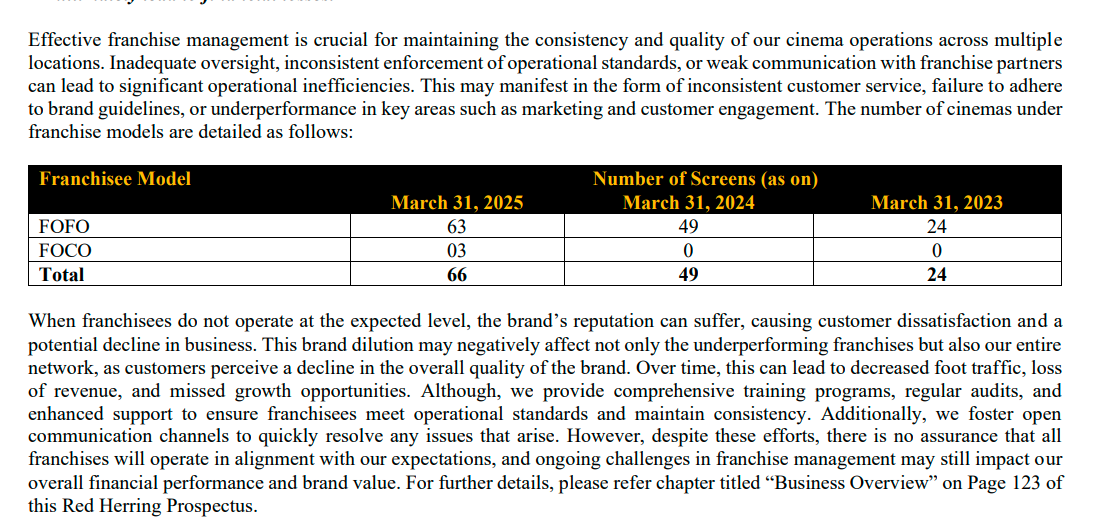
The reason I asked this question is because of the following para from DRHP-
FOFO model had 63 screens as of March 2025. Franchisee operated would mean operational management would be with the franchise and hence the confusion. This also highlights one of the risk. If franchisee does not live upto the standards this can damage the brand’s reputation and drive away customers. I checked on google reviews for different Connplex screens at different locations and they all seem to be good so far scoring 4.4 and above.

1 Like