
Aman ji,
IMO - bang on statement
3 Likes

Q3 updates are out; we Have to Watch out Margins and SSSG, but apart from that
If you look at the trajectory jumping from ₹11k Cr in 2022 to over ₹17k Cr today, it pretty much crushes the idea that physical retail is dying. To me, it just proves that only mediocre retail is dead.
But the part that’s actually kind of scary? They’re pulling these huge numbers with just 442 stores. In a country of billions. That consistent growth, adding roughly ₹2,000 Cr to the topline every year, that’s not luck. It’s pure execution.
Feels like we’re watching a titan being built in slow motion.
10 Likes
Only concern, sales growth is slowing down year after year. From 17% to 15% and now 13%
3 Likes
Base is getting big and apart from that quick commerce is taking a part of the industry but again my view would be same, once the dust settles and profitability emerges DMART will enter in quick commerce. Off course it won’t become market leader / disruptor right away but it will chip in slowly as we know the execution capabilities of DMART’s management.
3 Likes
Just sharing some thoughts:
There are two main sustainable models of trade: value for money and proximity (convenience).
Value for money: DMart, Reliance Retail
Proximity or convenience: General trade (GT) and quick commerce
Web commerce players like Amazon and Flipkart fall somewhere in between and currently seem somewhat confused.
It is difficult for any player to offer both value and proximity at the same time due to the underlying cost structure. A business can realistically excel at one, but not both.
Hence Dmart success is brick and morter store not ecommerece or QC.
6 Likes
very well articulated but if a company wants to diversify as it has pretty good diversification then this type of diversification (quick commerce) makes sense because it is a related diversification.
1 Like
Devenbhai,
First of all thanks for putting it on the radar 2-3 months back. I have looked at this off and on and especially last 1 week.
From my perspective and understanding of what Neville says is they are really not hyperfocussed on e-com. They are still playing around and figuring out the right strategy. I guess focus for next 2-3 years would be NCR/UP.
When i checked thier smallest towns they operate in it was a 1-1.5 Lakh population town. Now, India has 300 towns that have a population of 1 Lakh plus. If you read around the words, this is where Dmart is focused, especially in the North.
If you look at it that way, Dmart is way underprenetated where Qcom and the likes of Amazon don’t reach because pricing is a concern.
Just my 2 cents. Still looking at it.
5 Likes
That is the biggest opportunity. Bihar, Jharkhand, UP, and West Bengal
Also, elections are Round the Corner in WB and UP
Whats the source for this. Any communication from company
1 Like
@hardik_shah1 I don’t know which source exactly you are looking for, but these articles will help you understand. There is no official communication from the company.
1 Like
Looks like, DMart is selling books, at least through dmart.in and app. There is a Books Section. I have not seen books in the nearby DMart store.
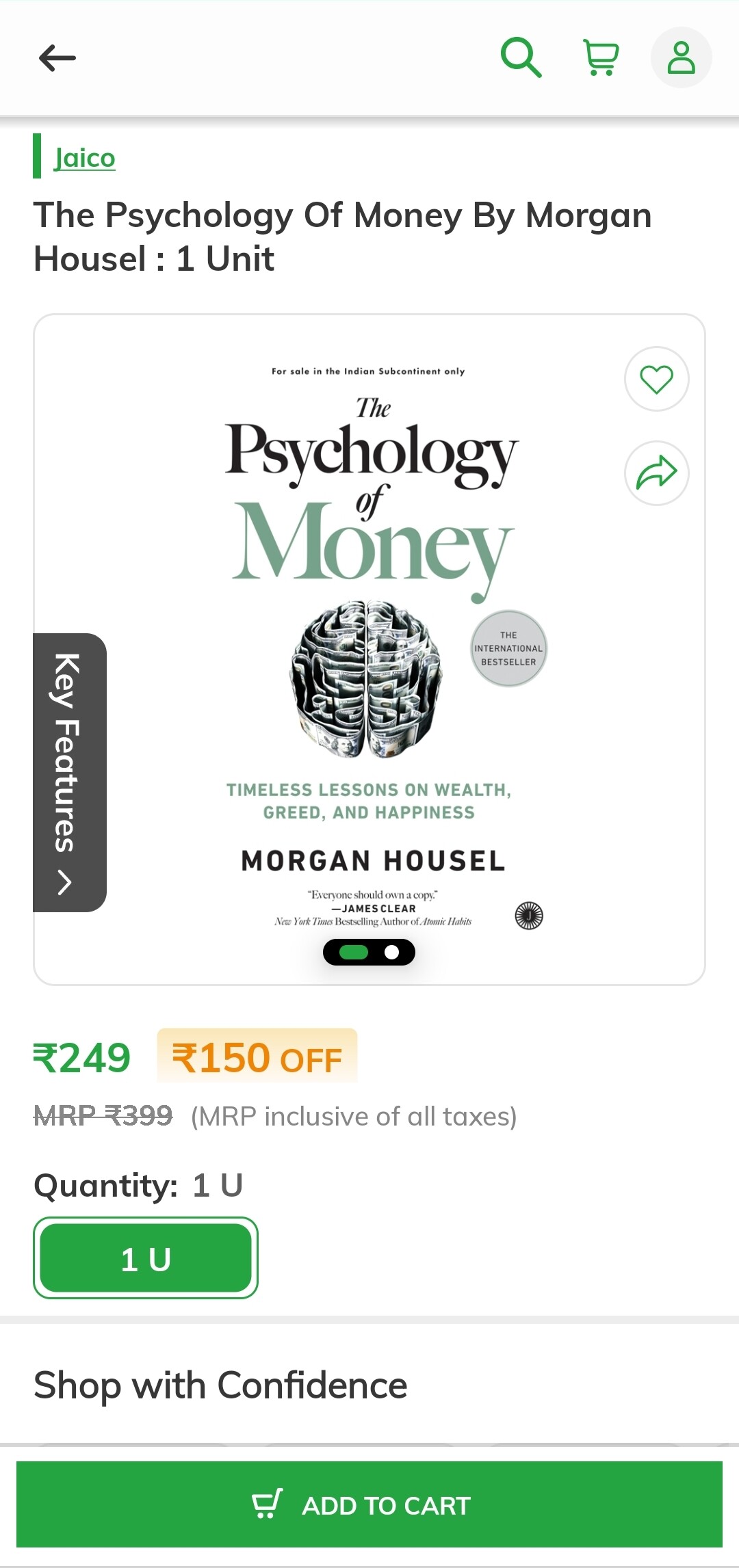

A quick sampling shows that the prices are cheaper than amazon. But yeah, the selection may not be as exhaustive, for now.
7 Likes
Don’t know the author - no link, liked it hence sharing.
4 Likes
wow what a read! specially all comments from Neville. Lots to learn and it seemed like not just reading thoughts of a seasoned CEO of a retail company but rather those of a seasoned Investor (top of value chain) as well…
While I read, I had thoughts of how this unique thinking & culture of the company will be passed on to future leaderships. This was partly answered in end when Neville mentioned that in first year, they do not give targets but rather make the new comer soak into the unique culture & business model. Rare, specially in an Indian comany.
Neville is moving out from CEO role in Feb 2026, again a rare thing of having almost an year of overlap with next CEO designate…something I had noticed in maybe some Tata group company or L&T earlier…big enough period for culture to soak in…
Still, people do ideate (not meaning anyone in particular but can be anyone in very distant future as well), some out of compulsion and some out of belief…my query here is how does one ensures that this unique business model & culture of dmart remains even when likes of Neville & significant others move out…Neville does own significant value of dmart stocks so would he remain in an overseing role in future? Also, what role does Mr. Damani play in driving this business model & culture as on today…if anyone has insights, would be good to know.
Disc. Core holding hence biased. Not a buy/sell recommendation. Not eligible for any advice. Post only for learning purposes and I can be wrong in all my assessments.
3 Likes


4 Likes
LTM Standalone EPS around 48, at current market price PE is 79, which is almost lowest since listing.
Once inflation increases to normal & new store opening accelerate as promised by company, revenue growth is also expected to increase.
And some point, these quick delivery companies will also stabilize & do business for profit.
So, may be bottom is done. Aage, market sabse uppar.
7 Likes
Disclaimer - I am a apparel / textile store owner and what I narrated below is my personal experience.
Also, I have used chatgpt to write this in order to avoid any grammatical mistakes.
I recently travelled to Ghaziabad, Meerut, Panipat, and Pilkhuwa, where I met multiple suppliers dealing in bedsheets, fabrics, sofa fabrics, sofa covers, and blankets.
One of these vendors has been supplying to Avenue Supermarts (DMart) for more than 10 years or so and mentioned that he was among the early vendors. According to him, DMart’s business model has changed since the end of 2024.
He said that DMart is now focusing more on profitable items. Internally, they have decided that their profit margin will be a minimum of around 20%, and in some categories it can go as high as 40–50%. Earlier, margins used to be much lower across most categories.
This change has had a very positive impact on his business. Because DMart is now willing to stock higher-priced products, he is able to supply costlier items than before. Even though he is supplying to roughly the same number of DMart stores, his revenue from DMart has increased almost fourfold.
He also mentioned that DMart has become more open to testing new products. They usually introduce a product in a small number of stores first, and if it works, they then roll it out to a larger number of stores.
He gave an example of a product called a sofa throw, which works like a sofa cover and is more commonly used in Western markets like Europe. He had been suggesting this product to DMart for several years, but initially DMart was very reluctant because the product was expensive and they felt customers might not buy such items without guidance.
However, in the last year or so, DMart agreed to try this product in about 10 stores. The product sold well despite being priced in the ₹1,500–2,000 range. After seeing the response, DMart expanded this product to around 40 stores and is continuing to evaluate it.
The vendor also supplies to V2 Retail, Megamart, and M-Mart. He said that business is doing well across these chains too. According to him, even low-price and value-fashion retailers are now trying to sell relatively premium or fashion-oriented products, which has been beneficial for suppliers like him.
He also shared an old incident that shows DMart’s cost-conscious culture. In 2014, he met the head of purchase for fabrics or general apparel at DMart, who was earning around ₹14,000 per month. This surprised him because that person was placing orders worth ₹10–20 lakh per month with this vendor alone and was managing around 130–140 vendors in total. The vendor even offered him a job, but the person declined.
Finally, he clarified that DMart is not directly going premium in an obvious way. They are still keeping some very low-priced items in the store so that customers continue to feel that DMart is cheap.
For example:
Cushion covers that cost DMart around ₹37–38 are sold at ₹49, which is a low-margin item and acts as an entry price point.
On the other hand, a pair of bloster covers that cost DMart around ₹120 are sold at ₹199, where margins are much higher.
According to him, DMart is intentionally keeping some items at very low prices so that customers do not feel that the store has changed, while at the same time earning much higher margins on several other products.
35 Likes
Agree with most of what you have written. Even in the FMCG space, strategy has been similar. The company is also acting smartly in expanding new stores in tier 2, tier 3 places where the impact of E-com and Q-com is minimal (if any at all). Business moat is strong in my opinion. The only challenge that i see is the valuation which has never been in my comfort zone (except probably during the IPO when i didnt invest)
1 Like
Quite interesting news.
But I think while the entry of a global giant like Lawson is big news for the Indian retail landscape, they aren’t exactly hunting in the same territory as DMart, though.
If anything, Lawson is a bigger threat to 7-Eleven India (Reliance) and the likes of Blinkit/Zepto for small, instant purchases.
If Lawson manages to scale to 10,000 stores by 2050 (their stated long-term goal), they will compete for prime urban real estate, which is already scarce. Most won’t stop going to DMart for groceries because a Lawson opened nearby. Most would just go to Lawson for the snacks you can’t find anywhere else.
But in India, they will have to pivot heavily toward vegetarian grab-and-go snacks to suit local tastes, which is a segment DMart started focusing on lately in their Stores.
2 Likes
Company opens new locations in Malls apparently. Their previous concalls they were actively avoiding Malls. Wondering what went into opening at these locations. Announcement here.