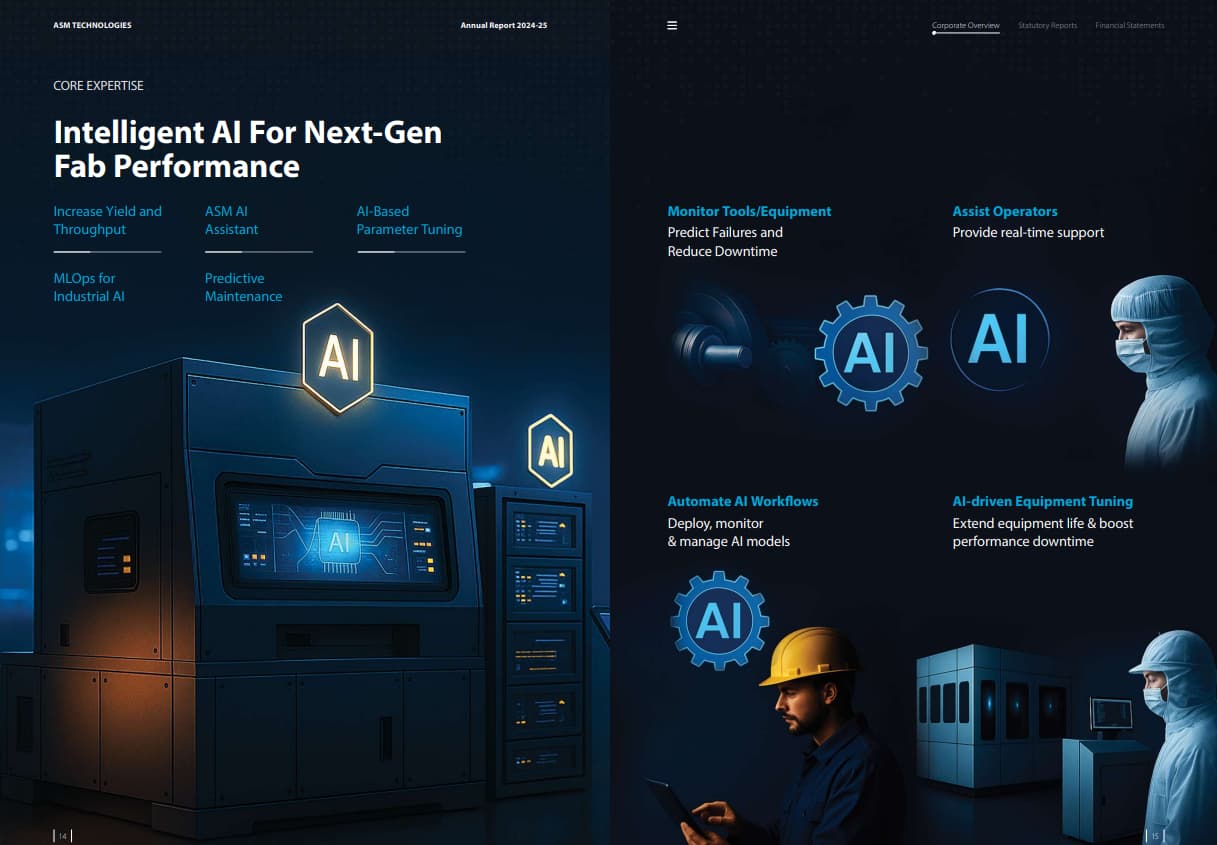
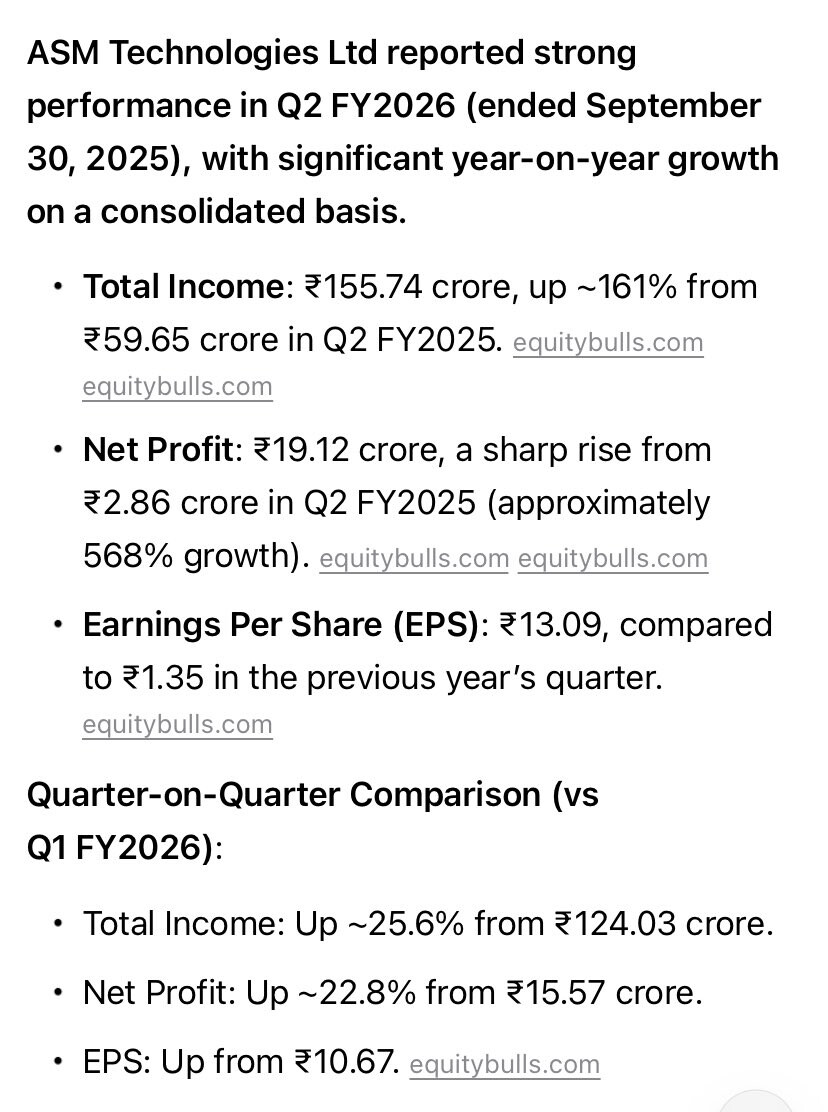
Sharing my thoughts from the AGM that took place on Friday below:
It was refreshing to hear this year’s AGM.
First off, the quality of questions from the shareholders continued on its upward trend. People are asking very clear questions to the management, which demonstrates that shareholders have a much better idea of the business and its future prospects these days.
Secondly, the management spoke with a level of confidence and conviction (without showing any arrogance and hubris) that was markedly different from previous years. They are successfully transitioning the company from an ER&D company to a DLM (design-led manufacturing) organization, so I feel that the confidence and conviction is warranted.
It was great to hear from Prasanth Sakhamauri, the MD of Hind High Vacuum speak this time around. As you may remember, ASM and HHV have formed a JV, that I believe is going to be of increasing importance going forward. He spoke about the goal to build tools, sub-systems and systems for the semiconductor industry. The company is working on innovations to process polysilicon faster and cheaper. Building partnerships/collaborations with photovoltaic companies are a work in progress. The end goal with this effort will be to help PV companies make new age solar cells.
They are also working on crystal pulling technology (expecting a prototype this year). For those who aren’t aware, semiconductors often require high grade monocrystalline silicon. For the solar industry, polycrystalline or amorphous silicon are good enough. The crystal pulling method helps form monocrystalline silicon, so I am very keen to hear about the progress that’s being made here.
At this point, the company is fervently working on designing various tools, systems and sub-systems for the semiconductor and solar industries, in addition to the consumer and industrial electronics space. Most of what the DLM division produces is counted as capex in these industries.
In the solar and semiconductor industries, the equipment has a longer life cycle. There is therefore a lot of scope to improve and customize equipment. In the electronics space (both consumer and industrial), life cycles are shorter (1-4 years).
The journey from design, to prototyping, to validating/qualifying, and finally to manufacturing (slowly building scale) for equipment can take 18-24 months or more.
FY25 was focused on growth and capability building. The year was critical for building resilience, and the fruits of this will be seen this year and beyond.
The revenue share of exports is expected to ramp up in the future.
The company announced two large MoUs this year (₹250 cr in TN and ₹510 cr in KA). Both are currently in the land acquisition phase. Once completed, they will form a strong base for the company for 5-6 years. There are central and state level subsidies available, and ASM is looking to leverage these subsidies wherever possible.
Currently, the manufacturing plants are operating at an 80-85% capacity. The larger plants are expected to come online in 18-24 months.
Similar to previous years, we were told that NDAs are in place which limit what can be said about equipment sales and client names.
Currently the staff breakdown is as follows: 2/3 ER&D, and 1/3 DLM. DLM is expected to grow. ASM intends to use the ER&D staff as a strategic pool of talent/value to assist with DLM efforts. ER&D is not solely an external client facing division.
ASM is working on internal IP efforts, and will update shareholders in the coming months. Currently IP is customer owned. I am keenly interested to know what internal IP the company will develop.
Bear in mind that semiconductor grade equipment requires much more skill and precision than equipment for the solar industry, so the company aggressively pursuing opportunities in the solar domain is great news. Progress here will serve as a foundation to then sharpen its skills and precision engineering prowess, which will then pay dividends when doing more work for the semiconductor industry. On this note, there are 3-4 very large names in the solar industry, and ASM-HHV is having discussions with two large players.
Semiconductor processing involves many complicated processes, and I was curious to know whether the company was doing any work with photolithography (arguably the most complicated process). The company isn’t there yet, but is open to actively work with customers on this technology (a sign of confidence in their skills).
Overall, I am happy to stay invested and see things play out.
Disclosure of holding: I kept buying shares in ASM Technologies from 2021 to 2023, with an overall cost basis of ₹227. I have a fairly concentrated portfolio and do not own more than 10 companies at any given time.