SOURCE : FEB(2026 CONCALL TRANSCRIPT) ,
“So, as of 31st January, the total order book is Rs.1427 Crores. Out of that, the anti-drone system and simulators are equally distributed of 50%, 50%. “
SOURCE : FEB(2026 CONCALL TRANSCRIPT) ,
“So, as of 31st January, the total order book is Rs.1427 Crores. Out of that, the anti-drone system and simulators are equally distributed of 50%, 50%. “
These are Zen claims: During Operation Sindoor in May 2025, the Zen Technologies anti-drone system (C-UAS) proved highly effective, successfully detecting and killing hundreds of enemy drones and swarm drones. The system outperformed others by jamming a wide range of data links beyond conventional 2.4/5.8 GHz, addressing threats outside standard frequency limits.
[image]Zen Technologies +1
Performance Highlights during Operation Sindoor:
[image]Zen Technologies +2
The success of the Zen C-UAS during this operation led to increased trust in indigenous anti-drone technology, with Zen Technologies subsequently securing major orders from the Ministry of Defence.
[image]Facebook +1
Disclaimer: Own a few shares. Biased. No recommendation. Please do your own research.
Yes. Going forward Zen expects the share of Simulator: Antidrone to become 50:50.
Electronic jamming often fails against Iranian drones, such as the Shahed-136, because they are specifically designed to operate autonomously without a constant radio link to an operator. [1, 2]
Primary Reasons Jamming Fails
Autonomous Navigation: Unlike commercial drones, many Iranian military drones are pre-programmed with GPS coordinates before takeoff. Once in the air, they do not need to receive control signals, making traditional “command link” jamming useless.
Inertial Navigation Systems (INS): These drones often use internal sensors (gyroscopes and accelerometers) to calculate their position. Even if GPS signals are successfully jammed, the INS allows the drone to continue toward its target with reasonable accuracy.
Hardened Electronics: Iran uses anti-jamming protocols and “frequency hopping” (constantly changing frequencies) to evade electronic attacks.
Sourcing of High-End Components: Despite sanctions, Iranian drones have been found to contain sophisticated, jam-resistant satellite navigation modules sourced from Western technology. [1, 2, 3, 4, 5, 6]
Practical Limitations of Jamming
Power Requirements: To jam a drone effectively from a distance, a jammer needs an enormous amount of power, often requiring a truck-sized generator.
Collateral Damage: Broad-spectrum jamming can interfere with friendly communications and local civilian infrastructure, such as Wi-Fi and cell signals.
Anti-Radiation Risks: Powerful jammers emit a strong signal that can be easily tracked, making the jammer itself a target for anti-radiation missiles or the drones themselves. [2, 3, 7]
While electronic warfare units have successfully downed some drones, the shift toward AI-driven targeting and autonomous flight makes “soft-kill” methods increasingly difficult to rely on.
Wonderful information. Do you get that through some defence magazines?
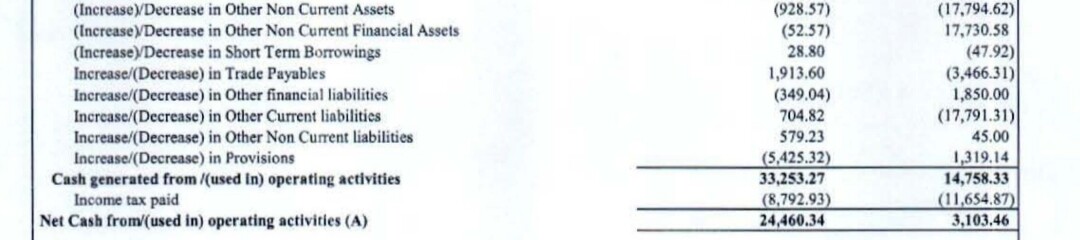
Zen tech CFO has increased to 244 cr in FY26 from -147 cr in FY25. The only positive takeway from the result
I think there has been some mistake in the report . In last year’s report it was mentioned as -144 cr for FY25
Zen’s orderbook on 31st march 2025 was around 650 cr, it didn’t increase till sept 2026 (mostly due to lack of orders under regular procurement Post Op sindoor) .Consequently, made a huge impact on sales and profits. Inventory days have also increased this year. Management were pessimistic about FY26 result and it reflected in the numbers. However, the current orderbook on 31st march 2026 stands at 1336.04 cr…. mostly converting into this financial year yielding substantial revenue.
Dr. Sreenivas Rao has joined Zen Tech as their new CTO. He is an acclaimed Scientist and former Dir. Gen. of Naval systems in DRDO.
Dr. Y. Sreenivas Rao is a distinguished scientist and former Director General (Naval Systems & Materials) at DRDO, who retired in September 2024 after nearly four decades of exemplary service. He holds a degree in Mechanical Engineering with distinction from JNTU, Hyderabad, and a PhD from Osmania University. He began his career at BHEL, contributing significantly to the manufacturing and technology transfer of gas turbines and related systems. In 2000, he joined DRDO, where he played a key role in India’s missile defence programme, working on communication systems, missile technologies, and warhead development. Dr. Rao was instrumental in the conceptualisation and development of missile defence systems, including interceptor missiles, and contributed to major national missions. Known for his leadership and technical expertise, he has made lasting contributions to India’s defence capabilities.
I am pretty sure they will start getting orders from Middle East and other countries. Their anti drone systems are proven. Their systems were integrated with older anti air defence turrets(l-70) and worked brilliantly during operation sindoor. Even if their systems can only detect drones like shaheed legacy era turrets can do the job.
Yeah, results does not amount to much I believe. Standalone results are even more hideous! But again, this is an order book story and not a QoQ story. That is what we need to be looking for especially in sunrise sectors within defense.
More excited about Ashok Atluri’s commentary on pipeline and product interest. No doubt that Anti Drone should be one of the hottest topics within the defense ecosystem. They also should do some more interesting acquisitions
@cdas3317 Please stop posting these AI-generated long tables. I don’t think anyone is even reading these. It is a waste of space.
Maybe you might not be monitoring as either you might not have invested or have no time to do these research. Someone actively tracking these as they might have invested some big amount and all small pieces matters to them. To be frank I also don’t monitor these many parameters but I like the approch. Someone already prepared and serving you with readymade information what’s wrong in posting. I do see that user posted in other channels as well but with this depth. I appreciate that. If you see this as useless that’s fine. Ignore and proceed. Simple.
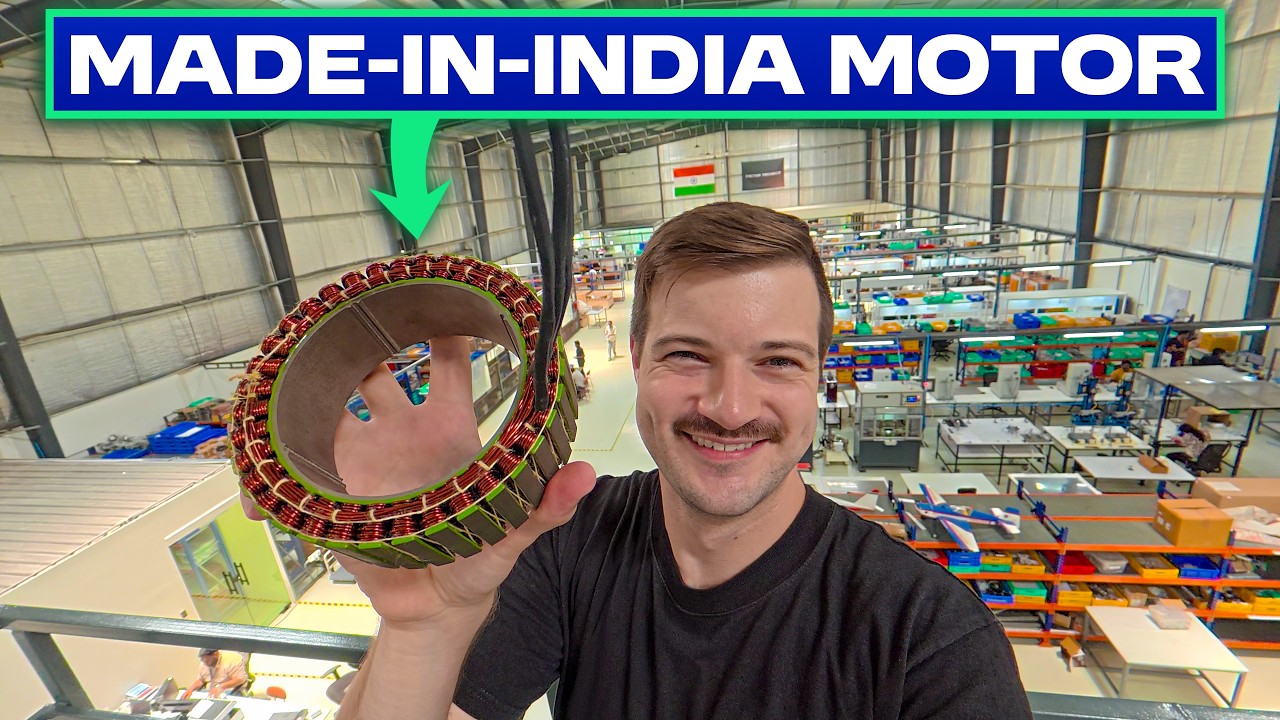
Zen technologies owns 51% stake in Vector Technics. Today even Anand Mahindra posted on X about this video.
Zen has done some wonderful acquisitions and investments.
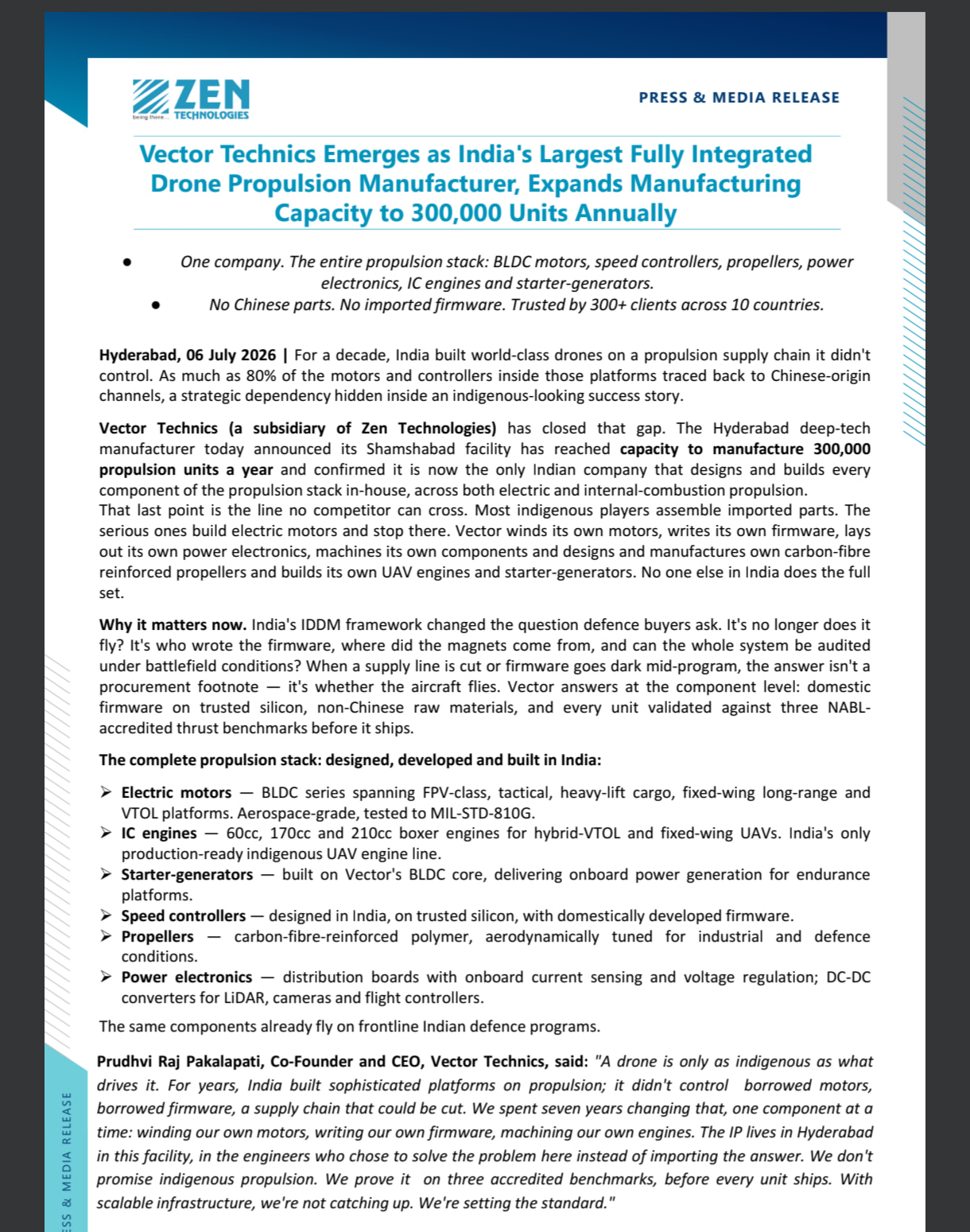
Vector Technics Update
Prudhvi Raj Pakalapati, Co-Founder and CEO, Vector Technics, said: A drone is only as indigenous as what drives it. For years, India built sophisticated platforms on propulsion; it didn’t control borrowed motors, borrowed firmware, a supply chain that could be cut. We spent seven years changing that, one component at a time: winding our own motors, writing our own firmware, machining our own engines. The IP lives in Hyderabad in this facility, in the engineers who chose to solve the problem here instead of importing the answer. We don’t promise indigenous propulsion. We prove it on three accredited benchmarks, before every unit ships. With scalable infrastructure, we’re not catching up. We’re setting the standard.
“We don’t promise indigenous propulsion. We prove it on three accredited benchmarks, before every unit ships. With scalable infrastructure, we’re not catching up. We’re setting the standard.”
Smells of AI from “we don’t…we do” phrasing. It’s not necessarily bad or good, but AI does this re-packaging all the time. If it’s indeed AI, I see lack of conviction and words galore.
I don’t think it is correct to judge the credibility of the management just because they have used AI in writing some Filings or even in their presentations. Maybe the founder has used AI, but if you see their Factory Visit Video on youtube, you will understand that they are not making some baseless claims using AI.
Many listed companies have actively started using LLMs to generate presentations, and they are distinguishable, like easy to identify that which are AI made and which are not. So do we now question the Quarterly Results as well.
One interesting thing I noticed today, half of Mint and BS, was filled with articles and responses from AI, but that is used to polish the language. It no way undermines the research and knowledge of the person who does all the ground work.
Zen unveiled India’s first high-altitude man-portable anti-drone system