Tried to decode the business and its products in an easy to understand way:
Part 1: The Basics — What is the Power Grid and Why is it Stressed?
- The Power Grid: Imagine the grid as a massive, real-time highway system for electricity. Power is generated at a power plant (like a coal, nuclear, or hydro station), travels down high-voltage transmission lines across long distances, arrives at substations (which act like highway exits that “step down” the voltage to a safer level), and is finally distributed to homes and factories.
- The Golden Rule of the Grid: Unlike water or gas, electricity cannot easily be stored on the grid itself. The amount of electricity being generated at any given second must exactly match the amount of electricity being used by millions of homes and businesses.
- Frequency & Voltage: Think of grid frequency (measured in Hertz) as the “heartbeat” of the grid. If generation and usage are perfectly balanced, the heartbeat is stable. If people suddenly use too much power, or a power plant fails, the heartbeat slows down (frequency drops). If there is too much power, it beats too fast (frequency rises). If the heartbeat fluctuates too much, power plants automatically shut down to protect themselves, causing massive, cascading blackouts.
The Stress: Traditional Grid vs. Renewable-Heavy Grid
Historically, managing the grid was simple. We had a few, massive power plants feeding electricity in a simple, one-way flow to consumers. These large plants had high “inertia” (heavy, spinning turbine generators that naturally absorbed minor shockwaves and kept the grid steady).
Today, countries like India are rapidly shifting toward Renewable Energy, targeting 500 GW of renewable capacity by 2030. This introduces severe stress to the grid:
- Supply Volatility (Intermittency): Solar and wind power are highly unpredictable. If a cloud covers a massive solar farm, or the wind suddenly stops blowing, gigawatts of power vanish in seconds.
- Two-Way Flow: Instead of a few big plants, we now have millions of distributed solar panels and wind turbines feeding power back into the grid from all directions, making electricity flow two-way.
- Low Inertia: Solar panels have no heavy spinning parts. This means the grid loses its natural “shock absorbers” and becomes highly fragile. Minor fluctuations that used to be ignored can now cause the entire grid to wobble violently, leading to events like the country-wide Iberian Blackout in April 2025 (which affected Spain and Portugal due to sharp voltage fluctuations and poor coordination).
Part 2: What Valiant Communications Actually Does
Valiant Communications does not manufacture the heavy physical infrastructure of the grid, such as steel transmission towers, high-voltage transformers, or power cables.
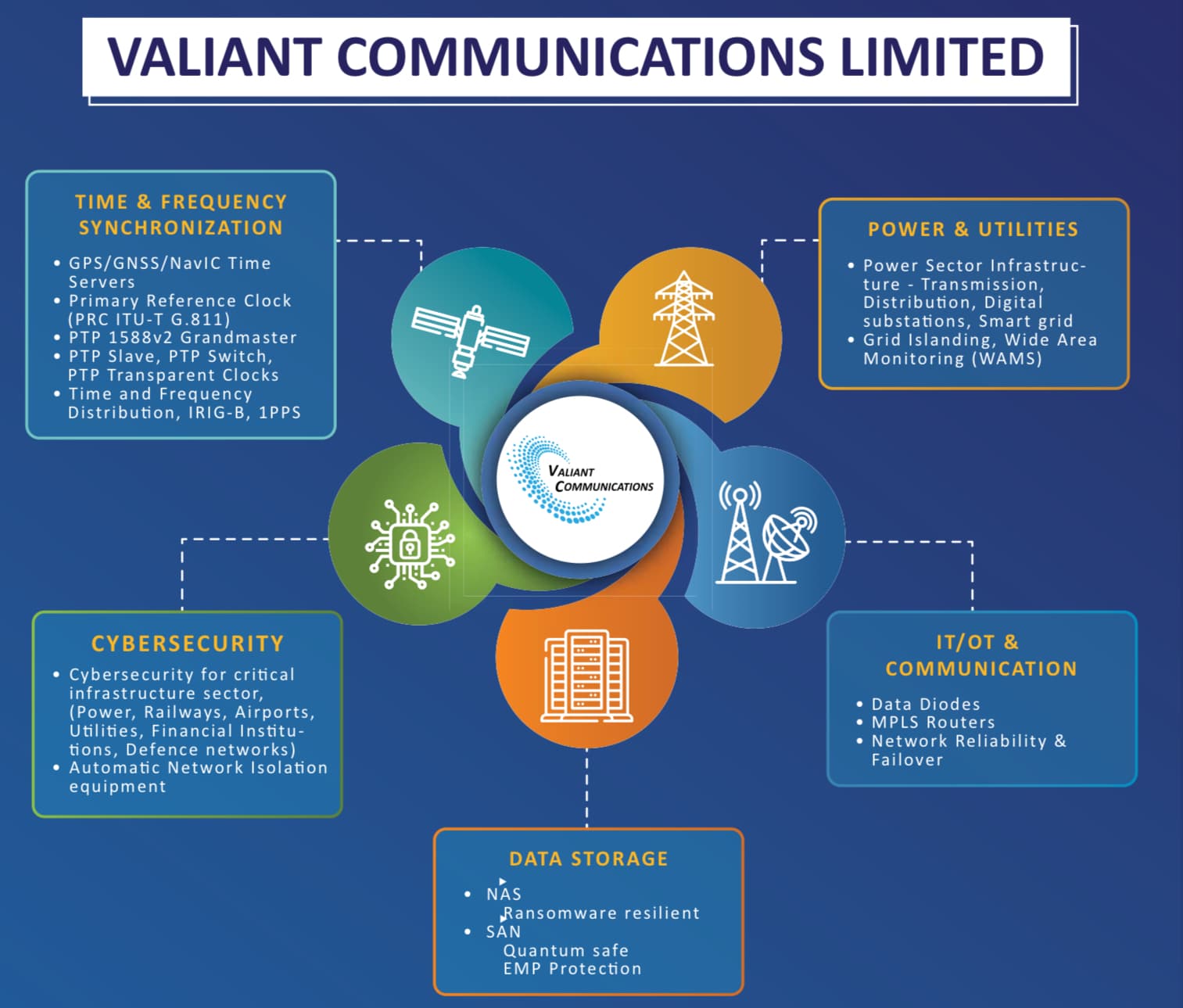
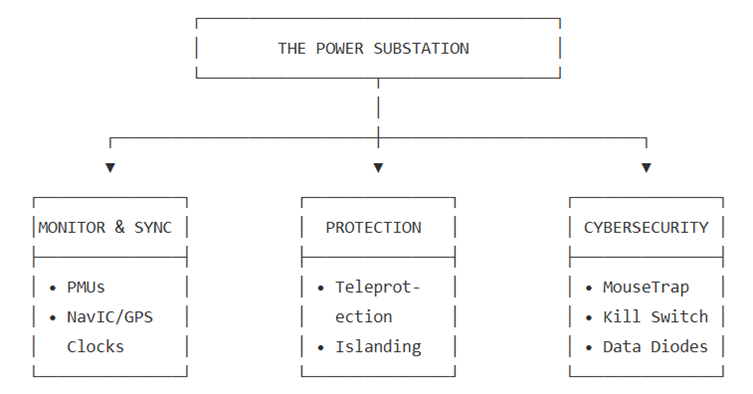
Instead, Valiant operates in the Grid Monitoring, Protection, and Stability Layer. They build the highly specialized, ruggedized computers, communication routers, and atomic-precision clocks that serve as the digital nervous system, air traffic control, and emergency brakes of the power grid.
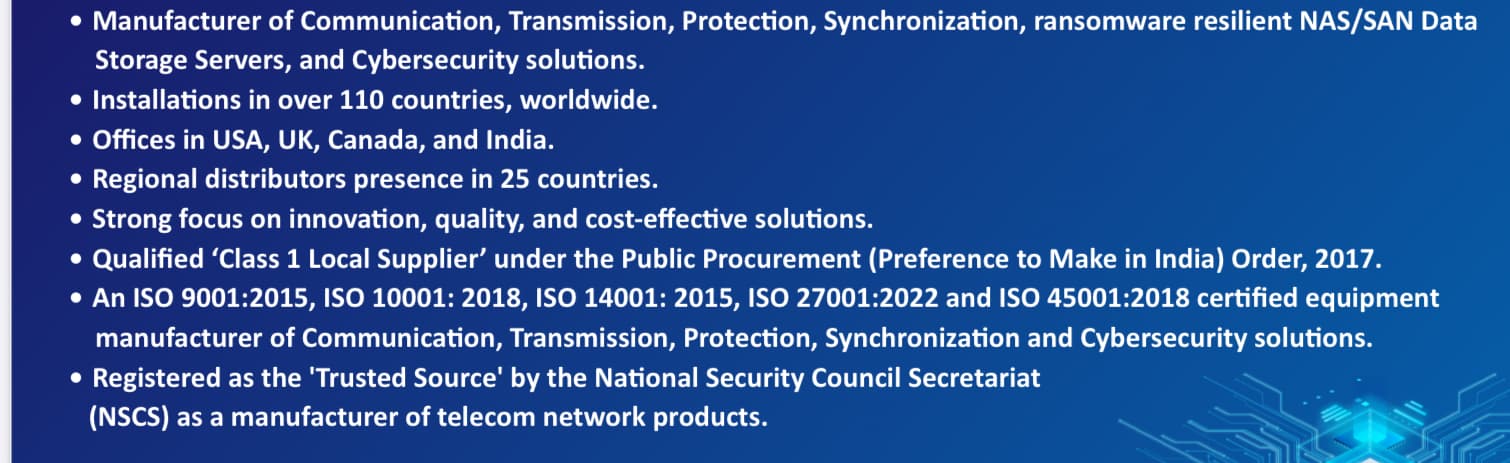
Their equipment is currently installed across more than 6,000 power substations (ranging from massive 765 kilovolt transmission lines down to 33 kilovolt distribution yards) in India and 110 countries globally.
Part 2: What is a “Zero-Day Attack” and Why is it a Grid Nightmare?
The digital transformation of the grid means that substations are now controlled by software and connected to networks. While this makes the grid smarter, it also makes it highly vulnerable to a devastating threat: the Zero-Day Attack.
What is a Zero-Day Attack?
Normally, cyber defenses like antivirus software and firewalls work by looking for a “signature”—a known piece of malicious code that has been identified before.
A Zero-Day Attack exploits an unknown vulnerability in software or hardware. Because the vulnerability is completely unknown to the software developers, no patch, signature, or antivirus definition exists for it yet. The attackers have “zero days” of warning before the exploit is weaponized.
Why is this highly dangerous today?
- Lightning Fast: Over 23,600 software vulnerabilities were published in the first half of 2025 alone. Nearly 30% of exploited vulnerabilities are weaponized within 24 hours of public disclosure—sometimes before developers can even write a patch.
- State-Sponsored Targets: Almost half of cyber attackers are linked to state-sponsored groups or hacktivists specifically targeting industrial and Operational Technology (OT) environments like power plants, water treatment facilities, and defense grids.
- High Containment Time: On average, it takes organizations 258 days to identify a breach and 64 days to contain it. During this time, hackers can quietly map the grid’s network and position themselves to turn off a nation’s power at will.
Part 3: How Valiant Defends Against Zero-Days (The Hardware Advantage)
Traditional software-based security is structurally blind to zero-days because it tries to recognize the threat. Valiant takes a fundamentally different approach: they don’t care what the attack looks like; they look at how the network behaves, and they use physical hardware to stop it.
They do this using a dual-layered defense system:
1. The VCL-Network MouseTrap (The Decoy)
The Network MouseTrap is an advanced intelligent “honeypot”—a decoy server that pretends to be a highly critical grid asset (like a substation controller or a power plant database).
- The Trap: An attacker exploiting a zero-day will eventually scan and probe the network to find targets. The moment the hacker touches the MouseTrap, they trigger an immediate alarm.
- Zero Prior Knowledge Needed: The MouseTrap doesn’t need to recognize the malware’s code; it simply knows that no legitimate user should ever be touching this decoy asset.
2. The Network Isolation Kill Switch (The Physical Guillotine)
If the MouseTrap detects an intruder, it is hardwired via a physical serial cable directly to Valiant’s Network Isolation Kill Switch.
- The Millisecond Disconnect: Within milliseconds of a confirmed intrusion, the Kill Switch physically disconnects the compromised section of the network (severing the local network from the wider internet).
- Un-hackable Fail-Safe: This is not a software command. It is a physical, hardware-level separation. Because the connection is physically severed, no malware residing in the network can bypass, override, or turn the connection back on. Even if the Kill Switch loses power or its control card fails, the network segment remains safely isolated.
This allows utilities and defense installations to comply with strict international and domestic regulations (like India’s CERT-In and CEA mandates and the UK’s NCSC CAF 4.0), which demand immediate network isolation capabilities.
Part 4: What are NAS and SAN Storage Equipments?
In any large organization (like a bank, a power utility, or the military), millions of digital files, databases, and logs are generated every day. Standard computers or individual local hard drives aren’t designed to handle or share this much data. Organizations use two main types of centralized storage systems:
1. NAS (Network Attached Storage): “The Shared Local Drive”
- The Analogy: Imagine buying a large external hard drive and plugging it directly into your office Wi-Fi router instead of your laptop. Now, anyone connected to that Wi-Fi can access, read, and save files to that single drive.
- What it is: NAS is a dedicated storage device connected to a standard network that provides file-level storage. It is simple to set up, highly collaborative, and perfect for standard office documents, shared folders, and general file backups.
2. SAN (Storage Area Network): “The Virtual Internal Drive”
- The Analogy: Imagine you have a massive bank of hundreds of high-speed hard drives sitting in a remote server closet, connected to your computer through ultra-fast, dedicated fiber-optic cables. Your computer’s operating system doesn’t see this as a shared “network folder”—it behaves exactly as if those hard drives are physically bolted directly onto your computer’s motherboard.
- What it is: SAN is a highly sophisticated, high-speed network of storage devices that provides block-level storage. It is much faster and more complex than NAS, designed to handle heavy, rapid workloads like bank transaction databases, virtual machines, and massive server clusters.
How Valiant’s NAS and SAN Products Differ (The “Moat”)
Standard NAS and SAN devices are manufactured by consumer and commercial IT giants like Dell or HP. However, power grids, defense installations, and critical government departments cannot use standard commercial storage because they are highly vulnerable to cyber warfare, physical electromagnetic surges, and foreign espionage.
Valiant’s storage platforms are specifically engineered for high-stakes, hostile environments:
- Ransomware-Resilient Security Layers: Standard IT storage is a prime target for ransomware hackers who encrypt files and demand payment. Valiant builds its storage servers with multiple layers of security, including physical network isolation (the Kill Switch), Quantum-Safe authentication, and Quantum-Safe encryption.
- EMP (Electromagnetic Pulse) Protection: In a warzone or during a major high-voltage grid failure, massive electromagnetic surges can instantly fry standard computer chips. Valiant manufactures specialized EMP-protected data storage systems designed to survive these extreme conditions.
- Single-OEM Integrated Backup (Data Beaver): Normally, an enterprise buys a storage box from one vendor, backup software from a second vendor, and security tools from a third. This creates complex integration risks. Valiant pairs its NAS/SAN platforms with its proprietary “Data Beaver” backup solution. This provides clients with a unified, single-OEM architecture that simplifies security and support.
- India’s Data Sovereignty Mandates: Under the Atmanirbhar Bharat policy, the Government of India has instructed all Critical Information Infrastructure (CII) organizations to install captive, secure data storage servers locally within the country. Because Valiant is a certified Class-1 local manufacturer whose storage equipment successfully passed rigorous Category-1 technical evaluations, utilities are legally incentivized to buy from them.
- Disruptive Price Advantage: Despite meeting extreme utility and military-grade ruggedization standards, Valiant’s NAS/SAN platforms are ~2 to 3 times cheaper than global giants like Dell or HP while delivering comparable or superior performance.
Part 5: Valiant’s Core Products, Their Uses, and Criticality
1. Teleprotection Systems
- What it is: A specialized, ultra-high-speed communication system that links protective switches (called “relays”) at different substations together.
- The Use Case: If a tree falls on a high-voltage power line, or a storm snaps a cable, it causes a “fault” (a massive, dangerous short circuit). Both ends of that power line—which could be 100 miles apart—must trip open and shut off the electricity in milliseconds.
- The Criticality: Standard office or home communication networks are “best-effort” (it doesn’t matter if your email takes two seconds to send, or if a YouTube video buffers). On the power grid, protection signals cannot tolerate a single millisecond of delay. Valiant’s teleprotection equipment ensures that substations communicate and isolate faults in less than 50 milliseconds. If this communication fails, the high-voltage lines will melt, expensive utility equipment will be destroyed, and a cascading, multi-state blackout will occur.
2. MPLS-TP / Ruggedized Packet Routers
- What it is: Ruggedized network routers built specifically to handle the extremely harsh, electromagnetically noisy, and hot environments of electrical substations.
- The Use Case: These routers carry the critical protection signals, SCADA control systems, and monitoring data across the grid.
- The Criticality: These routers use a technology called MPLS-TP (Multiprotocol Label Switching - Transport Profile), which guarantees a deterministic network. “Deterministic” means the data is guaranteed to take a pre-assigned, dedicated path with fixed, predictable speeds, rather than wandering around the public internet. If a physical fiber-optic line is accidentally cut, these routers automatically reroute the critical traffic in less than 50 milliseconds to keep the grid’s communications alive.
3. Phasor Measurement Units (PMU) & Wide Area Monitoring Systems (WAMS)
- What it is: High-speed “heart monitors” for the power grid.
- The Use Case: Instead of measuring the grid’s health every few minutes, a PMU measures the voltage, current, and grid frequency up to 50 times a second.
- The Criticality: In a fast-changing, renewable-heavy grid, operators cannot rely on slow, reactive systems. PMUs give grid operators real-time, predictive visibility. If the grid’s heartbeat begins to wobble in one state, operators can see the “phase angle drift” instantly and correct it before a failure occurs. Hitachi and Valiant are the only two primary manufacturers of PMUs in India, highlighting the extreme technical barrier to making these devices.
4. High-Precision Time Synchronization Clocks (GPS / GNSS / NavIC)
- What it is: Ultra-precise master clocks that synchronize all grid devices down to a sub-microsecond level using satellite signals.
- The Use Case: For PMUs to compare grid measurements across thousands of miles, those measurements must be timestamped with absolute synchronization.
- The Criticality: If clocks at two different substations are out of sync by even a fraction of a millisecond, the protection systems will miscalculate and trip unnecessarily, plunging areas into darkness. Furthermore, satellite GPS signals can be easily jammed or faked (“spoofed”) by hackers or hostile actors. Valiant is highly critical because they integrate anti-jamming and anti-spoofing capabilities, and they support NavIC (India’s domestic navigation satellite system). This provides a sovereign layer of security so that India’s power grid does not rely solely on foreign-controlled GPS satellites.
5. Grid Islanding Systems
- What it is: An automated “emergency quarantine” system.
- The Use Case: When a massive grid failure is spreading like a wildfire, traditional systems are too slow to stop it. Grid Islanding uses high-speed PMUs to instantly recognize that a collapse is imminent. Within milliseconds, it automatically cuts off and isolates the failing zones, while keeping the healthy zones running independently as a self-sustaining “micro-grid island”.
- The Criticality: Instead of an entire country going completely dark, the Islanding system acts as a firewall. It ensures that critical zones—such as hospitals, defense establishments, airports, and strategic industrial yards—keep receiving uninterrupted power while the rest of the grid is safely restored.
6. Cybersecurity & Quantum-Safe Encryption (Data Diodes and Secure Storage)
- What it is: Military-grade cybersecurity hardware and ransomware-resistant storage.
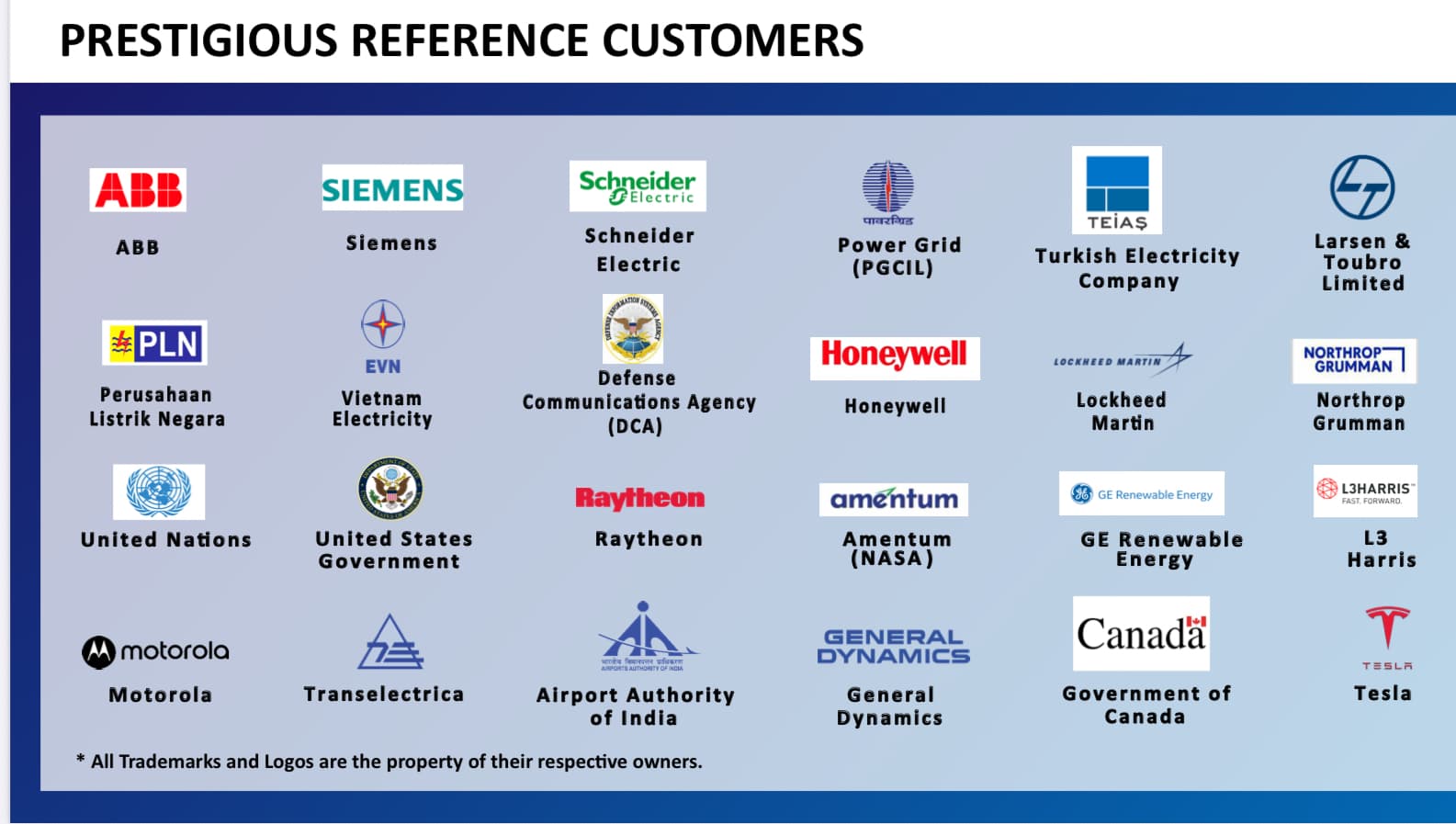
- The Use Case: Deployed for critical central agencies like the Grid Controller of India (formerly POSOCO) and energy giants like ONGC, these systems defend against hostile state-sponsored cyberattacks.
- The Criticality: Hackers targeting a nation’s power grid can wreak havoc by sending malicious commands to substations. Valiant provides “Data Diodes”—devices that physically allow data to flow in only one direction (preventing external hackers from sending commands back into the grid)—as well as Quantum-Safe encryption and local, captive data storage to safeguard critical operations.
7. Data Diodes
- What it is: Hardware security units that physically allow data to flow in only one direction.
- The Use Case & Criticality: Deployed for energy giants like ONGC and the Grid Controller of India, data diodes allow a central control room to pull data out of a secure substation, but physically prevent external hackers from sending commands back in to manipulate the substation.
Part 6: Why Valiant is a Highly Unique “Stress Fixer”
To understand the business logic of Valiant, it is crucial to recognize that they are not a commodity player.
- They are a “Stress Fixer,” not an initial build player: Valiant is typically paid not when a basic grid is being built out, but when the grid faces operational stress (due to renewable integration or frequency fluctuations) or heightened security threats.
- Compliance-Driven Demand: When the Indian government mandates strict cybersecurity norms or dictates that all Critical Information Infrastructure (CII) must install secure, captive data storage within the country to maintain sovereignty, utilities are legally forced to buy Valiant’s indigenous equipment.
- Massive Moat (Entry Barriers): It takes years for power utilities and defense departments to test and approve communication equipment. Once a product is integrated into a substation, the switching cost is extremely high, making customers incredibly sticky.
- Sovereign Advantage: Because power grids are sensitive to national security, governments prefer trusted local suppliers. Valiant is a certified “Class-1 Local Supplier” (meaning their products contain over 50% domestic content) and holds the prestigious “Trusted Source” certification from the National Security Council Secretariat (NSCS). This acts as a highly protective shield, keeping giant foreign competitors (like Cisco or Siemens) out of highly secure domestic projects.
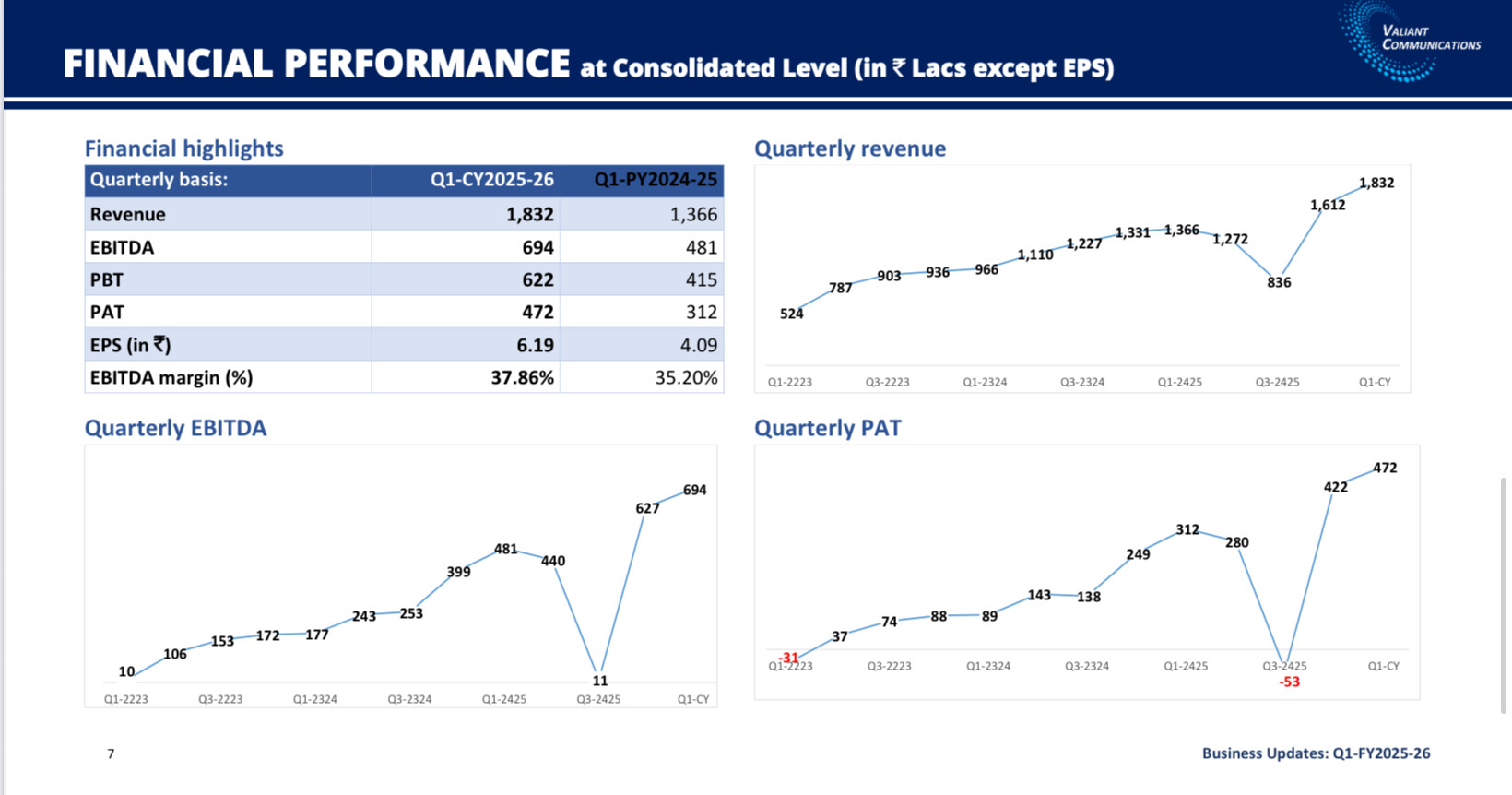
- R&D Heavy Tech Focus: Valiant behaves more like a deep-tech lab than a traditional manufacturer. Over an 11-year period (FY2015–25), they spent ₹14 crore on R&D, which actually exceeded their cumulative net profit of ₹9 crore during those same years, focusing entirely on building proprietary, mission-critical tech.
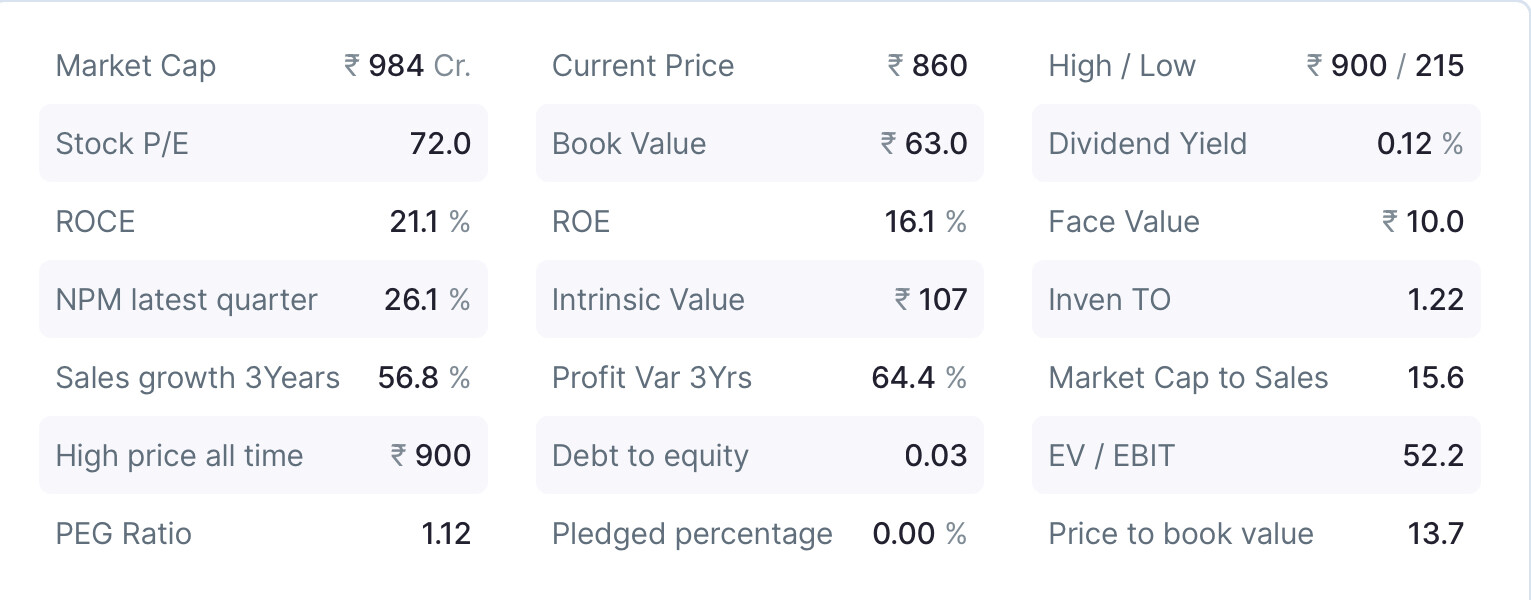
- Asset-Light Model: Rather than spending millions building factories, Valiant relies on a 100% outsourced, contract-manufacturing model. They supply the design, processes, and raw materials, while partners assemble the hardware. This allows them to maintain a highly capital-efficient balance sheet, boasting an exceptional current ratio of 6.44 and virtually zero debt (debt-to-equity ratio of 0.04).
Summary Checklist of Additional Key Terms to Remember:
- Substation: A critical node in the grid where voltage is stepped up (for long-distance travel) or stepped down (for local distribution).
- Fault: A physical event (like a short circuit or line break) that threatens to damage the grid if not isolated immediately.
- Relay: An automated switch that senses a fault and sends a trip signal to cut off the power.
- Inertia: The physical resistance of the grid to sudden changes in frequency; high inertia (traditional grids) keeps the grid stable, while low inertia (renewable grids) makes it fragile.
- WAMS (Wide Area Monitoring Systems): The real-time control system that takes data from PMUs to give operators a full, live, synchronized view of the national grid.
· Honeypot: A decoy computer system designed to distract and trap cyber attackers.
· Deterministic Network (MPLS-TP): A communication network that guarantees data will travel along a dedicated, pre-determined path at a guaranteed speed, rather than wandering randomly around the public internet.
VALIANT-TEJAS NETWORKS PARTNERSHIP
1. Product Synergy: “Orthogonal yet Complementary”
Tejas Networks is a major Indian manufacturer of fiber-optic transmission and high-speed networking equipment. However, their transport networks need specialized “nervous system” modules to safely interface with power substations and protect high-voltage lines.
This is where Valiant comes in. Instead of competing, Valiant offers what Tejas’s Chief Operating Officer, Arnob Roy, describes as an “orthogonal set of products” (such as teleprotection, precision timing clocks, and grid monitoring systems). These specialized components integrate directly into Tejas’s transmission solutions, allowing both companies to pitch a complete, unified utility communication package to customers.
2. The Business Model: Joint Bidding and System Integration
When major power grids upgrade, they put out massive end-to-end contracts. As a small-cap player, Valiant lacks the scale to bid on these multi-hundred-crore infrastructure projects alone.
Under the partnership:
- Tejas acts as the Lead OEM/System Integrator, bidding on the entire optical transport and networking backbone.
- Valiant acts as the Specialized Sub-OEM, supplying the high-margin, mission-critical grid protection and synchronization equipment within that overall package.
- This joint bidding structure serves as a “winning combination” that allows them to successfully outbid massive foreign multinationals like Cisco, Siemens, Nokia, or ABB for secure government contracts.
3. Concrete Proof: The Historic GETCO Order & Pipeline
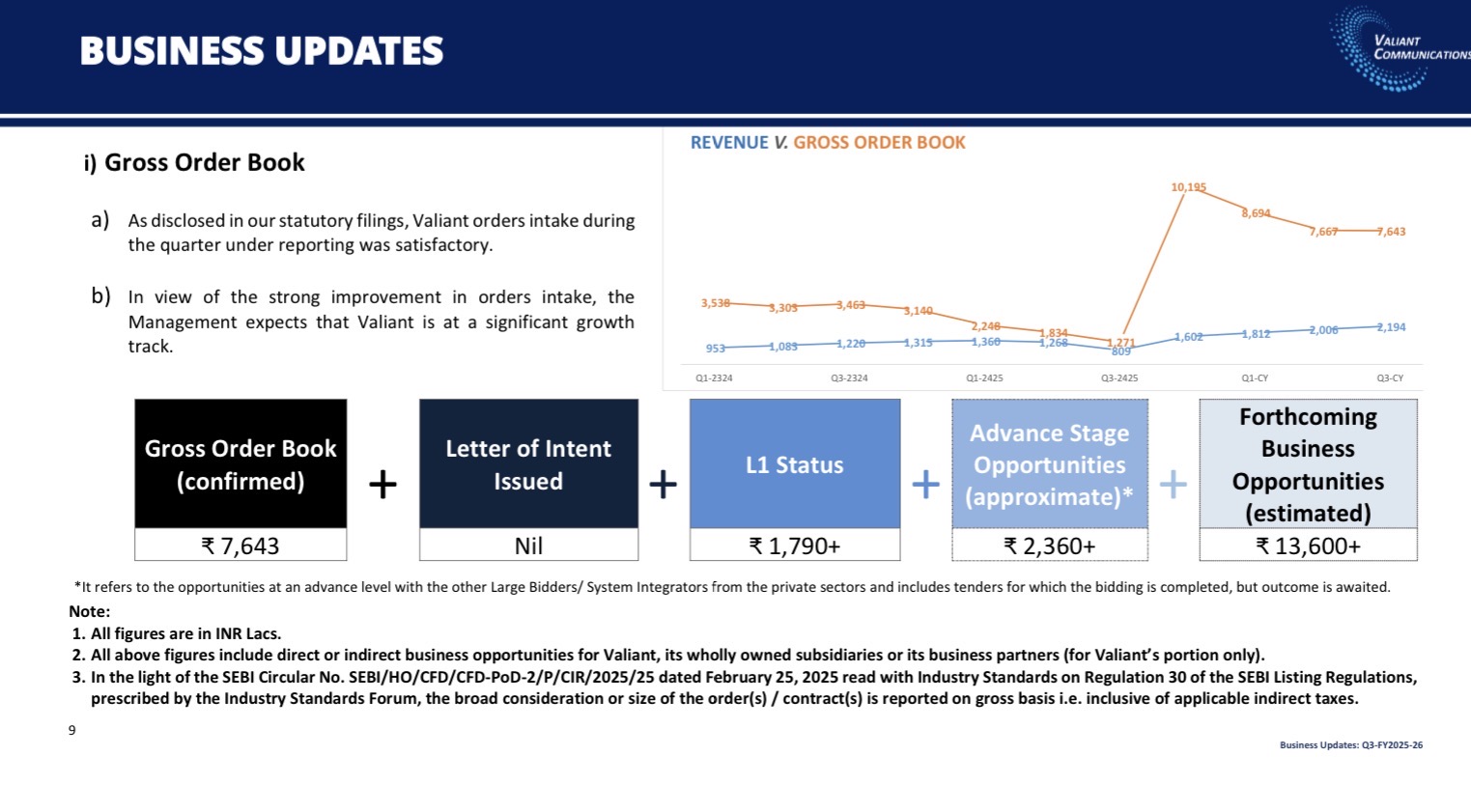
The commercial viability of this alliance was proven on January 10, 2025, when Valiant received the single largest order in its corporate history, valued at ₹41.35 crore (INR 4,135 Lacs), directly from Tejas Networks.
- The Project: Valiant is supplying and commissioning its specialized Communication, Protection, and Synchronization equipment for the Gujarat Energy Transmission Corporation (GETCO).
- Active Pipeline: Beyond Gujarat, the joint bidding strategy is actively targeting over ₹75 crores of State Electricity Board (SEB) opportunities across India, capitalizing on the multi-year grid modernization wave.
Valiant’s Products vs. Quality Power’s Products (STATCOMs & FACTS)
Think of grid stability as a combination of “physical muscles” and a “digital nervous system.”
1. STATCOMs & FACTS: The “Muscles” of the Grid
- What they are: STATCOMs (Static Synchronous Compensators) and FACTS (Flexible AC Transmission Systems) are heavy-duty, high-power electronics installed physically on transmission lines.
- What they do: When high-voltage lines experience physical voltage drops or shifts in “reactive power” (often caused by the sudden startup of heavy machinery or variations in wind farms), STATCOMs and FACTS instantly inject or absorb electricity to physically smooth out the voltage wave. They are localized, muscle-like shock absorbers for power flow.
2. Valiant’s Products: The “Brain and Nervous System”
Valiant’s products—like Phasor Measurement Units (PMUs) and Grid Islanding Systems—do not physically inject power or change voltage. Instead, they act as the grid’s high-speed intelligence layer.
- Grid-Wide Vision vs. Localized Muscle: While a STATCOM works locally to fix a nearby voltage dip, Valiant’s PMU acts as a synchronized heart monitor. It measures voltage, current, frequency, and phase angle up to 50 times a second, synchronized to the microsecond using satellite clocks. This gives operators a live, predictive “Wide Area Monitoring System” (WAMS) to see the entire grid wiggling before a blackout begins.
- The Emergency Quarantine (Grid Islanding): If a storm snaps a line, a STATCOM cannot solve that problem. Valiant’s PMU-based Grid Islanding system instantly spots the phase angle drift (<3 milliseconds), predicts the grid is about to fail, and automatically quarantines the damaged zone while keeping critical areas running independently.
- Ultra-Reliable Communication Protection: Valiant’s teleprotection systems and MPLS-TP routers ensure that if a short circuit happens, the protective switchboards at both ends of a line (which could be hundreds of miles apart) can talk to each other in less than 50 milliseconds to safely trip the line. This communication is essential to prevent high-voltage equipment—including STATCOMs themselves—from literally melting.
In short: STATCOMs and FACTS physically regulate the power flow; Valiant’s products provide the real-time telemetry, timing, and automated safety systems that tell the grid how and when to protect itself.
Major Project Breakdowns
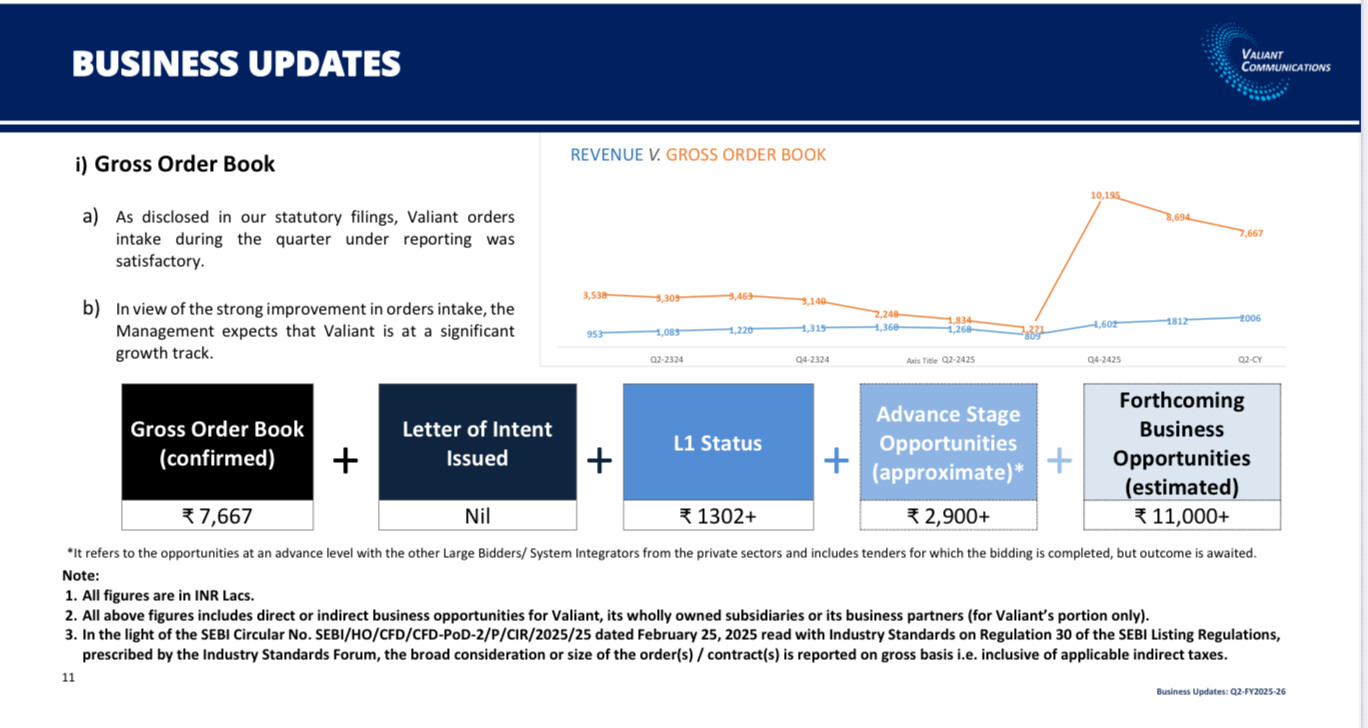
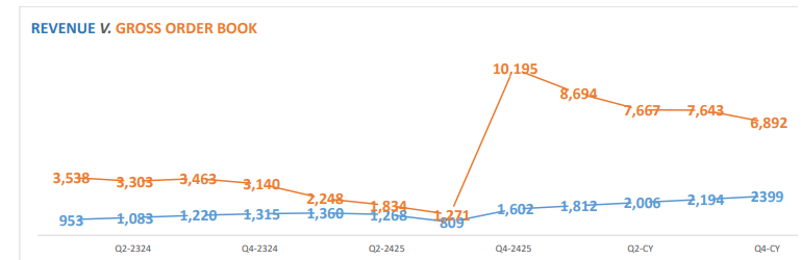
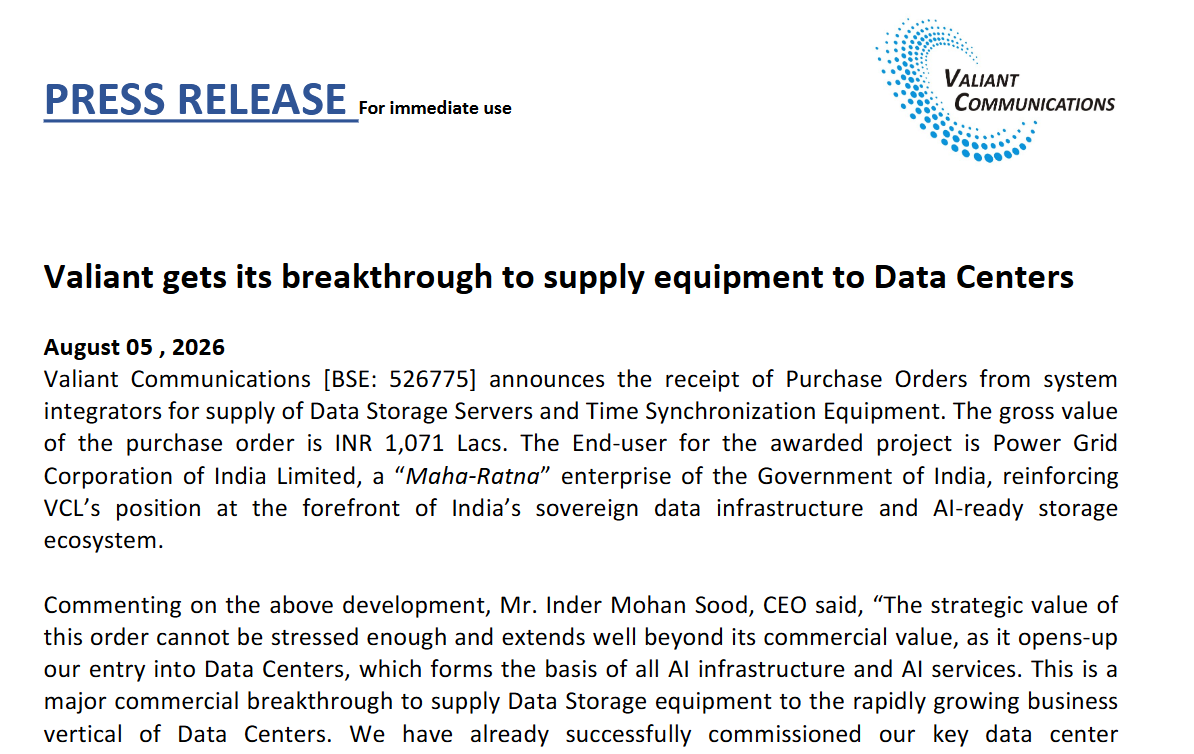
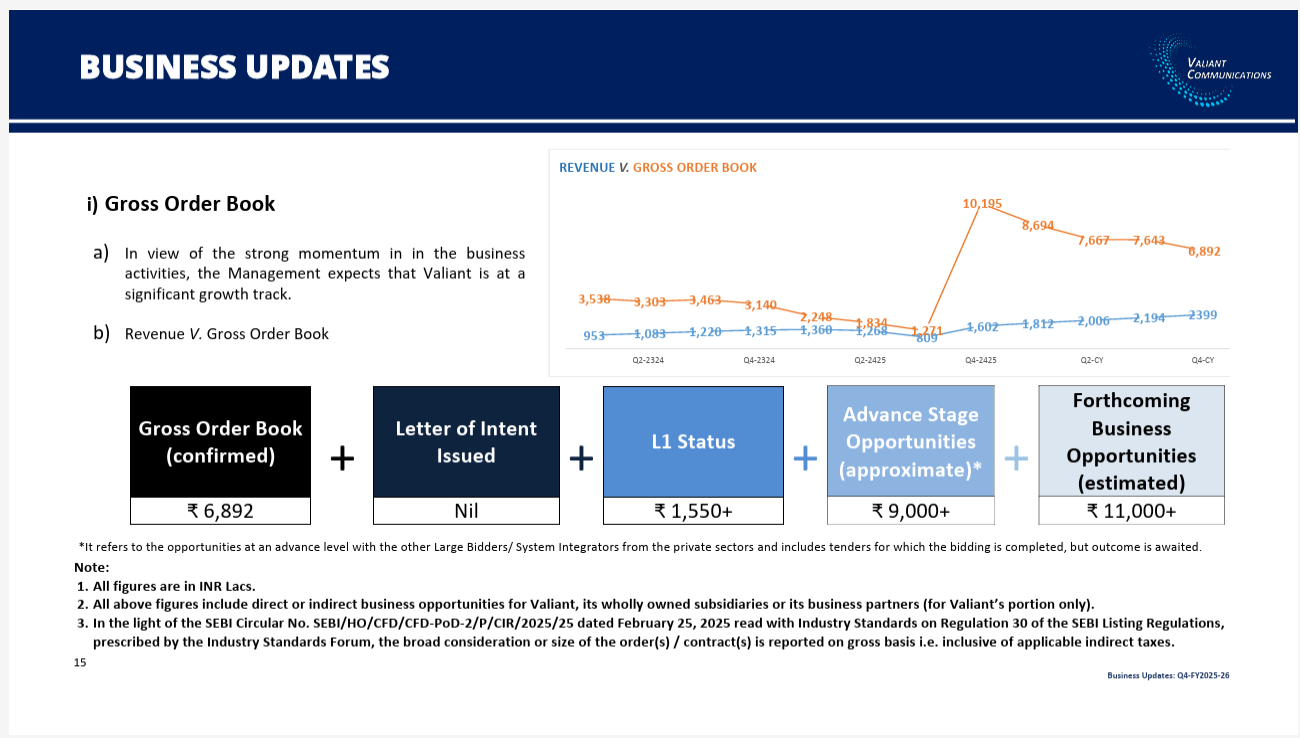
- Valiant has recently secured Purchase Orders worth INR 10.7 cr for data storage servers with data backup and time synchronization with GPS and NavIC equipment, from Power Grid Corporation of India Limited — a MahaRatna Government of India enterprise — as end-user. This is VCL’s strategic order into the Data Center application.
- GETCO Project #1 (Gujarat Energy Transmission Corporation): A confirmed purchase order valued at ₹37.46 crore (₹3,746 Lacs) inclusive of taxes, finalized in mid-2025. Valiant is responsible for supplying and commissioning communication, protection, and synchronization equipment, with an execution timeline wrapping up by June 30, 2026.
- GETCO Project #2: Valiant announced a joint venture exclusive to Project #2 with Tejas Networks as the lead bidder. The approximate gross revenue value allocated to Valiant’s portion stands at ₹39 crore (₹3,900 Lacs).
- Bhutan Power System Operator (BPSO) & Utility Orders: An international contract win totaling ₹6.08 crore (₹608 Lakhs), which includes international supplies for Bhutan’s power system and additional orders for the Indian utility market.
- Historical State Electricity Board Orders: Earlier contract wins through the partnership brought in over ₹19 crore (for the Madhya Pradesh State Electricity Board covering 400 sub-stations) and ₹15 crore (for the boards of Karnataka, Telangana, and Punjab).
Note: This is not a buy/sell recommendation