Updater Services – Simple Business, Steady Opportunity

What does the company do?

Updater Services supports medium and large enterprises by handling operational and compliance-heavy tasks that most companies either don’t want to manage internally or can’t do efficiently. Think of everything behind the scenes that keeps an office or commercial site running—from hiring and supervising security guards to maintaining air conditioning systems, processing payroll, and conducting background checks.

They operate in two core areas:

  1. Facility Management – This includes cleaning, pest control, security personnel, plumbing, electrical services, and other infrastructure-related services needed to keep a physical site functional. For example, they manage complete site services for large IT campuses, logistics hubs, and airport terminals.
  2. Business Support Services – This is a higher-value segment and includes employee verification, audit assistance, payroll services, sales support staffing, and airport passenger services. These are often more tech-enabled, recurring, and margin-rich. Clients may use Updater to manage their entire backend onboarding process or third-party audit trails.

This broad portfolio allows them to cater to a mix of sectors like IT parks, warehouses, logistics, airports, banks, and hospitals, offering bundled services across physical and operational layers.


Company background

  • Started in 1990 in Chennai
  • Has grown alongside India’s infrastructure and IT boom
  • Employs over 65,000 people today
  • Works across sectors: IT, BFSI, healthcare, logistics, public spaces
  • Conducted an IPO in 2023, raising ₹640 crore
  • Used the funds to clear debt and build reserves

Who runs it?

  • Founder: Raghunandan Tantry, who still leads the company.
  • Known for staying out of the spotlight but focused on execution
  • Prompters own 58.88%
  • FIIs 2.74% DIIs 15.35% and Public owns 23.05%

This kind of promoter-led continuity often helps in service businesses.


Why do customers stick around?

Clients work with Updater because it takes away operational pain.

  • Managing hundreds of frontline workers in-house is time-consuming and risky
  • Labour laws in India are strict—outsourcing to a compliant vendor reduces risk
  • Updater has systems and trained teams in place across the country
  • They’ve built trust: a 93%+ client retention rate tells the story

Long-term contracts and sticky relationships form a strong foundation.


Key numbers (TTP)

  • Revenue: ~₹2,500 crore
  • Net Profit: ~₹65 crore
  • Operating Margin: ~9%
  • Market Cap (May 2025): ₹2,290 crore
  • P/E Ratio: ~20x

The revenue mix is improving, and they’re now cash-rich post-IPO.


Peer comparison

Company Area of Work Market Cap P/E Screener Link
Updater Services Facility + support ₹2,290 cr 20x Link
Quess Corp Staffing + multiple areas ₹5,400 cr 24x Link
SIS Ltd Security, cash handling ₹4,800 cr 18x Link
Krystal Integrated Government facilities ₹930 cr 16x Link

Competitor details

Quess Corp

Quess is the giant in this space with over ₹15,000 crore in annual revenues. It offers a broad mix of services—staffing, payroll, HR tech, facility management, and IT support. While this gives it scale and stability, facility management is just a small part of its overall mix. Its margins are thin, and its large size makes it slower to shift focus compared to more nimble players. The company has a habit of acquiring multiple businesses, which adds complexity.

SIS Ltd

SIS started off as a security services provider and still derives a large portion of its revenue from guarding services. It also operates in cash logistics and some facility management. The business is heavily reliant on manpower, and while it has solid recurring revenues, pricing power is limited. They’re well-positioned in government and industrial contracts but have struggled to enter higher-margin B2B corporate services.

Krystal Integrated

Krystal thrives on government infrastructure contracts—railways, public hospitals, waste management services. These are long-term and high-volume, which gives them visibility. However, delayed payments, fixed-rate contracts, and low innovation mean margins are tight. It’s a stable player in the public sector, but growth is limited.

Updater Services

Updater is smaller, but more focused and strategically aligned. Their shift toward business support services—especially in private sector accounts—offers a better margin profile. They’ve been successful in bundling services at client sites (e.g. a logistics hub using both facility and audit support from them). The challenge will be in maintaining quality and culture as they scale.


Industry tailwinds

  • Industry size: Over ₹1 lakh crore (CBRE)
  • Outsourced share: 39% in FY23, expected to hit 45% by FY28 (Colliers)
  • Outsourced FM segment to grow from ₹39,000 crore to ₹86,000 crore (17% CAGR)
  • Business support services expected to grow over 20% annually (EY)
  • Drivers: Formalisation, rising infrastructure, and compliance needs

The overall trend is clearly favourable for organised players.


Growth triggers

  • More companies choosing to outsource non-core operations
  • Indian labour laws pushing firms to go with compliant vendors
  • Growth in infrastructure and commercial real estate = more service opportunities
  • Business support services are more profitable and sticky
  • Potential to cross-sell across existing accounts
  • Cash-rich position enables strategic acquisitions

What I like about it

  • It’s a real, useful, everyday business
  • High client stickiness
  • Strong financial discipline
  • Improving margin profile through better service mix

What can go wrong

  • Scaling issues – managing 65,000+ workers is not easy
  • Competitive pricing pressure – low barriers to entry
  • Client concentration risk – over-reliance on a few clients
  • High employee turnover – affects delivery and costs
  • Tech disruption in support services – risk of automation
  • Regulatory compliance – one big miss can hurt reputation
  • M&A integration risk – poorly integrated acquisitions can drag performance

Theme, Value, Growth

  • Theme: The sector is moving from unorganised to organised. Compliance, cost pressure, and a growing service economy support this shift.
  • Value: At 20x P/E, valuation looks fair for a clean, cash-generating company that is slowly improving its margins.
  • Growth: The opportunity is large. The industry is expanding, and Updater is trying to ride that wave by offering deeper services to the same clients.

What I’m tracking

  • Are client relationships getting deeper or wider?
  • Are they able to retain people and scale up hiring without hurting service quality?
  • How fast is the support services segment growing?
  • Is profit growing faster than revenue (thanks to better mix)?

These are key to margin improvement and long-term value creation.


Final thoughts

Updater isn’t trying to be a headline-grabber. It’s quietly doing the work that most companies don’t want to handle themselves.

If it keeps growing its business support services, maintains client relationships, and executes well at scale, it could turn into a steady compounder.

Risks are there, but so is a long tailwind.

Would love to hear more views, especially from those who’ve seen the company’s work firsthand.


Note: This is a personal research note intended for discussion, not investment advice. Please do your own checks before taking any position. I have a tracking position in this business.
22 Likes

The main question in all of the business category is, can they pass on the inflationary prices of higher wedges to the customers ? , as i understand this is a very price sensitive business as entry barriers are low.

1 Like

Agreed. I’m guessing they have service agreements where charges increase annually, which is common in most service industries — though that’s just a guess.

2 Likes

AI is encroaching on almost all professional, creative, and especially labor-intensive white-collar jobs. So there is certainly a risk.

Even their clients (IT companies) are at bigger risk as AI is getting better and better at coding, and related things.

2 Likes

UDS makes use of Gen AI in their services offered. An extract from their concall for Q32025 is as follows: “We successfully have begun utilizing GenAI sales intelligence, which is our proprietary technology called Intellibank . This would also start paying us back probably in the next few quarters coming. This technology will help us become more efficient in terms of helping our customers close deals faster and further improve our conversion rate”. Further intheir Matrix Business Segment “We have implemented a technology, which we call as Matex 2.0, which is a digital platform for tracking and verification, which is also fully operational from this quarter. This would help us in terms of improving productivity and efficiency, profitability.”. It reassures that they are proactively taking steps to miigate any sch threat of their business from AI.
Disclaimer: Invested and hence views are biasd. Not a recommendation to buy sell or hold.

4 Likes

They only have a small exposure to IT and are well diversified across non-tech sectors.

Sectorwise Revenue Split Q1FY25 [as per screener]
Industrial - 32%
Real Estate - 17%
BFSI - 16%
Others - 12%
Health Care - 8%
Retail/FMCG - 7%
IT/ITES - 6%
Education - 2%

Disc: Studying. Have a small tracking position.

5 Likes

What do you make of the q4 results?

Their airport cargo services are only with Air India ? In concall, they are saying Air India. So, it is carrier specific service or entire airport specific services?

1 Like

Both, Updater and Krystal seems undervalued at 15-16 PE. As per management (Both) 15%+ growth with same or slightly increase margin is achievable. Chance of PE derating seems less likely, if PE remains same than also we get EPS increase of 15% typist grow. Am I missting something?

Disc: Tracking position in UDS.

1 Like

May be because it looks boring & simple business. Nowadays people have tendency to run behind fancy thing. A stock with 15% growth in topline & even better than 15% growth in bottom line is available at 15 PE. What else we need. Just need patience when this sector comes in limelight & people starting giving higher PE.

I consider it as proxy to India’s growth. As more & more industry grows they need more such contracted outsourced manpower. Also there focus is on high margin BSS segment which will eventually improve margins. They have successfully acquired many businesses in the past & grow them well. Such future M&A will be cherry on the top.

Disclosure: I am holding shares at an average 290 rs. & my views might be biased.

3 Likes

Thesis Pointers:

  1. Dual-engine business: Integrated Facilities Management (IFM) and Business Support Services (BSS) offer diversification and steady cash flows.
  2. High client stickiness: 95% client retention over 5 years with marquee clients like Amazon, Tata EV, and Air India Express.
  3. Tech-led moat in BSS: Denave’s IntelliBank platform leverages AI and GenAI to drive sales conversion and client acquisition globally.
  4. BSS growth visibility: Fast-growing verticals in audit, background checks, and logistics, with international expansion in Korea and APAC.
  5. Margin expansion ahead: Management completed contract rationalization in IFM; BSS investment phase to bear fruit from FY26.
  6. Operating leverage likely: Subsidiary mergers (Stanworth, Tangy, Wynwy, ITSS) to unlock synergies in FY26–FY27.
  7. Clean balance sheet: Net cash company with RoCE > 22%, and no major capex requirements ahead.
  8. Q4 FY25 recovery: IFM grew 14% YoY and margins rebounded after a weak Q3, indicating strong execution.
  9. Valuation comfort: After a 35% stock correction, UDS trades at ~16–18x trailing P/E with 3-year PAT CAGR visibility of 17%+.
  10. Long-term AI optionality: IntelliBank could evolve into a scalable revenue intelligence SaaS play.

EBITDA margin expansion levers:

  1. Business Mix Shift Toward BSS (Higher-Margin Vertical):
  • Integrated Facility Management (IFM) is lower margin (~5.5–6.5%), manpower-heavy, and more commoditized.
  • Business Support Services (BSS), especially Denave and Athena verticals, offer 7–12% margins, depending on geography and service line.
  • As BSS scales faster (driven by Denave’s global contracts and Athena’s logistics support), the consolidated margin expands.
    Management expects BSS to grow at high teens with increasing contribution to consolidated revenue post FY26.
  1. Operating Leverage from Platform Investments
  • FY25 saw high opex due to front-loaded tech investments in IntelliBank and other platforms.
  • These costs are largely fixed, so incremental revenue from FY26 onward will yield disproportionate EBITDA gains.
    BSS EBITDA margins are expected to improve once the tech investment phase ends, likely in FY26
  1. Integration Synergies from Subsidiary Mergers
  • UDS is merging Tangy, Wynwy, ITSS, and Stanworth into the parent company.
  • Expected benefits:
    • Centralized cost base
    • Elimination of duplication in HR/admin/tech
    • Cross-selling across customer bases
      Full synergy benefits are expected to kick in by FY27.
  1. Denave Revenue Quality Improvement
  • Transitioning from low-margin reseller contracts to consulting and data-driven mandates.
  • Higher realization per employee as Denave deploys IntelliBank for revenue intelligence globally.
    International clients in Korea, Singapore, and LATAM have stronger margin.

Key Risks to Monitor:

  1. Labour-intensive model: Manpower-heavy operations limit scalability and expose margins to wage inflation and compliance costs.
  2. BSS margin volatility: Denave margins came under pressure in FY25 due to business mix and high upfront tech investments.
  3. Client concentration: Loss of a key Athena client in Q3 FY25 exposed single-client dependency risks.
  4. Integration risks: Ongoing mergers of subsidiaries could cause near-term disruption and integration challenges.
  5. Low public visibility for IntelliBank: Despite internal promise, the lack of third-party validation makes it hard to value the AI moat.
  6. High service competition: Fragmented IFM market with unlisted players like BVG, and listed peers like Quess and Krystal

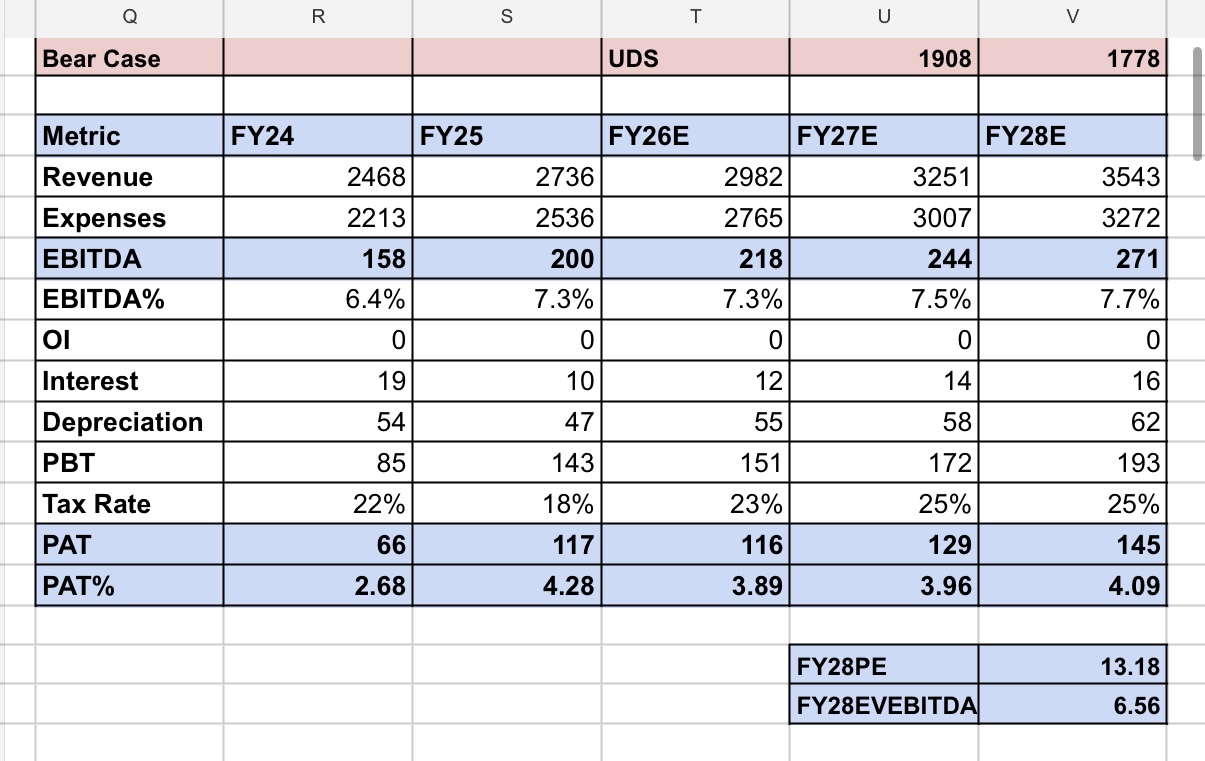
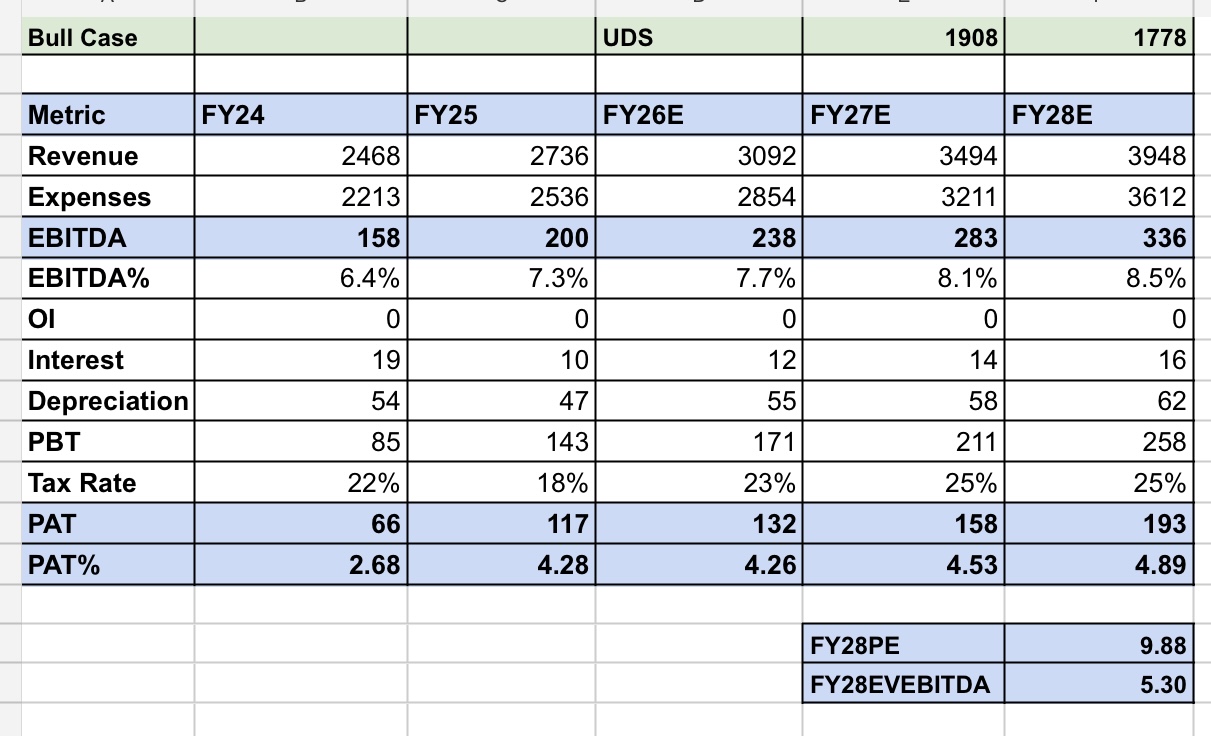
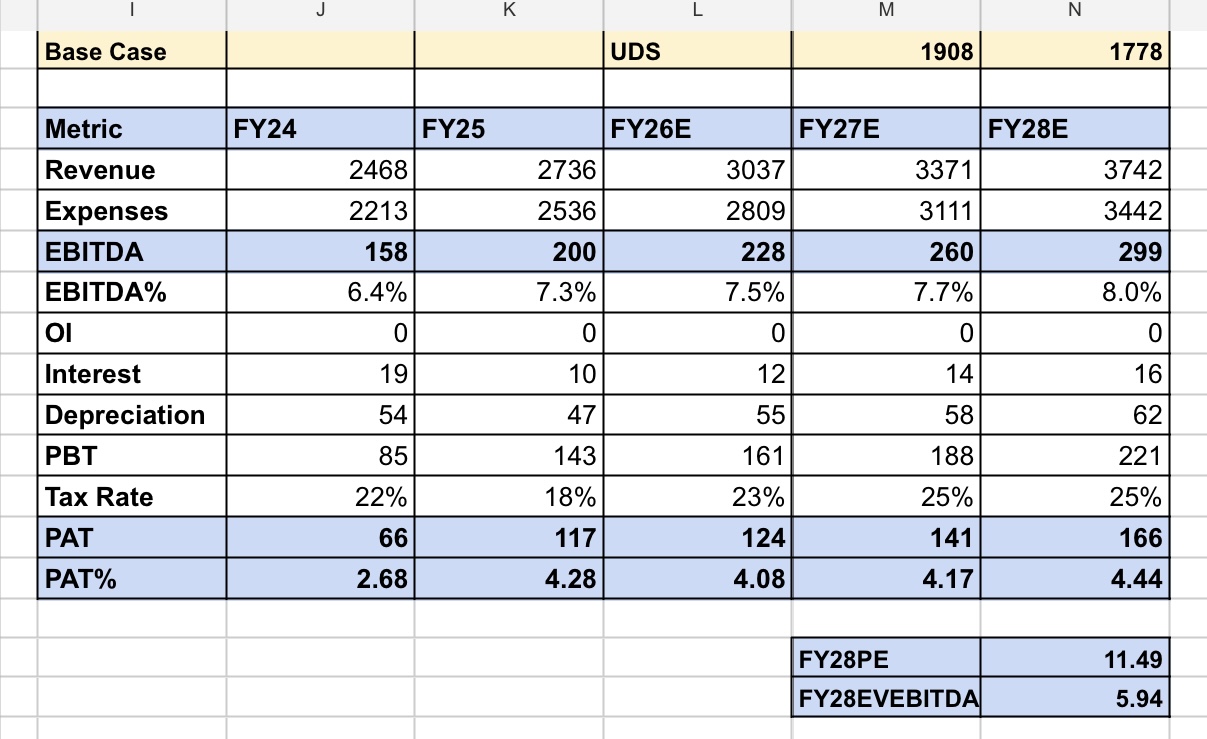
Projections:


Implied Upside:

  • Bull Case, assumed exit PE of 19:
    19 x 193/ 1908 = 92%
  • Base Case, assumed exit PE of 16:
    16 x 166/ 1908 = 40%
  • Bear Case, assumed exit PE of 13:
    13 x 145/ 1908 = -1%

Core assumptions:

Metric Bull Case Base Case Bear Case
Revenue CAGR 12.55% 10.96% 8.98%
EBITDA CAGR 18.84% 14.31% 10.65%
PAT CAGR 18.02% 12.34% 7.43%

Disclaimer: Invested. Not a buy/sell/hold recommendation.

15 Likes

Hello everyone, I am very new to investing and still learning.
By going through this thread, i researched about the company and found this interesting thing.
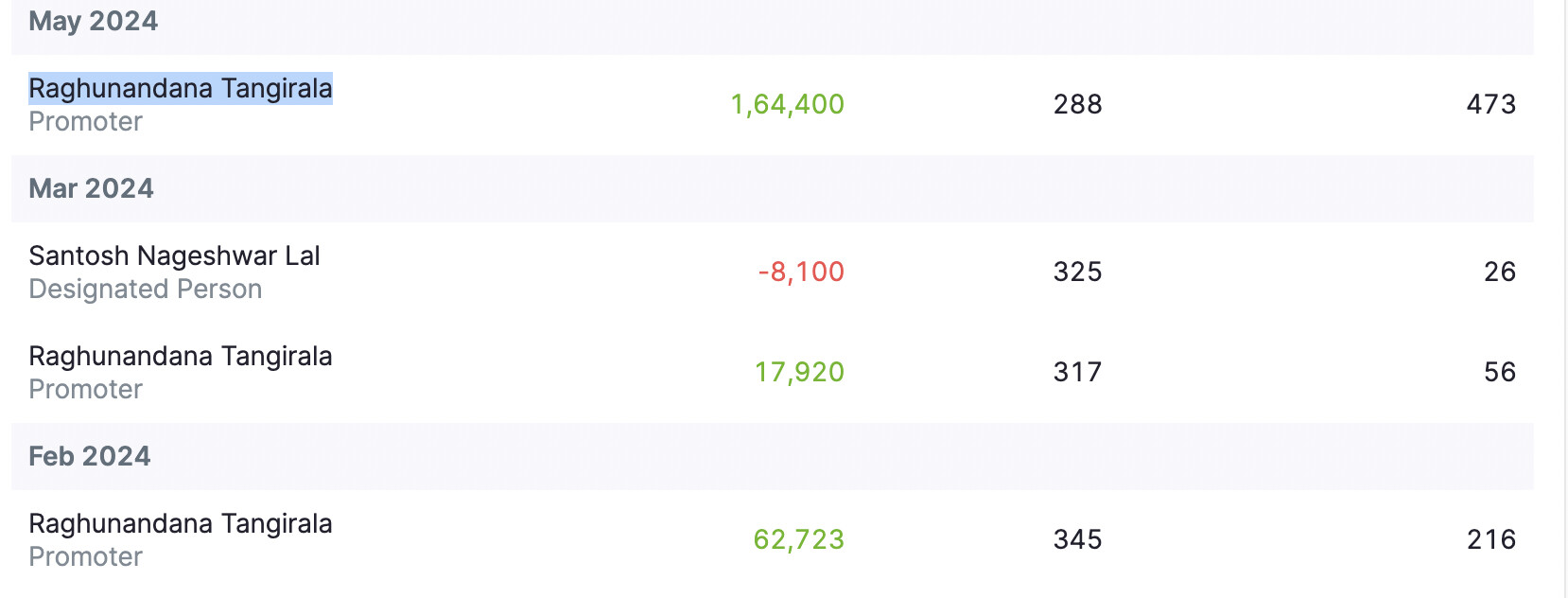
The promoter Raghunandana Tangirala (Promoter, Chairman and Managing Director) is constantly buying shares of this company.

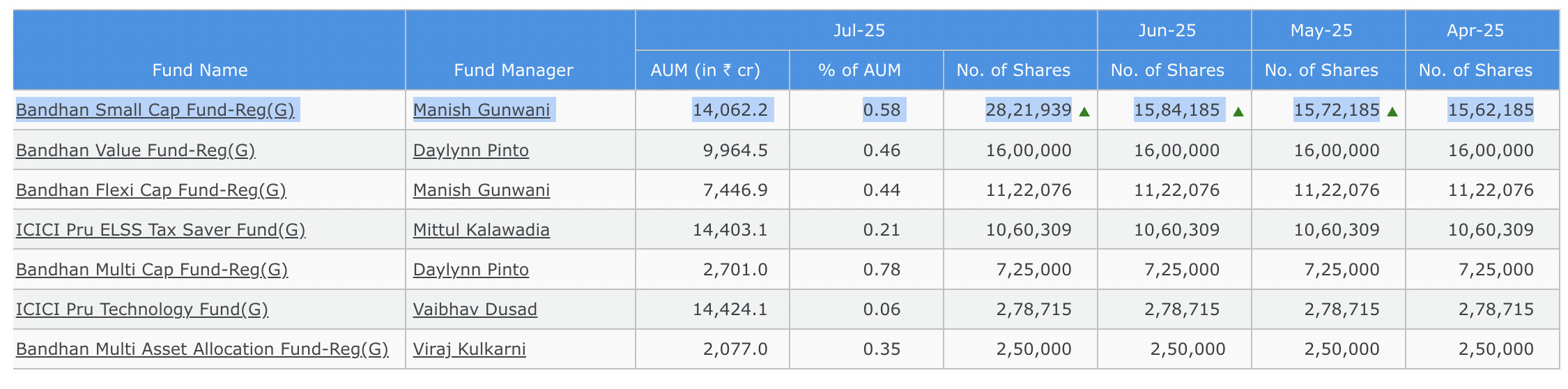
Also Bandhan small cap mutual fund is continuously increasing its stake in the company for the last 3 months.

4 Likes

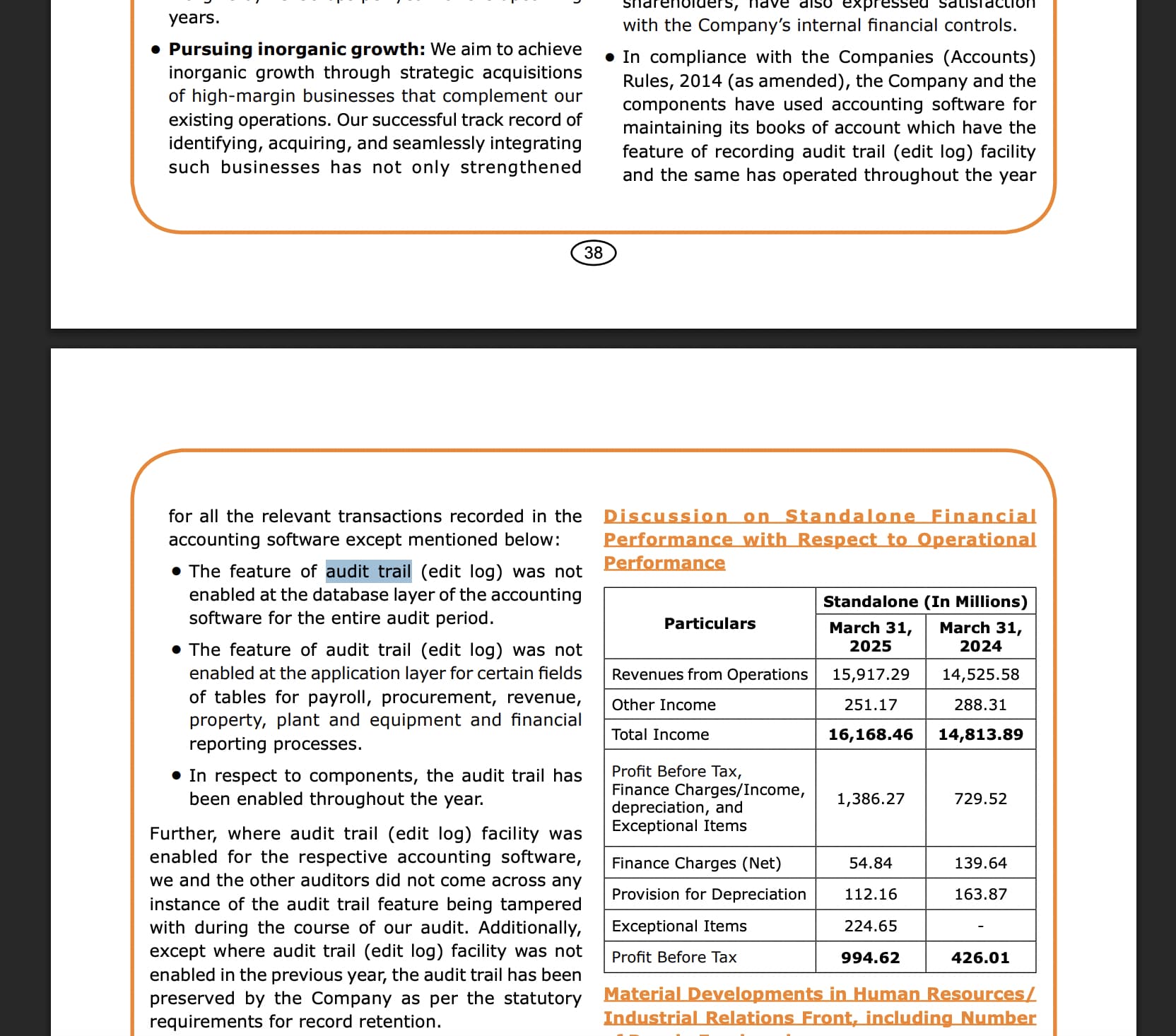
Can someone please help me understand whether it a concern that the audit trail was not enabled at the database layer? From AR 2025:

I asked the same question to IR team. Did not get an answer. I am not sure if this is even a valid concern by the way.

The business is available at very cheap valuations.
Don’t know if its being ignored by the investors or there is some real red flag in management that we don’t know yet.
Because business is great on all fundamental indicators.

2 Likes

Key catalyst for the stock was about growth & margin of BSS business. However when IT industry itself is struggling heavily, UDS’s BSS business will also struggle.

Stock movement also indicates result won’t be good.

Also their IFM business is not growing as per industry (Krystal is growing at 30% while UDS - manages hardly 12% growth.

I have position from 300 but looks like have to wait long for breakeven & for profit.

3 Likes

Exposure of IT business in total revenue is 5 to 7 % . So IT business slowdown may impact 2 to 3 % of total revenue .

2 Likes

Below is probably one reason:
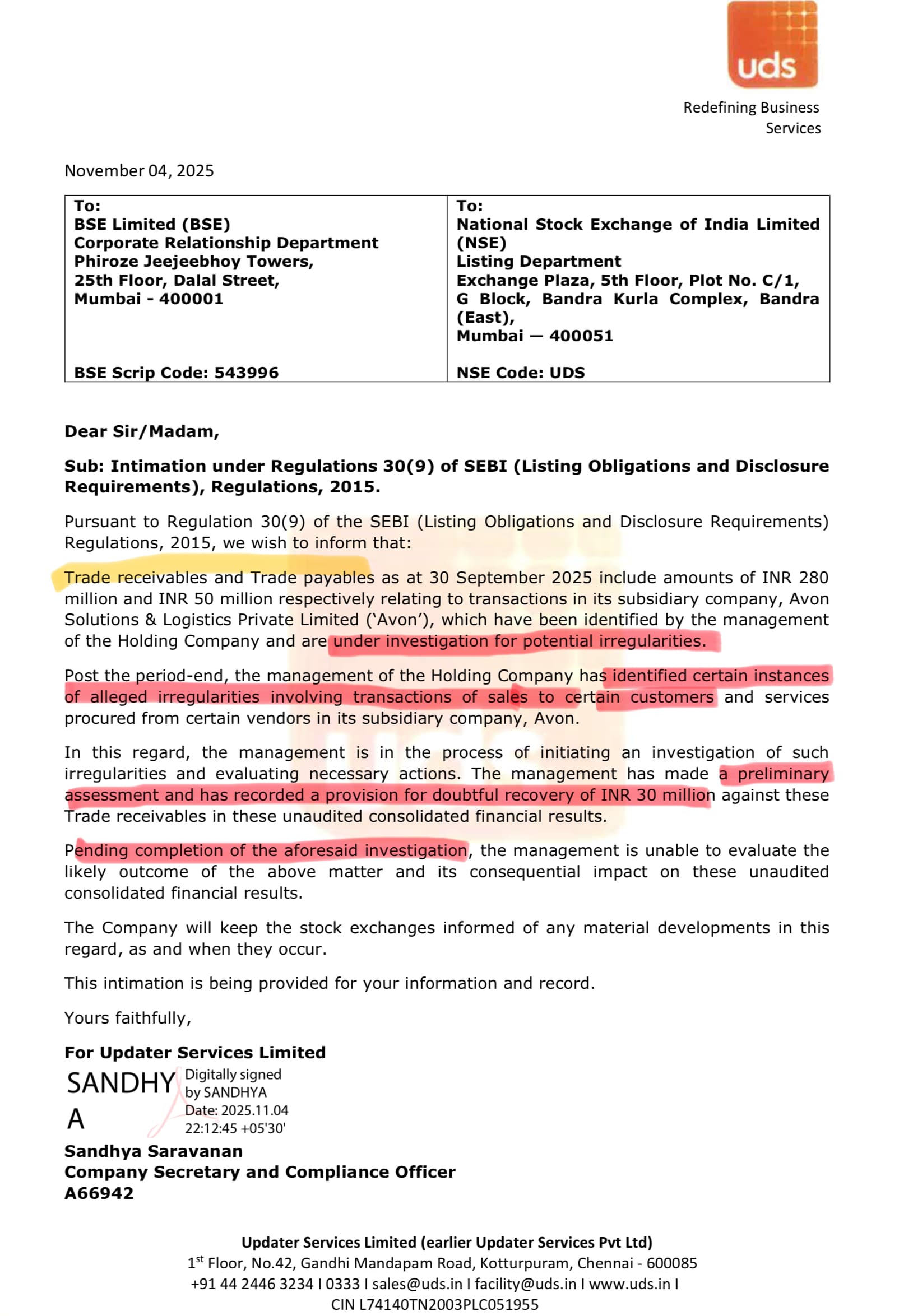
“the management of the Holding Company has identified certain instances of alleged irregularities involving transactions of sales to certain customers and services procured from certain vendors in its subsidiary company, Avon.”

1 Like

Q2FY26 Analysis and Breakdown. Higher margins engine Business Support services is not growing and Avon Logistics irregularities has turned the company’s thesis upside down. Promoter still keeps buying in small incremental amounts.

1 Like