Question - Guess what happened to the Indian IT services Industry -
Answer- The labour arbitrage has gone.
Question - Guess what happened to the Indian IT services Industry -
Answer- The labour arbitrage has gone.
anyone tracking it sector ,recently started studying it .if anyone has interesting names to study do comment them
I believe the Western world is actively working to eliminate the advantage that developing countries have traditionally held due to cheaper labour, called “labour arbitrage.” Two key trends are driving this shift: the rapid progress of artificial intelligence (AI), which can be seen as the “software brain,” and the development of humanoid robots, which represent the “hardware body.”
AI systems today are already capable of performing tasks at a level comparable to an average software developer. Meanwhile, progress in humanoid robotics is accelerating. Companies like Tesla are developing general-purpose robots (e.g., Optimus), and Nvidia is providing essential computing platforms for robotics and simulation.
An inflection point will be when humanoid robots with near-human capabilities are available at a price point below $10,000. If that happens, it could become more economically viable to manufacture products domestically (e.g., in the U.S.) than to offshore production, effectively ending the cost advantage of cheaper foreign labour.
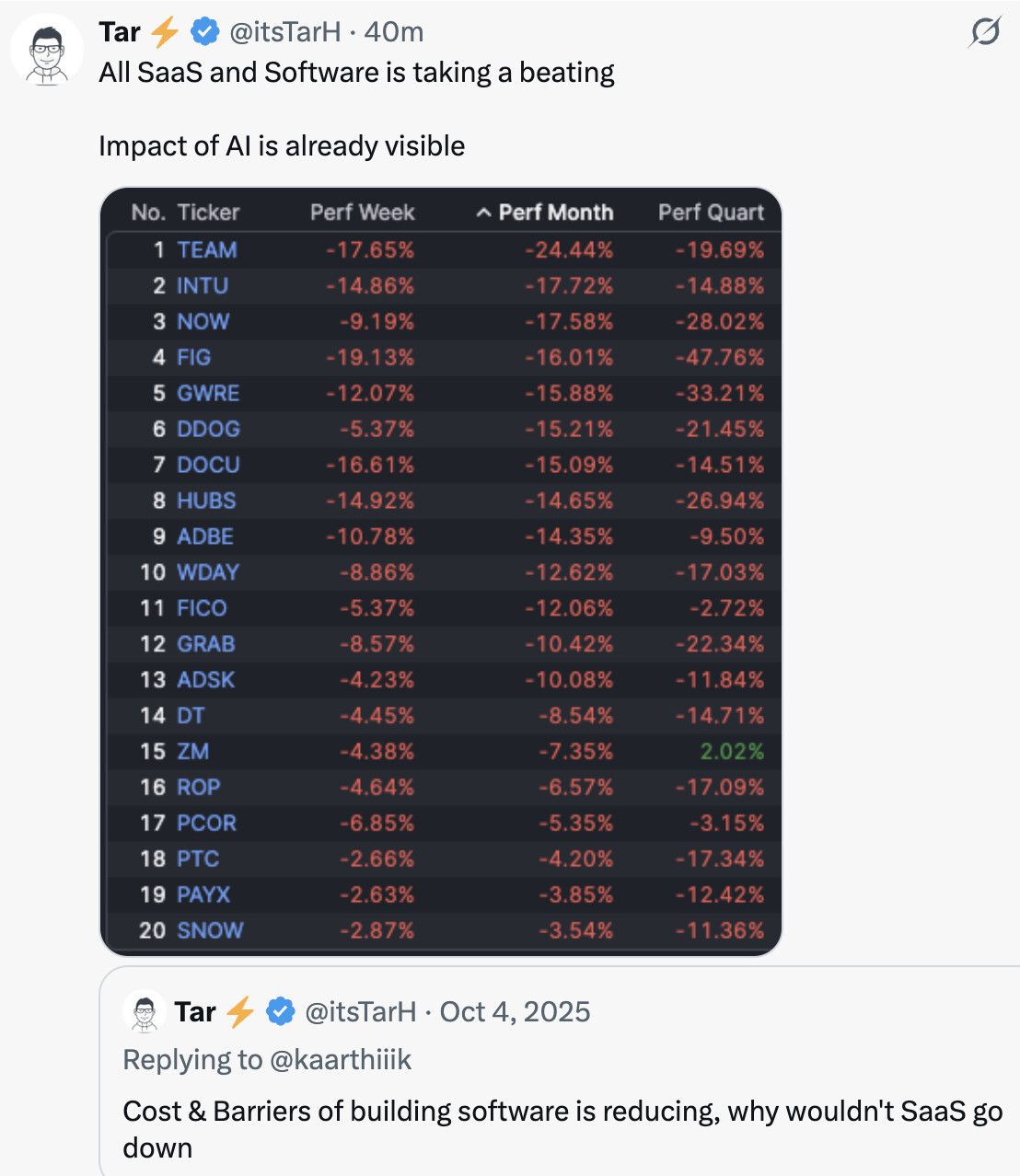
Interestingly, Carl Pei, the CEO of Nothing, recently said that the cost of software development is approaching zero. If this statement proves to be true, it might prove to be a Kodak moment for some companies.
I could be wrong, but that’s how I see things moving.
There might be an opportunity for value buy in IT:
Infosys partners with Anthropic to deliver enterprise AI solutions - The Economic Times Infosys partners with Anthropic to deliver enterprise AI solutions - The Economic Times
AMD Partners with TCS to Compete with Nvidia in India’s AI Market
Bootstrapping projects and features has become faster. Further gains will come from process improvements - software engineering processes such as Scrum will need to evolve, reducing communication/operational inefficiencies. i.e., less time will be spent on managing and more on building.
If less is required now to produce the same, chances are more will get produced - either more of the same or different kinds, i.e., competing/complementary products. Automation did something similar in FMCG - things could be made faster, leading to new categories (remember Dalgona coffee?) and new competitors. And then, what gets built still needs to be maintained - code, databases, integrations, platforms. You just don’t build and leave.
On the flipside, AI output is not deterministic - this applies to code as well. One needs to validate, test, and deploy. What you send to production can’t be left to chance; you need a team - devs, BAs, testers, managers, users - all pitching in. As things stand today, AI is a spoke in the wheel that helps teams release faster.
Then there is governance - data privacy/security concerns remain. Enterprises are hesitant to share their proprietary data, no matter what AI providers’ policies claim. Developing internal models is an option, but needs financial investment - both upfront and ongoing. Some middle ground will have to emerge.
We know B2C AI alone isn’t going to be enough, especially when consumers are pushing back on AI soaked subscription tiers. IT firms are stitching deals to win the perception war, a war likely started by the who’s who, with hundreds of billions at stake. AI has quickly become an industry - too big too fail. If they’ve been ignoring you, you need to shake things up. When stock prices fall, people notice. People act.
Not everything is a push though, there is a bit of pull as well. Enterprises are testing the waters, investing in AI integration where they see measurable gains. Those stubborn, long-pending application modernization projects could finally come to the fore.
AI is expected to cut down on jobs, but jobless growth won’t help AI’s prospects.
Bottom line - you win some, you lose some, what matters is how you adapt and make the most of it - that’s what will differentiate the leaders from the rest.
Came across this view yesterday, any thoughts?
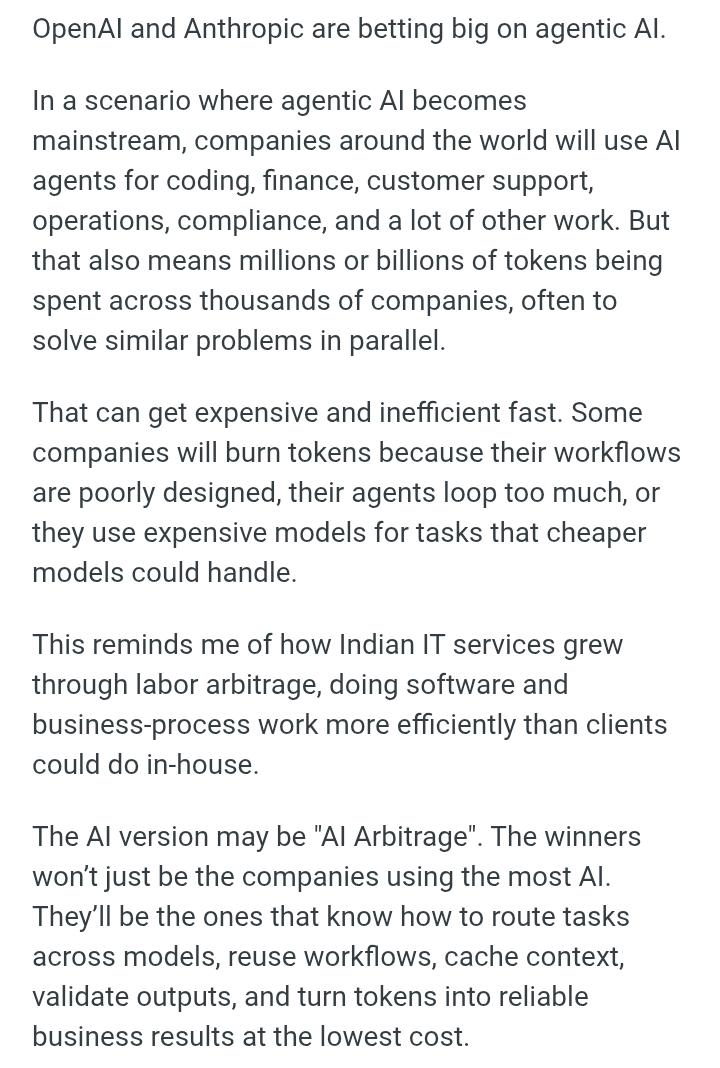
OpenAI is also getting into consulting
https://openai.com/index/openai-launches-the-deployment-company/
nicely expressed in article but nothing new, thats why any services industry (not just IT services) exist. And even so called consulting, which is in essence but service.
Would not like to stretch it long & mention just the major points i have at moment
Disc: Above are purely my thoughts and I am in ested in Indian IT hence extremely biased. Transactions recently as well. Not a registered advisor and not a buy/sell recommendation. I can be wrong in all my assessments and post is only for learning purposes.
A Margin appears to be on the horizon for our IT Giants
The odds of IT firm operating margins declining over the next 18 to 36 months are extremely high. The fundamental problem is that IT services are transitioning from an Asset-Light, Labor-Leveraged Model to a Variable Compute, Token-Taxed Model.
OLD IT SERVICES MODEL (Asset-Light & Pure Gross Margin):
Client Contract ($100/hr) → Developer Cost ($30/hr) + Cloud/Tools ($2/hr) = ~$68 Gross Profit
* COGS was almost purely human labor. Margin scaled linearly with headcount.
NEW AGENTIC AI MODEL (Token-Taxed Variable Cost):
Client Outcome → Automated AI Workflow → High Token API Usage + Inference Compute
* COGS now includes a variable, recurring “toll” paid to Hyperscalers/AI Labs.
In the classic model, once an IT firm built a software deliverable or automated a workflow, their incremental cost to maintain or deliver it was near zero.
In an AI-agentic model, every time the system executes, reasons, or self-corrects, it consumes tokens. Simple chat LLMs consume thousands of tokens per query. Complex enterprise AI agents (which break down tasks, loop through databases, execute code, and self-reflect) consume 10x to 50x more tokens per workflow.
If the IT firm absorbs token costs (in fixed-price or outcome-based contracts), their gross margins immediately compress from historical 35–40% levels down to software-like variable COGS levels (around 20–25%).
If the IT firm passes token costs directly to the client, they become a low-margin “reseller” or pass-through broker for hyperscalers, diluting their overall corporate operating margin percentage.
In the traditional cloud transition, IT firms didn’t buy the servers; they just billed clients to move data to AWS or Azure. In the AI era, the bottleneck shifted to compute and tokens.
Nvidia, OpenAI, Microsoft, and Google capture the vast majority of the margin value chain because they control the inference infrastructure. IT firms are stuck in the middle facing high compute acquisition costs on one side and price-sensitive enterprise clients on the other.
IT firms that run self-hosted, quantized small-language models (SLMs) on dedicated client hardware will eliminate the “token tax” paid to third-party labs and could come out with least damage.
Focus on IT services
IT services sector globally is $1.6 trillion dollar as per IDC , For comparison sake global auto is $2.5 trillion odd and energy sector is $ 3.5 Trillion dollar ..
But unlike other sectors IT sectors is very Fragmented sector .. Even top players like Accenture , TCS , IBM etc will hold low to Mid single digit market shares so essentially TCS , Infosys etc are Small and Mid caps stocks of IT services and persistent / Coforge are like Microcaps ..
But interesting thing is inspite of fragmentation industry makes decent operating margin and healthy cash flows , the business model itself is structurally attractive: low capital intensity + labor arbitrage + recurring revenue + specialization etc .. Plus B2B contracts - Relationship , Trust , Past history of execution etc can reduce commodity nature of relationship .
Can this change in future ??
Yes it can. If technology can alter labour arbitrage , contract tenure reduces , product service bundling increases , trust gets eroded by cyber attacks / ransomware etc., or client does backward integration to services ( GCC) ..
This is what has happened or perceived to have happened in last 2 years and people expect it will accelerate in coming years ..
So what is Action for Investors .. BUY , SELL or HOLD ..
Simple Answer It depends upon how this unfolds and how firms develop strategy to combat it ..
Complex Answer :
One Need to understand what are client thinking , what are their pressure points esp in AI and High interest era
What are large product and ecosystem players thinking .. How is competitive context for them changing .. will they need more support or less support of service companies to sell and sustain their products
3. How does this change entry and exit barriers of industry
The probabilistic answers to above will give you an idea how to play this sector ..
While expectation are low , but Risk is not totally off ..
Concentration on single player could be dangerous
This game will be interesting if Vendor consolidation happens , entry barriers are raised , service scope expands as AI enables more niche products launch
There two games being played by IT services -
Game 1 : Own major part or one key part of ecosystem like Accenture trying own cybersecurity
Game 2 : Be Critical part of all important ecosystem and Play soverignity card .. esp in Non US markets and some firms which want to own their own data / secrets / privacy .. - Few Indian IT services are in this game
Others players will have to align on each of above game of pick niche areas which can also be disrupted over time ..