
Company: TruAlt Bioenergy Ltd
Sector: Biofuel
Basic Details
• Market Cap: ₹4,130 crores
• Issue Price: ₹496
• Current Price: ₹480 (as of 15/05/2026)
• Listing Date: 3/10/2025
Financial Highlights
• Revenue: ₹1728 crores
• Net Profit: ₹97 crores
• ROE: 8.38%
• Debt-to-Equity: 1.09
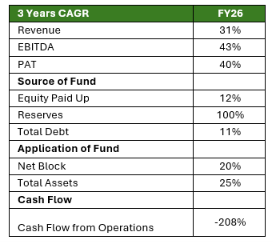
• Revenue Growth (3-year CAGR): 31.4%
Business Overview
TruAlt Bioenergy is a biofuel company incorporated in 2021. It is the largest ethanol producer in India. It is one of the very few non-PSU companies and the only ethanol company that is investing significantly in compressed biogas and sustainable air fuel. It has also obtained the oil marketing license. MRN Group is the parent group of this company. The company got listed in 2025.
Management Quality
The TruAlt MD Vijay Nirani’s father, Mr Murugesh Nirani, is the founder of MRN Group and Nirani Sugars. He was also an ex-minister of Karnataka. One of his brothers is a current MLA. TruAlt’s MD Vijay Nirani’s brother, Vishal Nirani, is the Managing Director of MRN Group, and he is also an executive director in TruAlt. MD’s spouse, Sushmitha Vijaykumar Nirani, is also one of the non-executive directors in TruAlt.
Major cases against the family members:
o Land grabbing case: The case was filed by a real estate owner, Alam Pasha, against former CM Yeddyurappa and former minister Murugesh Nirani. The case is still pending.
o Explosion case: There is a case against MD Vijay Nirani on the explosion that happened in the waste disposal unit in 2018, which caused the death of a few employees. It is doubtful that they would have possibly violated the rules. The case is in the Supreme Court.
The promoter group has a 70.55% stake in the company. In recent days, they have been adding shares in small quantities. It is noted that the promoters have pledged 36.8% of their holdings as a collateral for a term loan. The MD has updated that they are hoping to release it by this quarter.
IPO Proceed Utilization
Fresh Issue was INR 750 Cr, and the net proceeds were INR 650 Cr
- Multi-Feedstock Conversion at TBL Unit 4 - INR 151 Cr
- Working Capital Requirements - INR 425 Cr
- General Purpose - INR 81.35 Cr
Investment Thesis:
1.Compressed Biogas (CBG)
Revenue & Margin Drivers
Demand and supply at different corners: The demand for CBG is majorly policy-driven. Despite the government coming up with initiatives, there hasn’t been the expected uptake. SATAT Scheme was introduced in 2018, aiming to establish 5000 CBG plants to produce 15 MMTPA by 2025. According to the Petroleum and Gas Regulatory Board (PNGRB), only 160 plants are operative as of FY26.
Government’s push: I believe that, compared to before, the government will be more serious about CBG. CBG is 100% replaceable with CNG and PNG, as the methane property makes it almost identical. Approximately 50% of the natural gas is imported, and the government wants to reduce the import dependency, especially after the shortage due to the Strait of Hormuz issue. There are some practical bottlenecks, such as feedstock volatility and pipeline infrastructure, due to which CBG was not an economically viable business to many. But TruAlt has an advantage in these factors.
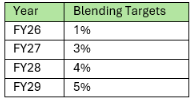
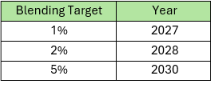
Blending with CNG in the pipeline: India has mandated a phased blending trajectory for Compressed Biogas (CBG) with Compressed Natural Gas (CNG) and domestic piped natural gas (PNG).
Agreements:
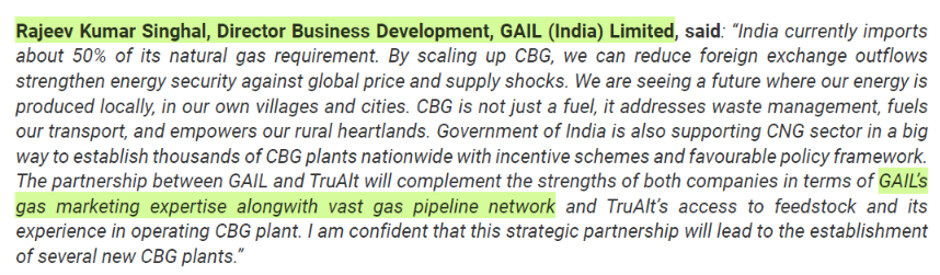
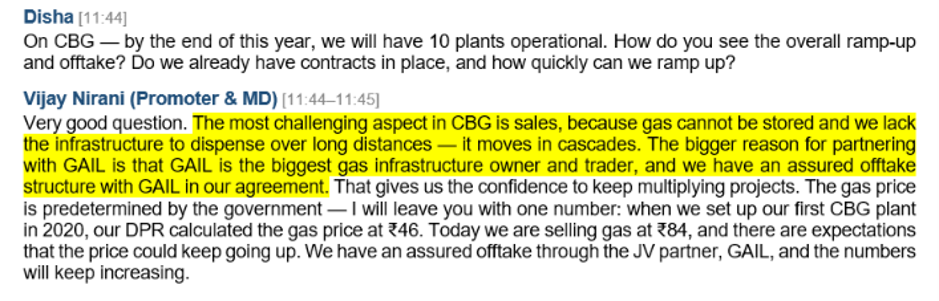
- The partnership with GAIL includes an assured offtake structure according to TruAlt’s management
- Entered 2 long-term agreements
- Tripartite agreements under the CBG-CGD (City Gas Distribution) synchronisation scheme with GAIL and AGP City Gas Pvt Ltd
Feedstock sourcing: For Sumitomo JV, the company will source in-house, and for GAIL JV, the company enters an agreement with other adjacent sugar companies. While Napier grass yields more methane per tonne than other feedstocks, we need to cultivate, irrigate and harvest it or source it from many farmers. TruAlt uses press mud and spent wash, which are by-products produced during ethanol manufacturing. The yield of methane per tonne is lower in these byproducts, but at the same time, there is no significant extra money spent on deriving it. This eliminates complexities with the feedstock supply chain by sourcing in-house, with less quality concern due to fewer inorganic materials, unlike municipal solid waste. It also eliminates pretreatment costs as it lacks the organic polymer lignin, unlike Agri residue. In terms of efficiency, it is twice that of cow dung (25 tonnes used for 1 ton of biogas). In a top-down view, India is one of the largest countries in terms of feedstock availability. But procuring each feedstock also has different challenges. In this landscape, TruAlt has better unit economics than other CBG producers. It is to be noted that Oil marketing companies investing in CBG also invested in the ethanol business.
By-products: Fermented organic manure is a nutrient-rich residual solid waste. It is sold to farmers and manure companies. It is sold at approx. INR 5565 per MT. But according to Alok Jain, director of MEPL Bio Energy, awareness among farmers is low, so they continue to rely on subsidised chemical fertilisers as they are familiar and easily available. A liquefied version of this is also sold or recycled to reduce freshwater consumption. Apart from this, carbon credits can also be sold.
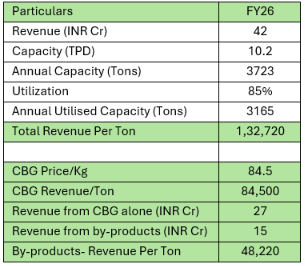
As per the FY26 revenue and CBG price per kg, the byproduct has also contributed a good amount of revenue per ton of CBG sold.
Joint Ventures
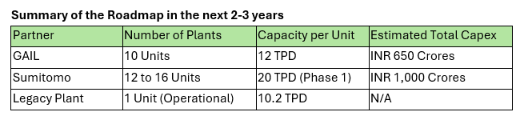
1. GAIL (India) Limited (JV: Leafiniti Bioenergy): GAIL is a PSU under the Ministry of Petroleum & Natural Gas.
2. Sumitomo Corporation (JV: TruAlt Gas): Sumitomo is one of the largest general trading companies in Japan
Supply Chain Factor
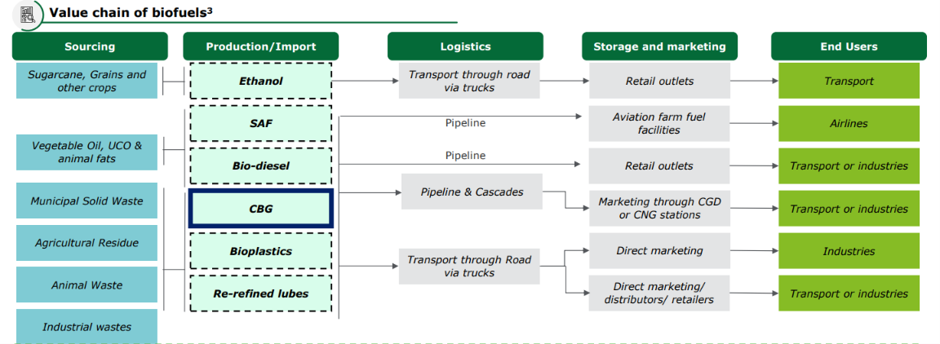
TruAlt becomes backward integrated in all segments and forward integrated in ethanol. But in the CGB, pipeline infrastructure is crucial for supplying the gas. Supplying through trucks in cylinder cascades will cost more. This is where the CBG-CNG Synchronisation scheme helps. The CBG is allowed to be injected into the CNG pipeline. By this, the logistics cost is reduced for the CBG producer. But for this, the CBG plant should be near the City Gas Distribution (CGD) grid. As the cost reduction makes sense only when the plant is near the CGD, up to where it must transport, and then the CBG is injected into the CGD pipeline.
Several projects are being developed in partnership with GAIL. This suggests that pipeline connectivity is likely to have been considered during site selection, which was done along with GAIL. But plant-level access to the CGD network has not been publicly confirmed. Also, we don’t have the location info on future projects with Sumitomo.
The Government of India’s DPI (Development of Pipeline Infrastructure) Scheme offers a 50% subsidy to connect Compressed Biogas (CBG) plants to City Gas Distribution (CGD) networks. We are also not sure of how much subsidy TruAlt will be able to avail. But what we can understand clearly is that the support from the government is not only on the demand side (blending target) but also on the supply side (Pipeline).
Margin
40-45% EBITDA margin as conservative guidance and, in the long run, aiming for a PAT of 40% in this segment.
2. Sustainable Aviation Fuel (SAF)
SAF consists of specially processed aviation-grade hydrocarbons that are chemically similar to ATF and fully compatible with aircraft engines. Up to 50% of SAF can be blended with ATF.
TruAlt partnered with Honeywell to use their Ethanol-to-Jet (ETJ) process technology, aiming to produce 10 crore litres Per Annum / 80,000 Tons Per Annum. They have signed an MoU with the Andhra Pradesh government to build a facility in the state with incentives such as elimination of SGST. Under the PM JI-VAN Yojana, the company has confirmation of financial assistance of INR 150 Crores.
TruAlt is at advanced stages to execute a long-term offtake contract with airline carriers, aircraft manufacturers, third parties, and oil and gas companies. After achieving a long-term offtake agreement and the price, the company intends to make their final investment decision. As of now, the company has said the capex required is around INR 2000 Crores for SAF.
Revenue drivers
Government Mandate
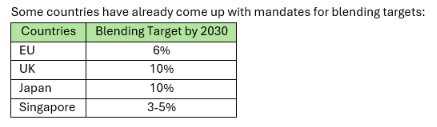
The demand for SAF is also tied to the government’s mandates. The Indian government has mandated blending targets for SAF with ATF for international flights.
Export Opportunities
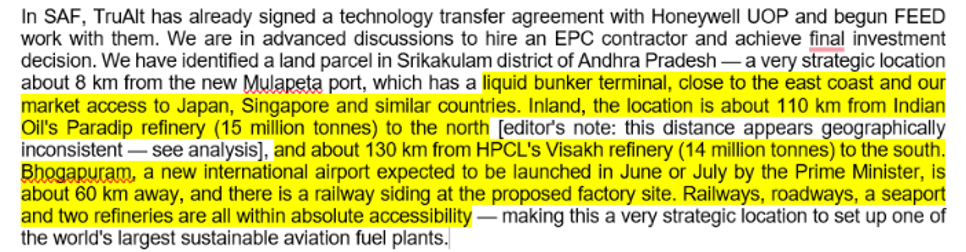
India has the advantage of abundant biomass, which some countries don’t. If they participate in the voluntary mandate of the International Civil Aviation Organisation (ICAO), this will be an opportunity for TruAlt. Even the location that the company has spotted for the SAF facility in Srikakulam would be just 44 Km away from the new Mulapeta port, which is to be launched by this year.
Margin
The company is expecting around 25% EBITDA from this business. The supply chain advantage could make the company competitive in terms of margin and pricing. Approximately 20 Crore litres of ethanol are required to produce 10 crore litres of SAF. TruAlt already has existing excess capacity of ethanol, and that will be redirected here. This improves the unit economics of both the Ethanol and SAF businesses.
Peers
Globally, a few large companies already have very large facilities for SAF. One of them is Neste, the world’s largest SAF producer with capacity 125 Crore Litres Per Annum. The Advantage TruAlt will have compared to the global players is the sourcing of the feedstocks within the country and even in-house. Neste sources its renewable raw materials from over 60 countries. TruAlt can offer SAF at a competitive price.
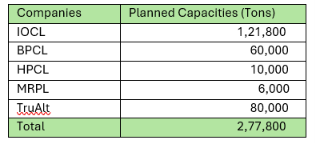
In India, TruAlt is the only dedicated bioenergy company and sugar manufacturing group company entering SAF. Others are oil marketing companies. Indian Oil has announced that it would produce SAF at the Panipat refinery with an approx. Capacity of 35,000 Tons per annum. It also partnered with Lanza to build an 86,800 tons plant for SAF with ETJ technology. Bharat Petroleum has announced that it will commission its first SAF plant by 2026. Hindustan Petroleum has announced to build a capacity of 10,000 tons per annum by 2027. It also announced a partnership with Boeing. Mangalore Refinery plans a capacity of approx 6000 tons per annum.
Demand = Supply?
The ATF consumption in India is 88.44 Lakh tons in 2025. ATF consumption of international flights could be 22.11 Lakh tons (assuming 25% of flights are international). Calculating 5% of the consumption as per the SAF mandate, we get 1.1 Lakh tons and assuming a 5% CAGR for 5 years, we get 1.4 lakh tons as the consumption of SAF in 2030. In the supply side, if we include all the planned capacities, we get a total capacity of 2.17 Lakh tons. So, the supply could become more than the demand.
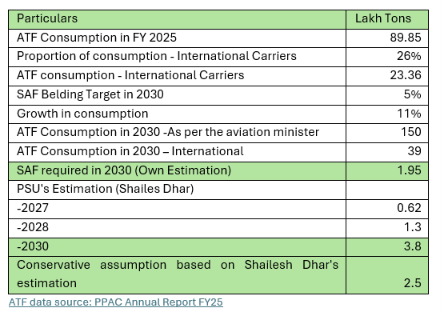
The aviation minister said India’s ATF consumption is projected to reach 15-16 million tons by 2030. Based on this assumption, I have estimated the required SAF for 2030. The demand is 1.9 Lakh Tons, and the supply is 2.77 Tons. So, with this, we can understand that if all the planned capacities are successfully built, the supply will be more than the demand by 0.7 Lakh Tons. According to IOCL, Shailesh Dhar, PSUs estimate a SAF requirement of 3.8 Lakh tons in 2030, which is 2x my estimate. But when we back-calculate the total ATF consumption in 2030 based on his number, we get 304 Lakh tons and international consumption of 76 Lakh Tons, which looks quite unrealistic, assuming only the demand in India. If export opportunities open, things could get different. Conservatively, I assume 2.5 Lakh Tons.
Margin
The company estimates a 20-25% operating margin in this segment
Risk
Non-compliance risk: As of now, we are not sure what the penalty is for non-compliance with the SAF target. If the penalty amount is lower than the expense they make for SAF, there is a possibility of non-compliance.
Dependency: Globally, the price of SAF is 3x that of ATF. The pricing TruAlt estimates for their SAF is 2x that of ATF. Airlines spend more than 30% of their topline on fuel. Therefore, despite the scope of 50% blending, the airlines may not go beyond the required target. Thus, the business becomes highly dependent on government and international mandates. This can change when the oil prices spike further.
Non-exclusivity: Though TruAlt is an early non-oil player building large capacity, the technology is not exclusive to the company. There are other company which are partnering with Honeywell for the ETJ technology.
3.Ethanol
Ethanol will continue to be the largest revenue contributor in the medium term.
Revenue and Margin Drivers
Blending Targets: The government already rolled out the E20 mandate. It is also promoting flex fuels for the long-term target of E85 and E100. Recently, the Union Minister of Road and Highways announced that Isobutanol is to be produced from ethanol and blended with diesel at a target of 15%. According to management, a 1% increase in blending creates demand for 55 to 60 crore litres of ethanol. Though technical and industry experts are positive about the blending, there is some outrage against the blending. The pace of implementation could slow down due to political reasons.
Possible Increase in Supply (optionality): TruAlt was unable to supply 15 Cr Litres (valued at INR 1062 Cr) for an allocation in the previous financial year, as it shut 3 of its 5 plants to integrate dual-feed capabilities. The company requested the Oil Marketing Companies (OMCs) to carry this quantity forward into the 2025-2026 allocation, but the OMCs did not initially grant the request. TruAlt filed a writ petition in the Karnataka High Court for a 90-day extension. According to the management, the court directed the OMCs to consider TruAlt’s request and extend the additional 15 crore litres to their current supply. Management mentioned that if this is implemented, this will boost their sales run rate from 2.2 crore litres per month to 5 crore litres per month.
Dual Feed Capacity: In the non-sugar season, the factories used to be idle, which used only molasses as the feedstock. In dual feed, other varieties of feedstock such as maize and rice can be used in the non-sugar season. Through this, the company has increased its capacity and capability to utilise the plants throughout the year. If the factories are operated for 180 days a year, now it could run 300-330 days a year.
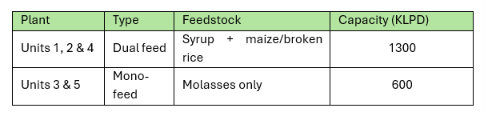
Out of this capacity, August 4, 2026, TruAlt Bioenergy’s Board approved a slump sale of Unit 5 (Badami Undertaking) to Onkar Agro Sugars & Energy Pvt. Ltd. for ₹171 crore, subject to execution of definitive agreements. This plant is a mono-feed plant with a capacity of 200 KLPD. The company has decided to use the funds to pay back debt related to the ethanol business.
Sustainable Aviation Fuel: The company is in the process of building a capacity of 10 Cr litres for SAF. The technology used is Ethanol-to-Jet (ETJ), which requires 20 Cr litres for 10 Cr litres of SAF. Thus, the company can divert the excess ethanol capacity towards SAF.
Retail stations: The company has launched a biofuel retail network under a franchise model. 7 stations are operational, and the company targets 90+ stations in the near term and 250 stations in 5 years. According to the company, they can make more margin with their ethanol by blending their own ethanol.
By-products: Though these are not the major revenue drivers, they primarily help in terms of margins for all the segments. Some of the byproducts’ prices have also been increased in the market. Thus, some act as additional revenue with no incremental investment. The by-products are Distiller’s Dried Grain and Soluble (DDGS), Carbon Dioxide, Potash derived from Molasses, spent wash, press mud and Bagasse.
Margin
Aiming to achieve 20-22% operating margin in this segment.
Risk
Allocation risk: The procurement quota is allocated state-wise. As Karnataka has more ethanol supply, each company would not get more quota beyond a certain level.
Policy and Pricing risk: Highly dependent on the policies and regulated pricing by the government
Pending supply: As of Q4 FY26, management reported that the OMCs had not yet implemented the order due to another ongoing litigation concerning the ethanol allocation methodology for Long-Term Offtake Agreement (LTOA) holders. Hence, we don’t know the time when the INR 1062 Cr order gets implemented.
Outrage against blending: The government would deliberately delay if the agitation against the blending becomes strong.
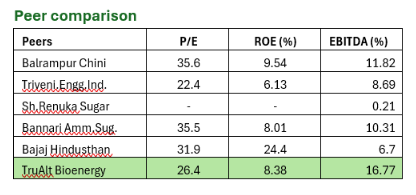
Biogas was only a tiny part of the FY26 revenue (INR 42 Cr). Rest all are ethanol. Still, TruAlt was able to make a 16.77% operating margin compared to other ethanol peers. Moreover, comparatively, it is trading at a lower valuation, having the new future growth avenues.
Financials
Closing Thoughts
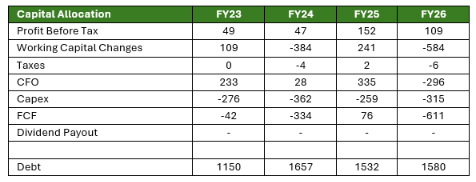
A question arises: if TruAlt can enter these new segments, why not other ethanol companies too? They can, but TruAlt became a first mover by winning long-term contracts for CBG business and partnering with credible value-adding JV partners. It is also in talks to initiate a long-term contract with seven airline carriers for SAF. The company intends to invest only after the contract confirmation. So, apart from oil marketing PSU companies, TruAlt is the only company that seems to be significant in CBG and SAF. Also, these are capex-heavy businesses. TruAlt is taking more risks to gauge the opportunities. Although the business opportunity looks attractive, the higher debt level and promoter holding pledge are red flags. Therefore, we need to be cautious and not get carried away.
Disclosures: I am holding this stock
Disclaimer: No Recommendation