
Agree to most of your points
1000cr vision can happen but business has to show some great numbers to hit 600, 700cr fist and time is running out faster
2 Likes
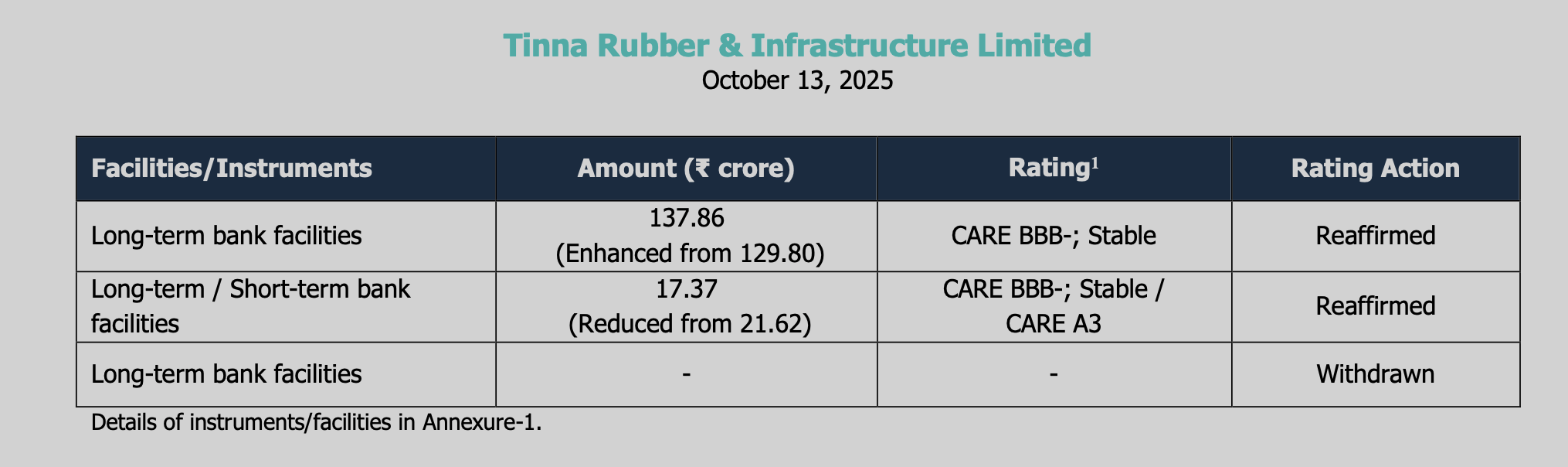
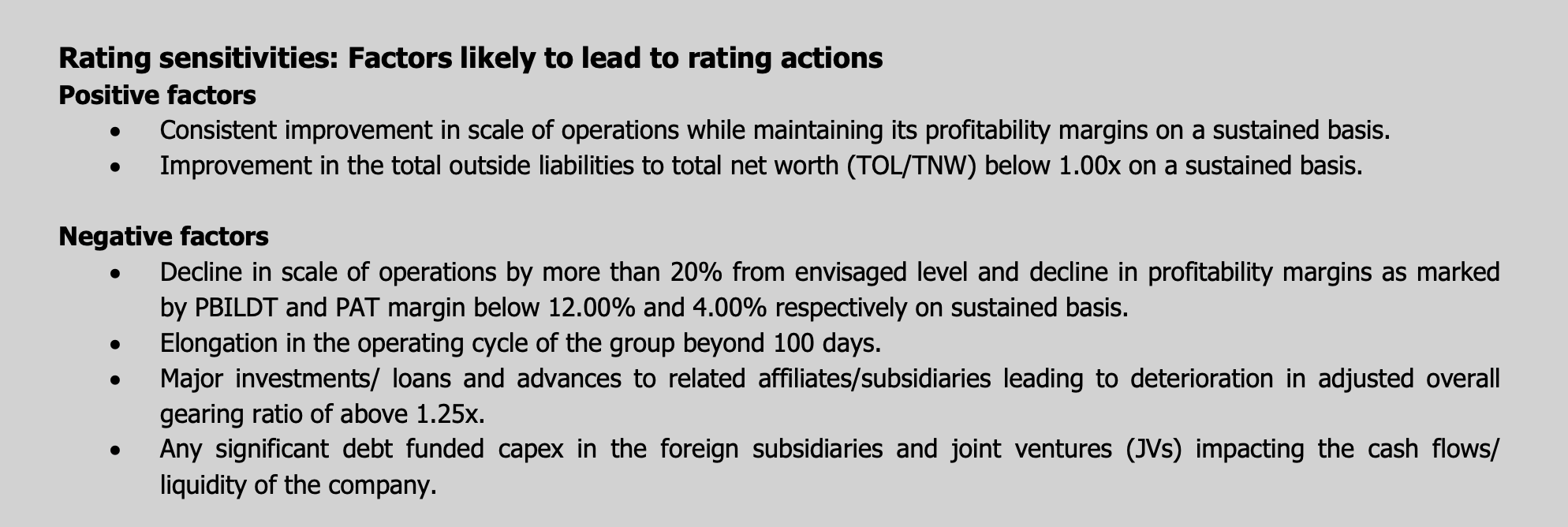
The latest results and investor presentation are out.
https://www.bseindia.com/xml-data/corpfiling/AttachLive/5f47bcee-fa97-4729-98b0-98adc83aada4.pdf
https://www.bseindia.com/xml-data/corpfiling/AttachLive/a4b9a8a7-0dc7-4535-a987-1ea533ad89f6.pdf
I am just sharing. Invested and biased with 3% allocation.
Very in-depth blog on Tinna.
Just sharing.
Invested and Biased with 6% allocation.
6 Likes
I think the biggest growth triggers that Tinna has are CRMB and MRP.
PART 1: THE CRMB OPPORTUNITY - WHY THE MARKET WILL EXPLODE
A. Understanding CRMB: The Superior Road Material
What is Crumb Rubber?
Waste tyres are mechanically ground into fine rubber particles (crumb rubber), then processed through ambient grinding to achieve uniform particle sizes. This uniformity is critical since inconsistent particle sizes produce inferior CRMB that separates during storage and fails quality standards.
What is Bitumen?
The thick, black, sticky material you see on a road under construction is Bitumen.
Why is it used?
Road construction uses other raw materials: crushed stone, sand, and gravel that provide mechanical strength. It’s the Bitumen that holds all these strong particles together, thanks to its sticky properties. You must be wondering, can’t concrete do the same? Sure, it can. But, roads are constantly subject to heavy truck loads, changing environments, ground movement, etc. Concrete can easily crack under these conditions. Bitumen is more flexible and easily outperforms concrete here. In addition, it is naturally waterproof. This is important, as water seeping through can disintegrate the structure of the roads.
Despite these properties, when we look around, we see roads
-
Crack in cold weather
-
Soften in high heat
-
Rut under heavy traffic
This is where CRMB comes to the rescue
What is CRMB (Crumb Rubber Modified Bitumen)?
CRMB is bitumen infused with 10-15% crumb rubber. Just like normal Bitumen trumps concrete in its flexibility and weather resistance, CRMB is Bitumen on Steroids, since the rubber significantly enhances the expansion and contraction properties of Bitumen, making it even more durable to mechanical and thermal stresses. CRMB
-
Resist cracking in cold weather
-
Don’t soften/rut in extreme heat
-
Handle heavy traffic loads better
-
Lasts 2x longer than conventional bitumen roads
The additional advantages: Instead of burning or dumping tyres, they’re converted into infrastructure, while reducing Bitumen usage by 10-15%. This is critical, since India imports > 40% of its Bitumen consumption
Given all these advantages, it shouldn’t be a surprise that the govt. would want to push for CRMB usage in the construction of roads starting from the national highways.
B. The Policy Trigger: The Mandate is Coming
July 14, 2025 - The Date That Changes Everything
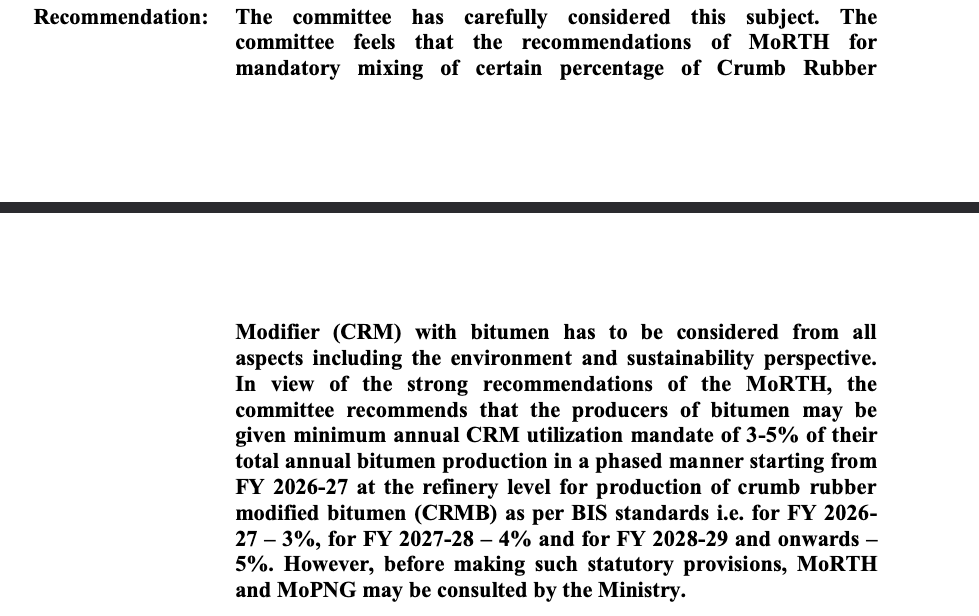
The Ministry of Environment, Forest, and Climate Change’s Technical Review Committee met and issued a formal recommendation:
Official Language (MoEFCC Document):
“The committee recommends that the producers of bitumen may be given minimum annual CRM utilization mandate of 3-5% of their total annual bitumen production in a phased manner starting from FY 2026-27 at the refinery level for production of crumb rubber modified bitumen (CRMB) as per BIS standards i.e. for FY 2026-27 – 3%, for FY 2027-28 – 4% and for FY 2028-29 and onwards – 5%.”
To add some context: Bitumen is produced during the refining of crude oil. In a refinery. IOCL is the largest Bitumen manufacturer in India
What This Means:
India’s refineries (IOC, BPCL, HPCL, etc.) will be required to blend CRM into bitumen before it leaves the refinery. Not optional. Not voluntary. Mandatory.
The Timeline:
-
FY 2026-27: 3% mandate → 300,000 MT bitumen must be CRMB
-
FY 2027-28: 4% mandate → 400,000 MT
-
FY 2028-29+: 5% mandate → 500,000+ MT
Current CRMB market: 200,000-300,000 MT
At 5% mandate: 500,000+ MT minimum
This means even if we make all other tailwinds vanish, the market still becomes around 2x in 3 years in the worst case.
The management’s estimate
India consumes approximately 9 million metric tons of bitumen annually. Management estimates the potential market for modified bitumen to be 10% of that total, or 1 million tons.
This means that the market will expand 4x from the current levels in the next few years, in the eyes of the management.
What solidifies our growth hypothesis of CRM blending is the recent contract signed between IOCL and Tinna Rubber for the supply of CRM. IOCL is the largest Bitumen and CRMB manufacturer in India. IOCL, being state owned PSU, this might indicate a possible pilot for the CRM blending mandate before the formal announcement. This might also mean IOCLis preparing itself for the mandate by securing its supply from the market leader, Tinna. But let’s not get ahead of ourselves and wait for more evidence of this.
What I must tell you is that both IOCL and the promoters of Tinna rubber are a part of the committee with which the Ministry has been in discussions for the mandate.
Now let’s see why the actual demand would be higher than this. The mandate might be unnecessary. Market forces are already driving CRMB adoption.
C. The HAM Revolution: Economics Drive Adoption Even Without Mandate
Ministry of Road Transport & Highways (MoRTH) is responsible for the development of roads in India. It used the BOQ(bill of quantities) based contracts before for the construction of roads.
OLD MODEL - Bill of Quantities (BoQ):
-
Contractor bids: “I’ll build 10 km for ₹50 crore using X tonnes bitumen.”
-
Gets paid upon delivery
-
1-2 year warranty, then the government’s problem
-
Incentive: Use the cheapest materials, pocket savings
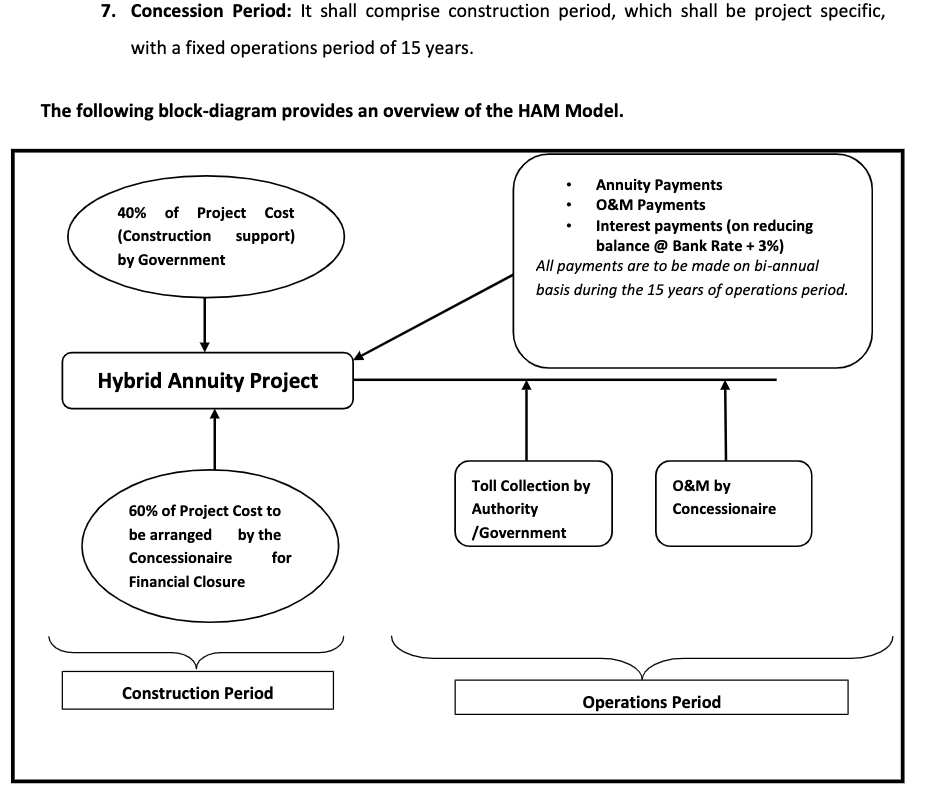
NEW MODEL - Hybrid Annuity Model (HAM) + Extended DLP:
-
Contractor gets 40% payment during construction
-
60% paid biannually over 15 years (annuities)
-
Annuities are only released if the road meets quality standards
-
If the road fails, the contractor pays to fix it
-
Incentive: Use materials that last 15 years
Current Reality (ICRA/Government Data):
-
HAM: 55-65% of new NHAI projects
-
EPC with extended DLP: 30-35%
-
Over 70% of new projects have 10+ year maintenance obligations
How is the quality aspect taken care of?
Contractors are evaluated based on their execution of individual projects, with larger HAM contract projects weighted more heavily.
In this evaluation scale, 40% of the marks are awarded for quality of execution, while up to 30% can be deducted for poor quality.

Why do these marks matter?
These marks affect the participation and qualification of contractors in the bidding process. In simple words, bigger, better quality contractors are incentivized to win more, bigger contracts.
Better performers
-
Require lower security deposits (bank guarantees)
-
Can bid for bigger projects
Worse performers
-
Can only bid for lower class (low value projects), lower capacity
-
Need to give bigger security deposits
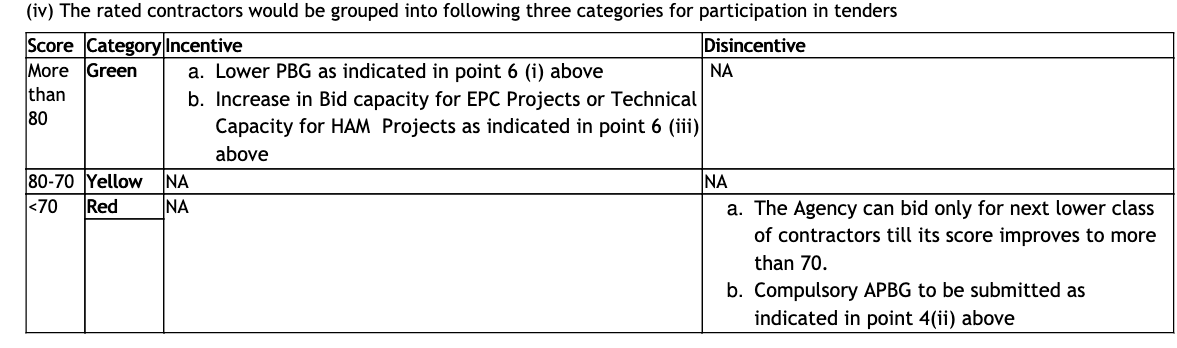
The important implication of this model for us is that the
-
Contractors are incentivised to use durable materials like CRMB instead of plain Bitumen. Though CRMB costs more upfront, it is more economical over its lifetime costs due to higher durability.
-
MoRTH is incentivising consolidation of the industry through value migration from smaller to larger, better quality contractors. With this the demand side for CRMB gets consolidated.
Demand Side Consolidating:
-
Fewer, larger buyers (NHAI HAM projects vs thousands of small contractors)
-
Quality-focused (performance payments at stake)
-
Long-term relationships (15-year contracts)
-
Sophisticated procurement (technical specifications, not just price)
This Forces Supply Consolidation:
-
HAM contractors need a consistent, quality-certified supply (can’t risk using informal sector rubber)
-
Need multi-year supply agreements (to secure bids)
-
Need technical support (application guidance, quality assurance)
-
Need scale (100+ km highways require thousands of tonnes)
Tinna currently hold 60% market share in the CRM market. Tinna already has strong relationships with some of India’s top contractors. Adani Infrastructure Limited and IJM (India) Infrastructure Limited are some of their repeat customers. Further consolidation would only accrue value to Tinna.
4 Likes
The Hidden Gem: Micronized Rubber Powder (MRP)
While you might be completely sold on the CRMB mandate story, let me tell you, Tinna has a second, potentially superior business: Micronized Rubber Powder (MRP) for tyre manufacturing, which is their premium, highly specialised product.
What It Is: Ultra-fine rubber powder (170 mesh, 88 microns) that tyre manufacturers blend into virgin rubber compounds in a certain percentage to manufacture tyres. In technical terms, this is called the inclusion rate.
The Economics:
-
Virgin rubber: $3/kg
-
MRP: $1.50/kg
-
Savings: 50% cost reduction
-
Performance: Equivalent or better (improved wear resistance, flexibility, thermal stability)
Why it makes sense for OEMs:
-
Massive cost savings (₹1.5 crore per 1,000 tonnes virgin rubber replaced)
-
Regulatory compliance (EU mandating 30% recycled content in tyres by 2030)
-
No quality compromise at proven inclusion rates
The Indian Opportunity:
Global adoption rates at close to 30% parts per hundred rubber (pphr):
-
US tyre manufacturers: 49% using MRP
-
European component manufacturers: 44% adoption
India adoption: <10% (vast underpenetration)
The Math:
-
India produces ~200 million tyres annually
-
Average rubber content per tyre: 4-4.5 kg
-
At 20% pphr inclusion rate MRP (conservative): 160,000-180,000 tonnes annual potential
-
Current organized MRP market in India: ~20,000-30,000 tonnes
-
This represents a 5–9x growth runway for the market, simply by matching EU and US adoption levels at current tyre production volumes, a conservative estimate.
Tinna has a massive 80% market share in MRP in India, according to management claims
If the CRMB story was uncertain, MRP looked like the real money-maker, a premium, differentiated product with proven demand and a massive runway in India’s growing tyre industry.
4 Likes
Any particular reason why India is still under 10% when they are having good opportunity to reduce the cost through MRP?
Is there any other product that Indian tyre manufacture are using instead of MRP to reduce the cost?.. it is difficult to be in competition when others are using a MRP and you are not.. so how Indian manufacturer are able cut to cost?
2 Likes
Multiple reasons. But, the biggest reason-
Not enough supply
Annual Tyre production was around 3 Million tons (FY25), while Tinna’s MRP (80% market share) capacity is just 20,000 tons. The reason for low capacity : production of MRP requires high quality Truck and Bus radial tyres (TBR), which are available only through imports.They are facing challenges due to multiple reasons in securing a steady supply of imported tyres as reported in concalls.
MRP itself is a substitute to the natural / synthetic rubber (2-3x more expensive thna MRP) that is used in the tires (4 wheelers and heavy duty commercial/ industrial vehicles)
Another factor that is specific to India and different from the USA, is that the tires are dominated by 2 and 3 wheeler segments Vs the 4 wheelers. In 2 and 3 wheelers , reclaim Rubber (coarser version of MRP) is used, which is also one of the product segments of Tinna. It is due to the domination of 2 and 3 wheeler tyres that the adoption rates also appear low apart from the low supply, capacity.
5 Likes
Just sharing this tweet covering the plant visit of Tinna Rubber
Just sharing.
Invested and Biased with 7% allocation.
Is it a warning signal? If 70% is imported, then we can be sure company facing problems in securing raw materials, at least in the short term. With experts differing on the duration of fall out of Iran war and no sign of hostilities coming down, I am keeping my fingers crossed. There are several potential disruptors like shortage of raw material, price rise, logistical challenges etc. Experts can give their opinion.
3 Likes
Yes. Very true. And Tinna has 2 international ventures.
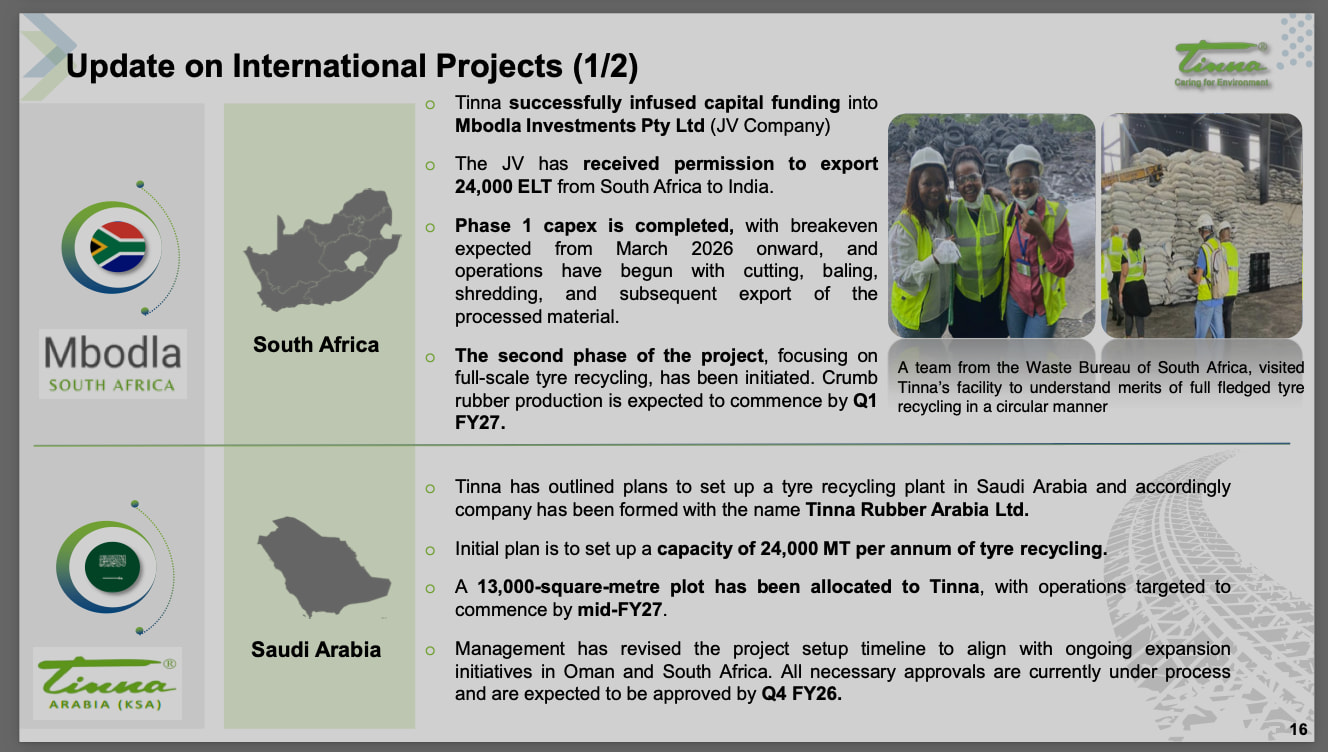
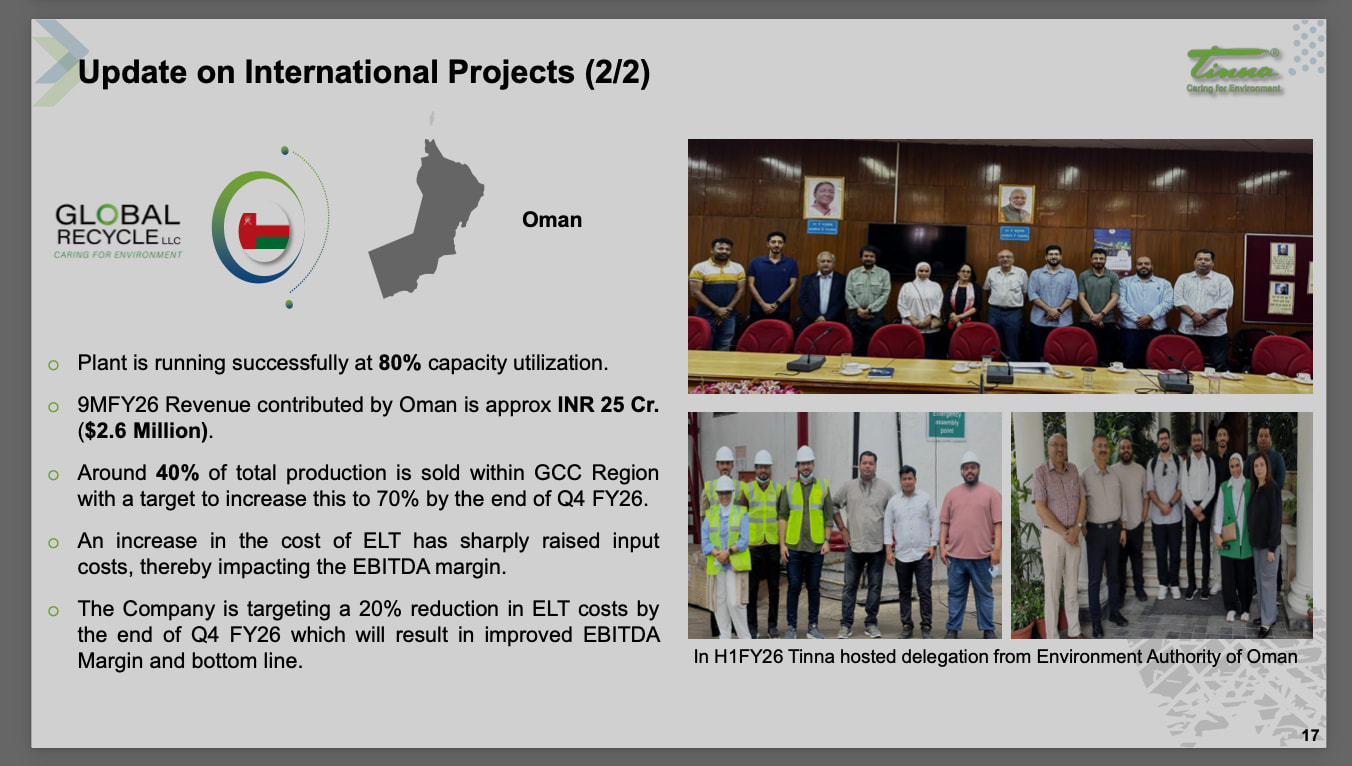
So these are the reasons, the stock has fallen significantly in the recent period.
4 Likes
In the past company had margins compression when scrap tyre prices increased. Now they are saying that they can crush different types of tyres coming from different sources. So to some extent thier margins are safe from price changes.
Now I don’t know does management is just spinning us or they are able to do it.
Management will always try to paint a ROSY picture. We , retail,investors have to put some margin of safety on such numbers. For Ex, when a management says that it will grow by 20%, I will assume it will grow by 10/15%.I apply same margin of safety for the GPM / OPM/ ROE/ ROCE, etc.
So here, we will have to wait for the results to know.
Found this video on tailwinds in the business

1 Like
Great video and great analysis
2 Likes
one mans meat is anothers poison…
Tinna at 2000 ATH versus Tinna at 865… H1 2024 YoY growth probably mislead a lot of investors in believing that it is going to be like this in the mid term and then the delay in meeting guidance, delay in Oman plant profitability and the delay in expansion at Saudi … add to that the loss in bitumen mix revenue… investors who bought at highs will look at it as disappointment while those who may be adding now will be licking their tongues in anticipation of quietly compounding their investment…
expecting that a return to near normalcy in the middle east will lead to a positive thesis being hammered of forward EBITDA valuation multiples based on management 2028 2029 vision… although Q4 was a solid performance,stagnation in earnings growth is a serious threat despite mgmt guidance…
4 Likes
If anyone have any idea, if any car manufacturer is trying to build recycling plants on their own, like we are seeing in case of batteries.
Battery manufacturers are laying down capex to build recycling units.
2 Likes
The results are out. Below is the link
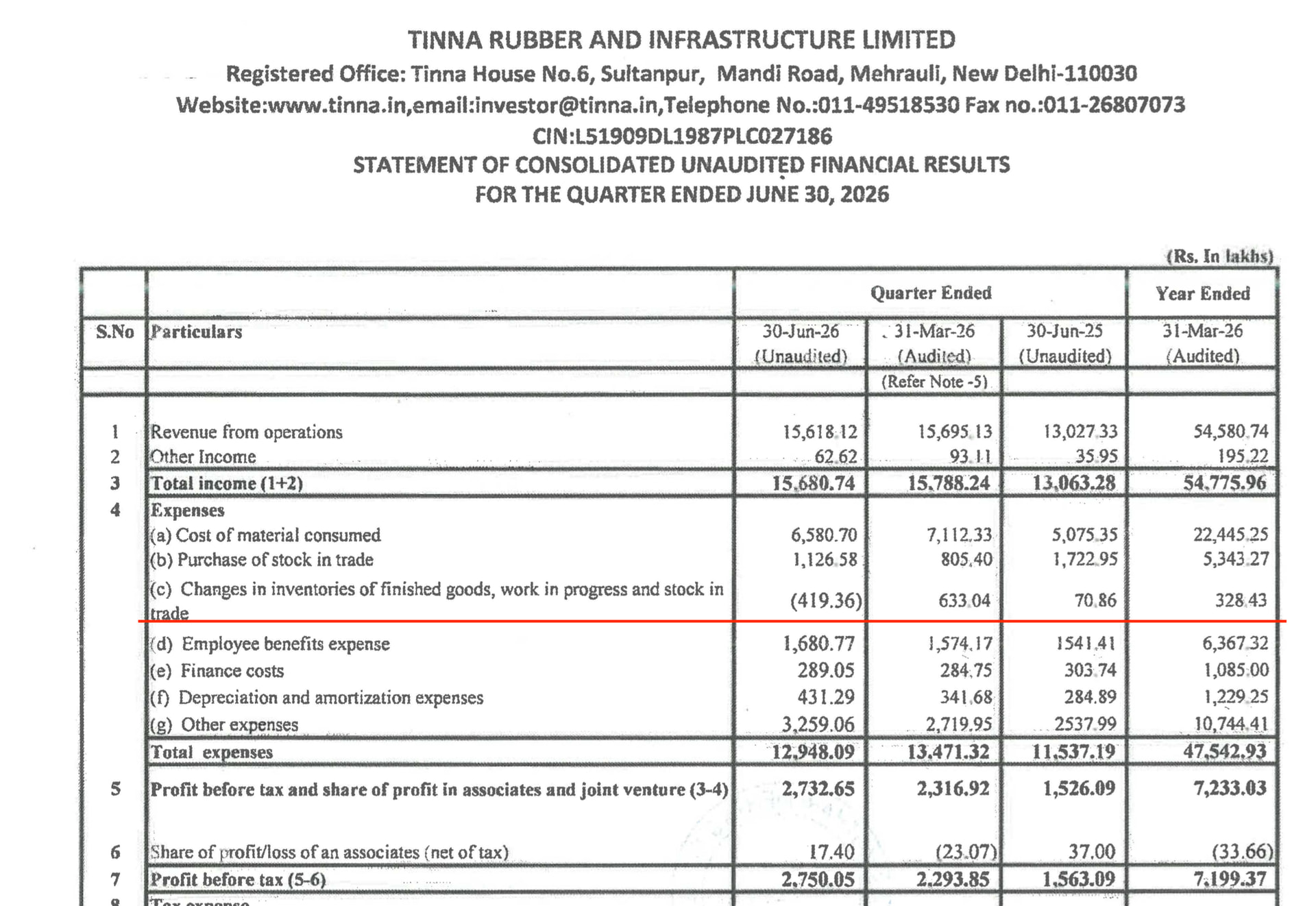
Can anyone explain the reasons for this?
Invested and Biased.
This line item essentially refers to the price movement of commodities (opening - closing stock) since prices moved up sharply for crude linked recycled rubber but not for input.
1 Like
The change in inventory implies change in inventory, in earlier quarters there has been inventory pile up, which has been liquidated.
1 Like