
Thanks a lot, Avinash.
As per Q4 concall - Management has guided for revenue of 900 cr in FY26, with 20% + EBIDTA margin. With 25% tax outflow, PAT turns out to be around 124 cr ( EPS of 60 rupees).
For FY 27 in a best possible scenario company can do a revenue of 1270 cr, i.e. 1200 at 100% capacity utilization of all 3 plants + 70cr from technical service. Leading to EPS of 85 rs.
Even at 40 PE, I believe upside is very limited.
One key monitorable to watch out for is inorganic growth. Management is looking for acquisition to add capabilities. Hopefully it will fructify soon.
Disclosure - invested from lower levels.
3 Likes

Q4 -may 2025 concall
PERFORMANCE
1…Plant
Ahmedabad: INR 565 crore
Kheda (first full year): INR 143 crore
Mabel Engineers: INR 43 crore
2…Industry
Hydrogen (30%),
Oil & Gas (30%),
Petrochemicals (23%),
Fertilizers (10%),
Others (7%).
3…Product Mix:
Heat Exchangers (65%),
Vessels/Reactors/Columns/Others (35%).
=Kheda plant’s focus is on vessels/reactors/columns
4…EXPORT@54%
US/Canada ~30%,
Middle East (Saudi Aramco, ADNOC) ~50%,
Australia/Nigeria ~15%,
Europe ~5%.
===============
FUTURE GROWTH
1…New products and diversification
A…Critical Equipment Foray: Successfully manufactured & delivered first chrome-moly-vanadium modified material equipment (critical metallurgy) for Indian client; first solid internal equipment (>200MT, single piece) for export customer at Kheda.
B…Clean Room Operations: Restarted titanium equipment manufacturing; further clean room projects underway for complex metallurgies.
2…Anup technical services
=Focus on high-volume, short manufacturing cycle jobs (“large volume play”); launch of Anup Technical Services (testing, health checks, site repairs) leveraging NABL-accredited lab and Mabel’s site capabilities.
=Already executed initial orders; services vertical expected to reach INR 200 crore in 3 years at >30% EBITDA margin.
3…Export Competitiveness:
= India remains cost-competitive vs. China, Mexico, and Europe, especially given recent tariffs and high energy costs in Europe. Management confident that “India still holds a dominant position in terms of being the most competitive country” for their product line.
4…Hydrogen Economy:
=Strong traction in hydrogen (esp. blue hydrogen, i.e., conventional hydrogen with carbon capture).
=Management notes: “when a blue hydrogen project comes up, it’s the conventional opportunity plus the CCU opportunity that comes your way.”
5…Capex
A…Kheda
=Phase 2 under Construction, completion in Q2 and commissioning in Q3
Capacity Utilization: With Kheda Phase 2, expected utilization in FY26 at 75–80%; currently operating at near full utilization without Phase 2.
B…Mabel Engineers acquisition
C…Total Installed Capacity (Post Kheda Phase 2)@ 1200 cr rev potential
: Potential of INR 1,200 crore annual revenue,
D…Long-term Capacity Plan: 2000cr rev potential
a…Kheda master plan for 7 bays (currently 4 after Phase 2), potential revenue of INR 1,000–1,200 crore from Kheda alone;
b…Odhav (Ahmedabad) INR 600 crore;
c…Mabel INR 200 crore;
= Total group potential INR 2,000 crore.
6…Growth guidance
=Ebidta guidance
20% EBITDA margin
=Revenue rowth u
25 % in 2026
=Future Business mix model:
-60% legacy products (>20% EBITDA), -20% high-volume quick-turnaround jobs (~15% margin),
- 20% high-margin services.
Disc…invested since 4 yrs
4 Likes

This has become a recurring pattern with this company. Almost every quarter, just before the results are announced, shares are bought by some relative or related party. I’ve pointed this out earlier in this thread as well.
To me, it seems quite clear that they may have access to information before it’s made public. In my opinion,not sure if this borders on insider trading, and I’m surprised that SEBI or the exchanges haven’t flagged this activity yet.
On the upside for retail investors like us, they haven’t started selling yet but it’s important to monitor them closely once they do. Let’s see how the stock story evolves going forward.
Disclosure - Invested and biased.
3 Likes
Possible ancillary play for Anup in this deal..

Anup had mentioned a few years back about green ammonia, need for heat exchangers.


2 Likes


Thanks for the write-up. This is on Nuclear segment entry, wanting to grow even further than steam generator, columns and vessels as well. Have you explored this side?
Could you share your report/presentation for reading?


Anup eng updaate(concall and ppt)
A…Technical services
Anup’s Technical services arm (the Service Module) has started executing orders with initial traction (~10 POs) and a clear scale-up
roadmap. This is a higher margin and higher ROCE business.
-Technological services
-grow this vertical to about INR200 crores in the next 3 years.
-~40% margins
B…Phase 2 kheda(jan 2026)
Commissioned Phase-II at Kheda Plant (now total Revenue Potential of ₹400 to 450 Cr p.a. for Kheda), ensuring capacity till FY27
Phase 1 (2 bays)
- commissioned in June 2023
Phase 2A (2 bays)
– One full bay is commissioned in Q2 FY26 and one open bay is commissioned in Jan’26
Phase 3 (3 bays)
– Future Plan
C…Order book
Order book
Healthy pending orderbook of ₹769 Cr
Encouraging Order inquiry pipeline of ₹1,200 Cr, to help build the orderbook for FY27 & FY28.
D…Export
Anup witnessed significant growth in its export revenue in the last three
years, contributing significantly to overall growth in scale of operations. Exports stood at ₹460 crore in FY25 (FY22: 28 crore)..
D…DIVERSIFICATION
-Oil and gas from 68% to 39%
-Heat ex from 70% to 56%
E…High margin/High Roce
-Anup has been maintaining healthy PBILDT margin of over 20% in the last many years despite commodity price volatility backed
by strict control over its overheads
-ROCE is expected to remain healthy at over 20%.
-Taken a conscious decision to book new orders with caution and book selectively the ones with risk protected and providing healthy margins.
-Capitalize on installed capacities and shift mix toward “higher value-add products, including design, critical and complex manufacturing and site services,” plus deeper push into “complex metallurgies.”
-Continues to achieve guided margin of 21%
C…FIRST
a)Complex
successfully manufactured and delivered our first solid internal 200 metric ton single piece equipment” to a “reputed client in Middle East.
b)…Nuclear energy
-Entered the nuclear energy segment with a strategic order win from a leading EPC player in India, marking a significant step in
diversifying into high-growth, future-oriented sectors
c)…Thermal.energy
First order secured for critical heat exchangers in the thermal power segment from a reputed Indian EPC, opening avenues for
future growth
d)…Clean energy
First order being executed for a patented clean energy storage technology throu
e)Skids
-first order for manufacturing skids.
The company has been strategizing to get into skids pkg business for some time and has successfully bagged its 1st order for skid package
(equipment + structure + instruments) for a project in Middle East. Once executed, this experience should open up new opportunities.
f) Air cooled heat exchanger
-first order for air heaters” and “one large order for air cooled heat exchangers for an export project.
capability stepping stone toward “data center needs for cooling systems” (noted as critical tech, but this is the first step).
Disc…invested
3 Likes
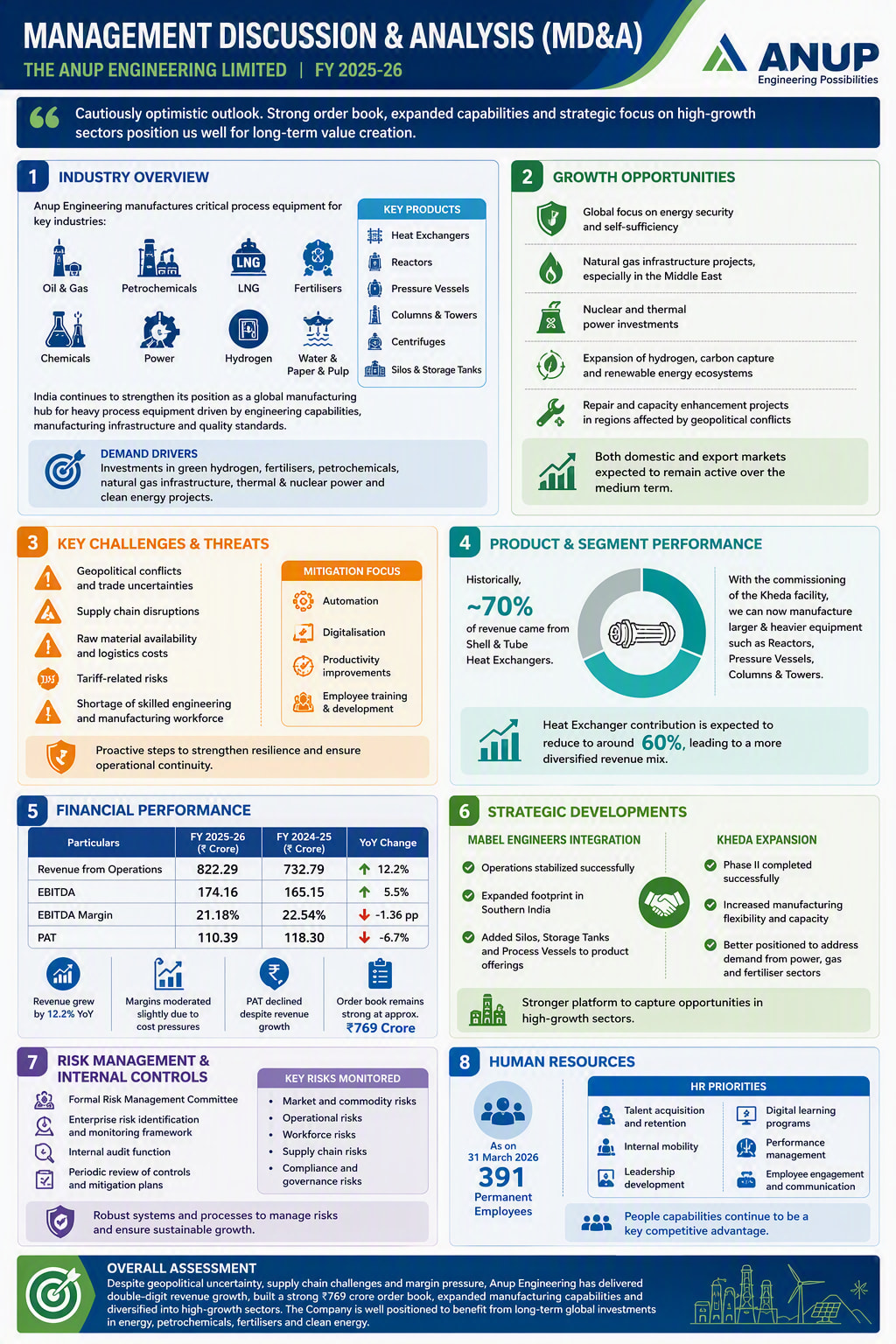
Annual Report of 2026 published a while ago. Energy security & Self Sufficiency driven by Geopolitical compulsion, Hydrogen Ecosystem expansion, Nuclear and Thermal power infra, Natural Gas infra expansion are key growth drivers as outlines in “Management Discussion and Analysis“. Summary of Management Discussion and Analysis attached.
Disc: Evaluating, not invested.
2 Likes
History of the Company
-
Establishment & Experience: The Anup Engineering Limited was established in 1962, giving it over 62 years of extensive experience in the heavy engineering and fabrication industry.
-
Group Lineage: The company is part of the Lalbhai Group family of listed entities, alongside businesses like Arvind Ltd., Arvind Fashions, and Arvind SmartSpaces.
-
Core Evolution: Historically, the company was heavily dominant in the fabrication of shell and tube heat exchangers, which traditionally constituted nearly 70% of its annual revenues.
-
Recent Milestones: In recent years, the company transitioned into an independent listed corporate structure, achieved a net debt-free status, and scaled up its capability to handle massive, complex static equipment. Strategic growth has been driven by the commissioning of its state-of-the-art Kheda facility in June 2023 and the acquisition of Mabel Engineers in Tamil Nadu, which was completed in June 2024.
-----------------------------------------------------------------------------------------------------------------Manufacturing Facilities
The company operates three main manufacturing locations and an advanced engineering center:
-
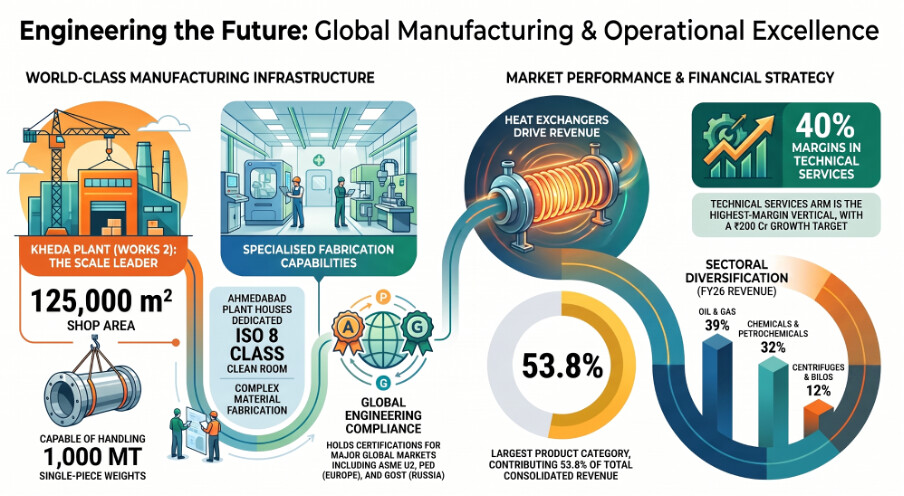
Ahmedabad Plant (Works 1): Located in Odhav, Ahmedabad, Gujarat. It has a total shop area of 45,000 m² and a covered area under the hook of 23,000 m². The facility features an under-hook height of up to 15m, a maximum equipment diameter threshold of 5.5m, and can output lengths up to 50m. Its single-piece weight capacity reaches up to 500 MT. Notably, it houses a specialized 500 m² ISO 8 Class Clean Room explicitly dedicated to complex, exotic material fabrication.
-
Kheda Plant (Works 2): Located in Hariyala, Kheda, Gujarat, positioned with favourable logistics near the national highway. This massive site features a total shop area of 125,000 m². Phase 1 was commissioned in June 2023, followed by the full completion of Phase 2A in January 2026. Kheda expands the company’s capabilities to manufacture exceptionally large-sized equipment. It handles single-piece weights up to 1,000 MT, lengths up to 100m, diameters up to 8.5m, and has an under-hook height of 17m. The plant’s current annual revenue potential stands at ₹400–450 Cr, with a future Phase 3 expansion of 3 additional bays already planned.
-
Mabel Plant (Works 3): Operated by its 100% subsidiary, Mabel Engineers Private Limited, located in Gummidipoondi, Chennai, Tamil Nadu. It offers a total shop area of 20,000 m² and a covered area of 5,100 m². It features an under-hook height of up to 10m, weight capacity up to 75 MT, and max diameter capabilities of 5m. Mabel provides crucial site fabrication capabilities and is qualified under Engineers India Limited (EIL) specifically for manufacturing Silos.
-
Engineering Centre (Vadodara): Based in Vadodara, Gujarat, this specialized office supports the company on structural, thermal, and mechanical design fronts while operating as an independent profit center.
-----------------------------------------------------------------------------------------------------------------
Different Segments & Core Sectors
The company reports under a single standalone operating business segment: Engineering Products. However, its product portfolio serves a highly diversified array of downstream process industries.
The consolidated sectorial revenue distribution across core industries in FY26 is broken down below:
-
Oil & Gas: 39%
-
Chemicals & Petrochemicals: 32%
-
Centrifuge & Silos: 12%
-
Fertilizer: 9%
-
Hydrogen: 8%
Additionally, the company has successfully diversified into high-growth, future-oriented sectors. It has entered the Nuclear Energy segment by executing critical fleet orders for NPCIL (such as the Kaiga-5 and Kaiga-6 projects) and expanded into Thermal Power via a major contract for NTPC power infrastructure.
Margin Profile
-
Core Static Equipment: The company maintains a steady industry-leading standalone and consolidated EBITDA margin profile, closing FY26 with a blended EBITDA margin of 21.2%, remaining safely within its structural guidance of 20%+.
-
High-Volume Standard Products: Newly introduced product lines aimed at capturing higher volume—such as Air-Cooled Heat Exchangers and industrial air heaters—operate on shorter cycles but carry lower blended EBITDA margins of roughly ~15%.
-
Highest Margin Segment: The absolute highest margin vertical within the business is the newly prioritized Technical Services Arm (Service Module). This specialized segment is a low-capex, high-ROCE vertical that commands robust margins to the tune of ~40%. Management has established a dedicated organization structure and a regional base in Dubai to aggressively scale this vertical to ₹200 Cr over the next three years.
Marquee Clients & Technology Licensors
The company works directly with major global engineering conglomerates, public sector undertakings, and oil majors:
-
Domestic & Public Sector Giants: Heavily services critical orders for Reliance Industries in the petrochemical space, NTPC in thermal power, and NPCIL (Nuclear Power Corporation of India Limited) for domestic grid expansion.
-
International Oil Majors: Secures large-scale orders from Middle Eastern state infrastructure entities, notably the Abu Dhabi National Oil Company (ADNOC) for high-pressure gas processing and skid packaging setups.
-
Global Technology Alliances: Holds prestigious proprietary manufacturing licenses with elite global process licensors:
-
Lummus Technology (Netherlands): Licensed partner for advanced Helixchangers.
-
Novolen Technology (Germany): Licensed manufacturer for specialized Polymerization Reactors.
-
E&R Brembana & Rolle (Italy): Licensed manufacturer for EM Baffle Heat Exchangers.
-
Technical Definition of Heat Exchangers
A heat exchanger is a highly specialized piece of static engineering equipment designed to efficiently transfer thermal energy (heat) from one fluid, gas, or process stream to another without allowing the media to mix or come into direct physical contact. This thermodynamic process is achieved by circulating a hot fluid and a cold fluid through adjacent channels separated by a thermally conductive solid wall or tube matrix.
In industrial process loops—such as petroleum refining, chemical synthesis, cryogenic gas processing, and power generation—heat exchangers are critical for controlling system energy, conserving thermal dynamics via waste-heat recovery, and regulating high-pressure chemical reactions. The mechanical integrity of a heat exchanger is governed by precise geometric sizing, fluid velocity constraints, and metallurgical configurations capable of resisting extreme pressure differentials, thermal stress, and chemical corrosion over long operational lifespans.
Anup Engineering’s Heat Exchanger Proficiencies
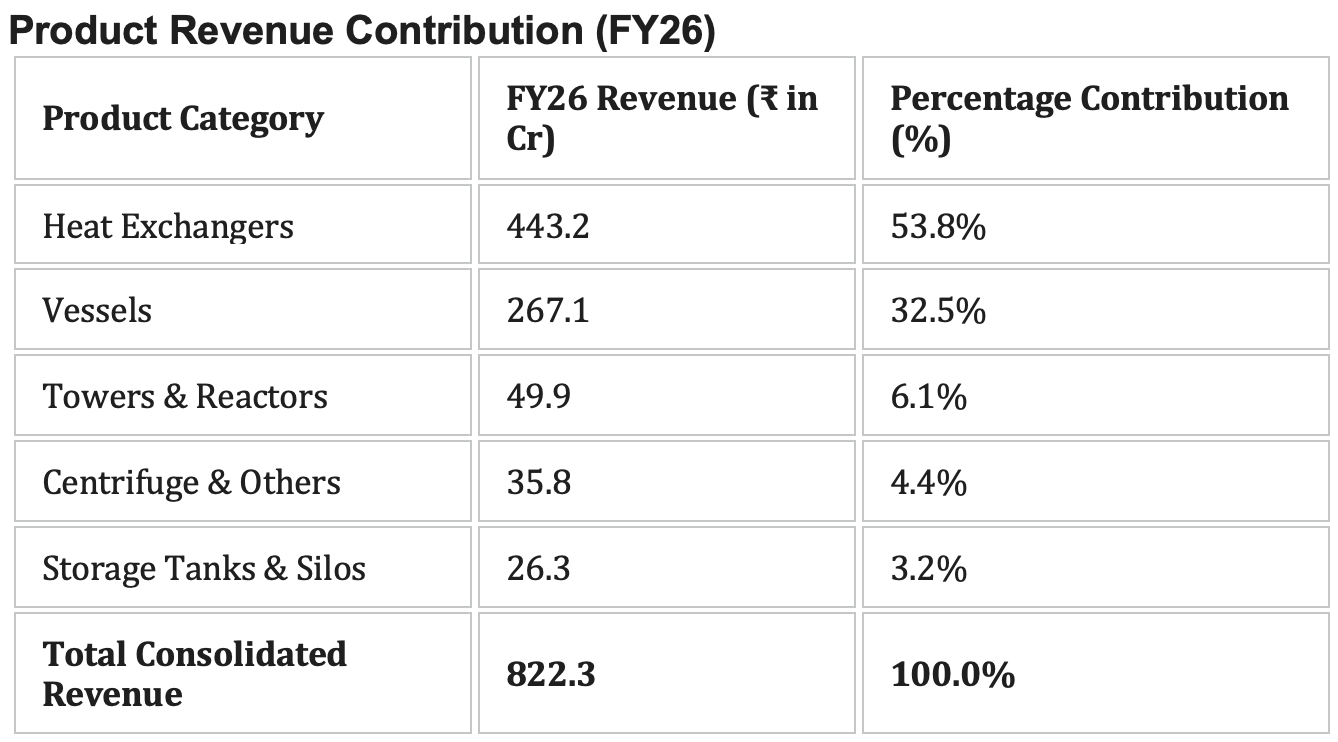
The Anup Engineering Limited maintains a deep, 62-year manufacturing profile in custom-built static process systems, with its heat exchanger division acting as the primary engine for top-line revenue. In FY26, the heat exchanger vertical generated ₹443.2 crores, contributing 53.8% of the company’s total consolidated revenue.
The company is highly proficient in fabricating several sophisticated configurations of heat exchangers:
1. Shell & Tube Heat Exchangers (Legacy Core)
-
Dominant Architecture: Shell and tube configurations represent Anup’s traditional core competency, historically comprising nearly 70% of its annual operational revenues.
-
Mechanical Construction: This design consists of a large outer cylindrical pressure vessel (the shell) housing a dense, precisely aligned bundle of internal tubes. One fluid flows through the inner tube circuit while the secondary fluid passes over the exterior of the tubes inside the shell enclosure to facilitate heat distribution.
-
Metallurgical Excellence: Anup specializes in fabricating these units out of highly complex, exotic metallurgies within its specialized manufacturing environments. The company possesses a dedicated 500 m² ISO 8 Class Clean Room exclusively for working with reactive materials. Its capabilities include processing Chromium Molybdenum Vanadium modified materials, solid Inconel (weighing up to 200 MT single-piece), and complex Titanium equipment.
2. Helixchangers (Proprietary Licensed Technology)
-
Technology Alliance: Anup operates as an authorized licensee for advanced Helixchangers, working in direct collaboration with Lummus Technology (Netherlands).
-
Design Edge: Unlike standard shell and tube systems that use conventional perpendicular quadrants or segmental baffles, a Helixchanger utilizes quadrant-shaped quadrant plates placed at a specific helix angle to the tube axis. This creates a helical, spiral fluid flow pattern on the shell side.
-
Operational Value: This design optimizes thermal fluid dynamics, drastically reducing shell-side pressure drops, minimizing localized dead zones, and reducing fouling tendencies. This enables chemical plants to run longer processing campaigns before requiring maintenance shutdowns.
3. EMBaffle Heat Exchangers (Proprietary Licensed Technology)
-
Technology Alliance: Anup holds the exclusive manufacturing license in India for EMBaffle Heat Exchangers, partnered with E&R Brembana & Rolle (Italy).
-
Design Edge: This architecture substitutes traditional solid metal baffle sheets with a specialized Expanded Metal (EM) grid structure.
-
Operational Value: The open grid allows longitudinal fluid flow parallel to the tube axis rather than cross-flow patterns. This grid setup provides continuous, multi-directional structural support to every single tube in the bundle, completely eliminating the risk of destructive tube vibration caused by high fluid velocities. It also enhances thermal transfer coefficients while reducing pumping power requirements.
4. Air-Cooled Heat Exchangers (ACHE) & Air Heaters
-
High-Volume Diversification: To capture shorter-cycle, high-volume capital expenditure markets, Anup has diversified into Air-Cooled Heat Exchangers and large industrial air heaters.
-
Design Edge: Rather than utilizing secondary liquid cooling loops (like cooling tower water circuits), these units use ambient air driven by motorized axial fans directly across externally finned tube bundles to cool the internal process fluids.
-
Strategic Growth: The company recently secured a breakout export order for this product category. Beyond traditional process site cooling, developing expertise in air-cooled configurations provides a technology pathway for Anup to venture into high-efficiency cooling setups required for fast-growing data center infrastructure segments.
-----------------------------------------------------------------------------------------------------------------
Critical Certifications
The company has successfully qualified for almost all key global engineering codes and standards required to export heavy pressure vessels and capital equipment globally. Its structural compliance framework includes:
-
ASME Codes: Full authorization across ASME Section I, ASME Section VIII Division I & II, alongside the highly stringent ASME U2 stamp.
-
Facility Stamps: Authorized U Stamp capabilities verified across its manufacturing plants.
-
Global Regulatory Passports: Approved credentials for CRN (Canada), EN 13445 / PED (Europe), GOST R / TRCU (Russia/Eurasia), IBR (Indian Boiler Regulations), AD-2000 Merkblatt HPO (Germany), ARH (Algeria), SAS (South Africa), NR 13 (Brazil), AS (Australia), and DOSH (Malaysia).
-
Management Standards: Certified under ISO 45001:2018 for Occupational Health & Safety and ISO 14001:2015 for environmental management.
Detailed Capital Expenditure, Timeline, and Funding
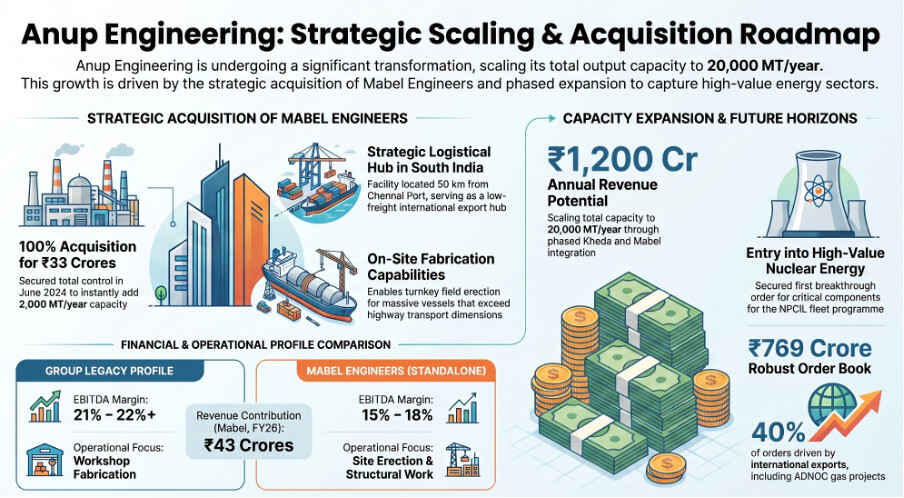
The Anup Engineering Limited has executed a structured capital expansion roadmap across multiple facilities to scale up its total output capacity to 20,000 MT/year, representing an aggregate revenue potential of ~₹1,200 crores per annum.
1. Capex Breakdown by Facility and Timelines
-
Kheda Plant (Primary Growth Driver):
-
Phase 1 & 1A: Commissioned in June 2023 (consisting of 2 manufacturing bays), establishing initial capabilities for handling larger-sized equipment like vessels, reactors, and columns.
-
Phase 2 & 2A: Construction began in late FY25. One full manufacturing bay was commissioned in Q2 FY26, and an additional open bay was fully commissioned in January 2026. This phase increased Kheda’s capacity to 10,000 MT/year, elevating its standalone annual revenue potential to ₹400–₹450 crores.
-
Phase 3: Retained as a future blueprint (consisting of 3 additional bays) to support subsequent tranches of demand.
-
-
Mabel Engineers Private Limited (Strategic Acquisition):
-
Timeline: The effective date of the 100% equity stake transfer was June 19, 2024.
-
Capex Allocation: Acquired for an outright cash consideration of ₹33.00 crores.
-
Capacity Impact: Added 2,000 MT/year of specialized structural and site fabrication capacity in Tamil Nadu, introducing new storage silos and piping spool product lines to the group.
-
-
Annual Machinery and Infrastructure Spend:
-
In FY25, the company recorded a standalone capital outflow of ₹44.46 crores for property, plant, equipment, and capital advances.
-
In FY26, consolidated capital expenditures reached ₹52.36 crores to complete Kheda’s Phase 2 machinery setup.
-
2. Funding Architecture
-
Internal Accruals: The company’s expansion has been predominantly funded through internal cash generation, maintaining a fundamentally conservative financial profile.
-
Leverage Profile: The company operates on a net debt-free basis. Long-term borrowing stood at a conservative ₹33.9 crores at the close of FY26.
-
Transient Working Capital Debt: Short-term debt temporarily rose to ₹73.9 crores in March 2026. Management confirmed this was an operational bridge to cover year-end receivables from back-ended dispatches, with swift liquidations in early FY27 returning the company to a cash-positive position.
Future Growth Prospects
The company enters the upcoming fiscal years with strong visibility, supported by a pending order book of ₹769 crores (including ₹146 crores in Letters of Intent). Growth is driven by expansion into high-value, non-cyclical energy infrastructure segments:
-
Nuclear Energy Core Expansion: The company secured its first breakthrough strategic order from a leading domestic EPC player to manufacture critical components for the Nuclear Power Corporation of India Limited (NPCIL) fleet program (specifically targeting the Kaiga-5 and Kaiga-6 reactors). This marks entry into a highly technical sector with multi-year order pipelines.
-
Thermal Power Segment Revival: Capitalizing on India’s renewed power infrastructure build-out (~14 GW of active domestic pipeline), the company secured its first order for critical high-pressure heat exchangers for an NTPC thermal power project.
-
Clean Energy and Decarbonization: The company is actively executing proprietary equipment orders for an advanced, patented clean energy storage technology through a European technology provider. It has already received follow-on repeat orders, positioning it well for global decarbonization Capex.
-
Geographical and Traditional Sector Tailwinds:
-
Domestic (60% of Order Book): Driven by PSU refinery doublings, massive greenfield petrochemical projects (such as PTA, PVC, and VCM plants), and fertilizer plants across India and Africa.
-
Exports (40% of Order Book): Sustained by Middle Eastern gas processing infrastructure expansions, notably under the Abu Dhabi National Oil Company (ADNOC) and downstream LNG developments in Qatar.
-
Strategic Operational Optionality
The company has cultivated several high-margin operational pathways that provide strong commercial optionality and insulate the business from traditional heavy fabrication cycles:
1. Technical Services Division (“The Service Module”)
This dedicated business vertical focuses on specialized refinery shutdowns, asset maintenance, troubleshooting, and field modifications.
-
The Optionality: It functions on an asset-light, low-capex framework that commands premium industry margins of ~40% alongside superior ROCE metrics.
-
Future Leverage: With a regional sales head established in Dubai, this segment is positioned to capture high-margin repair and maintenance contracts across the Middle East as geopolitical disruptions settle, with management aiming to scale this vertical to ₹200 crores within three years.
2. Turnkey *Skids and Modular Packaging Systems
The company recently secured its first commercial breakthrough in the modular segment—a ₹30 crore skid package order for an ADNOC gas project in the Middle East.
- The Optionality: Global engineering clients increasingly favour modular, workshop-tested skids (integrating equipment, structural steel, piping, and instrumentation) over traditional site construction to bypass local field bottlenecks. This successful project serves as a key Proprietary Track Record (PTR) to unlock higher value-add modular integration contracts.
3. Data Center Cooling Infrastructure
- The Optionality: The company’s recent entry into manufacturing specialized industrial air heaters and air-cooled heat exchangers serves as a technology bridge. Management noted that mastering this thermal layout establishes the engineering base required to eventually supply complex cooling system configurations for the fast-growing data center infrastructure market.
4. Engineering Consultancy Hub (Vadodara Office)
- The Optionality: Originally set up to insulate internal operations from design bottlenecks, the Vadodara engineering hub has stabilized to accept independent, external third-party design and product development mandates. This transitions a traditional operational cost center into a standalone, high-margin design consultancy profit center.
--------------------------------------------------------------------------------------------------------------------------
*What are Skid Packages?
In heavy industrial engineering, a skid package is a custom-engineered, pre-assembled modular system. Instead of shipping individual pieces of equipment (like pressure vessels or heat exchangers) separately to a project site to be connected, piped, and wired in the field, a skid packages the equipment, structural frameworks, piping, and instrumentation together into a single unit at the manufacturing workshop.
Why Customers Prefer Skids:
-
Plug-and-Play Installation: The entire package is delivered as a self-contained system that can be dropped directly onto the site foundation and hooked up.
-
Bypassing Site Bottlenecks: It is highly favored for landlocked or remote project sites where organizing field labor, conducting complex site welding, and managing field execution can be logistically challenging or costly.
The ADNOC Contract Details
The company achieved a critical commercial milestone by securing its first-ever turnkey skid package contract for the Middle East market.
-
The Client & Scope: The contract was bagged for a major gas infrastructure project under the Abu Dhabi National Oil Company (ADNOC) in the UAE.
-
Order Value: It is a substantial single order valued at approximately ₹30 crores.
-
Execution & Timeline: The engineering and design are being managed out of the specialized Vadodara design hub. The company is currently on track to deliver the final pre-assembled skid package to the client within the 12-month execution cycle.
Is it a Better Margin Optionality?
1. High Value-Add Positioning
Skid packages are classified by management as higher value-add products. By integrating structural steel engineering, precise instrument layout, and control system packaging on top of basic metal fabrication, the company moves up the supply chain from a standard equipment vendor to an integrated system provider.
2. The Margin Profile Strategy
-
Overhead Absorption: While management did not disclose an exact standalone EBITDA margin percentage for the skid segment (unlike the Technical Services vertical, which explicitly leads with ~40% margins), skids provide strategic operational advantages.
-
The PTR Multiplier: In this industry, securing a Proprietary Track Record (PTR) with a global oil major like ADNOC is standard practice to unlock future work. Proving execution on this contract provides the track record necessary to regularly pitch for 4 to 5 large-scale packages a year. This capability creates an operational pathway to scale revenue, optimize plant capacity, and drive margin expansion through fixed-overhead dilution.
=========================================================================
Key Risk Factors
While the medium-term prospects for the company remain supported by capacity additions, identifying the structural variables that could disrupt its execution highlights several prominent risk factors:
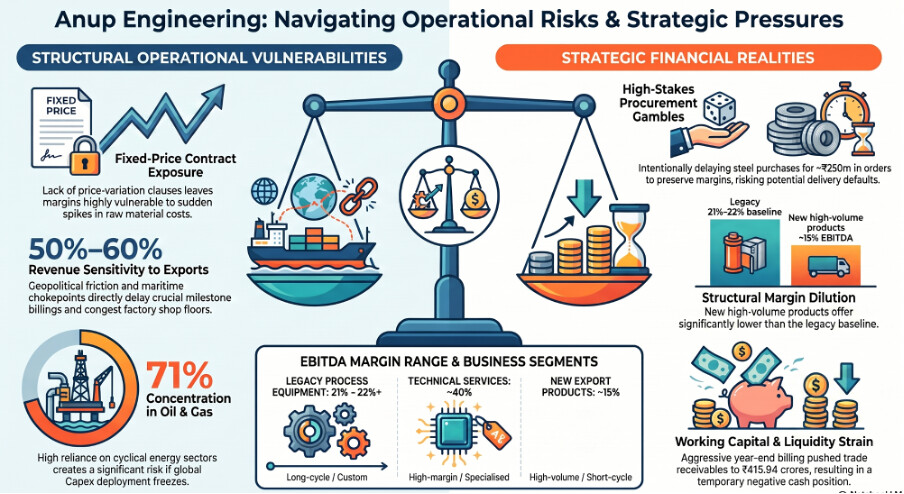
1. Fixed-Price Contract Exposure vs. Raw Material Inflation
-
The Core Vulnerability: Anup’s business layout relies heavily on fixed-price engineering and heavy fabrication contracts with both its global and domestic clients. It does not typically utilize price-variation clauses to pass on intermediate cost shocks to customers.
-
Impact on Profitability: Any sudden, sharp escalation in global steel, specialized alloy, or industrial input costs eats directly into manufacturing execution margins. This dynamic was visible in late FY26, where commodity price inflation compressed quarterly EBITDA margins down to 18.4%. Sustained commodity volatility remains a continuous threat to the company’s structural profitability.
2. Geopolitical Friction & Global Logistics Chokepoints
-
Maritime & Shipping Sensitivity: Because international exports act as a massive driver of corporate scale (traditionally contributing 50%–60% of total revenue), Anup is sensitive to global shipping stability.
-
Execution Delays: Heightened geopolitical tensions and localized trade route closures (such as disruptions near the Strait of Hormuz) create immediate friction. In late FY26, shipping line shortages led to a sizable accumulation of fully finished dispatch goods on shop floors, limiting shop floor layout flows and directly delaying crucial milestone billings.
3. Intensive Working Capital Blockage and Cash Cycle Strain
-
Long Product Gestations: Operating as a premium custom-built fabricator means managing complex, long-cycle manufacturing timelines that average close to 12 months per project.
-
Debt Expansion Risks: Delays in international collection timelines or a reduction in upfront customer advances create uneven working capital stress. For instance, a delivery bottleneck pushed the company into a temporary ₹110 crore net debt position at the close of March 2026 as trade receivables swelled. While seasonal adjustments clear these balances, any prolonged customer payment friction would persistently strain the company’s interest coverage and liquidity.
4. Severe Downstream Segment Concentration
-
The Over-Reliance Factor: Despite progressive entries into technical service modules, thermal power, and clean energy storage configurations, Anup’s core order ledger remains heavily anchored in traditional, cyclical end-user sectors.
-
Oil & Gas Cyclicality: In FY26, the combined share of Oil & Gas and Petrochemical clients commanded a dominant 71% of total sectorial revenue. Any prolonged global economic slowdown, energy market correction, or a sudden freeze in Capex deployment by corporate giants (such as ADNOC or domestic refiners) would directly dry up the order conversion pipeline.
5. Specialized Labour Constraints & Skill Bottlenecks
-
Precision Constraints: Unlike mass-production capital goods spaces, every product at the Kheda and Ahmedabad sites is designed and made-to-order. Automation plays a key part, but the ultimate final assembly, welding precision, and zero-defect tolerances require elite operators and highly specialized technicians.
-
Scale Bottlenecks: Finding and retaining an adequate pool of high-caliber operators to power the newly expanded 20,000 MT/year capacity setup is an ongoing hurdle. A sudden shortage of specialized human capital or regional wage inflation could derail execution deadlines and evoke strict liquidated damage penalty timelines from international clients.
TCE Management Assessment:
--------------------------------------------------------------------------------------------------------------------------
Disclaimer
This report is generated strictly from publicly available financial information and corporate transcripts with the analytical assistance of an AI Agent. This document does not constitute formal financial or investment advice, nor does it represent a buy, sell, or hold recommendation.
--------------------------------------------------------------------------------------------------------------------------
5 Likes
Poor Q1 result…any specific reasons?
Disc: invested
Due to Strait of Hormuz Problem
1 Like
Q1 FY27 Earnings Call held on 06 August 2026
Q1 FY27 was weak from an execution standpoint, impacted by delayed order intake in FY26, supply chain disruptions, higher logistics/input costs, and milestone-based revenue recognition delays.
Management attributed lower EBITA margins primarily to lower revenue absorption rather than uncontrolled costs.
Order book remains very strong at ₹985 crore, one of the best opening positions in the company’s history.
New orders worth ₹538 crore have already been booked during FY27 (Apr-Aug period) and inquiry pipeline is around ₹1,100 crore.
H2 expected to be significantly stronger than H1
The company has now provided guidance (conservative and risk-adjusted), previously withholded due to global uncertainties:
-
Revenue growth: 5% to 10%
-
EBITDA margin: Around 15%
Disclosure: Invested
3 Likes
Great information, thanks for this @ramana1777