
Data Centres are just power plants with servers
To understand why Techno Electric’s plan to transition into a data centre is a natural transition for the business, we need to understand how to build a data centre from scratch.
A Data Centre can be broken down into following layers:
- Layer 1: Power
- Layer 2: Cooling
- Layer 3: Servers
- Layer 4: Security
We can break down each layer to understand the components that go into building each layer, and if Techno can leverage its Power EPC experience for building each component of the layer.
Layer 1: Power
-
EHV Substation (110KV/ 220KV/ 400 KV/ 756 KV)
- Goal: Data centres require massive amounts of power (30MW to 100MW+). Utilities transmit this level of power at extra high voltage (110kV, 220kV, 400kV) because sending it at lower voltages over long distances would result in massive energy losses. However, the data centre equipment cannot use such high voltage. The substation’s primary job is to receive this high voltage power and step it down to a manageable medium voltage (usually 33kV or 11kV) via large transformers.
- Techno’s Expertise: High. This is their bread & butter. While peers (Yotta, CtrlS, Anant Raj) must hire an EPC contractor to build their substation, Techno can do it in-house. They can build them cheaper thus saving margin and faster due to deep relationships with Power Grid & state DISCOMS.
-
Switchgear
- Goal: Switchgear is a collection of circuit breakers, fuses, and isolators. Its job is protection and control. During emergency situations like lightning strike or short circuit, the switchgear must detect the surge and physically break the circuit in milliseconds to prevent the massive energy from exploding the transformers or frying the data centre’s internal electronics. In traditional switchgear, the ‘insulator’ that stops electricity from jumping between wires is simply Air. Because air is not a great insulator, the live copper parts must be kept meters apart to prevent jumping. This requires huge amounts of space. GIS (Gas Insulated Switchgear) replaces air with a special gas called Sulfur Hexafluoride (SF6). All the live parts (busbars, circuit breakers) are sealed inside metal pipes/ tanks filled with pressurised SF6 gas.
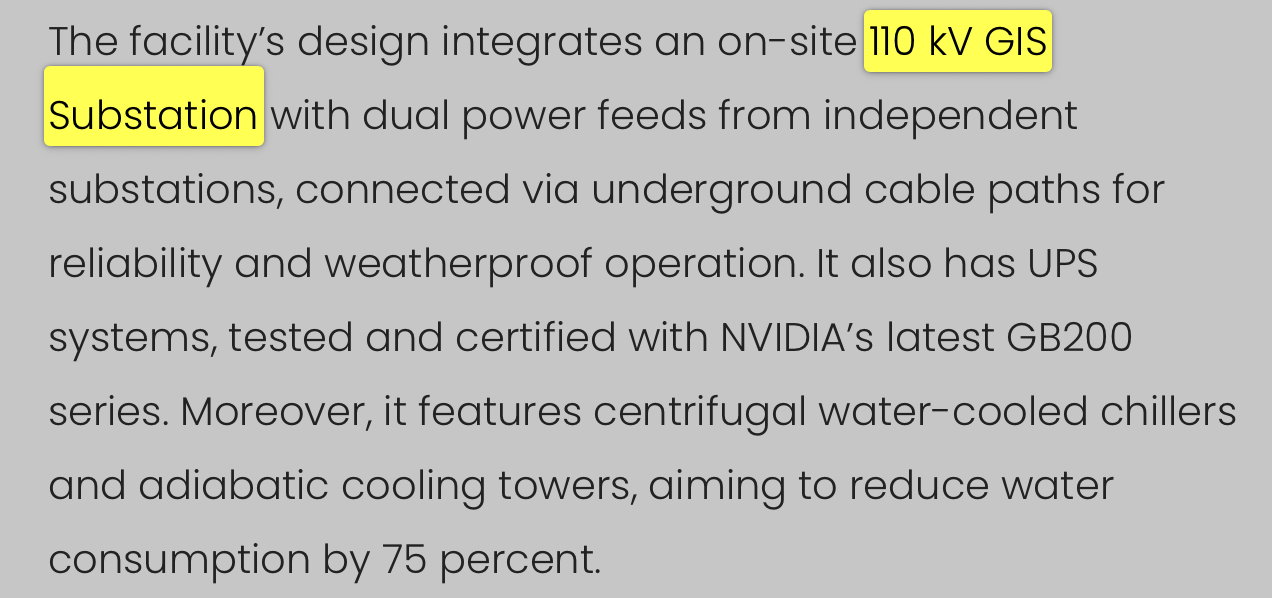
- Techno’s Expertise: High. Installing GIS is not like standard electrical work; it requires specialised SF6 Gas Handling capabilities. The joints must be sealed perfectly to prevent leaks, and the gas must be filled to precise pressures. Techno is one of the few Indian EPCs with certified teams for Erection, Testing, and Commissioning of GIS substation up to 765kV. For their Chennai Data Centre, they installed a 110kV GIS system. Because they have the in-house expertise to assemble and test these complex switchgear units, they don’t need to rely on expensive external specialists for maintenance or expansion, giving them better operational control than a typical IT focused data centre operator.
Source: Techno Digital unveils 36 MW AI-ready hyperscale DC in Chennai – w.media
-
Transformers
- Goal: To step down the massive voltage supplied by the grid (110kV for Hyperscaler) into usable levels (11kV distribution → 415V facility → 240V racks).
- Techno’s Expertise: High. They are a major procurement partner for OEMs due to their 765kV substation projects. This gives them priority delivery and pricing leverage that standard IT focused developers cannot match.
-
High Voltage Cabling
- Goal: Bringing the power grid into the facility. Data centres cannot rely on overhead wires (too risky). They require massive underground Extra High Voltage Cables (typically 33kV to 132kV) that must be routed through public roads and into the facility without signal interference.
- Techno’s Expertise: High. Techno is a market leader in laying underground EHV cabling for state utilities. Unlike commercial electricians who only handle low voltage (415V), Techno has executed complex 220kV Underground Cabling projects for state grids. Bringing a 110kV line into a data centre is routine work for their transmission teams.
-
Diesel Generators (DG)
- Goal: Diesel Generators serve as the critical long-term backup power source. When the utility grid fails, the UPS (battery) takes over instantly to prevent server shutoff. Within seconds, the Diesel Generators automatically start and synchronize. The DG take over the load from the UPS, powering not just the servers, but also the cooling systems (chillers/ fans) which batteries cannot support for long. They ensure the facility remains online indefinitely (limited only by fuel supply) during extended blackouts.
- Techno’s Expertise: High. Techno’s core competency in Power EPC is directly transferable to Data Centre’s DG installation. While the DG engine itself is a procured component, the complexity lies in the Balance of Plant (BoP), the critical supporting infrastructure which aligns perfectly with Techno’s historical strengths.
-
Fuel Handling Systems
- Goal: Moving diesel from massive bulk storage tanks (kept outside) to the Day Tanks (inside the building) that feed the generators. This requires industrial-grade pumping, filtration, and leak detection.
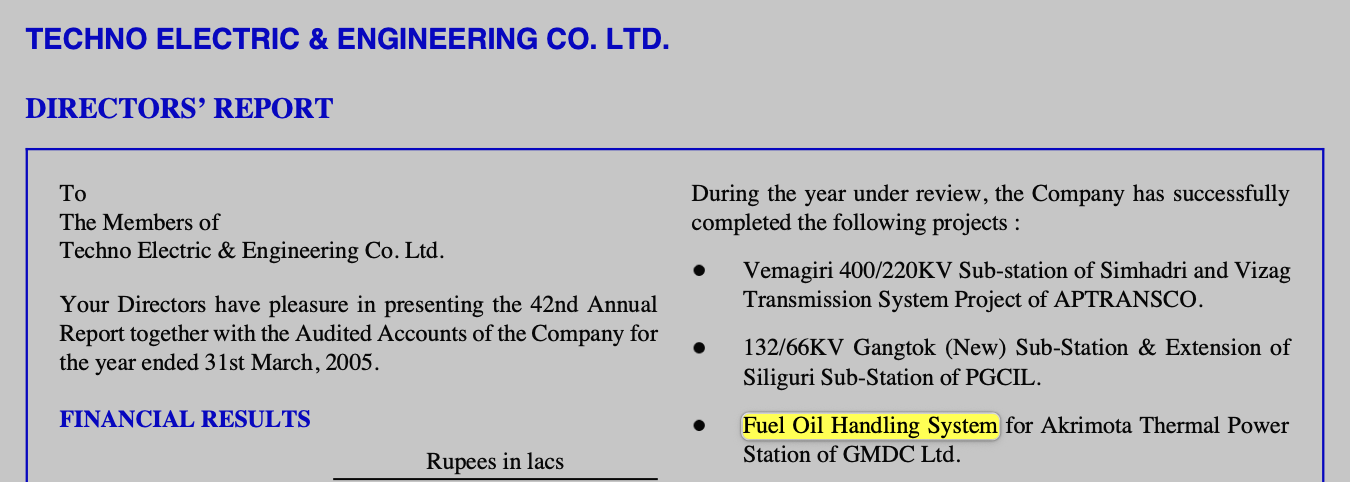
- Techno’s Expertise: High. This falls under Fuel Oil Handling Systems (FOHS), a standard component in the Thermal Power plants Techno has built in the past. Techno has executed the Fuel Handling packages for major thermal plants (like the Akrimota Thermal Power Station). Designing a system to move diesel for a data centre is identical to moving heavy fuel oil for a power plant, just on a slightly smaller scale but with higher redundancy requirements.
Source: Annual Report (2004-05)
-
Busducts (Busbars)
- Goal: You cannot use normal cables to move the massive current (4000A – 6000A) from the transformers to the server halls. Instead, data centres use Busducts, thick bars of solid copper or aluminium enclosed in a metal casing.
- Techno’s Expertise: High. Techno has a unique engineering edge here. They didn’t just install busbars; they pioneered extreme high current systems for aluminium smelters, executing the 360kA Busbar System for Hindalco (Mahan Project) and the 320kA System for BALCO/ Vedanta. Handling currents of this magnitude (360kA) requires mastering extreme heat dissipation and magnetic force cancellation. For Techno, designing a data centre busway (typically only 4kA - 6kA) is significantly lower complexity work. This deep understanding allows them to minimise resistive losses, directly improving the data centre’s PUE (Power Usage Effectiveness).
Source: Annual Report (2012-13)
-
Switchboards
- Goal: These act as the facility’s central nervous system for power routing. They take bulk power from transformers and distribute it to downstream branches (UPS, Cooling, IT Loads). Crucially, they contain the circuit breakers and protection relays that isolate faults to prevent a total facility blackout.
- Techno’s Expertise: High. While Techno does not manufacture the physical panels (they source these from Tier-1 OEMs like Schneider or ABB), the value lies in the Design & Protection Logic. Modern Hyperscale Data Centres are shifting from simple Low Voltage distribution to Medium Voltage (11kV - 33kV) networks to handle massive power loads. This territory is Techno’s home turf.
-
UPS
- Goal: Uninterruptible Power Supply
- Techno’s Expertise: Medium. It is a ‘plug-and-play’ product bought from vendors.
-
BESS
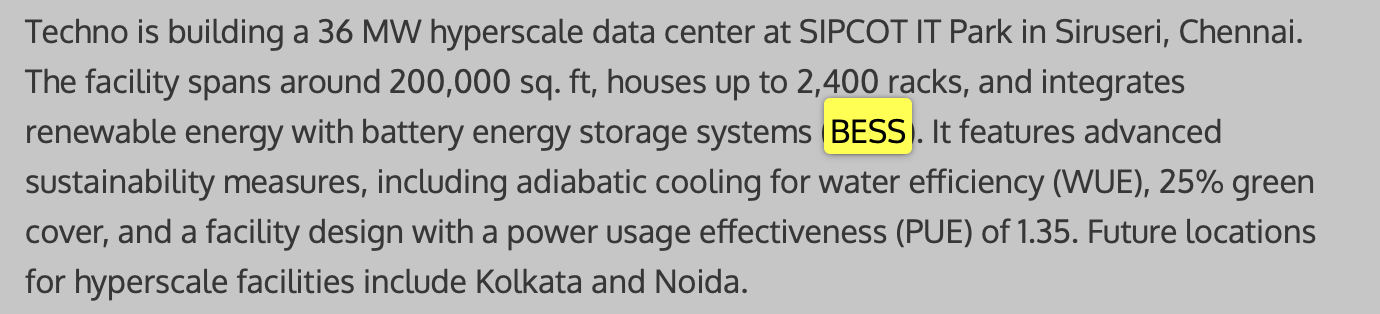
- Goal: Modern data centres are replacing heavy Lead-Acid batteries with high-density Lithium-ion BESS. These serve as the energy reservoir for the UPS and enable ‘Peak Shaving’ (storing cheap night power to use during expensive peak hours).
- Techno’s Expertise: High (Early Adopter). Techno is one of the few Indian EPC players aggressively entering the Grid-Scale BESS market. They have proven this capability by integrating a BESS solution into their own 36MW Chennai Data Centre (replacing traditional batteries). This gives them rare, hands-on experience with Battery Management Systems (BMS) and the strict thermal safety protocols required to stack lithium batteries inside an enclosed server facility, expertise that most standard electrical contractors currently lack.
Source: Techno Electric & Engineering unveils $1 billion investment plan to establish 250 MW data center capacity – pv magazine India
-
Server Rack PDUs (Power Distribution Units)
- Goal: These are intelligent power strips mounted inside the rack that plug directly into the servers. They monitor power usage at the socket level.
- Techno’s Expertise: High. Techno’s value here is in Load Balancing and Integration. Connecting thousands of high-power racks requires precise balancing of the 3-phase power to prevent neutral current issues, a common cause of fires. Techno’s experience in heavy industrial plants ensures this is engineered perfectly. Intelligent PDUs generate millions of data points. Techno’s Smart Metering and SCADA divisions allow them to integrate this data into a single dashboard better than a typical electrical contractor, giving the operator real-time visibility into every single server’s power draw.

Layer 2: Cooling
-
Chillers & Cooling Towers
- Goal: Chillers are massive machines that cool water to be circulated to the server halls. Cooling Towers are located on the roof or yard, these reject the heat extracted from the building into the atmosphere using evaporation.
- Techno’s Expertise: Medium. While Techno procures the Chiller units from OEMs (like Carrier/ Trane), the physical installation is pure Heavy Mechanical EPC. Techno is currently executing major Flue Gas Desulphurisation (FGD) projects for state power utilities (e.g. in Rajasthan and for DVC). These projects involve erecting massive steel absorber towers and installing complex slurry piping networks that operate under strict chemical and pressure constraints. For their 36MW Chennai facility, Techno is installing Adiabatic Cooling Towers (which reduce water consumption by 75%). The heavy structural fabrication required to mount these giant towers on roofs, along with the precision piping required to connect them, is identical in complexity to the heavy industrial scrubbing systems they build today.
-
Chilled Water Piping
- Goal: The arteries of the cooling system. These are large diameter (often 12-24 inch) steel pipes that carry tons of water between the chillers and the data halls. They must be perfectly welded, pressure tested, and insulated to prevent condensation.
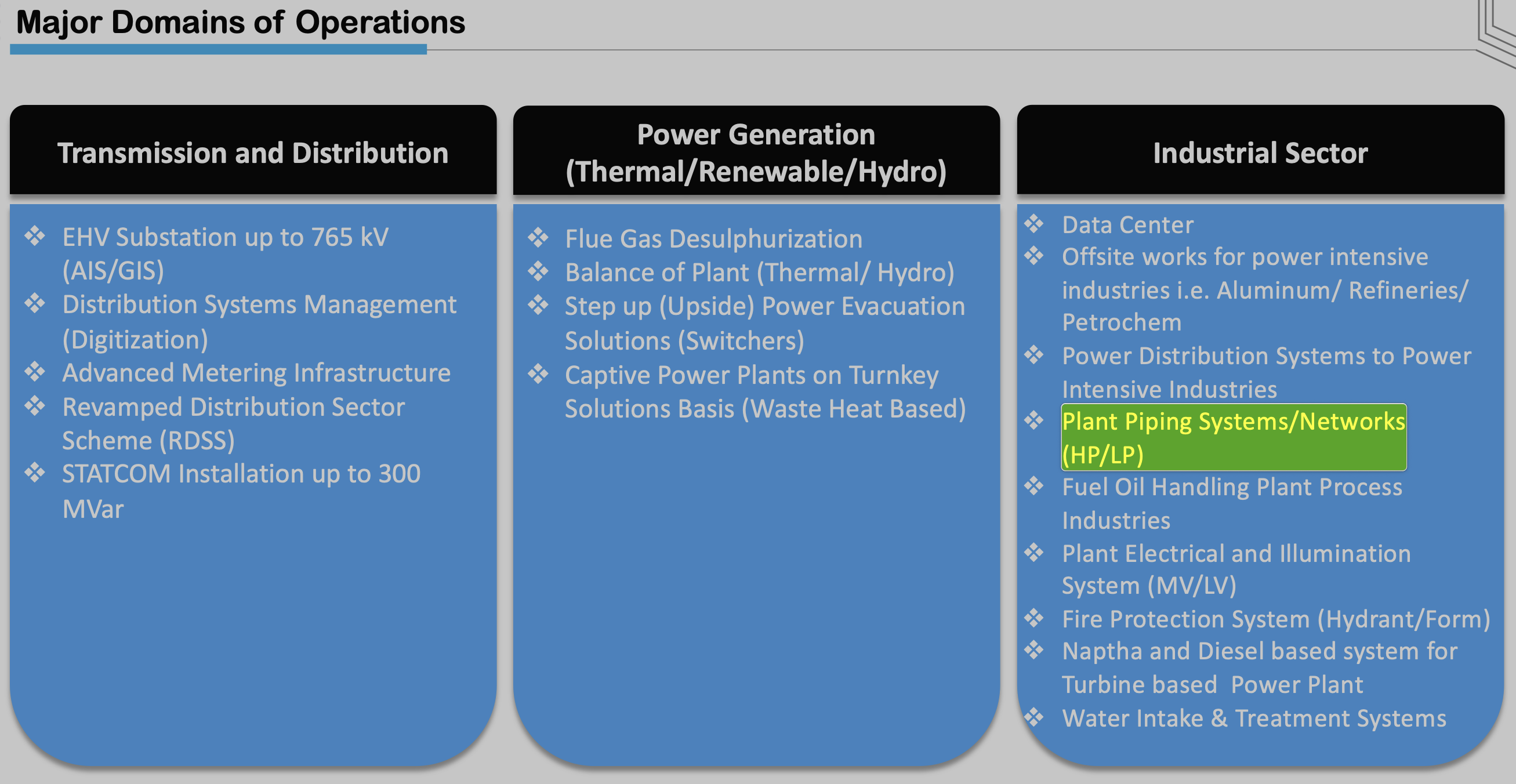
- Techno’s Expertise: High. Techno lists ‘Plant Piping Systems/ Networks (HP/LP)’ as a core service in their Industrial vertical. In power plants, Techno’s teams execute High-Pressure Steam Piping (often subject to strict Indian Boiler Regulations). Welding standard chilled water pipes (which operate at much lower pressures) is well within this high-grade industrial capability. They utilise their in-house Design & Engineering Division to route these massive pipes. This ensures complex coordination in the ceiling void (avoiding clashes with cable trays), a standard task they perform when designing crowded turbine halls for power plants.
Source: https://www.techno.co.in/public/uploads/2/2024-11/teecl_investor_q2fy25.pdf
-
Pumps & Valves
- Goal: The heart that circulates the water. These are not residential pumps; they are massive industrial centrifugal pumps that move thousands of gallons per minute. The valves automate flow control to ensure redundant cooling paths if one pipe bursts.
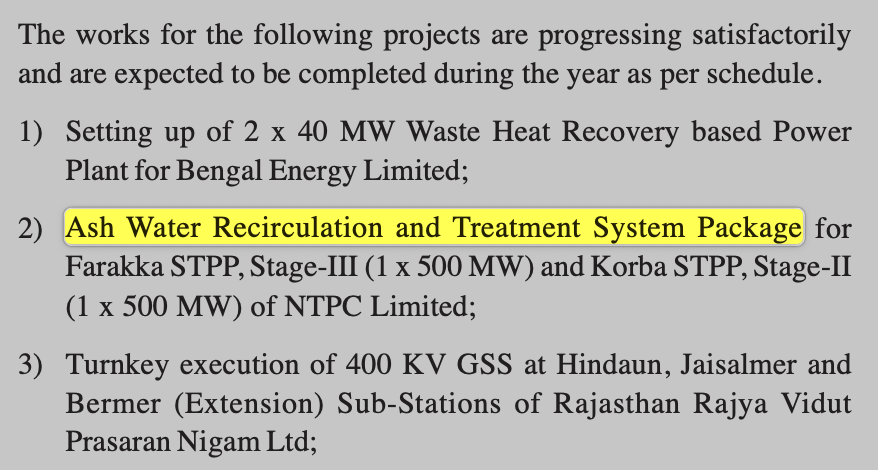
- Techno’s Expertise: High. This falls under ‘Balance of Plant’ Mechanical works. Techno has over 15 years of specialized experience (since 2008) executing massive hydraulic packages for state power utilities. They have executed critical Ash Water Recirculation Systems (AWRS) and Station Piping Packages for mega projects like NTPC Barh (3x660 MW), NTPC Farakka, and NTPC Sipat. Moving abrasive ash slurry for a thermal plant involves industrial grade pumps and high pressure piping networks, a hydraulic challenge significantly harder than the cooling loops of a typical Data Centre. Techno optimises cooling systems to be demand driven. By decoupling chilled water generation from distribution, they ensure pumps only use the exact amount of electricity needed at any given moment, a critical capability for keeping the Data Centre’s PUE (Power Usage Effectiveness) low.
Source: https://www.techno.co.in/public/uploads/2/2019-12/annual_report_2008_09.pdf
Layer 3: Servers
-
Server Racks
- Goal: The physical housing for the IT equipment. These are not just shelves, they are precision engineered steel cabinets (typically 2 to 2.5 meters) designed to handle static loads of up to 1500 kg and integrate with cooling systems.
- Techno’s Expertise: Medium-High. While Techno does not manufacture the racks (sourced from vendors like Rittal or Vertiv), the physical installation falls under their mechanical EPC scope. Installing thousands of racks in a hyperscale facility requires precise alignment and bolting to the floor grids, work that is similar in nature to the control panel erection work they perform in substations.
-
Containment (Hot / Cold Aisle)
- Goal: Advanced airflow management. Specifically, Techno utilizes Hot Aisle Containment (HAC). Instead of boxing in the cold air, this system encloses the back of the racks to trap 100% of the hot exhaust and ducts it vertically into a ceiling plenum. This prevents hot air from recirculating and allows the rest of the room to act as a consistent cold reservoir.
- Techno’s Expertise: High. Implementing HAC requires more complex mechanical work than standard methods, involving vertical exhaust stacks and airtight ceiling grid integration. This aligns perfectly with Techno’s industrial ventilation background. This specific architecture is a primary mechanical driver enabling them to run the facility at higher ambient temperatures, directly resulting in the 1.35 PUE (Power Usage Effectiveness) target at their Chennai Data Centre.
-
Structured Cabling (Fiber & Copper)
- Goal: The facility’s nervous system. This involves laying kilometres of Fiber Optic cables (for speed) and Copper cables (for management) to connect every server to the core network switches.
- Techno’s Expertise: Medium. This requires different skills than high-voltage power cabling. It is delicate work usually done by specialized certified installers. However, Techno has a unique advantage: OPGW (Optical Ground Wire). As a transmission EPC player, Techno has decades of experience installing OPGW fiber cables on high-voltage transmission lines. While data centre fiber is finer, their familiarity with handling optical fiber infrastructure is far higher than a standard electrical contractor. This is also key to their partnership with RailTel, where they are building Edge Data Centres directly along railway fiber lines.
-
Signal Reference Grid (SRG) / Earthing
- Goal: A mesh of copper wires under the raised floor that grounds all the racks. It protects sensitive servers from static electricity and electrical noise.
- Techno’s Expertise: High. Earthing is the number one safety requirement in the Substations Techno builds daily. They are arguably more qualified in designing complex grounding grids than almost any general building contractor.
Layer 4: Security
-
Fire Detection & Suppression
- Goal: To detect smoke / fire instantly and extinguish it without ruining the servers. You cannot use water sprinklers in a server hall (water destroys electronics). Instead, data centres use “Clean Agent” Gas Suppression Systems (like Novec 1230 or Inergen). These systems flood the room with gas to starve the fire of oxygen or heat, leaving no residue.
- Techno’s Expertise: High. Fire safety is a critical part of Techno’s core EPC work for Substations. High voltage transformers explode if they fail; handling them requires complex ‘Nitrogen Injection Fire Prevention Systems’ (NIFPS). Techno is already trained to install these high-stakes, automated suppression systems where a single failure can cost millions.
-
Data Centre Infrastructure Management (DCIM)
- Goal: The ‘Brain’ of the facility. This is a software suite that monitors every single sensor: temperature, power usage, battery health, and door status in real-time. It allows operators to see the health of the data centre on a single dashboard.
- Techno’s Expertise: Medium. While Techno doesn’t write the DCIM code (they buy software from Schneider/ Nlyte), they are experts in SCADA (Supervisory Control and Data Acquisition). SCADA is the ‘DCIM of the Power Grid’. Techno installs SCADA systems for the national grid substations they build, allowing remote monitoring of voltage and currents. Gathering data from thousands of remote sensors is identical to DCIM. Their Smart Metering division also gives them an edge in data visualization and telemetry.
-
Physical Security (Access Control & Surveillance)
- Goal: To prevent unauthorized human access. This involves a multi-layered approach: Perimeter fencing → Biometric Turnstiles → Mantraps (airlock doors) → Server Rack Locks.
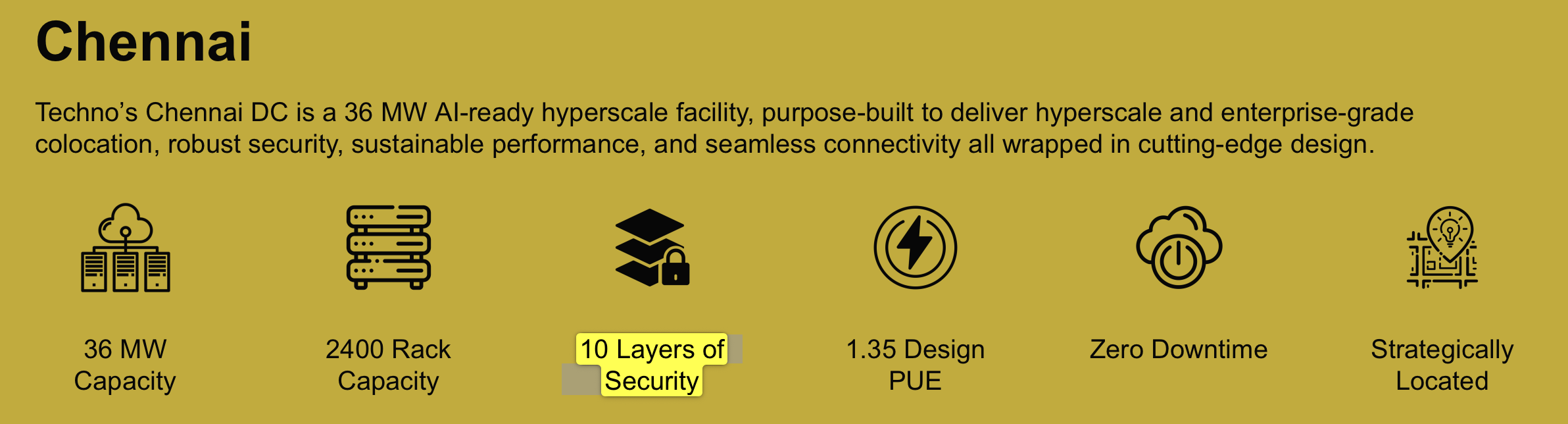
- Techno’s Expertise: High. Techno builds critical infrastructure (National Grid Substations) which are potential terror targets and require strict perimeter security (CCTV, motion sensors, electric fencing). For their Chennai Data Centre, Techno has implemented ‘10 Layers of Physical Security’, a standard directly adopted from their experience in securing high-voltage assets.
Source: TD Data Center Main - Techno Digital | AI-Ready, Scalable Data Center, Cloud & Network Infrastructure
-
Environmental Monitoring
- Goal: Detect water leaks. Sensing cables laid under the raised floor to detect even a drop of water from cooling pipes. Also, High frequency ultrasonic emitters to keep rats away from chewing fiber cables.
- Techno’s Expertise: High. This is standard ‘Balance of Plant’ mechanical work. In every power station Techno builds, they install similar environmental sensors to protect the control rooms from flooding or pest damage.
Techno’s Data Centre Plans
Techno has outlined a roadmap to develop 250 MW of data centre capacity by FY30-32, backed by a planned investment of $1 billion.
- Hyperscale Projects
- Chennai (Siruseri)
- Status: Live. Phase 1 (5.6 MW) was commissioned in August 2025.
- Specs: Total capacity of 36 MW. It is a Tier-3+ facility featuring a dedicated 110 KV substation.
- Key Innovation: It is the region’s first 100% water-cooled facility (using adiabatic cooling), achieving a verified PUE of 1.35, significantly beating the industry standard of 1.5+. This makes it uniquely suited for heat-intensive AI workloads.
- Kolkata (Salt Lake/New Town area)
- Status: Under construction.
- Timeline: Commissioning expected by late 2027.
- Capacity: Confirmed plans for roughly 14-15 MW, serving as a digital gateway for East India and neighbours (Bangladesh, Nepal).
- Noida
- Status: Under construction.
- Timeline: Partial commissioning could occur as early as H2 FY26.
- Capacity: Scalable up to 18 MW.
- Chennai (Siruseri)
- Edge Data Centres (RailTel Partnership)
- Techno builds and operates the data centres on land provided by RailTel along railway tracks.
- Revenue Share Model (Techno shares a percentage of revenue with RailTel).
- Tenure: 20 Years + 5 Years Extension (Starting 2024)
- Target of 102 cities
- Progress:
- Gurugram: Commissioned and operational (250 KW).
- Mumbai: Under construction (500 KW). Expected live by late 2025 / early 2026.
- Land has been finalized for Indore and Gandhinagar.
- The management has stated a goal to roll out approximately 20 edge centres annually.
- They are testing the waters with the first few pilot sites (Gurugram/Mumbai). Since the “Edge Data Centre” market is unproven in India (no one has successfully monetised a network of 100+ small centres yet), they are unlikely to commit capital to all 102 sites until the first few show a clear path to profitability.
When investors hear “EPC company entering Data Centres,” they often fear a lack of domain expertise. However, as the layer by layer breakdown above demonstrates, a Data Centre is roughly ~80% heavy infrastructure (Power & Cooling) and only ~20% IT.
Techno Electric is not entering a new domain, but rather repackaging its industrial mastery. They are simply swapping 765kV substation clients for 110kV data centre clients.
Why Techno has the ‘Right to Win’:
- Vertical Integration (Speed & Margin): While competitors like Yotta, CtrlS, Anant Raj must issue tenders and hire external EPC contractors to build their substations and cooling loops, Techno is the contractor. This removes the middleman margin, allowing them to build facilities at a lower cost per MW and crucially control their own delivery timelines.
- Solving the power Bottleneck: In the AI era, the hardest part of building a data centre isn’t buying servers; it’s securing reliable, massive power. Techno’s deep relationships with state DISCOMS and Power Grid, forged over decades of executing grid projects, give them a distinct advantage in securing the high-voltage connections that stall other developers.
- Risk Mitigation: They are accustomed to building 765kV substations where a single error is catastrophic. Transitioning to the relatively lower voltage environment of a data centre (33kV to 110kV) effectively means they are ‘playing down’ in difficulty, ensuring high reliability.
Disclaimer: Invested & Biased.