Tata Motors - On the way to world Automobile leader?

Did a deep dive on Tata Motors, as things have changed materially in last few years

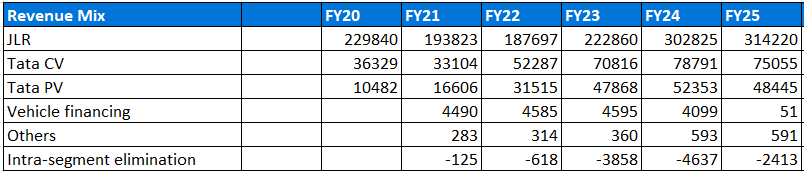
Tata Motors has 3 divisions - JLR (70% of revenues), Tata CV (18% of revenues) and Tata PV (12% of revenues)

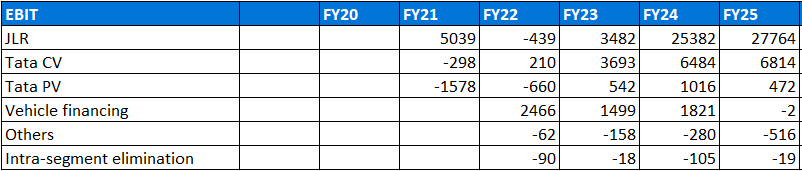
On profit front, JLR contributes (77% of profits), CV (20%) and PV (3% of profits)

JLR -

JLR being the most significant portion of revenue, profits and valuation for Tata Motors a lot more emphasis on the article is going to be on JLR.

JLR consists of Jaguar (Sports Car segment) and Land Rover (SUV’s) - 77% of profits

Land Rover -

Land Rover has multiple sub-brands the most popular being Range Rover followed by Defender, Discovery, Velar, Sport and Freelander.

For more than 5 decades, Range Rover stands out, thriving across the test of time. There have been only 5 generations of Range Rover in 50 years, a testament to the brand, the car and what it stands for.

The review on Range Rover 2024 model by Top Gear explains it perfectly -

“There are other expensive SUVs but there’s only one Range Rover. And it’s better than ever”

However, Range Rover comes with it’s shortcomings, Range Rovers aren’t the most reliable vehicles with maintenance problems across gearboxes, suspension systems and cooling systems.

The reliability issues have also resulted in fierce competition coming in especially from Toyota Land Cruiser, which is considered by many, the most reliable car.

Despite intense competition across SUV’s and Luxury Car over the decades, Land Rover brand hasn’t just survived but thrived across market’s. JLR and particularly Land Rover has leveraged it’s brand and upgraded it’s positioning as a luxury vehicle manufacturer with Average Revenue Per Vehicle increasing from 43000 GBP in FY19 to 73000 GBP in 24.

Let us understand how did it do that ?

Global Tailwinds in SUV and Luxury Cars -

Land Rover branding has benefitted from global SUV shift, with SUV contributing 48% of total global car sales in 2023 v/s a meagre 16.5% in 2010.

Pre-2010, Luxury car manufacturers have traditionally been focusing on the sports car segment with very low exposure towards SUV’s (barring Porsche)

Post 2010, Luxury car giants unveiled their SUV’s thereby expanding the market i.e. Rolls-Royce Cullinan, Bentley Bentayga, Aston Martin DBX , Maserati Levante Lamborghini Urus, Ferrari Purosangue.

With Land Rover being a strong traditional SUV only manufacturers, Land Rover has been able to take advantage of both SUV’s and premiumization by focusing on higher value cars.

The strategy has worked wonders with Land Rover portfolio is riding double tailwinds of both SUV and Luxury Cars.

On Land Rover, the company has increased focus on higher valued products i.e - Range Rover, Sport and Defender (ASP (Retail) of 85-115K) v/s Other brands ASP (retail) (45-50K).

These 3 brands contribute 64% of volumes in 2024 v/s 28% in 2019

Pick-up of defender and JLR has resulted in much higher profitability for JLR as a unit v/s lower profit models of Jaguar and Velar, Evoque and Discovery.

In addition to the above, the decision to license out Freelander (lower ASP and discontinued since 2015) to Cherry, makes it clear for Land Rover to play in luxury SUV market.

Halo Strategy -

Halo Strategy is a strategy of building limited editions, higher priced variants of models which offer a unique proposition to loyalist of the brand.

JLR’s strategy is leveraging it’s historical brands and models and

The company has deployed Halo strategy for vehicles from 250k to 1.5 mil GBP for Halo Vehicles, Editions, Bespoke, Project Vehicles and armoured.

Below is an indication of a Halo Vehicle -

2024 Ranger Rover SV Carmel Edition (1/17 units) priced at 370K GBP.

Halo cars growth has been 110% in FY24 and is expected to be 45% in FY25.

House of Brands -

JLR now has 4 distinct brands each -

Range Rover, Defender, Discovery and Jaguar

Range Rover cements itself as a Luxury SUV manufacturer with design and performance elements

Defender stands out as the adventurer tourer primary designed for off-roading

Discovery’s positioning is a family oriented vehicle.

Jaguar - Ruin or Reincarnation ?

Jaguar has been one of Britain’s most iconic sports cars post WW2. Jaguar’s focus on speed and design was ahead of it time.

2 Jaguar models have held the fastest car record -

Jaguar XK120 in 1949 at a top speed of 200.5 Km/h

Jaguar XJ220 in 1992 at a top speed of 349.4 Km/h

While Land Rover brand has stood the test of time, Jaguar has seemed to lost it’s identity over the years. Jaguar neither competes for the fastest car with Buggati and Koenigsegg, nor with luxury cars like Ferrari, Mercedes or Porsche, nor with reliable every day cars such as Lexus, BMW, Audi.

Brand positioning for Jaguar has been a question mark for the last couple of decades, with Jaguar volumes are down more than 50% from it’s peak, and volumes contributing less than 12% in 2024 v/s 30% in 2019.

Rebranding -

Jaguar is killing the old Jaguar, in less than 2 years, no old models of Jaguar’s will be sold and Jaguar has made a massive strategic decision to rebrand Jaguar to an all electric focused luxury car.

They aim to appeal to a much larger customer base rather than their traditional buyers.

Killing an old brand and rebranding is no easy feat. Success ratio has been minimal for a good reason, hence rebranding of Jaguar has long-term implications if it doesn’t success.

First shade of Jaguar’s 30 second video in November 2024 was bold to say the least, with engagement for Jaguar being at the highest levels. Look for yourself -

Jaguar Copy Nothing

Marketing genius ?

One thing is for sure, from Jaguar from being another car manufacturer has gained eye-balls. The marketing seems to have worked and is the first step in re-incarnation of a brand.

Opinions are mixed oscillating between backlash from existing customers and prospective buyers keeping a keen eye on the new Jaguar.

Jaguar further launched Jaguar 00 EV concept with bold colours named Miami Pink, Parisian Gold and London Blue.

Whether Jaguar’s rebranding is the disruptive marketing play of the decade or a blunder will only be known by end of 2026 when the new Jaguar EV launches.

However, if Jaguar is able to transform and position itself into a luxury EV car manufacturer, that could result in disproportionate upside to JLR 's fortunes.

Key geographies for JLR are USA (23%), China (22% of volumes), UK (18%), Rest of Europe (
18%), and ROW (18%)

What’s next for JLR ?

China is a big market where JLR has been losing market share due to faster adoption of EV’s.

JLR next big launches are crucial for long-term survival and we believe success of Range Rover EV and Jaguar EV can be game changers for the company either positive or negative -

Range Rover EV - H1 CY 25

Range Rover Sport EV - H2 CY25

Jaguar EV - CY26

Let’s talk numbers -

For FY25, company expects 29 billion GBP revenue with a 9% EBIT margin, a net positive balance-sheet and Free Cash flow of 1.3 billion GBP.

Long term, the company expects EBIT margins to hit double digits, potentially reaching at 15% levels in mid-long term.

For margins to continue treading upwards, volumes of high-end vehicles have to continuously increase whereas new launches of Range Rover EV and Jaguar should have reasonable commercial success. If ASP’s keep rising, JLR can potentially keep improving operating margins for next 3-5 years.

Share

Commercial Vehicles - (18-20% of Profits).

Important notice is - CV vertical will be demerged from Tata Motors somewhere in FY26.

Tata Motors is the largest CV company in India with 39.1% market hare.

Tata Motors is strong both on LCV and MHCV with comprehensive market share in each of the segments

Tata Motors has 34% market share in LCV. Key competition in LCV is M&M with 43% MS.

Tata Motors is more dominant in MHCV with 47% MS Ashok Leyland and VECV are competitors with 30% and 20%.

Segments where Tata Motors is strong are MAV Haulage (53%), Tippers(57%), Tractor Trailer (60%).

Segments where Tata Motors is weak is Buses and MCV goods where it has 35% and 28% MS.

In EV, the company has a combined
65% MS in EV with 47% MS in E-buses.

Going ahead, key trends is electrification trend in CV’s especially buses and LCV and shift toward higher tonnage will drive Tata Motors CV growth.

Growth drivers for CV unit are -

Stronger CV cycle

Higher EV penetration

Recouping market share

Passenger vehicle - (3% of profits)

Tata Motors is the third largest PV company in India with 13.8% market share. The company has 73.1% market share in EV’s.

EV contributed 13% of total volumes v/s 2.1% for Industry.

Key brands in domestic are Nexon and Punch contribution 60% of total volumes for Tata Motors

Growth drivers for Passenger Vehicle -

Strong 4W cycle and higher EV penetration

Margin improvement to double digits with increase in ASP and operating efficiencies.

Key Risks -

EV penetration not picking up

Limited presence in Large SUV

Conclusion - Broadly, bulk of valuation and incremental profit growth is dependent on how the JLR’s new launches and profit move. If they are able to nail down the newer launches, rebranding of Jaguar and focus on operating profitability, the company has massive potential to improve profitability.
13 Likes

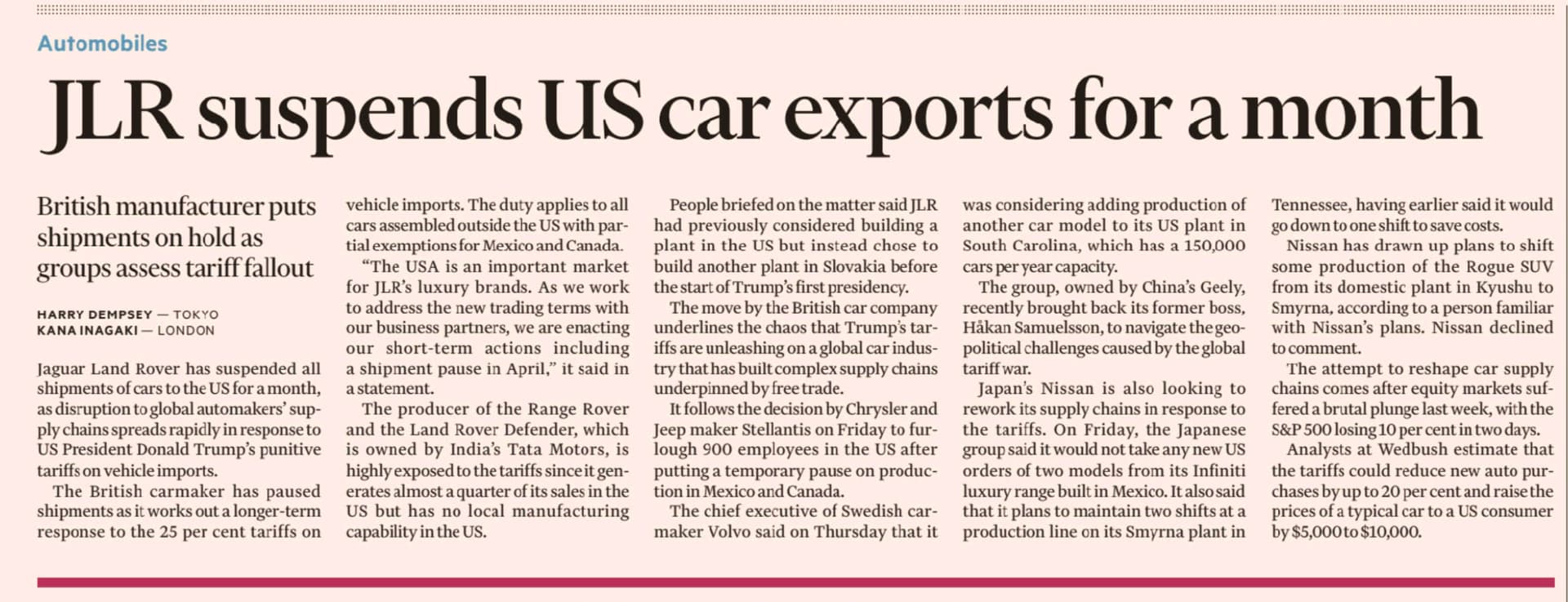
JLR suspends US car exports for a month.

Quarter of the JLR sales comes from US, so this amounts to 2% of JLR yearly sales for now!

4 Likes

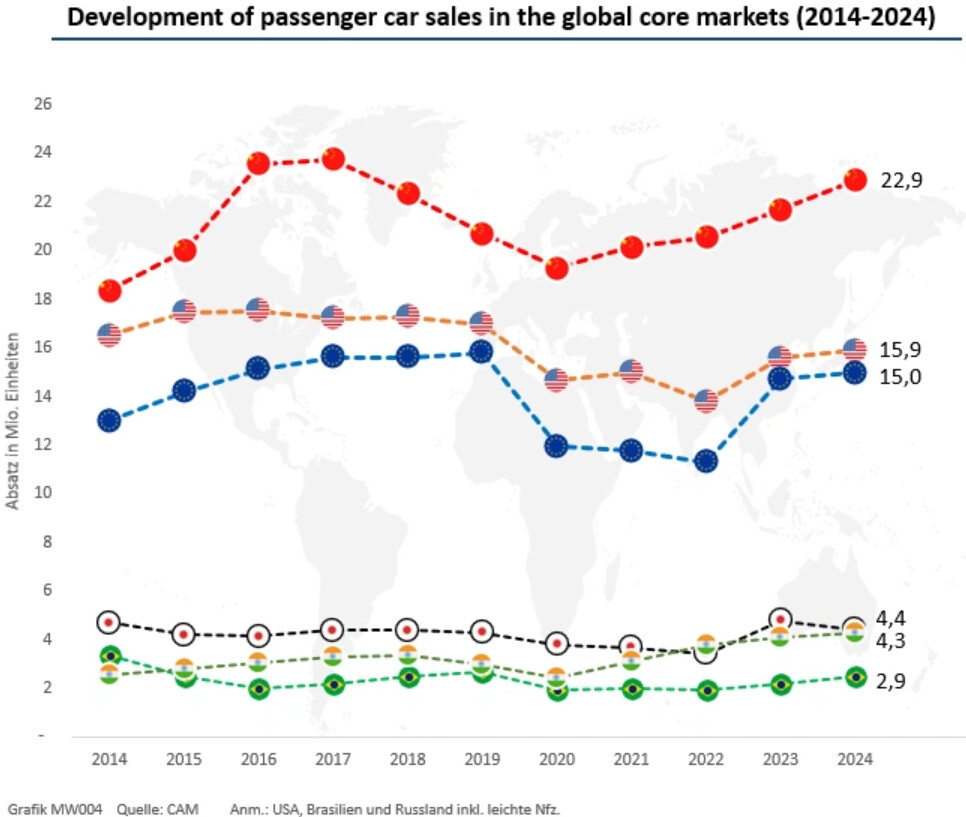
Recent data on passenger car sales from 2014 to 2024 highlights significant shifts in the world’s major automotive markets. As shown in the chart, China continues to lead with 22.9 million units sold in 2024, followed by the USA at 15.9 million and the EU at 15.0 million.

Notably, both the US and EU markets have yet to recover to their pre-COVID levels—and may never do so. In contrast, India and Japan have reached record highs since the pandemic, with India’s market nearly doubling in size over the past four years.

2 Likes

Doesn’t it look cheap? Assuming EPS ~50 (average of analyst estimates) market is pricing in ~6-9% earnings growth over medium term - which should be achievable, maybe not in short term.

Impact of Tariffs: It’s there on ~25% of topline but i feel its all short term turbulence, Trump/ Global trade should revert back.

China remains an issue for JLR - okay

India PLI contributes ~12% to PV sales, expected to increase in coming years as they roll out EVs

INR Cr.
Revenue 437,928
EBITDA 76,519
EBIT 70,569
PBT 28,932
Tax/(Tax credit) -3,986
Net income 32,918
EPS 89
Trading price 655
o/s 368
Net debt 16,022
Mcap 241,220
EV 257,242
P/E 7.3
EV/EBITDA 3.4
Regarding the financial performance for the year, Mr. Balaji emphasized the focus on internal plans, leading to improved profitability and cash flow. Key figures included a 27% revenue growth, ₹60 billion EBIT, over ₹47 billion profit before tax and exceptional items, and a net debt reduction of ₹16,200 crores, bringing the net automotive debt to ₹2,300 crores. He also pointed out the strong free cash flow of ₹22,300 crores for the year.

Mr. Balaji then discussed the source of growth, attributing it to volume increases and favorable currency translation. He mentioned that overall PBT improvement was ₹19,600 crores, with JLR contributing ₹18,900 crores and the India business contributing ₹700 crores. Tata Motors Finance Singapore also saw a reduction in its net loss. He noted that the reduction in automotive debt significantly lowered financing costs.

Looking ahead, Mr. Balaji stated that the operational activities related to the demerger are progressing well and are expected to be completed by October of this financial year. He mentioned strong data from Tata Motors Finance, with improved collections and reduced credit costs. He also highlighted the receipt of ₹142 crores in cash and the accrual of ₹209 crores related to the DVR litigation.

Mr. Balaji then handed over the presentation to Richard Molyneux to discuss the JLR performance. Mr. Molyneux started by emphasizing the stunning order book for JLR, particularly for the Range Rover and Range Rover Sport. He noted a solid Q3 performance despite a challenging macro environment, with GBP7.5 billion in revenue and 9% EBIT, the highest Q3 revenue with a very high wholesale volume.
Mr. Molyneux continued discussing JLR's financial performance, highlighting a strong EBIT margin of 9% in Q3, driven by positive pricing and product mix, which offset lower volumes and inflation. He mentioned that while wholesale volumes were slightly down year-over-year, the mix was richer, with 70% of sales coming from the higher-margin Range Rover, Range Rover Sport, and Defender models.

He also pointed out that JLR's order book remained strong, providing good visibility for future performance. While acknowledging some regional softness, particularly in China, he emphasized the overall positive trajectory and the benefits of their Reimagine strategy.

Mr. Molyneux further elaborated on the factors contributing to the improved profitability, including better pricing, favorable product mix, and the impact of JLR's cost efficiency program. He also discussed the effects of warranty costs and inflation, noting that while they had increased, they were being effectively managed. He concluded by reiterating the strong underlying performance and the positive outlook for JLR.
Mr. Molyneux continued his presentation by highlighting JLR's positive cash flow, noting that Q3 saw GBP1.24 billion in free cash flow after tax. He explained that while investment peaked in Q3, future capital expenditure would be lower, leading to stronger free cash flow generation. He also mentioned that they had GBP440 million of working capital timing differences that would reverse in Q4.

Looking ahead, Mr. Molyneux acknowledged the challenging market conditions, particularly in China, and the potential impact of tariffs and evolving emission regulations. However, he emphasized JLR's focus on driving material cost efficiencies, improving quality, and maintaining a strong structural base to navigate these challenges.

He then reiterated JLR's commitment to profitable growth and brand profitability, focusing on the right-hand drive markets and addressing operational execution. He noted some updated forecasts, particularly for China, where they anticipate a 9% premium ICE segment decline in FY25. Despite this, they are focusing on higher margin retail and sales efforts, especially for the Range Rover models, and are seeing positive traction on pricing.

Finally, Mr. Molyneux mentioned the upcoming launch of the electric Jaguar models, which are on track and will be built on a China-cost base and an amazing market architecture.
Mr. Molyneux concluded his section by emphasizing the strong brand relaunch for Jaguar, focusing on being bold and disruptive. He highlighted the positive initial press and customer interest, with significant website traffic and social media engagement. He reiterated the focus on holding full-year guidance for JLR, expecting a stronger Q4 and aiming for over 10% EBIT.

Following Mr. Molyneux, P.B. Balaji thanked him and then invited Ramanan GV to discuss the Tata Motors standalone (India) business performance.

Mr. Ramanan started by noting the strong performance of the India business, aligning with the positive market trends and the benefits of their successful PV and CV product portfolios. He highlighted a 3.4% year-on-year revenue growth for the standalone business, with improved profitability. He mentioned an ₹8.6 billion PBT and a 8.1% EBIT margin, which was up 130 bps and 100 bps sequentially and year-on-year, respectively. He attributed this improvement to cost savings and better operational efficiency.

Mr. Ramanan then elaborated on the EBIT walk, explaining that lower volumes slightly impacted profitability, but cost savings provided a significant offset. He also mentioned that PLI approvals for both PV and CV businesses contributed positively, leading to an overall EBIT of 9.6%, a 100 bps improvement over the previous year.

Finally, Mr. Ramanan stated his intention to hand over to Girish Wagh for the business review.
Mr. Wagh began by discussing the Commercial Vehicle (CV) business, noting a slight 1% year-on-year decline in overall volumes in Q3, which was an improvement compared to the 11% decline in Q2. He highlighted that while the bus and small commercial vehicle segments saw declines, the medium and heavy commercial vehicle segment remained flat. He also mentioned that the decline in Q3 was less severe than the previous quarter due to a higher base effect.

Mr. Wagh pointed out that fleet utilization has been improving throughout the year, leading to better freight rates and profitability for transporters, which in turn is driving improved demand for commercial vehicles. He noted a 5% quarter-on-quarter growth in overall CV volumes.

Looking at Tata Motors' commercial vehicle performance specifically, Mr. Wagh mentioned a 1% year-on-year decline in volumes, but a 13% sequential growth compared to Q2. He highlighted strong growth in the passenger carrier segment (30% year-on-year and 50% higher than pre-COVID levels), driven by demand for staff and school buses. He also noted significant growth in the electric bus segment, with over 7,200 e-buses delivered year-to-date and a strong order book. He also discussed their efforts in corporate customer mobility and their sustainability initiatives, including a zero-emission bus plant in Lucknow.

Regarding digital initiatives, Mr. Wagh highlighted the success of Fleet Edge, their connected vehicle platform, which has over 760,000 active vehicles. He mentioned high monthly active users and strong subscription rates, leading to improved operational efficiency and fuel efficiency for their customers. He also touched upon their focus on expanding their service reach and improving customer satisfaction.
Mr. Wagh continued by highlighting their strong presence in the small commercial vehicle segment with over 36,000 registered buyers on their E-Dukaan digital platform. He also mentioned their online vehicle sales platform, which has achieved more than 11,000 platform-assisted retail sales in Q3.

He then discussed their participation in the Bharat Mobility Global Expo, where they showcased their "Better Together" brand theme, emphasizing their commitment to understanding and meeting the evolving needs of customers. They presented a wide range of technologies, including battery electric vehicles, hydrogen internal combustion engines, fuel cell technology, and alternative fuel options like biofuel, flex-fuel, CNG, and LNG, across their commercial vehicle portfolio.

Looking ahead to Q4, Mr. Wagh anticipates it to be a seasonally strong quarter for the commercial vehicle industry. He mentioned their focus on increasing penetration in pickups and front-end transformation in SCVs, along with growing their service and spares businesses. He reiterated their commitment to achieving net-zero and circularity initiatives.

Following Mr. Wagh's presentation, P.B. Balaji thanked him and then invited Dhiman Gupta to speak about the Passenger Vehicle (PV) business.

Mr. Gupta began by highlighting the strong festive season in Q3, which contributed to robust retail sales in October and a traditionally strong December. He mentioned their focus on leveraging marketing campaigns around the launches of the Nexon CNG and Curvv, as well as festive period offers. He noted a 0.7% quarter-on-quarter increase in their strong retail performance and efforts to reduce dealer inventory levels.

Mr. Gupta then addressed the SUV portfolio, stating that while it continues to grow strongly for the Nexon and Curvv, they have taken some adverse pricing actions on certain hatches and sedans, which have impacted their market share.
Mr. Gupta continued discussing the Passenger Vehicle (PV) business, mentioning that their multiple powertrain strategy, including petrol, diesel, and EV, has helped them maintain a strong overall portfolio, with Nexon CNG adding to their offerings.

Regarding EV off-take, he noted a 15% year-on-year growth, but a slight sequential decline due to the impact of FAME II incentives phasing out in Q4. Despite this, their EV market share remained strong.

In terms of financials for the PV business, Mr. Gupta mentioned that while overall retail was strong, they experienced some inventory build-up, which they are addressing. He reported a revenue of ₹11,700 crores and an EBITA margin of 7.3% in Q3. The PLI approval had a positive impact of 150 bps on the EBITA margin, resulting in a flat overall EBITA margin.

Looking at profitability, the PV business recorded a PBT of ₹408 crores in Q3 FY24. Mr. Gupta highlighted significant adverse realizations due to intense competition and higher discounts, particularly in the ICE segment. However, he noted positive benefits from localization and battery price reductions for EVs. He also mentioned increased D&A and PDE costs related to new product launches and investments, resulting in a ₹171 crore increase year-on-year. Overall, the ICE business saw a ₹100 crore decline in profitability.

In the ICE segment, EBITA margins declined slightly from 8.5% to 7.3% due to adverse realizations, while the EV segment maintained a positive EBITA margin of 1.7%. Structurally, the EV business without PLI would have had a negative 1.7% EBITA margin, highlighting the importance of battery cost savings and structural interventions.

Looking ahead to Q4, Mr. Gupta indicated that the industry's strong festive performance in Q3 is likely to moderate. He mentioned their focus on reducing channel inventory and anticipated some channel inventory reduction in Q4.

Finally, regarding the EV segment, Mr. Gupta reported a 23% year-on-year increase in registrations. He emphasized their focus on the back of new product support for growth in this segment, aligning with Tata Motors' overall commitment to EVs.
Mr. Gupta concluded his presentation by highlighting that Calendar Year 2024 was their fourth consecutive year of highest-ever PV volumes, maintaining their number one position in the high-growth SUV segment and leading in EV penetration. He also mentioned their effective channel inventory management, keeping it below 25 days.

He then discussed their participation in the Bharat Mobility Global Expo, where their stall showcased future-facing sustainability and safety technologies, including their Gen 3 EVs (Harrier EV, Sierra.EV, and Avinya concept) and the new launched models (Tiago and Tigor.ev).

Mr. Gupta also highlighted their showcased powertrain options, including flex-fuel and hydrogen fuel cell technology, emphasizing their focus on sustainable mobility solutions. The expo saw significant visitor interest in their products.

Looking forward to Q4, their key focus areas include driving profitable growth by optimizing the sales network, improving inventory health, and capitalizing on new launches like the refreshed Nexon. They will also be focusing on driving EV penetration and expanding the Tata.ev charging network.

Mr. Gupta then handed back to P.B. Balaji for the closing remarks.

Mr. Balaji thanked the speakers and provided a summary of the key highlights from the quarter, including strong cash generation and a focus on profitable growth. He also acknowledged the hard work of the entire team.

He then opened the floor for questions and answers.
Mr. Balaji then moved to the Q&A session. He mentioned that they expect the underlying demand to improve gradually, supported by stable interest rates, and anticipate JLR's wholesale to likely improve in Q4, driven by retail growth. He also stated they would remain watchful of the overall demand situation, particularly in China.

Mr. Balaji then opened the floor for questions.

The first question was from an analyst, Raghu, regarding JLR's FY26 revenue and ROCE targets, the reasons for the targets, expected dealer inventory levels, and the point at which pick-up trucks would contribute meaningfully.

Richard Molyneux responded that their revenue and ROCE targets are based on cutting costs and taking progressive volume out of the business. He explained that as revenue increases and costs are managed, the EBIT impact and ROCE targets should naturally follow. He acknowledged the dynamic nature of the Chinese market and stated that their current targets already factor in their expectations for that region.

Another analyst asked about the outlook for demand in FY26.

Mr. Balaji responded that while it's too early to provide specific guidance for FY26, they anticipate a gradual improvement in overall underlying demand.

An analyst, Ashish, asked about JLR's demand expectations for FY26, particularly in China, and their strategy for dealer inventory management and retail margins in China.

Richard Molyneux stated that they believe China will rebound, although the timing and pace are uncertain. He emphasized their focus on maintaining healthy retailer margins and managing inventory levels closely in China, as this is crucial for a stable and profitable network. He noted that China is an important market and they are committed to its long-term success.

An analyst, Kapil Singh, inquired about the impact of depreciation on future profitability, considering recent investments, and the expected timeline for pick-up truck launches and their D&A impact.

Mr. Balaji clarified that depreciation has already been reducing due to moving older ICE vehicle platforms to their end of life. He stated that while they expect some increase in D&A in Q4 due to the launch of the new BRV (likely a typo and referring to a new product), overall depreciation levels should remain manageable. He indicated that they would provide more specific details on future product launches and their financial implications at the appropriate time.
An analyst, Kapil Singh, followed up by asking about the financial impact of depreciation over the next three quarters.

Mr. Balaji responded that depreciation should remain roughly stable for the next three quarters.

Another analyst, Richard, asked about the market share expectations for India PVs, particularly with the Curvv launch, and the overall industry volume growth outlook for the next year.

Mr. Balaji stated that they are optimistic about gaining market share with the Curvv launch and anticipate good volume growth for both the industry and Tata Motors in the coming year.

An analyst, Shailesh Chandra (likely the same Shailesh Chandra from the management team, now asking a question), inquired about the ramp-up issues for the Curvv, considering past experiences with new launches and supply chain constraints, and the expected timeline for the Curvv to reach its full potential.

Mr. Balaji acknowledged the ramp-up challenges typically associated with new launches and the ongoing supply chain issues. He indicated that they have taken learnings from past experiences and are working to mitigate these risks for the Curvv. He suggested that it would take at least a quarter for the Curvv to reach its full potential in terms of volumes.

Shailesh Chandra then asked about the expected growth rates for the industry and Tata Motors in the current financial year.

Mr. Balaji responded that they anticipate the industry to see relatively flat growth this financial year, with a slight possibility of 2-3% growth.

Shailesh Chandra (again, likely the management team member) then provided his perspective on the industry growth, suggesting it has been relatively flat so far this financial year, with only about 2% growth. He anticipates a similar trend for FY25, with potentially 6-7% growth in the second half if the macroeconomy improves and government stimulus is introduced.
P.B. Balaji then addressed a question about the sustainability of the EV margin improvement, the impact of PLI incentives, and the overall margin outlook for PVs.

Dhiman Gupta clarified that the reported EBITA margins for PVs already include the benefit of PLI. He emphasized that structural improvements in margins are being driven by better mix (more Curvv), increased localization, and the benefits of battery cost reductions. He stated that these factors, along with potential market development activities, will contribute to future margin improvements.

P.B. Balaji then responded to a question about the later-than-anticipated PLI payments and their impact on future EV margins. He acknowledged the delay but reiterated that the ₹1 billion PLI benefit for EVs is still expected and will be a crucial factor in improving their EV margins going forward.

An analyst, Kapil, asked for clarification on the total PLI benefit expected for the EV business and its planned utilization.

P.B. Balaji confirmed the total expected PLI benefit for EVs is around ₹2 billion. He explained that about ₹1 billion has already been received, and the remaining amount is expected. This funding will be used to support their investment plans in the EV business.

An analyst, Nishit Jalan, inquired about JLR's EBIT margin target of 10% for FY26 and the key drivers to achieve this.

Richard Molyneux reiterated their confidence in achieving the over 10% EBIT margin target for FY26. He stated that this will be driven by increased volumes, the benefits of their Reimagine strategy, and continued focus on cost and material efficiency. He also mentioned the positive impact of the Range Rover Electric launch in the back end of FY26.

Richard Molyneux then addressed a question about the potential impact of VMH-related costs on JLR's profitability and their strategy to mitigate these effects.

He acknowledged the potential impact of VMH but stated that they have factored this into their planning and will continue to take actions to mitigate any adverse effects through material cost reductions and other efficiency measures.
Richard Molyneux concluded the Q&A session by stating that they do not anticipate any significant impact from VMH in Q4.

P.B. Balaji then addressed a follow-up question about the EV ramp-up and the competitive landscape in the Indian EV market.

Shailesh Chandra provided a detailed response, emphasizing that the Indian EV market is still in its early stages and presents a significant growth opportunity. He acknowledged the increasing competition but highlighted Tata Motors' early mover advantage, strong brand, wide product portfolio across different price points, and growing charging infrastructure as key strengths. He believes that the market expansion will benefit all players, and Tata Motors is well-positioned to capitalize on this growth. He also mentioned their focus on creating a better customer experience and building a robust EV ecosystem.

Shailesh Chandra further added that while there might be some initial hiccups in the market share dynamics due to increased competition and new launches, the overall EV adoption is expected to rise significantly, and Tata Motors is geared up to maintain a strong position.

P.B. Balaji then thanked the analysts for their questions and concluded the earnings call.
P.B. Balaji addressed a question about the penetration of EVs in the overall sales mix and the expected intensity of competition in the EV segment. He stated that while the EV penetration is currently low, it is expected to increase, and Tata Motors is prepared for increased competition.

Richard Molyneux responded to a question about the outlook for VME and warranty costs for JLR in the current quarter. He indicated that the industry is not showing signs of becoming less competitive, and while VME might have peaked, they anticipate it to remain at a similar level for the next quarter. He also mentioned that warranty costs are expected to be slightly higher than the low base of the previous year.

Richard Molyneux further clarified that the sequential and year-on-year movements in ASPs (Average Selling Prices) for JLR are primarily due to product mix, with China's pricing being a smaller factor. He stated that these movements are not considered material.

P.B. Balaji then addressed a question about emission costs.

Richard Molyneux briefly stated that he would cover the emission cost details later in the discussion.

P.B. Balaji then asked Richard Molyneux to elaborate on the emission costs.

Richard Molyneux explained that the question on emission costs was likely related to Jinesh Gandhi's earlier question. He confirmed that they have covered the emission-related aspects already.
Richard Molyneux then provided details on emission costs for JLR. He stated that the most relevant markets for emission costs are the EU and the UK, and they are closely working with the relevant regulations, anticipating increased costs in the next few years due to evolving emission standards for both ICE and BEV vehicles. He highlighted the uncertainty around future regulations and potential government emission targets for BEVs, which could significantly impact costs. He affirmed that they are closely monitoring the situation and working with the UK government, expecting their emission costs to rise next year.

P.B. Balaji then mentioned upcoming exciting developments, particularly the timelines for the Range Rover Electric deliveries and other EVs coming after it.

Richard Molyneux confirmed that the Range Rover Electric, first BEV under their EMA architecture, is on track for deliveries starting in mid-2026, following the Jaguar that was showcased earlier.

P.B. Balaji then addressed the SCV (Small Commercial Vehicle) segment, mentioning increased competitive intensity and pressure on tonnage. He asked Girish Wagh about their plan to address this market and limit the impact on market share.

Girish Wagh responded that within the SCV segment, the lower end and the upper end are showing different trends. The lower end, particularly the BSVI transition, has led to some ground loss to three-wheelers due to initial pricing challenges. However, with BSVI phase II implementation, they have corrected pricing and are seeing positive traction in pickups in the upper end of the SCV segment. He believes the significant price increase in small commercial vehicles due to the BSVI transition has created an opportunity for their offerings.
Girish Wagh further elaborated on their strategy in the SCV segment, highlighting their focus on offering a comprehensive product portfolio, including electric options, to cater to diverse customer needs. He emphasized the positive customer acceptance of their Ace EV and their efforts to improve customer experience and penetration in rural markets. He believes their multi-pronged approach will help them regain market share in the SCV segment.

P.B. Balaji then asked for clarification on the revenue percentage that is currently attributable to PLI benefits for the PV business and the expected increase in the future.

Dhiman Gupta stated that currently, about 13% of their PV revenues are attributable to PLI benefits. He anticipates this percentage to increase in the future as their EV pipeline expands and they receive more PLI payouts.

P.B. Balaji then shifted the focus to the European market, asking about the signs of premium demand recovery and the addressable market for Jaguar.

Richard Molyneux responded that while there have been some green shoots in the premium automotive market in Europe recently, it's still too early to confirm a sustained recovery. He noted some challenges, particularly for Jaguar which is undergoing a brand repositioning. He emphasized that their focus is on ensuring they have the right products and brand positioning to gain market share in the long term, rather than solely focusing on volume. He indicated that they are targeting specific segments and customer groups for Jaguar.
P.B. Balaji then directed a question to Shailesh Chandra regarding the EV charging network expansion in India, the role of government subsidies, and the pricing of EV charging versus ICE refueling.

Shailesh Chandra explained that the EV charging network expansion in India involves OEMs, oil marketing companies (who have received government subsidies), and smaller startups. He believes that while OEMs will focus on charging infrastructure for their respective brands, oil marketing companies and new charging point operators will play a significant role in the overall expansion. He noted the government's focus on promoting EV adoption through initiatives like the ₹7,000 crore subsidy under the Prime Minister E-Bus Sewa scheme. He also mentioned that while the initial focus is on highways and areas with higher EV penetration, the government is also incentivizing charging infrastructure development in other locations. He emphasized that the cost of EV charging is currently lower than refueling ICE vehicles, which is a crucial factor in driving EV adoption.

P.B. Balaji then asked Girish Wagh for his outlook on the CV demand recovery in the coming year, considering the government's infrastructure spending and favorable base effect.

Girish Wagh stated that after a strong first quarter with year-on-year growth, the second quarter showed a slowdown. He anticipates the second half of the coming year to be better due to increased economic activity and infrastructure projects, although he refrained from giving specific growth numbers.
Girish Wagh continued his outlook on CV demand, noting that while the third quarter saw a year-on-year decline, it was an improvement sequentially. He expects the fourth quarter to be flat year-on-year, leading to an overall decline for the current fiscal year. However, he anticipates growth in the next fiscal year, driven by government spending on infrastructure and various end-use sectors.

P.B. Balaji then addressed a question about the North American retail performance for Jaguar Land Rover in Q3, which showed a 48% year-on-year growth, and the sustainability of this trend.

Richard Molyneux explained that while the year-on-year growth in North America was strong, the sequential growth from Q2 to Q3 was more moderate at 15%. He attributed the strong year-on-year performance to favorable comparisons with a weaker base in the previous year due to homologation timing issues. He expects performance in the US to remain relatively strong in the coming quarters, driven by strong demand for Range Rover and Defender.

P.B. Balaji then shifted the discussion to the bus segment in India, asking about the outlook for Q4 and the company's strategy in this market.

Girish Wagh stated that the bus segment has shown maximum year-on-year growth and they have gained market share. He anticipates the strong performance to continue in Q4. He highlighted their strategy of offering multiple fuel options, including diesel, CNG, and electric, to cater to different customer needs. He also mentioned their focus on the MCV (Medium Commercial Vehicle) bus segment and their participation in profitable tenders.

Girish Wagh further noted the increasing acceptance of their electric buses and their focus on participating in tenders for state transport undertakings. He believes the bus segment presents a good opportunity for profitable growth.

P.B. Balaji then concluded the Q&A session and thanked everyone for their participation.
Girish Wagh provided additional details on the MCV bus segment, noting significant growth and improved profitability. He highlighted their strong product portfolio, multi-fuel options, and readiness for Q4 demand. He also mentioned improved profitability across the CV segments due to better product mix and cost management.

P.B. Balaji then addressed a question about potential stress in financing for the small commercial vehicle and pickup segments, as well as the bus segment.

Girish Wagh acknowledged some stress in the small commercial vehicle and pickup segments, particularly for first-time buyers and smaller operators. However, he noted improvements throughout the year and stated that financiers are now being more selective and focusing on better credit profiles. He also mentioned that the financing situation for the bus segment is relatively stable.

Girish Wagh further elaborated on the challenges in the M&HCV bus financing segment due to higher ticket sizes and longer repayment periods, but noted that state transport undertakings generally have better access to financing.

P.B. Balaji then addressed a follow-up question about the accounting of the ₹209 crores from the nine-month accrual related to PLI.

P.B. Balaji clarified that this amount has been entirely accounted for in the nine-month period.

P.B. Balaji then opened the floor for the last question.

An analyst, Rakesh Kumar, asked for the key takeaway message for the call.

P.B. Balaji concluded the call by reiterating the key highlights: strong cash generation, improving profitability across businesses, positive momentum in the EV segment, and a focus on profitable growth and navigating market challenges effectively. He thanked everyone for joining the call.
Richard Molyneux addressed a question about JLR's investment strategy in ICE powertrains and platforms beyond 2030, considering the shift towards EVs. He reiterated their previous communication that they would not be investing in new ICE powertrains or platforms. Their strategy is to optimize the existing ICE powertrains for their remaining lifecycle, focusing investments primarily on BEV architectures. He acknowledged that the transition to BEV will be gradual and vary across markets, necessitating a balanced approach.

P.B. Balaji then provided closing remarks, summarizing the key points of the earnings call and the upcoming investor events, including the Investor Day and the JLR results announcement. He thanked the participants for their insightful questions and concluded the call.
2 Likes

While it looks Cheap though Uncertainty on the JLR front is something which makes me avoid this stock.
25% of the revenue of JLR i.e. 15% of Tata Motors come from North America which is definitely going to get impacted due to Tariff’s . Moreover, 18.9% of their share is from China which is moving towards EV

Now if JLR is in difficult situation then it can pull down the complete Tata Motors stock. I haven’t got a satisfactory answer from the Mgmt on this situation therefore while it might be cheap but it’s definitely on a safe stock at this point in time

1 Like

“Speaking at a Jaguar Land Rover plant in the West Midlands, the British prime minister said the deal meant US tariffs on cars from the UK would be cut from 27.5% to 10% for 100,000 vehicles every year. The announcement by the two countries made the UK the first to agree a trade deal with Washington”

There was uncertainty on the JLR front before the UK - US trade deal but now they can export cars at 10% tarriff for 100,000 cars every year.

UK exports 27% vehicles to the US which includes JLR, Mini Cooper, RR and Aston Martin. This would be a milestone deal for the UK’s auto makers and surly JLR will be beneficial.

2 Likes

https://www.valueresearchonline.com/stories/224973/tata-motors-hype-vs-reality-long-term-investors/

4 Likes

TATA MOTORS TO ACQUIRE IVECO GROUP

2 Likes

Who Calls the Shots on Tata’s Corporate Actions? A Costly Misstep?

Tata’s recent corporate actions regarding Tata Motors raise serious questions about strategic planning and shareholder value.

First, they reduced TTML’s equity capital by extinguishing DVR (Differential Voting Rights) shares, triggering a massive tax liability on “deemed dividends” from accumulated profits. As of the record date in 2024, TTML had nearly ₹10,000 Cr (~€1B+) in accumulated profits—leading to a hefty tax payout.

Now, Tata plans to raise a similar amount in equity to fund the acquisition of Iveco. Here’s the irony: Had this acquisition been executed before the DVR conversion, the accumulated profits could have been utilized, reducing the balance sheet surplus to ZERO—and avoiding the tax hit altogether.

A $4B deal like this doesn’t happen overnight. Due diligence, negotiations, and structuring typically take over a year. So why wasn’t the sequence optimized?

Who pays the price?

  • Retail shareholders bear the brunt through reduced value.
  • Tata Sons, the promoter, also takes a hit—but given their scale, the pain is relatively lesser.
  • The only clear winner? The Government of India, which pockets ~₹584 Cr in taxes.

Was this a strategic oversight, or is there more to the story? Who truly benefited from this move?

20 Likes
2 Likes

This year, Jaguar and Land Rover will have close to Zero Free cash flow due high amount of Capex involved to prepare itself for the future. Also, India PV business still hasnt turned completely cash flow positive.

Some optionality which is in the business is, Jaguar, FreeLander and Indian Passenger Vehicles. If these kick off well starting FY27 onwards, business will be valued much higher from here.

7 Likes

Question to those who received New ordinary shares of TataMotors (NOS) after cancellation of TataMotors DVR (AOS) and still holding them!

Did you pay tax on the capital gain (LTCG/STCG) for the converted shares?

The opaqe conversion of Tata Motors DVR shares to Tata Motors Ordinary Shares broke all images of Tata Group’s investor friendliness in my mind. I held 2000 Shares of TML-DVR when the announcement was made to convert 100 TML-DVR to 70 ordinary shares, I was delighted with the swap ratio offered. However,the excitement turned to horror when the final outcome came. Around 4 lacs was termed as deemed dividend and added to Income, 52 Tata motors shares were sold by the company to pay TDS on deemed divided. The stock was made to rise to hits highest level of 1111 on the last day of trading before conversion and then collapsed spectacularly to 650-700 levels. Overall I paid 30% tax on deemed dividend of 4 lacs on 2000 TML-DVR. My CA has advised to add this to the cost of TML-DVR shares. However,I am not sure that the IT deptt would allow so and what would be the reflection on AIS when I sell these shares eventually.
Finally I came to the conclusion that any company with too many moving parts is unfit for investment by retail investors.Disc: Holding tata motors from 2018

4 Likes

So apart from the deemed dividend you didn’t pay the capital gain tax yet for the shares swapped.
What is the buy price & date showing for the swapped shares in your brokers account?
For me it’s showing as 1111.35 & date as 23rd Sept 2024.

I have not sold the shares,If the communication would have been transparent about deemed dividend, I would have sold the shares and only paid Long term capital gains. I have already paid 1.2 lacs in Income tax and now when I will sell,there would be LTCG as well. The stock is already 40% down. If you check carefully,the promoters share is down after this rejig at the cost of minority share holders only. If they were so positive about their own company they would have been incresing their own holding. Esentially this company is like a large kingdom,with several satraps running their own fiefdoms. The compnay spends well on R&D but the products are not groundbreaking. The cars are still filled with bugs and service centres are really awful.Below is the screenshot of TML promoter’s share after extinguishmnet of TML-DVR.

1 Like

Actually turns out even if you have not sold the swapped shares you will have to pay capital gain tax(LTCG/STCG) based on the holding period of the DVR shares.

Refer this link,

Check the screenshot attached under “To give you an example for resident individual investors:”
Step 2: 15 shows the capital gain after deemed dividend and for which we have to pay the tax!

I wish someone can clear this doubt!

1 Like

Seems like a decent opportunity post stock split.

JLR + PV

The Land Rover segment contributed over 93% to the overall sales of JLR in fiscal 2025, with Defender, Range Rover and Range Rover Sport continuing to gain momentum.

Near-term concerns

  • Shut down due to Cyber issue: JLR was shut down in late August 2025 due to a cyberattack that disrupted its global IT network. The shutdown halted all worldwide production and led to a phased restart of operations starting in early October.
  • US Tariffs: GBP 200 million was from US tariff cash hit. In the US you pay your tariffs in cash essentially one month after. So, in the Q1 we had two big tariff payments in May and June.

Tata Motors CV

  • Iveco acquisition: Iveco will be acquired by Tata Motors Commercial Vehicles (TML CV) after demerger for Euro 3.8 billion (~Rs. 380 billion) through an all-cash voluntary tender offer.
  • The acquisition of Iveco is expected to be completed around April 2026. The acquisition is expected to be funded initially through bridge debt of Euro 3.8 billion which is expected to be refinanced within 12 months through a mix of long-term debt and equity in 70:30 ratio.
  • Iveco’s reported earnings before interest and tax (EBIT) margin at 5.3% in calendar year 2024 (4.8% in the first half of calendar year 2025) are lower compared to global peers and TML CV EBIT margin of ~9.0% (fiscal 2025) given the high depreciation and research and development (R&D) expenses. The EBIT margin of the consolidated entity, post-acquisition, is expected to be ~7%. Similarly, the return on capital employed (RoCE) for the TML CV business which is currently ~37% is expected to moderate to ~20% for the consolidated entity. Iveco, in 2024, charted out a plan to reach EBIT margin of 7-7.5% by fiscal 2028 and TML’s management has articulated that the plans will continue as per the earlier guidance
  • Furthermore, the TML CV business is also likely to be net debt free at the time of its demerger. The acquisition debt for the transaction is likely to be taken at the intermediate holding company and is expected to be refinanced within 12 months with a combination of debt and equity.
  • Furthermore, the expectation of continued healthy FCF generation in the India business of Rs 60-65 billion, in the near to medium term, is expected to support the combined financial risk profile.

Financials & Valuation

Post demerger; at Rs. 400 per share, the JLR + PV piece trades at ~6x EV/EBIT.
At 15x EV/EBIT, the CV piece gets a valuation of Rs. 107,000 crores, compared to Rs. 80,000 crores of Ashok Leyland. Tata Motors CV is a market leader and has a PAT of Rs.5000cr + compared to Rs. 3300cr of Ashok Leyland.
There could be upside opportunity in valuation of both CV as well as JLR + PV.

8 Likes

thank you for this. without accouting for synergy between Ivecco and TML. They should collectively do 5000 Cr by CV + 200 Mn (~2000 Cr) Cr by Ivecco, on a worst case scenario. so a 7K Cr normalised earning at 7% discount rate also should be ~1 lac Cr mcap. Upside can be synergy benefits in cost saving + TML`s faster international expansion+ alternate energy vehicles in CV India space etc. Any 20-30% margin of safety below 1 Lac Cr mcap for CV is a great buy for a long term compounding machine.

6 Likes