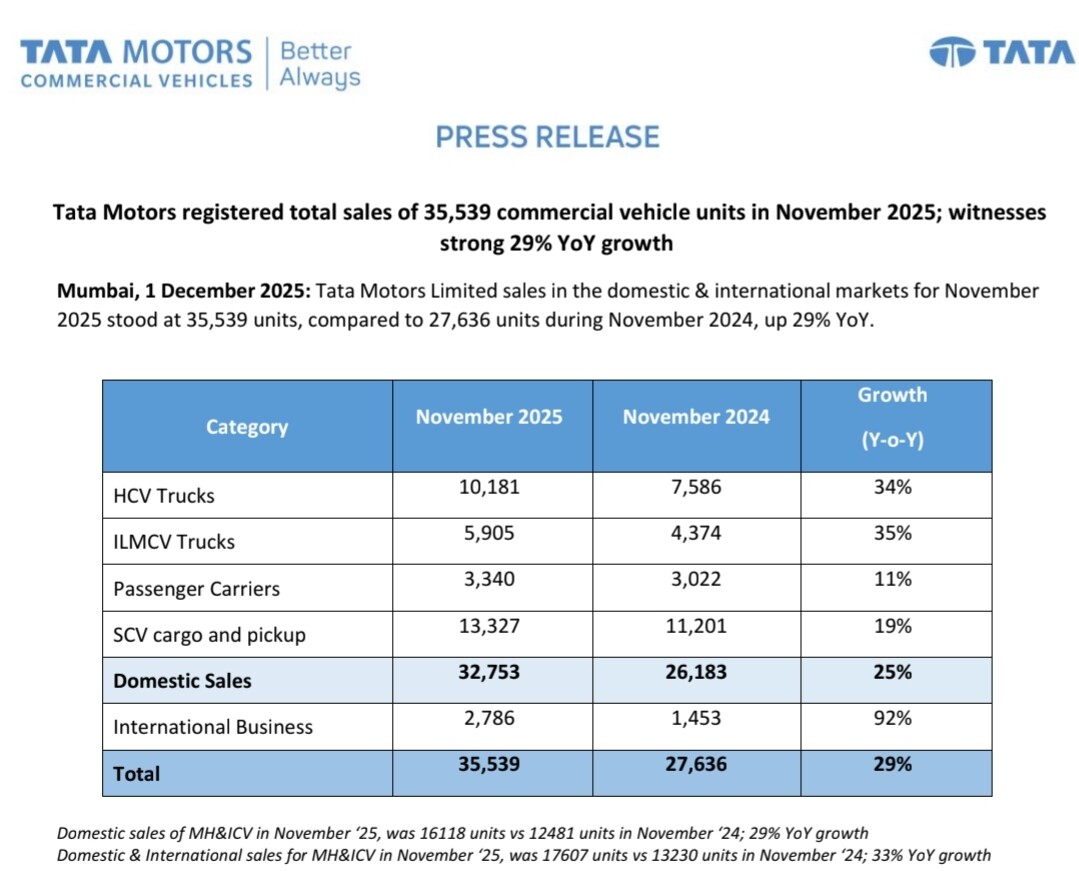
Tata Motors is paying €3.8 billion( about ₹38,200 crore) to acquire Iveco’s commercial-vehicle business (i.e., excluding its defence unit)
- The offer is €14.1 per share in cash
- An extraordinary dividend of €5.5–€6.0 per share will be paid to Iveco shareholders from the sale of its defence business
- Tata has secured bridge financing for this deal
The Tata Motors–Iveco deal is potentially a very big shift in the global commercial-vehicle (CV) landscape.
How Tata Motors + Iveco Will Be Placed Globally After the Acquisition
Scale and Global Reach
-
Post-acquisition, the combined commercial-vehicle business is expected to generate ~€22 billion in revenues.
-
Geographic mix will be roughly 50% Europe, 35% India, and 15% Americas. * Annual sales volume projected to be ~540,000+ units/year.
-
This global scale gives Tata-Iveco a strong presence in developed markets (especially Europe) while leveraging Tata’s strength in emerging markets (India, Asia, Africa).
-
Diversified & Complementary Product Portfolio
-
The two companies’ product lines are highly complementary: Tata is strong in light and medium vehicles (especially in India), while Iveco brings strength in heavy trucks, buses, and specialized commercial vehicles.
-
There is also potential for technology sharing: Iveco’s expertise in powertrains (through its FPT business) and sustainability (electric/hydrogen) can strengthen Tata’s global competitiveness.
-
This broad product mix will help the combined entity address a wide range of customer needs across geographies.
-
Improved Operating Leverage & Synergies
-
By combining operations, Tata-Iveco can spread capital investments (R&D, manufacturing) over a larger volume base, improving cost efficiency.
-
The deal is expected to reduce the cyclicality of cash flows, since Tata gets more balanced exposure across developed and emerging markets rather than being overly dependent on one geography.
-
Tata gets access to Iveco’s global sales, service, and financing network, which would have taken years to build by organic expansion.
-
Competitive Positioning Among Global CV Players
-
According to analysis, the combined Tata-Iveco business could become one of the top-4 global players in the medium and heavy commercial vehicle (MHCV) space.
-
Current global leaders in heavy CV include Daimler Truck, Volvo Group, and Traton (Volkswagen’s CV arm), so Tata-Iveco will be aiming to compete directly with these giants.
-
With improved scale, broader geographic reach, and technology capabilities, Tata-Iveco could pose a credible challenge especially in Europe, Latin America, and emerging markets.
-
Risk & Challenges
-
Integration risk: Merging two large CV businesses with different cultures (European vs Indian) and operations is non-trivial.
-
Regulatory risk: Approvals will be needed (merger control, foreign investment, etc.).
-
Cyclical demand risk: CV markets are inherently cyclical. While geographic diversification helps, downturns in Europe or the Americas could still hurt.
-
Capital intensity: Scaling up will require substantial ongoing capex (especially for new technologies like EVs and hydrogen), and financing risk is non-trivial.
-
Strategic Implications
-
This deal aligns with Tata’s long-term ambition of building a globally competitive CV business, not just being dominant in India.
-
It gives Tata a dual home base: India + Europe, which is powerful strategically — especially for global expansion.
-
The combined entity is better positioned to invest in sustainable mobility (EVs, hydrogen), thanks to a larger revenue base and stronger R&D/mfg capabilities.
| Column 2 | Column 3 | Column 4 | D | E |
|---|---|---|---|---|
| Company | Annual Revenue (CV only) | Annual Volume | Key Markets | Notes |
| Daimler Truck (Mercedes-Benz Trucks, Freightliner) | €55–60 bn | 500k–520k | Europe, US | Largest global heavy-truck maker |
| Volvo Group (Volvo, Mack, Renault) | €48–50 bn | 300k–320k | Europe, US | Strong in heavy trucks & construction equipment |
| TRATON Group (Scania, MAN, Navistar) | €46–48 bn | 330k–350k | Europe, US | VW’s CV arm; strong profitability |
| Tata Motors + Iveco | €21–22 bn | 530k–550k | India, Europe, LatAm | The new #4 globally post-merger |
| PACCAR (Kenworth, Peterbilt, DAF) | €30–32 bn | 250k | US, Europe | Strong profitability in US |
| Hyundai Motors CV | €10–12 bn | 200k | Asia, Middle East | Growing rapidly |
| Isuzu Motors | €9–10 bn | 170k–180k | Japan, Asia | Leader in LCVs in Asia |
Global CV market = ~6.5–7 million units per year (LCV + M&HCV + buses)
| Column 1 | Column 2 |
|---|---|
| Company | Approx. Global Share |
| Daimler | 7–8% |
| TRATON | 6–7% |
| Volvo | 5–6% |
| Tata–Iveco (combined) | 7.5–8.5% |
| PACCAR | 3–4% |
| Hyundai | 3% |
| Isuzu | 2.5–3% |
Starting Point – Current Profitability (Before Acquisition)
Tata Motors CV (Standalone India CV Business)
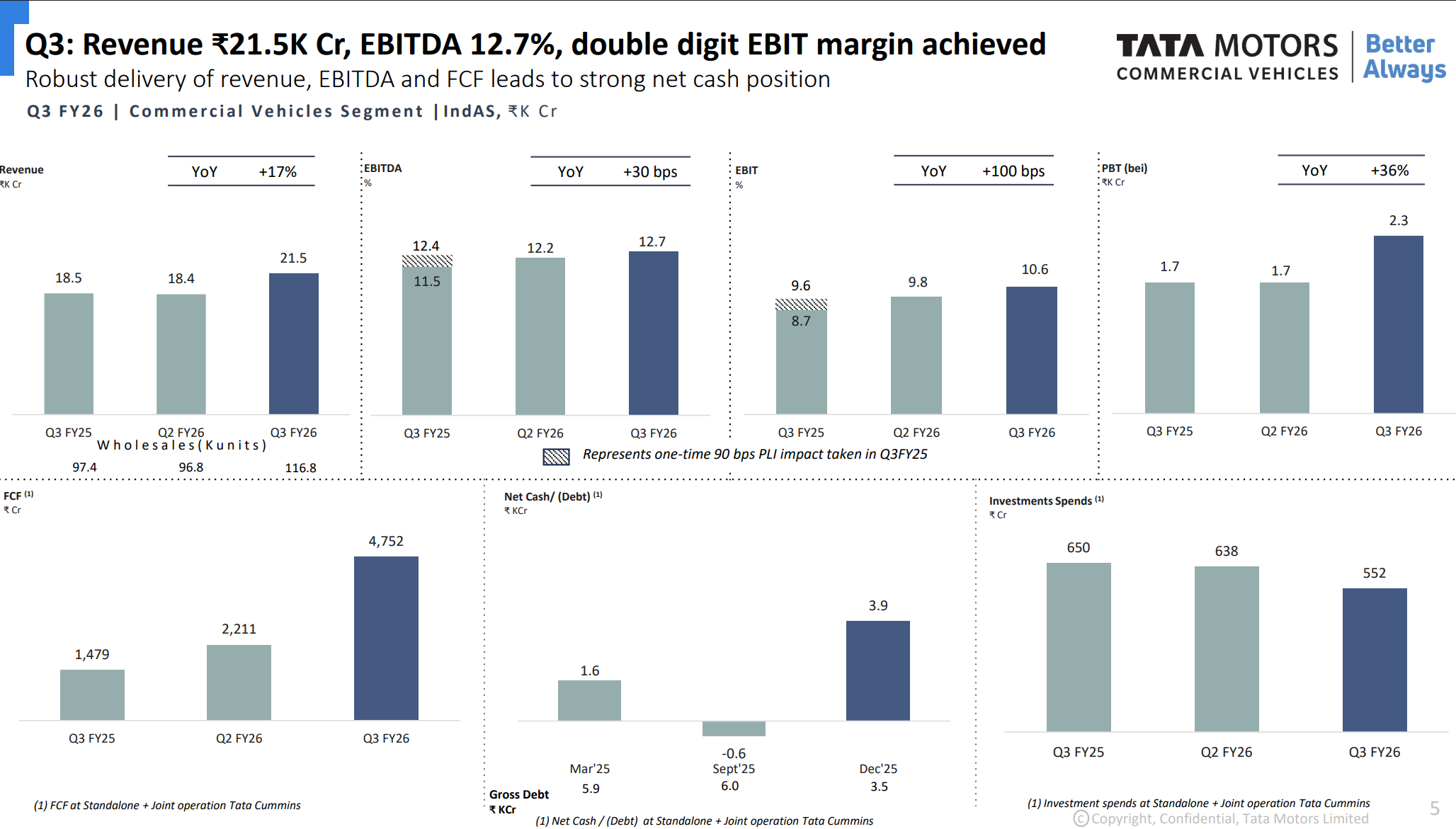
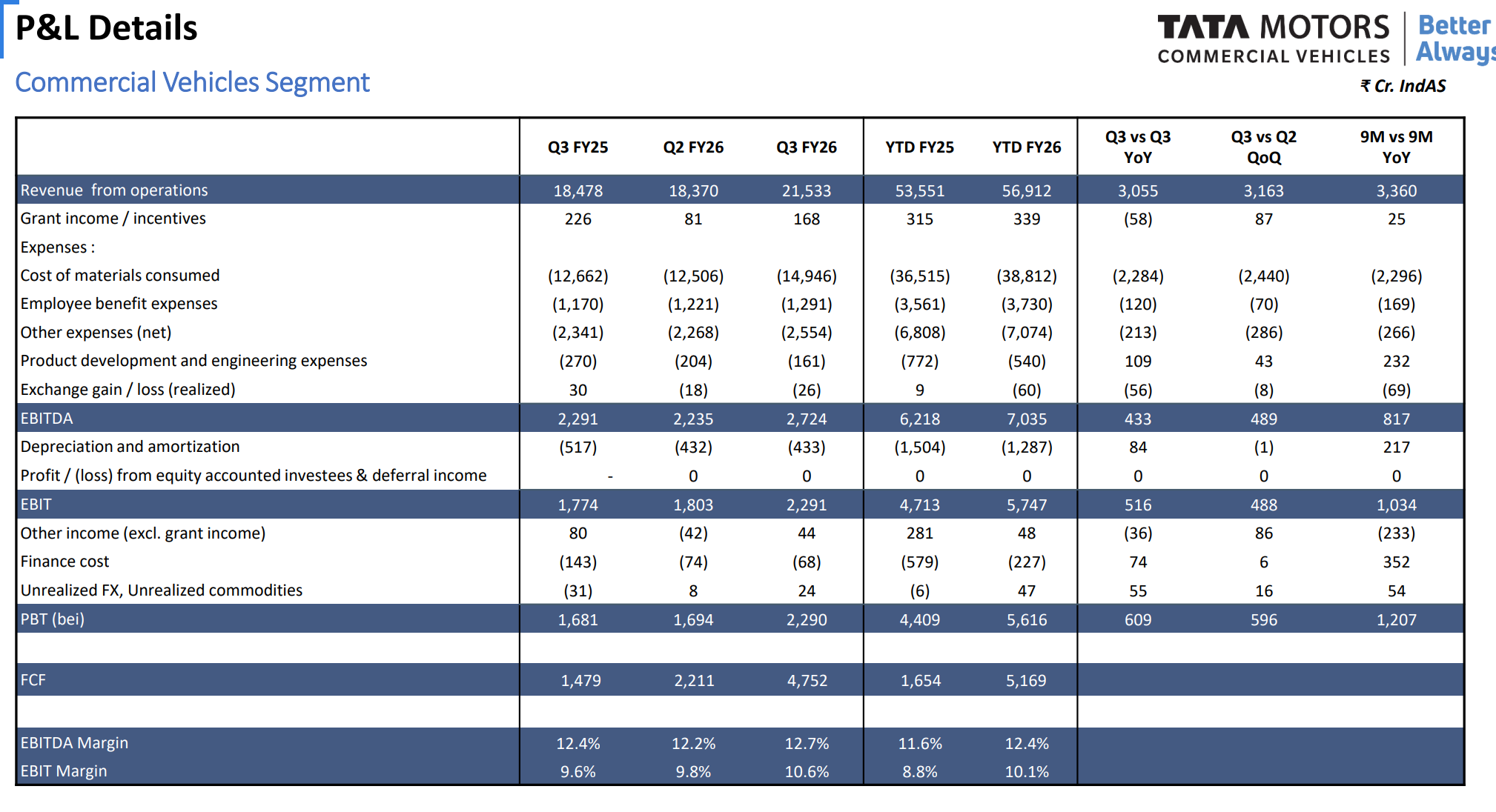
- EBIT margin: 6–8% (strong cycles can touch 9%)
- EBITDA margin: 10–12%
- ROCE: improving but still moderate
- Cyclical but profitable in India; exports small.
Iveco (Excluding Defence)
- EBIT margin: 3–4%
- EBITDA margin: 6–7%
- Lower margins due to European cost structure, R&D, EV/H2 spends.
Combined business naturally lands at ~5–6% EBIT before synergies.
Impact of Debt Financing on Profitability
Acquisition cost: €3.8 billion (~₹38,000 crore)
Let’s assume realistic post-deal borrowing conditions:
- Interest rate: 6.0–7.5% (euro debt blend + rupee hedging costs)
- Annual interest cost: ₹2,200–2,700 crore
This interest load directly reduces net profit and ROE.
Profitability Immediately After Acquisition (Years 1–2)
EBITDA Margin
- Combined: 8–9%
- Tata: stronger EBITDA
- Iveco: weaker EBITDA
- Mix averages out lower than Tata alone
EBIT Margin
- Likely 5–6% on consolidated basis
- Tata India CV drags upward
- Iveco Europe drags downward
Net Profit Margin (After Interest)
- 2–3%
Because added interest cost materially reduces PAT.
 Bottom Line (first 2 years)
Profitability dilutes after acquisition.
The two biggest reasons:
- Iveco’s lower margins
- High interest burden on the acquisition loan
Profitability After Synergies (Years 3–5)
Both companies have stated that synergies will come from:
- Platform sharing
- Common powertrain procurement (FPT)
- Shared EV/H2 development
- Reduced duplicate R&D
- Shared suppliers & volume advantage across continents
Expected Synergies
- 1–1.5 percentage point improvement in EBIT margin
- ₹1,000–1,500 crore annual cost savings possible
- Higher capacity utilization benefits in Europe & LatAm
EBIT Margin Expectation Post-Synergies (Year 3–5)
- 6–7.5% EBIT (improvement over integrated base)
EBITDA Margin (Year 3–5)
- 10–12%, similar to the best peers excluding China
Net Profit Margin (After Interest)
- 3.5–4.5%
Once synergies start to materialize and debt begins to amortize/refinance.
Capital Structure Effects
- Debt/EBITDA initially spikes to ~3.5x
- Target to bring it down to 2.0–2.5x via:
- Cashflows from Iveco
- Improving EU markets
- Rationalizing capex
- Spin-out of non-core assets (common in such deals)
As leverage falls, PAT margin rises.
Assumptions Used
Revenue Growth
- India CV: 6% CAGR
- Iveco Europe/LatAm: 2–3% CAGR
- Weighted blended revenue growth: 4% per year
Margins
- Iveco EBITDA margin baseline = 6%
- Tata CV EBITDA margin baseline = 11%
- Combined starting EBITDA = 8.5%, increasing with synergies
Synergies
- Year 1: 0
- Year 2: +0.3% EBITDA
- Year 3: +0.6%
- Year 4: +0.9%
- Year 5: +1.2%
Debt & Interest
- Acquisition cost: ₹38,000 crore debt
- Effective interest rate: 7%
- Annual interest burden: ₹2,660 crore
- Deleveraging: Pay down ₹3,000 crore/year from operating cash flow
Full 5-Year Model
(All numbers in ₹ Crore)
| Column 1 | Column 2 | Column 3 | Column 4 | E | F | G | H | I |
|---|---|---|---|---|---|---|---|---|
| YEAR | Revenue | EBITDA Margin | EBITDA | EBIT Margin | EBIT | Interest | PAT Margin | PAT |
| Y1 | 2,00,000 | 8.5% | 17,000 | 5.3% | 10,600 | 2,660 | 1.6% | 3,200 |
| Y2 | 2,08,000 | 8.8% | 18,300 | 5.5% | 11,400 | 2,450 | 1.9% | 4,000 |
| Y3 | 2,16,300 | 9.1% | 19,700 | 5.8% | 12,550 | 2,200 | 2.3% | 5,000 |
| Y4 | 2,24,900 | 9.4% | 21,150 | 6.0% | 13,500 | 2,000 | 2.7% | 6,100 |
| Y5 | 2,33,900 | 9.7% | 22,700 | 6.2% | 14,500 | 1,800 | 3.0% | 7,000 |
A) DCF Valuation for Combined Tata CV + Iveco Business
Assumptions for DCF:
- Projection period: 5 years (as per model)
- Revenue growth: 4% p.a.
- EBITDA margin ramp: from 8.5% → ~9.7% by Year 5
- Depreciation / amortization: assume ~2.5% of revenue (capital-intensive CV business)
- Tax rate: 25% (estimate)
- CapEx: assume 4% of revenue (moderate capex)
- Change in working capital: assume 0.5% of revenue per year (modest WC needs)
- Terminal growth rate (g): 3% (conservative, given mature CV business)
- WACC (discount rate): 9% (reflecting risk: global CV ops + leverage)
Simplified DCF Estimate (5-Year + Terminal):
| Column 1 | Column 2 |
|---|---|
| Year | Free Cash Flow (FCF) Estimate* |
| Year 1 | ~₹11,000 cr |
| Year 2 | ~₹13,000 cr |
| Year 3 | ~₹15,000 cr |
| Year 4 | ~₹17,000 cr |
| Year 5 | ~₹19,000 cr |
Terminal Value (TV):
TV=FCF×(1+g)/(WACC−g)≈19,000×1.03/0.09−0.03≈₹326,500cr
Present Value (PV):
Discounting FCFs + TV back to today at 9%:
- PV(FCFs) ≈ ₹54,000–60,000 cr (sum of discounted cash flows)
- PV(Terminal) ≈ ₹205,000 cr
Enterprise Value (EV) ≈ ₹260,000 – 265,000 cr for the combined CV + Iveco business under this conservative scenario.
Implied Return / Value Creation:
Given Tata is paying ~₹38,000 cr for Iveco (per earlier), this DCF suggests significant value creation, assuming synergies and FCF trajectory hold.
Detailed Cash-Flow Model (5-Year, Conservative Case)
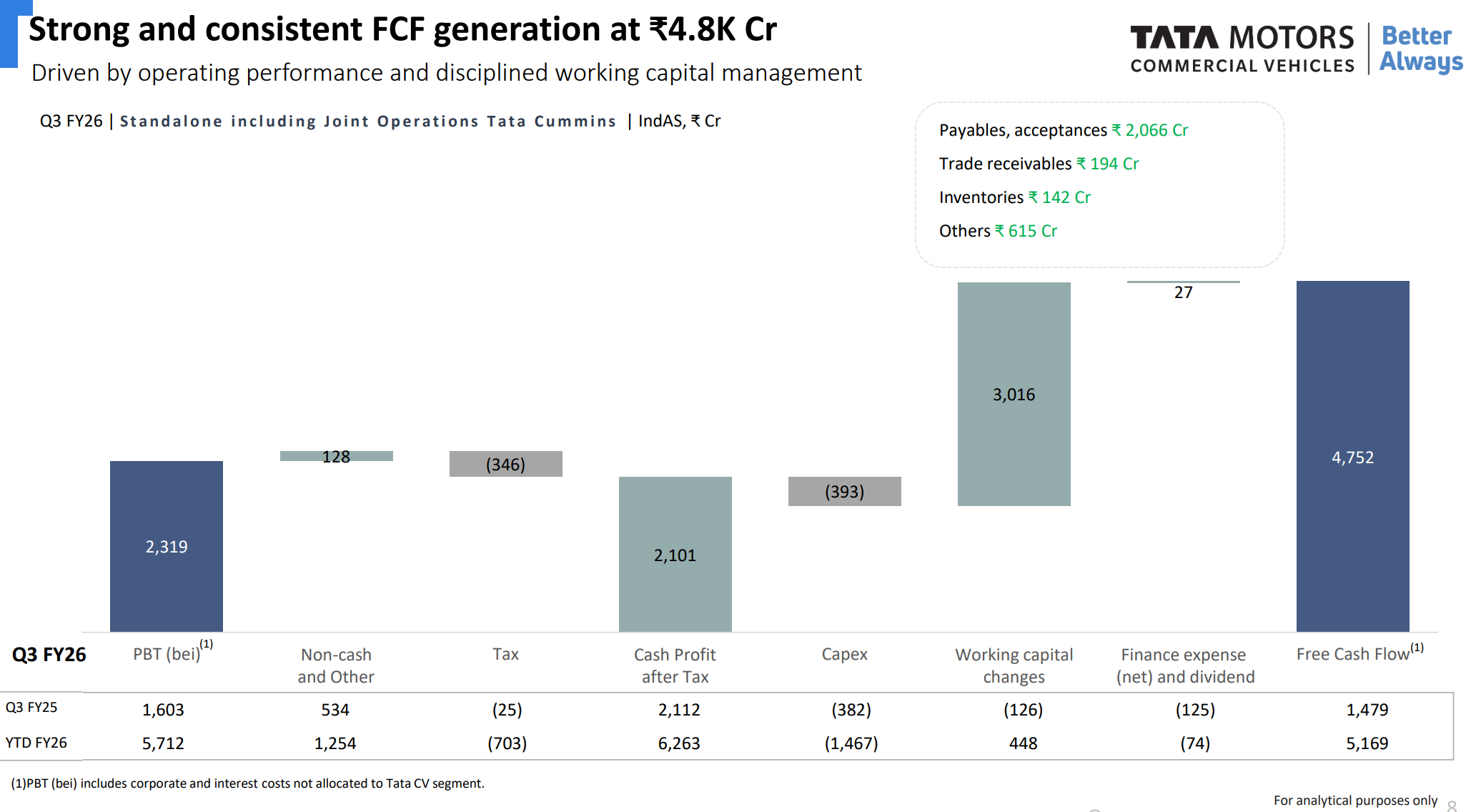
FCF build (with capex, depreciation, working capital, and interest):
(Values in ₹ cr)
| Column 1 | Column 2 | Column 3 | Column 4 | E | F | G | H |
|---|---|---|---|---|---|---|---|
| Year | EBIT | Depreciation | CapEx | Δ WC | Interest | Tax | FCF |
| Y1 | 10,600 | 5,000 | 8,000 | 1,000 | 2,660 | 2,000 | ~11,000 |
| Y2 | 11,400 | 5,200 | 8,300 | 1,040 | 2,450 | 2,300 | ~13,000 |
| Y3 | 12,550 | 5,400 | 8,650 | 1,080 | 2,200 | 2,700 | ~15,000 |
| Y4 | 13,500 | 5,600 | 9,000 | 1,120 | 2,000 | 3,000 | ~17,000 |
| Y5 | 14,500 | 5,800 | 9,400 | 1,160 | 1,800 | 3,600 | ~19,000 |
Key points:
- CapEx is disciplined but meaningful (4% of revenue roughly)
- Working capital increases, but not aggressively
- Interest burden reduces over time (assumed repayment)
- Tax paid only on operating profit (EBIT) minus interest: gives realistic PAT conversion
- FCF is positive from Year 1, and grows strongly — this supports the debt paydown plan
Comparison vs Global CV / Truck OEM Peers
To understand how Tata-Iveco stacks up vs major global CV players (in terms of profitability, ROCE, leverage), here’s a comparative framework:
- Peer Margins & ROCE Context
- According to Tata’s management, combined ROCE is expected to stabilize around 20%.
- Broader CV / truck OEM average “return on sales” (ROS) for global players: According to Berylls, many global truck OEMs (Daimler, TRATON, Volvo) had adjusted ROIs / margins in the 6–8% range in some years.
- Thus, a 6–7% EBIT margin is broadly competitive.
- Leverage & Capital Efficiency
- Tata is taking significant debt (bridge loan) to acquire Iveco.
- But they plan to repay the acquisition debt in ~4 years via cash flows + some equity + monetisation of Tata Capital stake.
- S&P (credit rating agency) acknowledges the debt but expects the CV business to maintain a “strong balance sheet” on its own after demerger.
- So while leverage will be high early on, the plan and cash flows support a reasonable deleveraging path.
- Synergy Realization & Risk
- Cost synergies: Procurement, R&D, platform sharing. Tata has identified opportunities in overlapping R&D (~40% overlap) and sourcing optimizations.
- Revenue synergies: Potential to sell Iveco trucks in India and Tata’s products in LatAm / Europe.
- Risk: Legacy European cost structure, union issues, and integration risk remain. Business-standard notes that operational savings are not trivial but there are “legacy costs.”
- Overall, execution risk is non-trivial but the upside is large if synergies are captured.
Sensitivity Analysis (How Key Variables Impact Value & Profitability)
Here are a few “what-if” scenarios and how they could materially change the outcome.
| Column 1 | Column 2 | Column 3 | Column 4 |
|---|---|---|---|
| Variable | Base Assumption | Sensitivity Range | Impact on Valuation / Profitability |
| Interest Rate on Acquisition Debt | 7% | 6% – 9% | At 9% interest, the interest cost rises → reduces PAT and FCF by ~₹400–600 cr/year → lowers DCF value by ~₹10,000–15,000 cr. At 6%, value is more comfortable. |
| Synergy Realization Speed / Magnitude | +1.2% EBITDA uplift by Year 5 (from synergies) | Range: +0.8% to +2.0% | If synergies are only +0.8%, EBIT and FCF trajectory is weaker, reducing EV by ~₹15,000 cr. If +2%, value could jump by ₹10,000–20,000 cr. |
| Terminal Growth Rate (g) | 3% | 2.0% – 4.0% | At 2%, Terminal Value shrinks, EV falls by ~₹25,000 cr. At 4%, EV increases materially. But 4% is aggressive for a mature CV business. |
| CapEx Intensity | 4% of Revenue | 3% – 5% | If capex is 5%, free cash flow is lower → value goes down. If capex is 3%, FCF is higher, boosting valuation. |
| Working Capital Requirement | 0.5% of revenue | 0% – 1% of revenue | If WC needs are intense (1%), FCF drops, EV falls. If WC requires are minimal (0%), more cash is free → higher value. |
Key Risks to Watch (in this Valuation & Cash Flow Scenario)
- Execution Risk on Synergies
- If procurement / R&D synergies are delayed, the FCF ramp-up will be slower.
- Cultural integration (India-Europe) may eat into expected cost savings.
- Macroeconomic Risk
- European CV demand could weaken → impacting Iveco’s revenue.
- Rising interest rates may increase refinancing costs beyond what Tata expects.
- CapEx & Technology Risk
- EV and hydrogen CV technology will need continued investment.
- If Tata-Iveco underinvests, they may lose competitiveness; if they overinvest, FCF could strain.
- Regulatory Risk
- Emissions regulation (e.g., EU) could impose costs.
- Trade/access issues in some markets.
- Debt Risk
- If cash flows don’t materialize as expected, repayment of the acquisition debt may stretch.
- Refinancing risk post-bridge loan if markets are unfavorable.
Hopefully this analysis helps every one who is interested in TMCV