
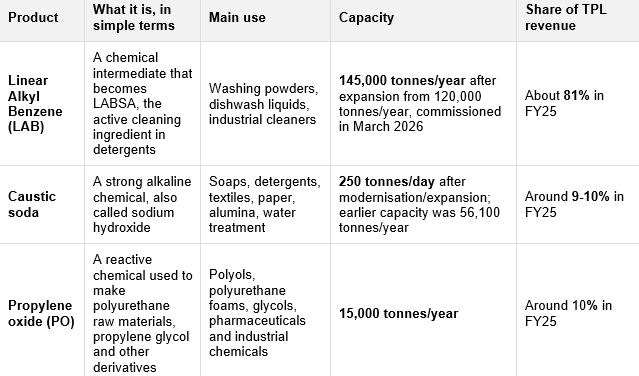
Tamilnadu Petroproducts Ltd (TPL) is a petrochemical converter. It buys crude-linked inputs such as kerosene/n-paraffin and benzene, converts them into chemicals, and sells them mainly to detergent, FMCG, and chemical companies. Its most important product is Linear Alkyl Benzene (LAB), the key raw material used to make detergents.
LAB – The Core Business
The detergent powder: the cleaning power comes from surfactants. Manufacturers first convert LAB into LABSA, which is then blended into detergent formulations. So when people buy more detergent, shampoo bottles, dishwash liquid, or industrial cleaners, demand for LAB rises.
TPL’s LAB plant is located at Manali near Chennai and is the only LAB manufacturer in South India. It sells largely to large FMCG companies under annual off-take agreements, where prices are revised monthly based on international raw-material prices.
Example: If Hindustan Unilever, Procter & Gamble, or Nirma needs LABSA for a new detergent launch, it may buy LAB from TPL, convert it into LABSA, and use it in Surf Excel, Ariel, or comparable detergent brands. TPL’s top five LAB customers account for more than 80% of that division’s sales.
Market share: LAB
Domestic capacity share: TPL represents roughly 23% of India’s LAB production capacity, according to CARE Ratings. Market leader in South India where it holds over 85% share.
Domestic demand share: India’s LAB market was estimated at about 562,000 tonnes in 2025; TPL’s expanded 145,000-tonne capacity equals roughly 26% of that demand if fully utilised.
Global share: The global LAB market was about 4.41 million tonnes in 2024. TPL’s 145,000-tonne capacity is therefore approximately 3.3% of global capacity/demand, though actual sales share may be lower because TPL is primarily domestic-focused.
Competitive position: TPL is a domestic market leader in South India and one of India’s main LAB producers alongside Reliance Industries, IOCL, and Nirma.
Global LAB supply has remained tight globally as many plants took maintenance.
Italy mothballed a 220 KTPA LAB plant citing high European energy costs.
FMCG-linked LAB demand remains structurally strong.
Shift to liquid detergents using LABSA 96% is lifting LAB demand.
It is exploring non-detergent LAB uses such as crop protection and EOR polymers.
LAB product Value Chain:
LAB’s value chain starts with crude oil and ends in the detergent powder or dishwash liquid in a household. TPL sits in the middle: it buys crude-derived feedstocks, makes LAB at Manali, and sells it mainly to detergent manufacturers, who convert it into the active cleaning ingredient.
Crude oil
↓ Refining
Kerosene / jet-fuel cut + naphtha
↓ Separation / refining
n-paraffins (C10-C14) + benzene
↓ TPL: dehydrogenation
Linear olefins
↓ TPL: alkylation with benzene
Linear Alkyl Benzene (LAB)
↓ Customer: sulfonation
LABSA / LAS
↓ Neutralisation and formulation
Detergent powder, dishwash liquid, industrial cleaner
↓ Retail
Households, hotels, hospitals, industry
Backward Integrated (Raw Material)
One of the major raw materials required for manufacturing LAB is N-Paraffin (NP). TPL has an in-house facility to manufacture NP, which provides cost competitiveness against imported NP. With the backward integration, dependence on higher cost imports of N-Paraffin has gradually reduced.
In the HCD business, the major by-product in the production of caustic soda is chlorine. Disposal of chlorine is a major challenge faced by Caustic Soda units. However, with the in-house Propylene Oxide (PO) plant using the hydrochlorination process for manufacturing, there is an increase in the captive consumption of chlorine and higher utilisation of the caustic soda unit. The capacity utilisation of caustic soda plant has been consistently high at ~70-80% over the last four years.
Capacity Utilisations:
The LAB plant maintained a high utilisation rate of 80%-90% over the last three years, except for FY24, where it dropped to 74% due to a 54-day production disruption caused by a cyclone Michaung in December 2023 and subsequently revived back to 86% in FY25.
Caustic soda and chlorine
Caustic soda is produced by passing electricity through salt water in a process called chlor-alkali electrolysis. This creates two products: caustic soda and chlorine.
Example: A textile mill may use caustic soda to treat fabric; a soap maker may use it in saponification; an aluminium producer may use it to refine bauxite. TPL uses some chlorine internally to make propylene oxide and sells the rest to Manali Petrochemicals.
Market position
TPL is a meaningful regional producer but not a dominant national or global caustic-soda player. Its caustic-soda plant has generally operated at about 70-80% utilisation, and the company’s new 250-tonne-per-day cell house is meant to improve efficiency and support higher chlorine offtake.
Propylene oxide
Propylene oxide is a chemical building block. TPL sells its entire PO output to group company Manali Petrochemicals Ltd (MPL), which uses it to make downstream products such as polyols and propylene glycol.
Example: Polyols made from PO can go into flexible polyurethane foam used in mattresses, car seats, furniture cushions, and insulation. Propylene glycol can be used in pharmaceuticals, cosmetics, food applications, and industrial fluids.
Market position
TPL’s PO capacity is 15,000 tonnes/year.
Its commercial exposure is limited because all PO is sold to MPL (Manali Petro), making it more of an internal value-chain product than a broadly marketed commodity.
Globally, TPL’s share is negligible; China has very large PO capacity, with individual Chinese plants often larger than TPL’s entire PO facility.
What happens if crude stays at $100?
Pass-through pricing: TPL’s LAB contracts are repriced monthly based on international raw-material prices, so it can eventually pass most feedstock inflation to customers, due to which value growth will be more than 50% which will offset the volume degrowth if any.
Inventory gains: If crude and feedstock prices rise quickly, TPL may sell chemically produced inventory bought at lower cost, temporarily boosting margins.
Import protection: India imposed five-year anti-dumping duties on LAB imports from Iran and Qatar in June 2025. This makes it harder for cheap imported LAB to undercut domestic producers, improving TPL’s pricing power.
Higher competitor costs: Middle Eastern and other global LAB producers also face higher feedstock costs, which has lifted global LAB prices and the Straight of Hormuz disruption is helping them in terms of the landed import price of LAB which is much higher than the pre-war realizations.
Benefit from China petrochemical closures
China’s closures could help TPL, but the benefit is indirect and uncertain. TPL mainly sells in India, so it does not directly export large volumes to China; its FY25 LAB exports were only 40 tonnes to South Korea, or 0.04% of turnover.
Where it can help
- Higher Asian chemical prices: If Chinese caustic-soda, PO, or related chemical supply falls, regional prices can rise. That may improve TPL’s realisations for caustic soda and chlorine/PO-linked products.
- Fewer competitive imports: If Chinese or Chinese-linked supply becomes less available, Indian buyers may rely more on domestic suppliers such as TPL.
- Better utilisation: TPL’s expanded LAB capacity needs demand and stable pricing; a tighter regional supply environment supports both.
Firm off take contracts - In these contracts, TPL agrees to supply a fixed quantity of LAB throughout the year. The price is not fixed for the entire year; instead, it is adjusted every month based on international raw material prices, so that both sides are protected if prices change a lot.
Capacity Expansions:
LAB revamp completed on 11 March 2026, raising capacity from 120 to 145 KTPA.
Caustic Soda modernisation completed in Q4, raising capacity from 150 to 250 TPD.
Risks:
NP sourcing was a challenge as refiners used NP in-house and market supply vanished (Raw Material Sourcing Risk).
Any delay in capacity expansions and volume ramp up of the new capacities (Execution risk).
Crude oil and Natural Gas prices cooling off and global disruptions easing.
Caustic faces domestic glut at ~78% utilisation and new capacities in South and West India.
Investment Thesis
LAB realizations have gone up by almost 2x in the last 6 months. Current realizations stand at 2,400$ per tonne, which pre war stood at 1,200-1,300 $ per tonne.
Looking at the current levels of crude oil and expecting it to stay between 80-110$ per barrel, TN petro can clock almost 240-280 Cr PAT in FY27 (which will be the highest PAT) and currently trades at 4-5x PE on FY27 PAT basis. Q4FY26 had a one-off plant shutdown (Original 60-day LAB shutdown extended by ~30 days due to execution delays) due to which already FY26 base is low in terms of revenue and PAT. It can post record 3,200 Cr Revenues in FY27, which will be the highest revenues in history and trades at 0.3x Price to Sales.
Q1FY27 PAT growth was 128%. With similar numbers (should be higher as new capacity is commissioned and crude oil has stayed at elevated levels), Q2FY27 PAT growth can again be 120-130% on a YoY basis.
Consistent results delivery can provide almost 70-100% upside in the next 1-year time.
Disclosure: Invested and Biased