Not sure, but company had given clarification to SEBI on volume increase that there is no important update
Anyone has clarity in why the share is moving so much so quickly?
These are findings from Google bard AI
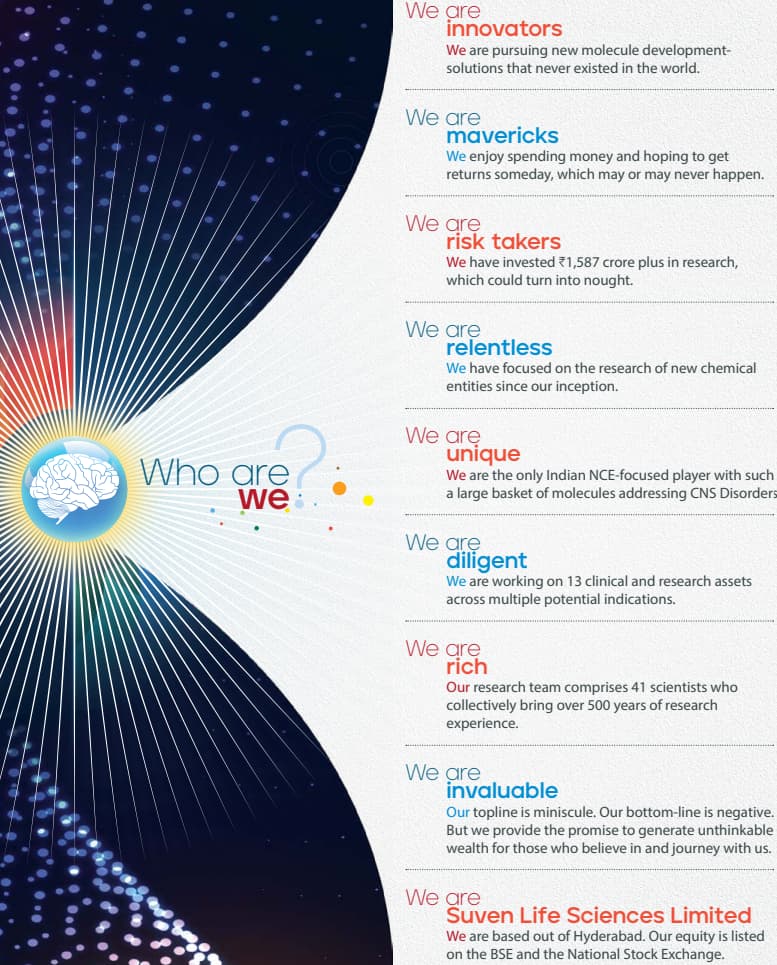
Very unique declaration, must read the annual report
https://www.bseindia.com/xml-data/corpfiling/AttachHis/007c45d2-6a1a-4596-8455-e89552d6590a.pdf
[Suven Pharma acquires a majority stake in a CDMO company for ~230cr]
Venkat Jasti’s billion-dollar gamble: Can Suven Life crack the CNS drug puzzle?
Hi learned members, can someone tell me why the stock keeps going up and up when both sales and profit growth have been negative since a couple of years?
Co is raising 850 Crs, lot of marquee investors are putting in the money. Read this note carefully.
https://www.bseindia.com/xml-data/corpfiling/AttachHis/4adfffe6-a28c-4a70-b253-6033aeeeaa24.pdf
Pls note the price of the warrants issued. This is highly highly risky bet, depends upon the success of molecules being developed.
Was really looking forward to the Annual Report
Suven FY25 AR.pdf (6.6 MB)
Read the first 15 odd pages till Chairman’s message. In this company numbers won’t tell you anything. Everything is future looking and ![]()
Not sure if you are as excited as i’m ![]()
Key New Molecule Entities for Suven Life
-
SUVN-502 (Masupirdine)
Previously it was being developed for Alzheimer’s and dementia and but in its Phase 2 trial of 564 patients it failed to meet its stated endpoint however on further analysis it was found that at least 40 patients with agitation symptoms had shown improvement. Suven then requested USFDA to approve a trial focused on these types of patients. Since then, the objective has changed to Agitation and Aggression in Alzheimer’s type dementias for which Phase 3 studies are ongoing.
A similar molecule ( Idalopirdine ) by a European company ( Lundbeck ) addressing Alzheimer’s was out licensed in July 2013 to a Japanese company ( Otsuka ) for an upfront payment of $150 Million with milestone based payments of ~$675 Million on clearing of regulatory and sales based milestones. However it failed its Phase 3 trials in 2017. But in 2023 their other drug Rexulti received USFDA’s approval for Treatment of Agitation Associated with Dementia Due to Alzheimer’s Disease. It was developed in partnership with Lundbeck and is marketed by both the companies however it was already in the market as a drug with focus on Schizophrenia and Adjunctive Treatment for Major Depressive Disorder. Rexulti did sales of Rs. 22,000 Crores in CY24 worldwide (denominated in YEN/DKK originally), but that can’t be taken as a proxy for Suven’s drug as its indication targets a smaller and niche problem compared to a blanket cover for Rexulti.
Globally there are about 50 million people living with Alzheimer’s disease and since this disease generally starts to affect people when their age crosses 60, it is expected that the patient base will increase rapidly over the next decade as geographies with large old-age demographics like Japan, USA, Europe etc. enter this age bracket in increasingly higher numbers.
Note – During the 2002-2012 decade 244 drugs were tested for Alzheimer’s related use cases, out of which 54 went onto Phase 3 trials and only 1 drug was approved for marketing (Failure rate of 99% overall and 98.2% for Phase 3).
Phase 3 Clinical Trials updates can be found here - https://clinicaltrials.gov/study/NCT05397639
Approximately 375 participants will be enrolled at approximately 50 centres worldwide.
Completion of the trial is expected by end of 2026 with results declaration by 2027.
(Study Start Date is incorrect as the endpoint was changed when the previous phase 2 trial failed, actual start date is – September 2015)
Clinical Trial comparison between SUVN-502 and Rexulti
Since SUVN-502 was originally meant for a different use case and upon its Phase 2 failure in 2019, Suven found that in its Phase 2 trials a particular group of people with Alzheimer’s symptom of Agitation was being addressed by their drug so they requested the FDA to make their Phase 3 trial about addressing Agitation in Alzheimer’s. So due to this conjunction the drug was not tested exclusively for this use case during the 2019’s Phase 2 trials. Agitation studies require standard metrics to be used like CMAI but since the original study was not focused on agitation, this metric was not used. On comparing the clinical trials results for SUVN-502 and Rexulti, we found that Rexulti was using the CMAI metric while SUVN-502 was using NPI, MMSE etc which don’t exclusively measure agitation in participants hence we can’t gauge whether SUVN-502 has an edge over Rexulit until Phase 3 is completed which has the CMAI metric we require to assess the efficacy and probability of success.
-
SUVN-G3031 (Samelisant) - Narcolepsy, Phase 2 POC - Clinical Study
The Phase 2 study met its primary endpoint, with samelisant demonstrating statistically significant and clinically meaningful reduction in EDS measured by the Epworth Sleepiness Scale (ESS) total score compared to placebo at Day 14 (p<0.05).
Narcolepsy is a rare disease with about ~3 Million people globally affected by Narcolepsy.
According to Suven’s AR24, their molecule for Narcolepsy is superior than other approved pharmacological agents as those mostly fall under the scheduled treatment options with abuse potential while those with non-schedule treatment options have limitations related to cardiovascular safety and other drugs interaction safety. Samelisant is most likely to not be a scheduled drug.
Suven says that based on their pharmacokinetic and pharmacological profile, Samelisant may not have such issues, indicating the differentiation over the currently available pharmacological agents.
Phase 3 Clinical Trials updates can be found here -
https://clinicaltrials.gov/study/NCT04072380Phase 2 has been cleared successfully in 2023 and Phase 3 is expected to be initiated in Q2FY26.
Participants for Phase 3 will need to be recruited across the world and which will take time and may delay the trials.
There are 3 major drugs already approved and commercialised catering to this disease –
1. XYREM – Acquired by Jazz Pharma in 2005, Xyrem is a scheduled drug for treating symptoms of narcolepsy like excessive daytime sleepiness, sudden music weakness etc. It was doing ~$1 Billion in yearly sales until generics started commercialising and a competing drug WAKIX was launched. It did sales of $233 million in CY24.
2. WAKIX – Launched by Harmony Biosciences in 2019-2020 after receiving FDA approval for EDS in Adult Patients with Narcolepsy and later it also received approval for treatment Of Cataplexy in Adult Patients with Narcolepsy.
It did sales of $714.7 million in CY24.
It is not a scheduled drug which is leading to higher adoption over other scheduled drugs operating in this segment.
- SUNOSI – Launched by Axsome Therapeutics which it acquired from Jazz.
It is also a scheduled drug for treating symptoms of narcolepsy like excessive daytime sleepiness. It did sales $94.3 million in CY24.
Combined Sales of all 3 drugs in CY24 was Rs. 8,752 crores.
XYREM has lost its market share as it’s a scheduled drug whereas WAKIX is not.
Clinical Trial comparison between SUVN-G3031 and WAKIX
On comparing SUVN-G3031 with Wakix we found that their efficacy is very similar (measured by ESS - Epworth Sleepiness Scale).
Efficacy for SUVN-G3031 (Phase 2)
Efficacy for WAKIX (FDA Label)
SUVN-G3031 also had similar Treatment emergent adverse events (TEAEs) and minimal severe TEAEs as that of Wakix. (TEAEs can also be considered as Side Effects of the drug)
Based on my limited review of the Clinical Trials results of SUVN-G3031 and Wakix, I believe G3031 has fair chances of clearing Phase 3 trials however there is no clear edge over Wakix as the efficacy seems to be the same. Good thing to note is that G3031 is most probably a non scheduled drug which gives it a edge over Xyrem and SUNOSI but Wakix will remain a threat.
-
SUVN-911 (Ropanicant)- Major Depressive Disorders, Phase 2b Trials ongoing
Ropanicant addresses patients with Major Depressive Disorders (MDD). Suven plans to advance Ropanicant into a double-blind, placebo-controlled Phase-2b clinical study in MDD patients, which has begun in 2025 and results are expected in 2026/2027.
Suven’s AR24 says that Ropanicant addresses major limitations of current antidepressants by offering rapid onset of action, no sexual dysfunction and pro-cognitive effects (non-clinical data).
Phase 2 Clinical Trials updates can be found here -
https://clinicaltrials.gov/study/NCT06126497I could not find much info available about this molecule and since its also a early stage one, any monetization is very far off into the future.
-
SUVN-D4010 (Usmarapride) - Depression, Dementia, Planning for Phase 2 POC- Initiation by Q4FY25
-
SUVN-I6107 - Central Nervous System (CNS) disorders - Phase 1 Trials ongoing.
Suven Life has 11 other molecules in pipeline which are still in the Research & Development stage.
-
Drug discovery costs
Cost differs in every Phase of the trial as each successive phase requires more clinical data which requires a larger participant base to test on (Phase 3 trials can require more than 1,000 patients). There are initial incubation and R&D costs as well.
1. Phase 1 - $2-8 million – Safety, tolerability
2. Phase 2 - $10-20 million - Safety, tolerability and efficacy
3. Phase 3 - $20-50 million – Similar to Phase 2 but happens on a larger scale.Therefore, it is essential that the end drug use market should be at least enough to cover the cost of trials to make commercial sense.
Generally these R&D costs are met by the pharma company’s other pharmaceutical businesses which allows the R&D departments to work interrupted and free from fund raising challenges, however since Suven Life Sciences has now been demerged from Cohance and is now independent but since it is backed by a dedicated promoter who can fund these costs, Suven’s R&D can go on at least for the next few years. Suven also had raised ~Rs. 850 Crs. from the promoter as well as from DIIs/HNIs in 2025 which gives it ~2-3 years runway if warrants are converted.
-
Drug Discovery Monetization
Partnership with bigger pharma companies -
Since Suven is not housed under any big pharma company and will have cost and funding constraints, Suven can partner with other pharma companies if those companies find promise in the new molecule and its clinical trial results. Some of the ways to structure it are -
-
Outright sale of the discovered molecule - This can happen at any stage of the drug discovery process and payouts will depend upon the progress of the drug trials and also on the Total Addressable Market by the drug.
-
Collaboration and sharing of profits - JV, Partnerships.
-
Royalty Financing - If the acquiring companies see promise in the drug, they may offer some upfront payment (5-20% of Expected Peak Annual Sales) to fund the trials and then agree upon a royalty arrangement where the discovery company may receive lumpsum payments or yearly payments based on sales and regulatory based milestones.
-
Some past and current case studies with similar drug discovery characteristics in India are - Wockhardt, Glenmark Pharma, Orchid Pharma, Panacea Biotech etc.
There are many other nuances in drug discovery/monetization process like Insurance coverage, Marketing agreements, Doctor Community Acceptance, Adoption curve, Patent expiries and associated exclusivity periods, Affordability etc. which are unique to every situation and company.


