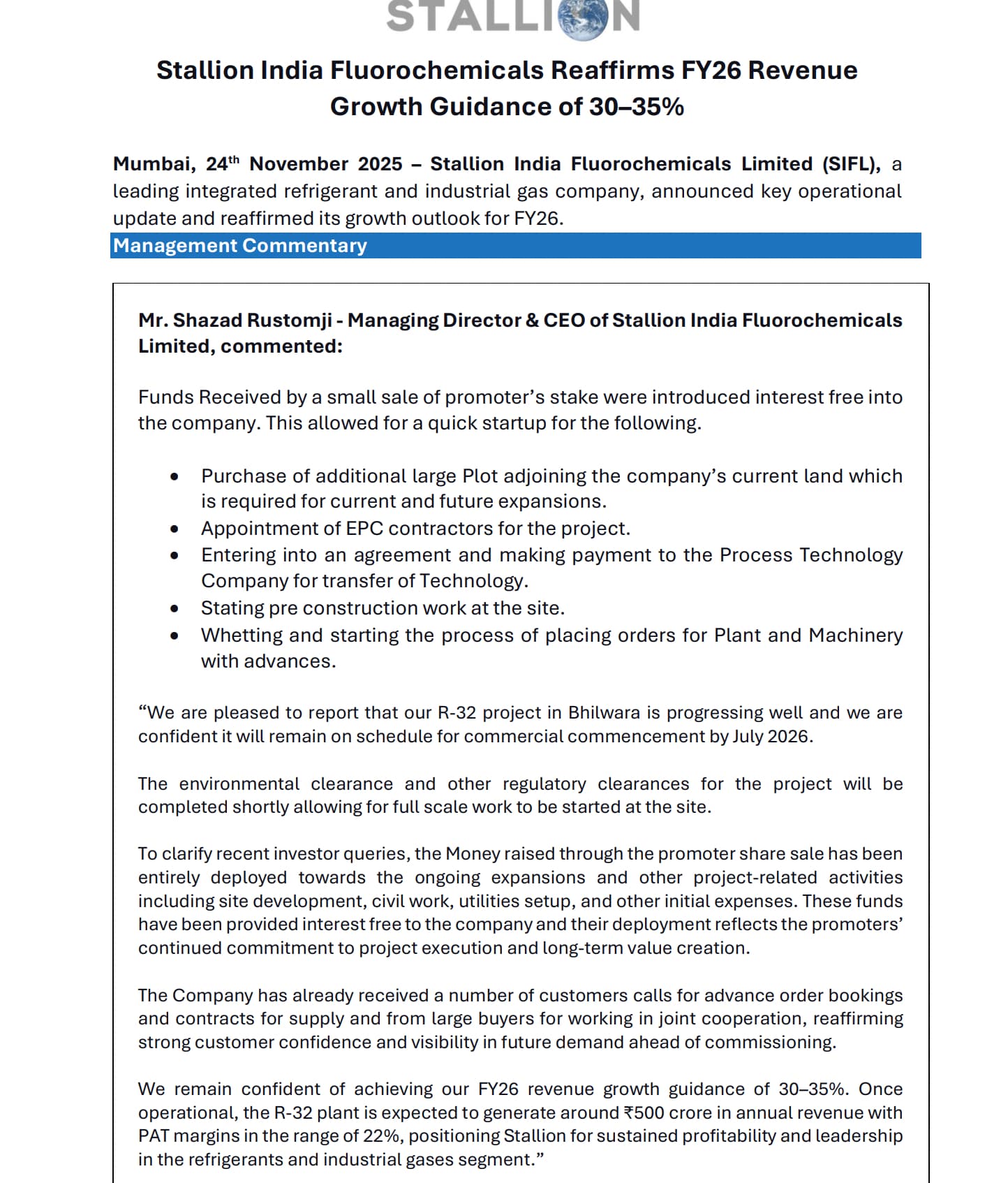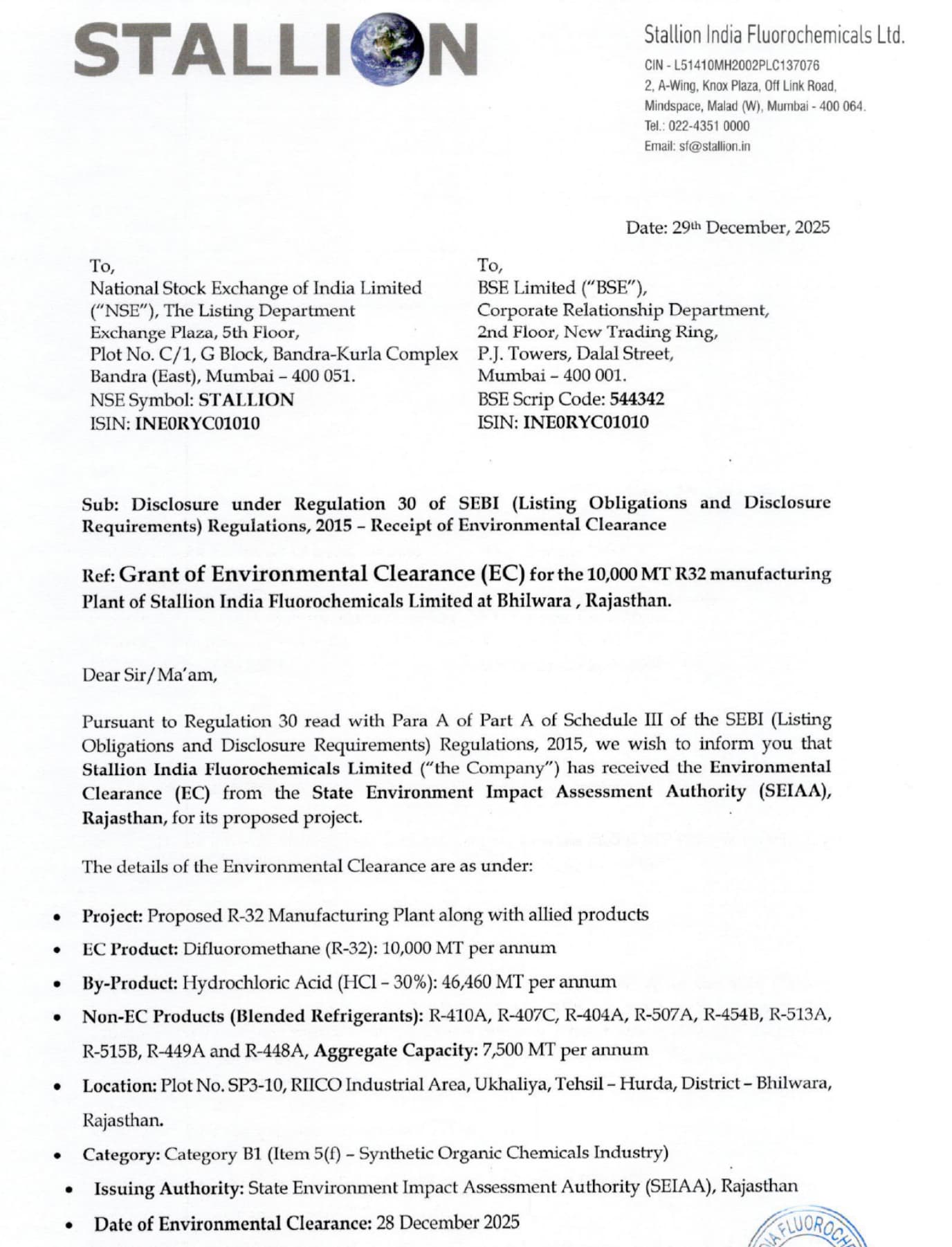
While I find the above news as positive, my main concern lies around very low “volume to delivery” ratio. Approx 20% to 30%. It is decreasing since July
@Satishwe Do you find this concerning ?
Would love to know your views
Disclosure: Not invested
While I find the above news as positive, my main concern lies around very low “volume to delivery” ratio. Approx 20% to 30%. It is decreasing since July
@Satishwe Do you find this concerning ?
Would love to know your views
Disclosure: Not invested
I don’t track the volumes or technicals that much as i don’t understand it well.
Anyone else who has good knowledge about this could comment.
I have reviewed the last three concall transcripts again, and at no point did the management mention anything about selling their personal shares or providing interest-free loans to the company. Had it been communicated earlier, the market reaction might have been different.
The underlying issue appears to be a cash flow problem. While the company is growing aggressively, its operations are not yet generating enough free cash to fully support the ambitious capacity expansion underway across Rajasthan, Mambattu, and Khalapur. So far, management has repeatedly stated that expansions are being funded through internal accruals and bank borrowings, but recent developments suggest liquidity pressure may have started showing up. (Just my guess)
At this stage, the best outcome would be if some institutional investor engages with the management, clarifies the situation, and provides some kind of support to the stock.
Technicals: The stock has now closed below its 50 EMA for the second consecutive day. A sustained close below the 200 EMA (around 170) could be a warning sign that something is wrong with the company.
Invested with a small allocation.
was studying Navin Fluorine International Concall and found some insights from the management on the R32.
Navin fluorine is doing a capex of 236 crores for additional HFC capacity equivalent up to 15,000 MTPA of R32 which is expected to be commissioned by Q3 FY '27.
the management mentioned that the supply situation is going to be more constrained for R32 due to consumption cuts coming all over in the west and China is going to cut 10% capacity in 2029 itself whereas India is going to cut in 2032.
They also mentioned that the additional capacity can come through India only where new capacity cannot be added after 2026. the world is moving to low GWP (Global Warming Potential) gases, and this is supercharging demand for R32 in blends and new A/C (RAC) units.
An analyst did the math on their revenue projections and asked if they were assuming a price of $4.5 to $6.5 for R32. The CFO didn’t confirm the exact number but did say they expect the "pricing environment will remain firm.
This new capex is strategically designed to use their “full entitlement under the quota” provided by the Kigali Montreal Protocol. They have a license to produce, and they’re building the factory to max it out.
Disclaimer: Invested and views may be biased.
There are enough experts on the forum to comment about business quality and technicals etc. So I won’t go into that. But I’d like to share a few thoughts on promoter quality.
They did an IPO in Jan’25 for Rs 200 crores out of which they net received ~Rs. 150 crores. The IPO was oversubscribed 188x overall suggesting massive demand at the offer price. As a result of this IPO, Promoter ended up with ~68% share of the company from 94% pre-issue stake - a 26% dilution!
Just 8 months after IPO (in Aug’25), promoter started saying they need to raise another Rs 200 crores for Bhilwara facility and selling their stake (this time ~3%) to give that money to the company interest free?! And who are they selling it to? Why are they not hiring I-Bankers/Institutions and raising money the proper way again? Why are they not engaging lenders to raise debt when B/S is hardly levered?
Interestingly, DRHP/May’25 concall don’t mention anything about Bhilwara facility or “backward integration” anywhere, and in Aug’25 concall, they mention “backward integration” 14 times plus announce Bhilwara capex. Why are strategic priorities shifting so abruptly? What is the hurry?
All these actions suggest poor business planning, poor strategic thinking and poor personal financial planning on the part of promoter.
Add to it promoter’s lack of basic financial sense - inability to answer queries around negative Operating cash flow, queries around inventory levels. These simply look like red flags to me.
Again these are just my thoughts and I’m open to be fact checked/countered with thoughtful opinions by investors in the scrip!
Disclosure : Not invested. Above is not investment advise. Please do your own research.
Stock has been listed for less than 12 months and is yet to create meaningful supports/resistances. I wouldn’t read too much into price action or technicals myself until this business goes through one complete Price maturation cycle.
Found this is posted today. I could not get any new insights form what is already known. But sharing here for further research.
His earlier posts on many other stocks too have pessimistic view, but stocks have done well ( ex in same sector as stallion https://www.drvijaymalik.com/linde-india/) .
https://www.drvijaymalik.com/stallion/
Summary:
Stallion India Fluorochemicals Ltd has increased its sales sharply by 33% year on year over FY2021–25; however, it operates in commoditised refrigerant gases without any meaningful differentiation, and its products are easily replaceable, taking away the pricing power of the company. As per the management, current profit margins represent peak profitability and are difficult to sustain. The company is unable to pass on volatility in input prices to its customers because its business is very low-value-adding.
The company faces intense price-based competition from much larger, integrated global and domestic players. The Indian market faces oversupply, which, coupled with very cheap imports from China, makes it a very difficult market to operate. As a result, Stallion India Fluorochemicals Ltd has lower margins when compared with its peers.
The business of refrigerant gases is capital-intensive due to non-fungible machinery; each gas requires dedicated equipment. Moreover, the business is highly seasonal, due to which players have to create a higher capacity just during the peak season of February–May.
The company faces high risks from a regulatory and technological perspective. Moreover, Stallion India Fluorochemicals Ltd.’s heavy reliance on the relationship with Honeywell is risky because the agreement is non-exclusive and requires renewal every three years. Also, the patents of HFOs will soon expire, which will open the market to all players.
The company’s business is working capital-intensive. The company holds large inventories to manage import-related delays and experiences high receivable days with regular write-offs. Despite reporting ₹89 crore of cumulative PAT over FY2021–25, it generated a deeply negative cumulative CFO of -₹90 crore, resulting in negative free cash flow.
As a result, all capacity expansions, including Khalapur, Mambattu, and the proposed R32 manufacturing plant in Bhilwar, are being funded through IPO proceeds and fresh equity raises, and not from internal cash generation.
A single executive director of the company, Ms Geetu Yadav, has received the highest compensation, has been gifted shares worth ~₹30 crore, and is allocated 50% of ESOPs, but she has a limited attendance in board meetings and almost nil participation in conference calls.
Stallion India Fluorochemicals Ltd witnessed a sharp increase in the promoter and executive remuneration in the IPO year. Similarly, rent payments to the promoter increased significantly in the IPO year. Reports by the monitoring agency, CARE, have highlighted missing invoices, untraceable transactions, and excess spending on issue (IPO) expenses without shareholder approval.
Project execution by the company has been repeatedly delayed despite aggressive commitments. Instead of completing the projects quickly, Stallion India Fluorochemicals Ltd has continuously expanded the scope of its projects.
The company withheld payments to an old supplier and paid only after the supplier complained to SEBI.
Promoters have also withdrawn significant money, more than ₹115 crore, from IPO’s offer-for-sale proceeds, loan repayment, and subsequent market sales during a sharp stock correction.
Going ahead, an investor should closely track the company’s ability to generate positive and sustainable operating cash flows, and the timely and efficient execution of ongoing and proposed expansion projects. She should monitor the renewal terms of the Honeywell agreement as well as any stress on the balance sheet due to large expansions. She should assess the efficiency of working-capital management as well as changes in the shareholding of promoters to assess whether promoters withdraw further money from their investments in the company.
Disclaimer- I am heavily invested including my group from 95/100 levels. I have met people from the company and discussed. Of course there is a limited understanding. While every money management should be backed up by risk management, it’s imperative to have a detailed view considering so much confusion prevailing including misinformation.
Let us understand what this company is and what we are talking about!
CONCISE SUMMARY OF POSITIVE ARGUMENTS
1.Fluorochemical and speciality gas structural growth. The Kigali amendment is the single most important driver.
2. HFO’s from HFC. Low GWP. Stallion first mover advantage and dedicated plant.
3. Geographical split of plants, asset light model and low lead time for OEM JIT (Just in time). Management forecasts additional 200 crores from this alone with 3-4% increase in EBITDA margin.
4. Backward integration and in house manufacturing instead of imports.
5. Customer stickiness- upselling and long-term contracts with customers.
6. Value chain shift to new age sectors like aerospace, EV, 5G etc with higher margin and more entry barriers.
7. Management forecast 30-35% CAGR topline for next 3-4 years supported by increasing capacity.
CONCISE SUMMARY OF NEGATIVE ARGUMENTS
1.Import dependence on helium and cryogenic purification.
2. Working capital lock in for inventories and sales quota war.
3. Seasonal demand picks up, regulatory delays for Kigali. All this results in inventory build-up.
4. Revenue concentration for now-R-32. Maharashtra and Delhi
5. Absence of long-term procurement contracts.
6. Forex risk- 85% of costs imports linked
PART 1- HISTORY OF COMPANY
History till IPO- this is a Mumbai based company specialising in the processing and distribution of refrigerant and speciality gases. The company was founded by Shahzad Sheriar Rustmoji, a first-generation entrepreneur at the age of 22 (1991). Next year (1992) Mr Rustomji pivoted to the fluorochemical sector sensing growing demand in the AC and refrigeration market. Formal incorporation came during 2002 when Stallion India Fluorochemicals was registered as pvt ltd company. The initial focus was to debulking (breaking bulk shipments to smaller quantities) and bottling of refrigerant gases. Panvel opened the facility in 1998, Manesar came in 2002.
The promoter wanted to play a midstream player by bridging between upstream manufacturers (like Honeywell) and end user OEM (AC, auto, pharma etc).
1998-2002: foundation- debulking and bottling at Panvel. Focus on HFC.
2006- Exclusive distribution agreement with Honeywell for HFC in India (50% of Honeywell’s output for India requirement- HFC plus others). This included adding/blending capabilities and expanding to pre-filled cans.
2013- Diversification- Commercialised HFC-32 with Daikin. Entered automotive AC gases.
2018- Blending expansion- full scale blending operations, targeting aftermarket (70% revenue). Fleet expanded to 5 facilities including Khalapur (Maharashtra) for high purity special gases.
2020- Northern Push- Launched Ghiloth plant in Rajasthan to serve northern markets. (Delhi/Maharashtra- 50% revenue). Boosted capacity to 37200 MT.
2023- Pre IPO- Conversion to Public Limited, brought ex Honeywell to board. Focused on ESG (low -GWP HFO for Kigali Amendment).
IPO and afterwards- Raised 199.45 Crores and offer for sale (0.45 Crore) at price band of 90-95 at 33% premium 126. Funds usage- 100 crore for working capital, capex on new facilities (50 Cr) and balance for general corporate purpose.
Evolution- small debulking unit to Honeywell partnership to JIT …now expansions like Bhilwara R-32 and HFO transition (low GWP gases)
PART 2- INVESTMENT ARGUMENTS
Product Portfolio- HFC- HydroFluorocarbons, next generation HFO-hydro fluoro olefins, speciality gases. Industry served- AC, refrigeration, semiconductors, pharmaceuticals, firefighting.
Maharashtra and Delhi contribute 74.41% of revenue, it’s a B2B (Business to Business) model which leans on blanket purchase orders, serving OEM and aftermarket. While refrigerant gases remain the primary revenue driver contributing 87.34% of product sales, R-32 alone comprises 13.15% of total revenue. HFO and speciality gases are exclusively supplied to OEM which demonstrates technical specificity.
Segmentation of end user:
Room AC- 23%, Automobile- 9.87%, Chillers- 9.24%, Aerosol-5.73%, Glass Treatment- 3.02%, Semiconductor glass- 0.07%
It imports 90% of its raw materials- China and relies on third party infrastructure which leads to fluctuating global prices and supply side risks unlike integrated giants like Linde which control upstream operations as well. To mitigate this Stallion is pursuing backward integration, planning to manufacture molecules like R-32 in house using fluorspar and hydrofluoric acid.
The decentralised manufacturing model allows bulk gas delivery over shorter distances reducing freight costs by 3 to 4 times compared to centralised operations. Also maintaining a smaller size of manufacturing facilities, it avoids unionised labour thresholds.
Total Capacity- 28800 MTPA
Khalapur- 10800 MTPA
Ghiloth- 7200 MTPA
Panvel- 7200 MTPA
Manesar- 3600 MTPA
New expansion- Mambattu- HFO debulking and blending -7200MTPA capacity catering to white goods manufacturers in Tirupati- Sricity corridor. Khalapur- high purity gases like liquid helium with 1200 MTPA capacity targeting electronics, medical imaging and medical research applications.
Post these expansions it will result in 37200 MTPA.
Each new upcoming facilities projected to contribute 100 Crore to annual revenue. The management expects 3-4% improvement in margins over the medium term. Speciality gases liquid helium will begin November 2025.
The Khalapur unit will feature infrastructure for ultra-high purity (99% plus) processing catering to semiconductors, medical imaging, space technology etc. Stallion will import high purity helium as India does not have much helium reserves and also capital-intensive nature of such operations. It is called trans filling operations where helium is decanted from tanks to smaller cylinders. These are critical for clean room conditions.
Key issues: a. Import dependency b. working capital stress (high inventory level, extended receivables cycle) c. revenue demand is cyclical.
Kigali agreement- 197 countries including India agreed during 2021 to replace HFC which depletes ozone. This creates a huge demand shift from R410A>R-32 to HFOs (R1234-yf, R-454B). The Bhilwara plant with 10000 MTPA and Manbattu HFO plant directly ride this wave. During the transition period of this agreement low GWP gases expected to command a 20-100% premium (already seen in EU/USA). This also forces manufacturers to make molecules in house as import quotas will tighten. In short, the Kigali agreement is the biggest tailwind for this industry. This creates a 20-25 year forced replacement cycle significantly uplifting growth and margin.
Key drivers for growth
1 India has been slow on HFC phase down under Kigali amendment offers a near term stability for Stallion’s product portfolio. Developed markets have moved aggressively to replace HFCs India freezes begin 2028 with 85% reduction target by 2047. This prolonged time period allows structural replacement for refrigerants like R-32.
2. Stallion is investing in HFO, the next gen refrigerants with ODP (Zero ozone depletion potential) and low global warming potential (GWP). Mambattu facility is a first mover advantage in Indian HFO market where direct competition is limited.
3. Flourochem and speciality gas are projected to increase at 16-18% CAGR through 2029 reaching around 675-725M USD. The sectors for growth- healthcare (medical devices, respiratory gases), automotive (coating and refrigerants), semiconductor/electronics (etching and disposition), aerospace/defence (high purity gases), data centers/quantum tech (fire suppressions and cryogenics).
4. Semiconductor and liquid helium- Khalapur aims to be a key supplier in the semiconductor eco system leveraging high purity gas infra. Initial revenue may get delayed as it requires strict qualification requirements, at same time it creates an entry barrier. The design of the semiconductor is going to be complex which will need niche gases which Stallion aims to supply. Given the absence of helium reserves in India Stallion’s trans filling model fills a critical supply chain gap with clean room grade handling systems.
5. Diversification of products- from commodity R-32 to HFO’s, speciality gases, liquid helium is a more structural uplift in the value chain. Speciality gases offer higher margin where decentralised hubs will lower the freight and labour costs and leverage its early positioning.
COMPETITION:
SRF- fully integrated (upstream to blends), Global HFC scale but less agile and more capital intensive.
Navin Flourine- Midstream, limited backward integration with R&D led to high value CRAMS. HFC portfolio is small.
GFL- Strong upstream, large HFC scale. HF in house and entering HFO. Focused more on polymers than gas blends.
Stallion- emerging, partial integration. Focussed on specialities and HFO. Small base imports are dependent for now.
Unlike fully integrated peers, Stallion is still building its upstream capabilities including plans to manufacture core molecules like R-32. The backward integration will reduce import reliance and enhance supply chain control.
Asset Turnover- 1.4 against industry average of 0.56 (higher efficiency because of low capex)
Fixed asset turnover- 24.32 against 1.07 industry average. Very high reflecting asset light blending and distribution.
Inventory turnover- 27% against 23% industry average . Slightly elevated to support faster delivery cycles.
Debtors turnover- 28% against 22% average. Indicates working capital lock up.
Debt/EBITDA- 0.05 against 2.04. Extremely low leverage, limited finance burden.
Stallion has an asset light model and efficient fixed asset which align with current downstream blending and distribution. Of course, higher inventory level indicates the company is investing in stocks to reduce lead time for serving OEMs which run on JIT model! This is a strategic advantage in the fragment refrigerants markets!
Saying this higher lock in in working capital (receivables) results in negative cash flow requires reverses and close attention as scale goes up.
INDUSTRY STUDY
While Stallion is far from Linde integrated model, its strategy achieves a major tangible requirement.
SPECIFIC ASSERTIONS
1 Is there any competitive advantage i.e. switching cost? Just like any other commodity?
Yes, theoretically true but there are IMPORTANT PRACTICAL QUALIFICATIONS before branding commodity type.
Why it’s not easy to switch… Regulatory and OEM approvals. Every OEM (say Daikin etc) must get their finished product recertified if they change the exact source of the refrigerant (even purely identical). Re certification takes 6-18 months, and can cost 5 Crores per model line. Because it requires re-testing of performance (safety, warranty, and sometimes BIS compliance).
Batch to batch liability- if there are field failures (leak and burnout) OEM will need full traceability back to the exact batch and supplier. Suppliers are locked in between 2–5-year contracts!
Blending and mix consistency- R410A, R32 blends and many speciality mixes are proprietary blends. Even if the base molecule remains the same, exact tracing of impurity differs between suppliers.
Logistics and cylinder management- Large OEMs run as JIT (just in time). They have dedicated cylinder pools, valves and return logistics. Switching means new cylinder fleets, valve changes and training. Switching cost can be 1-3 Cr capex plus 3/6 months of disruption.
Honeywell exclusivity- many OEM demand Honeywell sourced gas because end consumers recognise the brand. Stallion is the ONLY company in India with Honeywell’s exclusive distribution rights.
So, what is actual moat? It’s not the molecule itself but a combination of: A. Honeywell brand +exclusivity B. Regulatory and warranty lock in for OEM. C. JIT supply chain integration (cylinders, valves and logistics). D. Long term contracts (2-5 years).
RHP 2025- Stallion has exclusive distribution of Honeywell HFC (R-134a and R-32) in India since 2006, which gets renewed every 3-5 years with 50% output commitment. Stallion handles blending/packaging, not manufacturing.
The word exclusive has been used 12 times in RHP (Page 45- Exclusive distributor, Page 112- Exclusive Distribution Agreement Page 115- Exclusivity).
The Competition council has been okay for the last twenty years.
PART 2 coming soon!
Once I finish all parts somewhere a conclusion as well.
Part 2
1. Pricing power of products – current and future
Pricing power is low to moderate in basic HFC debulking (87% of revenue now, margins 10-12%).
Pricing power is medium to high in custom blending and speciality gases (13% of revenue now, margins 25% plus).
There is no denial commodity nature of core operations now. But just in time custom mixes, Honeywell exclusivity brings 10-15% premium to pricing.
Management speak:
“Our pricing power in basic HFC debulking remains limited due to standardization, but we achieve 10-15% premiums through Honeywell exclusivity and custom blending (30% of HFC volume). In specialty gases, we command 20-25% margins on high-purity helium/nitrogen trifluoride for semiconductors—500 TPA inquiries Q3 show demand outpacing supply. Kigali phase-down will further enhance this as HFOs transition from 5% to 20% mix by FY27.” From the MD.
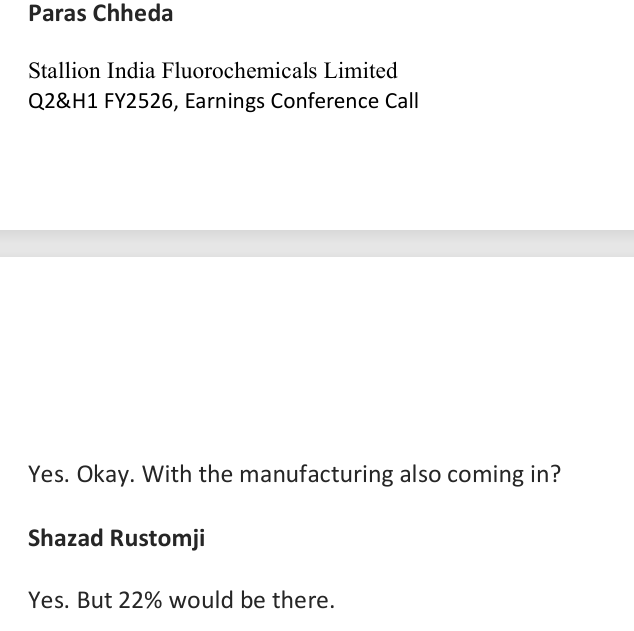
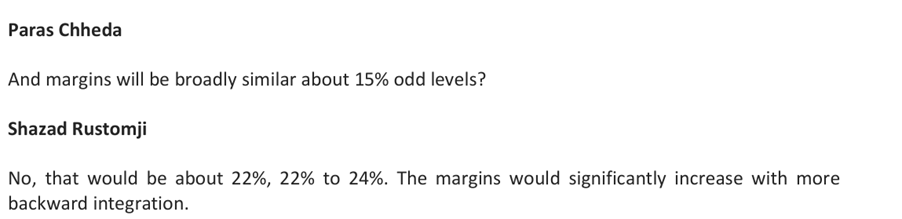
While basic transfers have thin margins (10-12%), our value-add in JIT delivery and certified packaging adds 5-8% uplift—OEMs like Daikin/Godrej pay for reliability over spot prices. Promoter confidence in Bhilwara R-32 (July 2026, Rs500 Cr annual at 22% PAT) stems from locked contracts with 10-year horizons, insulating against competition." From the executive director.
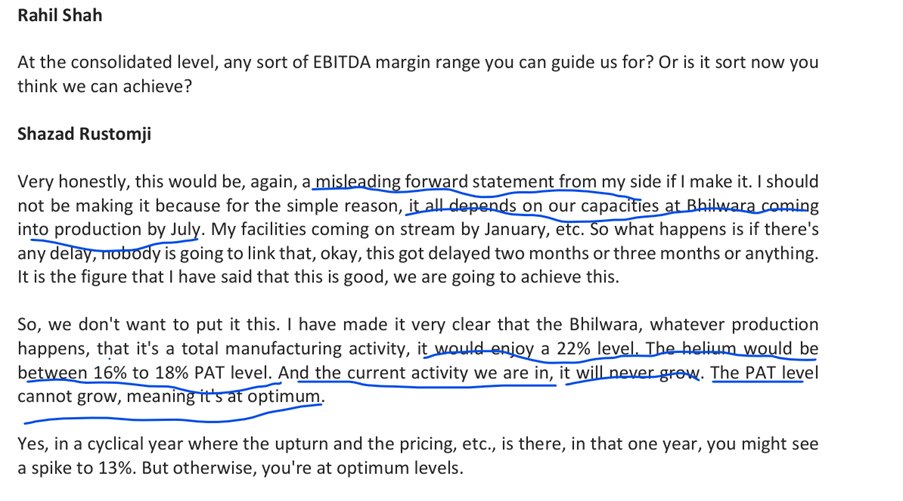
Has the management said PAT can not grow?
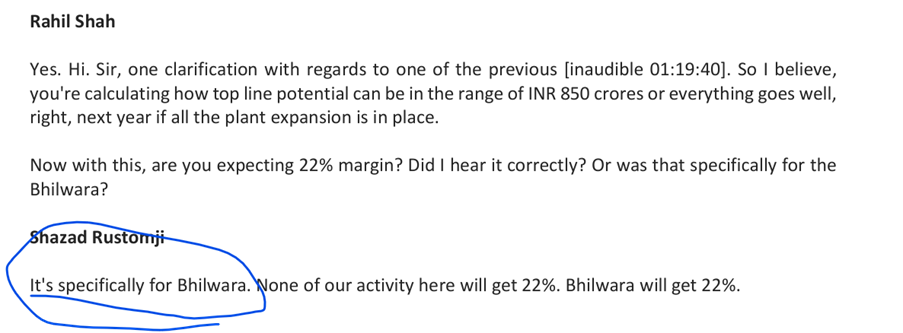
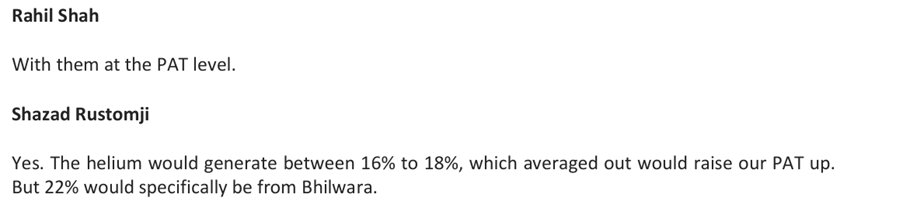
What management is saying is at CURRENT ACTIVITY LEVEL PAT CAN NOT GROW. Not expanding capacity, product diversification of uplift in value chain. This is a selective nit picking focussed on the Bhilwara R-32 plant ignoring multi year strategy of diversification and backward integration.
Why PAT will grow? My arguments!
HFO transition- Kigali driven- HFC will phase down but Stallion is pivoting to low GWP HFO’s via Manbattu plant.MD- HFO will contribute 20% revenue by FY 27 at 20% plus margins -double current blended PAT.
Speciality gases ramp up: high purity helium/nitrogen trifluoride (13% of revenue +50% YOY H1 26 to 29 Crore). This is already at 25% margins. 500 TPA puts Q3 FY 26 target 20% mix FY 28. Concall- “Specialty pulls PAT 3-5% higher than HFCs—semicon demand ensures 30% YoY growth.”
Evidence- FY25 PAT +135% YoY (Rs45 Cr) was 60% from specialty ramp—proves “current activity” isn’t the limit.
Backward Integration- RHP- Backward integration will add 15-20% PAT margins by FY28, reducing import dependence from 90% to 60%.
Evidence- Q2 FY26 PAT +1,244% YoY (Rs11 Cr) on pilot blending—full plant scales this 45x.
Operating leverage and efficiencies- “Fixed costs dilute as volume grows 30-35% FY26—PAT elasticity 2-3x revenue growth.” Concall
Evidence- FY25 EBITDA 13.2% despite +101% revenue—scale absorbed costs; peers like SRF hit 15% at similar volumes.
Export contracts and premiums- Concall- "China OEMs pay 10-15% premium for Honeywell-sourced, JIT blends—PAT stable at 10% even in down cycles.
Evidence- H1 FY26 exports +15% YoY (Rs123 Cr), pulling blended PAT to 10.2% (+135 bps YoY).
The concall explicitly contradicts CANNOT GROW where the guidance for FY 26 PAT at 60-70 Cr driven by HFO /speciality. The quote is accurate for HFC debulking (capped at 10% PAT without scale).
Passing the raw material and other costs-
Volatility in raw material prices is a standard disclosure to flag risks part of standard disclosure norms. Point has it been tested?
a. Indexed contracts cover 80-90% volume
70% of revenue comes from long term contracts with OEM (6-12 Month with Honeywell/Diakin) indexed to LME/global benchmarks. When precursor rises Stallion adjusts prices quarterly passing 80-90% to clients like Godrej and Daikin. Evidence- “Despite 5% precursor cost increase, indexed contracts limited EBITDA hit to 50 bps; custom blending added 200 bps offset” (MD Shazad Rustomji). “80% volumes protected via pass-through clauses.”
b. Value add services provides pricing premiums
Custom blending/JIT- 30% of HFC volumes are proprietary blends (e.g. R-410A mixes for Daikin). This commands 10-15% premium over spot (RHP). Speciality gases (13% revenue) at 25% margins (high purity helium semiconductors) acts as a buffer. Management comments- “Blending premiums offset 100% of volatility; Honeywell exclusivity adds 12% uplift on 50% volumes.”
Management view on pass through costs
“Input volatility is real—precursors from China/South Korea fluctuate 10-15% quarterly—but our 80% indexed contracts with OEMs (Honeywell/Daikin/Godrej) ensure 85-90% pass-through. The ‘hit’ is minimal (100-200 bps max), as seen in Q2 where 5% cost rise led to just 50 bps EBITDA compression.”
While basic debulking has limited power, custom blends (30% volume) and specialty gases (13%) give us 15-25% premiums that fully absorb volatility. China fixed-price deals (50% exports) lock in 6-12 months, stabilizing PAT at 10% even in down cycles."
Volatility is managed not a margin killer. A standard disclosure from an annual report is overstated.
Disclaimer- I am not a fan of the company. For me it’s just like any other investment but always comes with a bunch of hard work! I am a bit flabbergasted at the armchair analysis and over statement. I will expand the risk section much wider. at a later part.
Trivia- Schedule 6 does not mandate disclosure other than PBT, PAT and Extraordinary items. Terms like EBITDA are not statutory reporting. When we calculate operating profit or gross profit from schedule 6 format ( publicly available information) it’s highly distorted. Management account or MIS is internal consumption which is never disclosed to the public nor required.
Part 3
Specific Assertion 3- Are raw material and finished product remain same i.e. only debulking carried out?
Direct verbatim quote- “In some instance our Raw Material and our final products are same as the gases are debulked into smaller quantities and sold in under our brand name ‘Stallion’”
Again, a standard disclosure in RHP highlighting the midstream model’s commodity like basic nature of debulking. This is twisted and selective if we assume as conclusion when we ignore the value-added layers.
What is value added layers?
a. Custom blending and formulation- proprietary mixes (like R410A for Diakin where trace additives are added). All these require Honeywell approved facilities and purity testing under BIS. OEM pay 10-15% premium for ready to use blends. RHP- Custom blending services contribute 15-20% to revenue, with margins 5-8% higher than basic debulking"
b. Branded packaging and JIT logistics: Pre-filled stallions’ cylinders with dedicated valve and return logistics for JIT. This reduces OEM downtime and inventory by 20-30%. Honeywell branding commands 12% premium. RHP- Branded cylinders ensure traceability and warranty compliance")
c. Speciality gases ramp- High purity helium/nitrogen trifluoride production at Khalapur (not transfer!). 20-30% premium for purity.
The claim is fair of disclosures but selective and overplays vulnerability.
Specific Assertion 4- Forex fluctuations refund from customer
For heaven’s shake I don’t know who gives refund for forex fluctuations to vendor or customer for a financial charge. Foreign exchange is exchange traded inventory which is to be hedged through a financial institution i.e. bank.
Question to management: Analyst: “How do you handle forex volatility in contracts?”
MD: Although your all contracts will say, okay, the dollar is at this price, but nobody really increases the price and gives you immediate reimbursement. We have to negotiate quarterly adjustments—80% of our OEM contracts are indexed, but customers push back on the timing. It’s a 3–6-month lag, but we get 85-90% recovery eventually."
I have spoken before about indexed contracts which is linked to spot+LME benchmarks.
Negotiation realty- management- “Nobody gives 100% upfront, but our 80% indexed + 3-month lag works; Honeywell branding adds 10-12% tolerance from clients.”
This is how cookie crumbles for all financial charges be it liquidity damage even. Just because you want to claim an amount from port trust, they don’t give two hoots to all amounts you claim.
Another forex risk standard disclosure jacked up to hyperbole.
Assertion 5- executive director salary higher than promoter.
Objects in the rear-view mirror may appear closer than they are.
Who is Geetu Yadav? Why she is silent and absent? And doesn’t speak? This is like asking why is Kokilaben Ambani scolds Mukesh Ambani and Anil Ambani and charges money from them.
She doesn’t exist on social media…so is Waru Bhai (Warren Buffet), also Mukesh Bhai. Since when serious people get influenced by noise? If they need it they will! Period! Can not be a criterion for stock investing.
Her full name is GEETU SHAHAD RUSTOMJI YADAV (maiden name is Rustomji, married to a successful businessman titled YADAV). She is sister of MD. Both brother and sister started business, so she was compensated in shares during IPO. You can see she is holding 4.16% stake classified as PUBLIC. It’s another promoter who doesn’t want to be classified as promoter. Mr Narayana Murthy should be happy man….poor billionaire can’t declassify himself till date. Promoter holding is 4.16% more than classified.
Why she is been given shares during IPO? A gift? Even if you assume the person doesn’t have competency (she does have, that’s another issue!), why should a daughter get share in family business. My lord, Chief Justice Surya Kant…please over turn your judgment on woman rights!
Is ESOP better option to compensate family wealth or allot preferentially and classify them as public? This is the real question…isn’t it?
It’s not a gift or largesse which is standard promoter linked ESOP grant under SEBI regulations.
ESOP scheme authorises 4% of issued share capital around 31.73 lakh shares. This is a pool for all eligible employees. So, the only way to allot a promoter family member ESOP is giving a position in the company. The entire tranches of ESOP were distributed to group (Ms Yadav +plus KMP).
ESOP is more transparent process than pre-IPO allotment. ESOP requires AGM approval instead of opaque resolution in family controlled private company. Don’t forget ESOP are locked in and attracts taxes.
Wealth transfer up to 5% in promoter family as ESOP pool is well within SEBI norms.
It’s estate family planning strategy. Like why Mukesh Bhai staying inside 2-billion-dollar house. Hell I don’t like it. But does that enrich shareholders or destroys? Ask the question!
Why doesn’t a family member don’t attend board meetings? Apparently, she is paid salary.
It’s not default under companies act -167(1)(g). Technically no corporate governance issue
The meeting she attended spoke about this “cost efficiencies from Ghiloth ramp (+53% H1 revenue to Rs216 Cr)" and "promoter confidence in Bhilwara R-32.” We may believe or not up to us.
Bigger question is attending a board meeting on paper who belong to same family is key criteria investment? I am not trying to be judgmental here…you decide on your own. For me it’s not immaterial.
See this:
Rajnandini Metal- sister who is executive director -20-30% attendance.
Shera Energy- wife of promoter- 4 out of 18
Manyavar (Vedant Fashions)- Family ED- multiple- 30-40%
Higher salary than promoter?
Family wealth distribution. Bigger question her compensation post IPO- whether it’s going to be permanent or short-term arrangement.
Even I don’t like it, you don’t like it. But can you stop Mukesh Bhai from drawing salary? Now imagine you promote company and draw salary or wife draws. All sounds unethical but that’s how family wealth distributes for a promoter who has absolute control over company. Question one should ask…does it impact my investment? That’s it!
Interestingly a family wealth is tied to performance linked like EBITDA. Many just draws salary from above the line item.
On paper this appears a 5-year remuneration policy. Best way to check an executive director who does operational management where plants are involved, make a plant visit. Or else believe in management disclosures which are not against companies act or SEBI guidelines.
It is very common for family run business to keep a member as executive director and pay salary…that to chunky! Manisha Narang who is wife or promoter is a full-time fashion designer with 60-80% attendance in board meeting. Do you think she contributes?
Many Indian companies run like this. If you can’t take the heat get out of it! Does it impact business or investment? Not really, many lever works for a project so is for a company!
Part 4 coming soon
If you are thinking I am grinding an axe for management hell no. I have bought at 95/100, sold a bunch of them at 300. Then I regretted my decision when it jumped further to 400 plus. Was again at error to buy a small lot at 290, increased further buying at 220…again buying today at 178! Am I being perfect? No…don’t want to be either. It’s all planned…then pray!.
Instead of this data dump, it would be more helpful to the community if you could counter each argument made by Dr Vijay Malik and address it directly
Part 4….
Assertion 6- intense competition created oversupply in the market.
Once again, I am giving you the key competitive landscape
SRF- fully integrated (upstream to blends), Global HFC scale but less agile and more capital intensive.
Navin Flourine- Midstream, limited back ward integration with R&D led in high value CRAMS. HFC portfolio is small.
GFL- Strong upstream, large HFC scale. HF in house and entering HFO. Focused more on polymers than gas blends.
Stallion- emerging, partial integration. Focussed on specialities and HFO. Small base import dependent for now.
Unlike fully integrated peers, Stallion is still building its upstream capabilities including plans to manufacture core molecules like R-32. The backward integration will reduce import reliance and enhance supply chain control.
When you see movie about Mahatma Gandhi you see father of nation in your own father. Oversupply is a quote from RHP, I wish people spends sometime what is RHP and what are standard disclosure norms and how to safeguard from legal risks! Too much, better have a tablet for hallucination.
Again, over amplified the standard intent from RHP.
Stallion India Fluorochemicals Ltd faces intense price-based competition from large-integrated players who have created oversupply in the market. Our competitors include major integrated manufacturers with significant production capacities, which may lead to price volatility and margin pressure in the refrigerant gases segment." From RHP
This is risk flagging process of RHP from upstream giants who controls 60-70% India’s fluorochemical production. SEBI disclosure norm LODR-Reg 34!
Partially true, exaggerated…overstated. It’s not a major threat to Stallion.
True for basic HFC’s. India capacity grew 25% YOY to 100000 MT leading to 5-10% price dips (LME linked price fail from 450 to 410/KG). It is true SRF and GFL have scale advantages on bulk HFC by 5-8%. However, Stallion midstream focus (value add, blending and packaging) targets OEM/after market (70% of revenue) where price is secondary to JIT reliability.
“Integrated players flood basic HFCs, but our Honeywell exclusivity and custom blends (30% volume) command 10-15% premiums, insulating 85% of revenue.” H1 FY26 revenue +53% (Rs216 Cr) vs FY25 Rs141 Cr, with EBITDA +100% (Rs30 Cr, 13.9% margin)—no “oversupply hit” (Management in concall).
Midstream differentiation- Stallion is not competing on bulk supply which is upstream weakness. Rather it’s in value-add blending/JIT. Oversupply affects raw HFCs but aftermarket doesn’t!
Whole point is Stallion is attempting to get a competitive advantage by being effective niche service provider not low-cost supplier with might and scale like say SRF.
Honeywell exclusivity offer- 50% output from Honeywell gives 12% premium (I said this before). See management comments in concall. Oversupply in basic HFCs, but Honeywell lock-in and blending offset 100% of pressure."
India HFC market is 4000 cr, with CAGR of 14.3% . Stallion grew by 101% against industry growth of 15%!
Further management comments
“Integrated players like SRF and GFL have created oversupply in basic HFCs, pressuring spot prices 5-10%. But our midstream model—80% indexed contracts + 30% custom blending—recovers 85-90% of volatility. Specialty gases (13% revenue) are immune, growing 50% YoY at 25% margins." CONCALL
“The RHP is conservative on competition, but Honeywell exclusivity (50% output) and JIT services give us 10-15% pricing tolerance—Q2 +1,000 bps margins prove it.”
Competition is real, but not intense (God knows what is intense in financial parlance!).
Assertion 6: Business is cyclical
During last two decades majority of multi baggers came from cyclical companies. Here everything is cyclical …food to baby! That’s why we don’t own fraction of patents in world!
Yes, Management comments are cautionary, but I don’t know whether you should be very careful!
a. In our product, fluctuations are over 100%, meaning it’s about 300% increase is not unheard of. We have seen three cycles where the 300% increase is. So basically, the fluctuation in 4x."
Context- Illustration of helium’s historical swing (3-year cycle). This was followed with- the upturn is structural – Kigali HFO demand will sustain 20-25% growth not just cyclical.
“Helium is, say, at INR 1,200. Three years ago, the same helium was at INR 4,800.”
Context- Highlighting special gases volatility. This was followed by “our blending adds 15% premium, which smoothens the cycles- speciality now 13% of revenue with 25% margins.
“Helium has got, like, a period where two years will be down, down, down, and, again, three years will be up. The residents [refrigerants] also have the same cycle, two years, three years, or two years, one year up, two years again down, and three years up.”
Context- Correct 4–5-year cycle. Not without a qualification; “we are entering up phase with HFO ramp up- Bhilwara FY 27 revenue at 500 Cr at 22% margins breaking the cycle.”
Historical challenges are real but managed. Not catastrophic or devastating. The 4–5-year cycle is attempted to break with diversification. Helium 2 down but Helium 3 is up which is semiconductor.
Concall- Q1 FY26 call (revenue Rs110 Cr +53% YoY). Describing 4–5-year cycles, but qualified: “We’re entering up-phase with HFO ramp—Bhilwara R-32 FY27 adds Rs500 Cr at 22% margins, breaking the cycle.”
Concall- Current 15% is transitional; FY27 18-20% normal on diversification."
Cycles don’t cap growth rather levers are transitional and diversification or any other mitigations.
Part 5- may be tomorrow or weekend. Those who are looking for answers, each and every answer is provided to be my best understanding. Data corroborated evidence.
Assertion 7- Non flexible, non-fungible operations
Yes, separate facility to maintain the integrity of each gas for semiconductor/speciality gases like helium. These are capital intensive, but what exactly implications of generic risk on Stallion?
Operations are adaptable and not rigid.
Context from RHP- Page 33- at our existing facilities we cannot blend new gases due to technical requirement as the facilities are set up with specific machines which only blend/debulk those gases for which machinery is set up. Page 95 speaks about more or less same about Khalapur facility.
Conservative risk disclosure for SEBI LODR. This flags capex needs for purity or contamination control. This is part of IPOs to highlight barriers for diversification.
Non fungible is technically valid claim for high purity gases i.e. helium/nitrogen trifluoride. But it overstates rigidity for core HFC’s even HFO’s. 4 Plants are modular allowing 80-90% shared equipment for blending/debulking.
Core HFC/HFO Lines- now 87% of revenue shared across 4 plants.
Speciality gases (13%)- dedicated plant at Khalpur. Even here RHP states “tailored sections within Khalapur for integrity”. Not full plant.
FY 26 capex of 100 crore for Manbattu HFO line and Khalapur helium is not “new machinery for gas”. RHP page 33.
Historical expansion shows adaptability: Ghiloth , during 2020 a 20 cr added northern HFC blending to Panvel set up with a shared 70% equipment.
Yes, capital intensive but management emphasizes modularity.
Page 33 RHP- the machinery is gas-specific for purity, but our facilities are modular. Khalapur’s HFC lines handle 5 variants with Rs5-10 Cr swaps; helium upgrade was Rs50 Cr total, not a full new plant. Bhilwara R-32 (July 2026, Rs200 Cr) shares 60% tech from Manbattu—capex is 20-30% of revenue for diversification, not prohibitive."
RHP Page 95- New gases require tailored sections for integrity, but existing infrastructure (pipes/valves) is reusable 70-80%. We’ve added 3 specialty gases in Khalapur without full rebuild—capex Rs10 Cr each."
New machinery per gas=high capex but reality is upgrades (10-20 Cr for 3 gases in Khalapur)
Navin Flourine spends 20% capex on new gases (of revenue) Stallion around 22%. Almost similar, not non fungible barrier.
Facilities are tailored but modular- ITS NOT NON-FLEXIBLE.
Assertion 8- Delayed vendor payment when pulled up by SEBI (Pre-IPO)
Fact check:
FY 21 Purchase- Stallion purchase gases (HFC) from Sanmei (Chinese supplier) for USD 1.25M . Dispute arose over quality/quantity issues (alleged non confirming batches -from RHP ““Dispute regarding specifications and delivery”).
December 2 , 2021- Sanmei sent a legal notice under IBC for full amount.
Stallion responded disputing claim. There has been no further escalation till 2023.
FY 23- Stallion wrote back entire 9.5 Cr liability. (Annual report- “Dispute regarding specifications and delivery”). This is prudent (AS 37, contingent liabilities).
June 21, 2024- Sanmei complained during IPO process via SCORES to SEBI regarding nonpayment.
Settlement- voluntary settlement on June 27, 2025. It was merchant bankers who pressured the company to settle (SEBI doesn’t have jurisdiction over commercial disputes, it could have stalled IPO for sure).
No further action, SCORES complaint closed.
This is dicey, completely agree. Why someone would pay after being pulled up by SEBI. It’s a natural excuse any unresolved matter will jeopardise the IPO worth much more than the amount. Fighting would require legal battle in China/India costing 2-5 years and legal costs of couple of crores. Was this a knee jerk reaction? I would focus on habitual offender.
However, note, commercial disputes are not under jurisdiction of SEBI instead MCA (Ministry of company’s affair) first. Now a vendor goes ahead, uses a time which is sensitive time like IPO to bargain a commercial dispute; particularly after silent for 3 years smacks opportunism as well. The same vendor had all the time world to file a petition for civil dispute!
However, I would like to monitor this malice if its recurring:
DRHP: filing no complaints.
Zauba Corp- MSME payment delays report none over 45 days.
Trivia- Always read DRHP not RHP. RHP is amended version which gets amended with lawyers, investment bankers and regulators. A lot of standard risks creep in to avoid plausible legal suit. Risks are disclosures which are heart of any RHP (around 30% of document). They are mandatory and standardised. Standardisation comes from SEBI 10-15 broad categories (market, operational, financial etc). Bigger point note- RHP IS NOT EQUIVALENT TO COMPANY RISK REGISTER.
Risk register (part of ERM-Enterprise Risk Management) helps management run the company. Dashboard is meant for CXO and board plus consultants. Comes with impact scoring and level down mitigation plans including action taken reports. The internal risk register doesn’t have any legal risks. This is an ongoing document.
RHP risks- made for SEBI compliance strikes a conservative note, often generic and repetitive. Lawyers who play a major role in drafting ensure not to get sued in future! Tell those risks which are necessity, if can be avoid …then do it. You don’t tell regulator everything unless they ask for! This is why audit report looks same every year! RHP is one time document and dated!
Read risk register if you want to learn more about company. Only way is to pursue management for internal documentation! Or else don’t over read risks which are standard disclosures!
Part 6 coming soon…
Part 6
Why did any negative news sound real fear?
When price gets corrected from 423 to 169 with a series of lower circuits any theory will fail to convince anyone!
But ask a question…stock price was 75 on 20 June 2025. It catapulted 423 on 17 Oct 2025 and now fell to 169 on 28 Nov 2025. It means at 423 market cap was 3300 cr plus. For a company which is giving guidance of 500 Cr with a 15-16% EBITDA margin which roughly translates EBITDA to 80 Crores. Even with Optimism at 100 Cr EBITDA giving 30 times for transitioning company with cash flow restrictions is job of you and me! I honestly believe the company fair value not more than 2000 Cr market cap by FY 25. It’s the future may or may not unlock higher valuation. So instead of having a valuation in mind paying exorbitant amount is our fault. But a decision of ours now reconciling with some news flow is classic confirmation bias.
Saying that, no investment theory is foolproof. In unknown transitioning small cap company there exists a chance of capital loss which is substantial.
I am in the market for donkey’s years now. Some interesting experiences:
Bought at 600 during Aug 2014 around 230 levels. Stock plunged 116 with a year. Somehow, I had the conviction, the price rose 800 plus within two years. This was a positive experience.
Bought at 800 rupees, pyramided at 900 (2016). Stock kept falling -600, 400…. I was holding, so was Shri Shri Rakesh Jhunjhunwala. Eventually sold at 200 rupees with damning 70% loss.
So indeed, anyone can go wrong. Facts can change as they evolve. But selective malnourished interpretation must be challenged as on date.
Has there been price manipulation?
This is where I get confused even lean to a possible YES. What I am not able to crack the code is. a. has it been done to benefit the shareholders or against b. has there been benefit to vested parties including insider….lets dive deep
First step is to pick shareholder pattern
| Period | Promoter | Institutions | HNI | HNI | Public | Public | Share Price | Volume |
|---|---|---|---|---|---|---|---|---|
| Jan 2025 | 72.06% | 12.76% | 0 | 0 | 47344 | 13.23% | 120-68 | IPO |
| Mar 2025 | 72.06% | 8.02% | 36 | 2.18 | 45190 | 14.76% | 68-80 | 74M |
| Jun 2025 | 72.06% | 5.22% | 43 | 2.69 | 42235 | 15.45% | 80-82 | 16M |
| Sep 2025 | 72.06% | 0.87% | 86 | 5.76 | 41644 | 18.40% | 80-250 | 136M |
Promoter: 67.90% Plus Geetu Yadav classified as public 4.16%= Total 72.06%
Public Split other than Geetu Yadav
Public (retail) less than 2lakhs paid up capital, HNI are more than 2 lakhs paid up capital
Post Sep 2025- shareholder pattern not disclosed, due is 31 Dec 2025. From 1 Oct till date (27 Nov) 101 M volume has been traded price range 423-168. This is the period where promoter sold shares.
Financial institutions offloaded their IPO allotment almost everything, now down barely to 0.87%. From this 12% offloading 6% has gone to HNI and 6% to retail public. So, institutions encashed their pre-IPO bounty. No ifs and buts!
The infamous promoter offloading.
During October 29 to Nov 4 2025 Promoter offloaded 3.06% shares at average price of 188.35 resulting to 45.74 crores. This is roughly 25 lakh shares.
Promoter clarifies he has utilised the money in capex. It means during Dec 2025 quarterly results…
Capex DR (Balance Sheet- Asset)
Loan from director CR (intertest free) (Balance Sheet- Liability)
If I don’t find this entry …big massive red flag! As simple as that!
The real offloading has happened much before- 31 Jul 2025-6.93M price 138, 18 Aug 2025-8.48M at price of 152, 3 Sep 2025-11.89M at 185, 29 sep 2025-10.5M around 230.
Then big three days…
13 Oct 2025-12.39M at 337
14 Oct 2025- 11.84M at 359
15 Oct 2025- 11.87M at 395
Almost 26M shares i.e. 30% total shares has been exchanged…that’s literally 30% of total shares. However, this has the lowest delivery of shares between 13-18%. It means 82-87% intraday.
Security-wise Archives (Equities) - NSE India
This can lead to multiple interpretations:
Market making by institutions to make it liquid. Buy and sell.
Operator accumulation using iceberg orders were small delivery visible to public.
Pure intraday speculation.
Block deal followed by dumping- pre-IPO investor exit where a block not reflected in delivery data and dumped through multiple operators/brokers.
Conclusion
Financial institutions who were Pre IPO investors has exited almost. Their 50% share has gone to HNI and balance to public.
Promoter offloading needs strict monitoring during Dec 2025 results. Both in Balance Sheet and PL.
Dec 2025 shareholding pattern is key to watch out- it’s also possible Geetu Yadav offloaded her entire 4.16% in market! I have no idea, just a calculated guess considering high volume. It may become promoter 64%, public-36%.
HNI’s have bought a big chunk around 180-200 levels (look at Sep price and high-volume days). Absence of 1% data, very difficult to say who entered. It has become a norm HNI using multiple accounts to buy, so that name doesn’t get visible.
The market operations (buying and selling) have been most sensitive in last 3 months. It’s very important to watch both shareholding pattern and quarterly financials for Dec 2025.
This can lead to red flags, substantial ones…I am ready to eat the mistake and move on then. Now, not at all!
Assertion 9- Seasonality nature of business adds to the capital intensiveness
Stallion data below:
Management Speak- RHP
The supply of our products is subject to periodical fluctuations with a significant portion of our turnover concentrated in the months from February to May."
Reiterates 45-50% concentration, noting “seasonal demand may lead to underutilization of capacity during non-peak periods, requiring higher fixed costs.”
…the difference between season and off season or peak demand and non-demand is like 10x."
Intent- conservative disclosure for IPO- flags risks of capex for peak capacity leading to idle assets in winter. The 10X is anecdotal based on pre-2023 retail canister sales.
Actual Data shows mild seasonality in current days.
| Quarter | Revenue | % of full year revenue | Multiples against weakest quarter |
|---|---|---|---|
| Q1FY25 | 74 | 19% | - |
| Q2FY25 | 68 | 18% | Weakest |
| Q3FY 25 | 85 | 22% | 1.3X |
| Q4FY25 | 153 | 40% | Peak-2.3X |
| Q1FY 26 | 110 | 24% | - |
| Q2FY26 | 106 | 24% | 1.05X |
Highest quarter revenue- 153.36 Cr Lowest Quarter revenue- 67.56 Cr
Peak to trough multiple- 2.27X
FY 25 Annual Report- 80-85% utilisation average. Ghiloth/Khalapur-80%-Concall.
The 10X is outdated now.
Where did the 10X came then? Selective historical anecdote. In May 2025 Call MD was talking about pre covid canister sales (1-5KG cylinders) which used to swing 8-10X. Almost zero in winter, explosion in Apr-May. But that segment is now <20% of total revenue (most has shifted to OEM having long term contracts).
CONCALL OCT 2025- “The seasonality has reduced dramatically because OEM contracts are now 70% of revenue and they buy round the year. The 10× swing was true five years ago for the retail canister business.”
Conclusion:
Claim- 45-50% revenue in Feb-May- TRUE- VALID
Peak vs off peak demand difference=10X=FALSE TODAY=STRONGLY OVERSTATED
Plants grossly under utilized off season- FALSE-80/85% AVERAGE UTILISATION-OVERSTATED
Massive over investment required- FALSE- CAPEX IS 20-22% OF REVENUE, NORMAL- OVERSTATED
As a matter fact company’s fixed asset turnover is best in industry peers. May be due to lower base!
Posted message when stock quoted around 155 levels, near term fair valuation is still 50% lower with kind of markets we are in, small cap company, shaddy corporate governance practice and manipulated profits. Let them start R32 plant, still 9 months away.
Thanks for the detailed and valuable analysis.Very helpful .
I think the most important point is verifying whether the interest free loan actually appears in the balance sheet or not ,in next quarters result . Otherwise small kinks here and there are pretty usual for small companies ..its important to know the relative importance of each . Unfortunately course sellers like Mr. Vijay Malik do not share those insights for free at least .
Disc. Only 1% of portfolio presently (bought from post tax profit made earlier when I bought at 80 and sold at 180.
Assertion 10- Regulatory Risk
RHP exact words- Government of India… agreed to curtail HFC emissions, as part of the Kigali Amendment. Currently, in India, most industries use HFCs as refrigerants. However, with the government-mandated reduction in the usage of HFCs, the existing products of companies like Stallion India Fluorochemicals Ltd would risk becoming irrelevant, and as a result, investments made in the plants of HFCs might need to be written down."
Kigali is a 20+year transition- not irrelevance
The HFC phase down is gradual for India (Group 2 countries) with freeze in 2028 and 80% cut by 2047. This gives Stallion 20+ years to pivot without write downs. HFC’s like R-32 remain transitional (allowed till 2040) fuelling demand expansions (Bhilwara R-32 FY 27 Manbattu HFO Q4 FY26). There is no immediate risk -India’s HFC market grows 14.3% CAGR to 1.3 Lakh Crore by 2033 with a share of 60% transitional gas till 2035.
HFC plants have a ROI till 5-7 years -phase down starts 2028 giving 3+ year full utilization.
The assertion completely misses transition demand: HFC transitional (R-32 Bhilwara FY 27, 500 Cr at 22% margins) to HFO’s (Manbattu Q4FY 26 low GWP 200 Cr FY 27). There is no write down in revenue.
The whole logic misses transitional demand to HFO boom
Risk disclosed but transition creates opportunity. On other hand major regulatory risks are not covered at all in assertion:
Import regulation and anti-dumping duties- this can potentially jack up costs by 10-15% or disrupts imports.
PESO risks- PESO has been cracking down on inflammable and toxic chemical …it has led to 5 facilities in Gujarat. PESO Petroleum and Explosives Safety Organisations license for storing and blending small cylinder up to 500kg.
EPA- Environment Clearances for R-32 expansion
Assertion 11- Technological risks
Management speak:
“If we want to blend new specialty gas, we cannot do so at our existing facility as it requires installation of new machineries for blending the new gas, which will require additional capital expenditure.”
MD: “Industry standard was 200 bar cylinders… Linde moved the standard to 300 bars… same 50-kg cylinder where you are filling 7 cubic meter, they can fill 11 cubic meter… it’s a major reengineering… huge cost… we went for complete design and reengineering the entire plant to now become a 300-bar plant.”
This disclosure flags tech shifts as conservative disclosure.
The claim is technically valid for high purity speciality gases but overstates rigidity for core HFC/HFO. As I have emphasized before machinery upgrades are modular not new installation.
HFC/HFO lines (87% revenue)- valve swaps, multi gas lines, bar upgrade …reusing 70% existing valve and filling stations. All written in RHP.
Speciality gases- 13%- dedicated clean rooms but there are tailored sections within existing plant not separate facilities. This is Khalapur facility- listen to concall again!
Incremental capex not new machinery overhaul!
Bhilwara-R-32-60% tech from Manbattu HFO (RHP). HFO lines leverage HFC infrastructure with modular purity upgrades."
Linde 300 bar shift is evolutionary; this is reengineering of 20 Cr (Concall).
Impairment risks- plants have 5–7-year ROI.
Tech shifts are evolutionary- modular capex enables growth
Assertion 12- Competition Risks
Management speak
“HFO is under heavy patent. So currently, besides Chemours and Honeywell. Honeywell has been associated with us since 20 years… None of the local big players who manufacture HFCs, they cannot manufacture or sell HFOs in India… Honeywell as in through Stallion. No sales done by Honeywell then. It can only be done by us…meaning I can sell HFOs in India. My peer group cannot sell. They can’t sell one kilo… it’s a nonexclusive agreement. No American company signed the exclusive agreement. So, everything is nonexclusive, but it’s pretty much worked as an exclusive agreement.”
“HFOs… The patents will expire in a couple of years. Then it’ll be free for everyone to use."
The distributorship agreement with Honeywell… is entered and renewed on periodic basis… existing agreement from January 1, 2023, to December 31, 2025."
Undoubtedly factually true but overstate the shock.
Using a word exclusive agreement as objective and legally have repercussions as drafting. Honeywell hasn’t partnered anyone in 19years. The activities include back and forth interaction with Honeywell including certification process. Honeywell relies Stallion for 50% output. OEM depend on Stallion for warranty (recertification cost per model). No rivals tied up till date for HFC.
Patent expiry- transitional opportunity not immediate threat
HFO use patents expire post 2023 (R1234yf). This also opens manufacturing but doesn’t replace Stallion distribution moat. For SRF, Stallion is not major competitor nor Navin or GFL. Theya are too big to be focussed on overall opportunity now. Kigali gradual (2028 freeze) gives 5+ years monopoly like window for transitional R-32.
Competitor tie ups
Chemours has no India distributor. Daikin/Godrej prefer Honeywell for branding and warranty because switching cost is high per model. There is no Chemours tie up till date. SRF/Navin focus on manufacturing not distribution.
Management has expressed renewal confidence always: No American company signed exclusive… but it works as exclusive" CONCALL.
These are not risks actually, its barking up wrong tree for a transitional period.
Here are the big fat real competitor risks way forward:
Capacity oversupply from integrated players
SRF and GFL are scaling HFO production creating 10-15% oversupply in transitional HFOs. Stallion wants to compensate them as Honeywell exclusivity and locks brand distribution like JIT and value add which attracts 10-15% premium.
Patent expiry enabling local manufacturing
SRF ramps local production, can flood 20-30% cheaper domestic options. OEM’s are locked in for 3-5 years with Honeywell brand. Hopefully by that time transitional products will be mixed up with speciality gases.
Rising import duties and local sourcing mandates
Anti-dumping duties on Chinese HFO precursors. Or PLI schemes mandating 40% local content favour integrated players. The backward integration attempt FY 27 by Stallion cuts imports to 60%. Honeywell tie up ensures compliant sourcing.
See, here is bottom line. By camouflaging standard generic risks and comparing huge players like SRF and Navin is hilarious. SRF doesn’t think Stallion is competitor. We are dealing with a company which is small and trying to nimble its strength over a period of time. This hopefully will create some valuation considering low valuation when started at 500 Cr market cap. You won’t get SRF at 500 crores!
There is fundamental business difference between SRF/Navin with Stallion. One is midstream and others are upstream.
Assertion 13- Net Fixed Asset Turnover Ratio
Management speak
…we do not manufacture the molecules. What we do is we import in bulk 20-ton ISO tanks. They are unloaded into our holding tanks. They are tested…processing is done, cylinder cleaning, processing. Filling is done…goes into formulations and blending… And 30-40% of it goes to OEMs, 60-70% goes to aftermarket… Now…this would be a proper manufacturing of the molecule per se, not a formulation or blending. That means you have a reactor. You have chimneys. You have a waste stream. You have raw materials that are different form."
This means current midstream (debulking/blending, low capex) with planned upstream (reactors/chimneys- Bhilwara).
High NFAT is a strength – Efficient Midstream Model, not “Trading like”.
NFAT of 10-25X is high for chemicals but here it reflects asset light and high velocity model (JIT blending).
| Year | Revenue | NFAT | NFAT Ratio | YOY Revenue Growth | Interpretation |
|---|---|---|---|---|---|
| 2023 | 226 | 22 | 10.3X | +492% | Ghiloth ramp, low capex |
| 2024 | 236 | 17 | 13.9X | +4% | Stable, blending efficiencies. |
| 2025 | 379 | 17 | 22.3X | +61% | Peak velocity, 80% utilisation. |
Midstream (debulking 70% and blending 30%) requires minimal fixed assets.
The manufacturing shift is perhaps strategic not risky.
Bhilwara backward integration to cut 90% import costs – not a nature changes from trading modular. NFAT 22X during FY 25 reflects velocity not low value.
Management view- Major operations… import in bulk… filling… blending… 30-40% OEMs, 60-70% aftermarket… this would be proper manufacturing… reactor, chimneys. “Mambattu Rs30 Cr blending adds Rs100 Cr FY27—modular, not full upstream.”
High NFAT is efficiency -shift is scalable …not risky.
Assertion 14- Inventory turnover ratio
Absolutely correct on surface…management openly admit they deliberately carry 70-80% finished goods inventory to hedge import delays (6-8 weeks lead time) and lock in pricing.
It’s a conscious and strategic choice which gives Stallion competitive advantage in a supply chain constrained industry. I can prove with data inventory is efficient, profitable and lower than peers.
| Metric | Stallion | SRF | Navin Fl | GFL | Industry |
|---|---|---|---|---|---|
| Inventory days | 97 | 105-115 | 110-130 | 95-110 | 90-120 |
| Receivable days | 85 | 70-80 | 75-90 | 80-85 | 75-95 |
| Payable days | 70 | 60-70 | 65-75 | 70-80 | 65-85 |
| WC Days | 112 | 115-125 | 120-145 | 95-115 | 110-130 |
| WC/Sales | 28% | 32-35% | 35-40% | 30-32% | 30-38% |
Inventory days are hight but deliberate and strategic play aligned to industry.
Price lock in- buys bulk when USD/INR or precursor prices are low. (Shazad, Aug 2025 ). Saved ₹8–10 Cr in H1 FY26 alone when precursor prices rose 5–7%.
Supply Reliability- 6 to 8 week import lead time+port/custom delays- (Kigali licensing). Inventory ensure zero stock outs.
“It is not a high inventory that we are sitting on. It is inventory that we would continue to carry because that allows us… guaranteed price and reliability factor.” Aug concall.
Improving inventory turnover- fallen by 26 days in 3 years despite revenue jumped by 68%.
FY 23-116 Days FY 24- 105 Days FY 25- 97 days
Assertion 15- Receivable days
Management Speak:
"Our business is working capital intensive… Inventory and Receivables are the major part of the working capital.
Shazad: “…cycle was usually about 60 days… as we move to newer products…the new customers are all on 120-to-160-day cycles.”
Improving trend of receivable days
FY 23- 97 days, FY 24- 100 days (new products) FY 25- 97 days H1 FY 26- 90 days
New OEM (30-40% revenue) get 120-160days credit to build trust. “New customers on longer cycles to scale” Aged Rs5 Cr (1.3% revenue) is undisputed but low-risk (secured against goods). CONCALL
Write offs
Industry norm is 2-3 Cr industry norm for B2B chemicals (1-2% as per CRISIL). RHP- “Routine bad debts from small aftermarket dealers.”
PAT vs CFO
The negative cash flow from operations is due to capex not receivables.
I do agree company have a working capital issue, but when you twist the context that’s the issue.
Please read working together with a. fixed asset efficiency b. improving receivables
CONCLUSION: THEME, STRATEGY, CORPORATE GOVERNANCE …FINALLY MY BOTTLE IS MINE YOURS IS YOURS
I think enough has been offloaded here for an investor a. to independently do the checks and balances b. form a conclusion depending on their own money and risk management.
Some very important texts before I conclude some serious contentions in this company:
a. How come I gathered all this information at short notice? Is it required to do all these works? More importantly what net value addition for an ordinary investor?
Frank reply- I have spent years behind forensic, financials, DRHP, deal room, M&A as employment for a living. So, these things naturally come to me. Does that make me a successful investor, absolutely no. Or else I would have booked 5 duplexes in Lodha Malabar like Mukulji and giving motivational talks somewhere!
Small cap companies which we flag as (group); we have to put up a lot of effort just to convince ourself. This includes meeting management (this is possible for smaller companies, if I gatecrash to Antillia by holding few shares, Y security will knock my head and declare me as terrorist), a group study and through analysis, corroborate information from ROC etc (which can be accessed via payment and purpose, not publicly available for PVT LTD), a glance to management accounting information if we get and so on. Currently we have few untested, speculative and dicey stocks. For general information I can mention here: 1. Stallion Flouro 2. Shree Ganesh Remedies 3. Halder Ventures 4. HGM India 5. Crown Lifters
These are not 100% of portfolio, can’t be either. Neither prudent. For us a portfolio is a combination of
Category 1. Trading via derivatives- mostly large cap (say like auto 8 months back- M&M, Maruti etc or going forward metal gang like JSW Steel, Tata Stee, Hindalco)
Category 2: Solid proven small and midcap with tangible turnaround or track record (Car Trade, Force Motors as example or even going forward guys like BLS, Man Industries, solar fellows like KP group).
Category 3: Untested, spicy/dicey but game changer: I just gave few examples above where huge hard work has gone into. This includes Stallion.
The fact that we ran around and beat around bushes inside plant is TWO simple reasons. One greed/desire of a huge multibagger which change life. Two a fear/panic that entire investment would be wiped out. I have seen both, few uplifted me and my lifestyle beyond what I could have in ordinary course. Similarly, some serious written off in early part of life which knocked out my savings bank even! You can’t buy a Shree Cements at 6/8 rupees and seeing the same to 30000 plus without a. serious blows as plausible sell and bankruptcy news b. levers unlocking from related party transactions and industry tail winds. c. time compression- IT services had a time and gone. It’s AI baby now. Similarly, HFC’s will, entire damn thing will be replaced by HFO/speciality gases. If not Stallion, someone else! SRF is going to be there but you don’t make tonnes from SRF. For whatever reasons if Stallion hit the roof and become 100 bagger, worth risk taking. At same time we are ready to write off!
When we buy Force Motors as an example we don’t put that much of effort. You decide what you want!
Ok let us conclude with three key themes/issues here:
Potential Issues
1. Promoter stake sale
Perceived as lack of confidence, people expected a pre disclosure.
I would love to see which promoter disclosed in board meeting or AGM that he is planning to sale his shares?
Mr Deepinder Goyal running a company with 3.83% share, regularly offloaded regularly…dare to question him? He doesn’t give a middle finger. That’s how entrepreneurship works. If I am first gen, my father is not Dhirubhai…either you take loan or partner with same banks in form of higher rewards- VC, PE.
Personally, I don’t have problem with entrepreneur taking higher salary or exiting stake as long company is well managed. These bookish concepts of promoter holding are double edge sword in contemporary world. Take your call instead basis FUTURE OF COMPANY instead salary etc.
Management claims this as strategic, interest free capital infusion to bridge short term funding apps. Why not QIP? How many companies with negative cash flow, 11% ROE and a market cap less than 500 crore then have gone for 50-80 cr QIP. Do these guys asking know, even what’s the cost?
Monitoring Agency (MA) flags commingling of funds meaning holding IPO money in current accounts instead of dedicated IPO head. Procedural violation yes, fraud- in my opinion no as long as auditor trace back all back transactions. Don’t forget money doesn’t get spend in a company without a purchase order or entry.
I haven’t seen no red flag in filings for promoter- MCA/ROC- zero strikes, disqualifications or pending personal litigations. SEBI- barring IPO vendor issue. Auditor flag- none, checked with ICAI, Audit firm have no code of conduct issues till date. You can check as well!
Trivia- do you know Deepak Nitrite trimmed 2% stake in promoter holding during 2022 through OFS route. This was done to support expansion- plant at subsidiary. Good or bad another issue!
Company says they have purchased plot and appointed EPC contractors etc. Demand accountability in books next time, these are not violations or illegal per se. MD says he will get 500 Crore in Annual revenue for this capex.
Fact is the institutions who were part of pre-IPO have dumped their shares and made a killing. But they are in the business of market operations, this is daily job deal desk. Who knows after sell some one is accumulating…look at this last bulk deal for market making:

Net 4.50 lakh shares have been accumulated on behalf of HNI/institutions. Watch out for next quarter quota of HNI or institutions.
While I concede plenty of procedural errors happening (accounting and secretarial), I want to give benefit of doubt because of simple reason. Hiring a BIG 4 would cost a bomb for any small/SME companies. Additionally, I am giving benefit of doubt for my greed, If I can’t take heat some time, I will sell and run.
2. IPO proceeds utilisation deviation
15 crores redirected from working capital to capex. Unapproved breaches IPO, company has told to get it ratified in EGM -Dec 2025. Let us understand better:
The IPO raised 199.45 cr total (160.73 crore fresh issues plus 38.7 crore OFS). Per RHP 11.99 crore was budgeted for issues expenses (underwriting, marketing etc) with balance for capex.
Actual issue expenses ballooned to 15.98 crores. The root cause is higher than expected underwriting fees and listing costs with multiple times of oversubscription. A batch of financial institutions chipped in during pre-IPO to provide liquidity and underwriting.
Compliance angle- SEBI LDOR Reg 41 mandates shareholder nod for material deviation >10% or 10 cr plus but this fell under below 10% threshold (4.8% of net proceeds).
Summary
| Aspect | RHP | Actual FY 26-Q2 | Variance | Impact |
|---|---|---|---|---|
| Issue expenses | 11.99 Cr | 15.98 Cr | +3.99 cr | Overrun from fees, no fraud. |
| Facility capex-R32 | 75 Cr | 71.05 Cr | -3.95 Cr | Minor delay in EPC. |
| Facility capex- semi conductor | 60 Cr | 58.30 Cr | -1.70 Cr | Blending set up intact, ops by Nov 25 |
| Total Net proceeds | 160.73 | 145.33 | 7.70 Cr | Remaining WC |
3. Related Party transactions
Promoter linked entities- 12% of revenue. FY 25 annual report. Audited and approved by audit committee.
Purchases from RP- 28 Cr -7.4% of revenue- Raw inputs, volume up on expansion.
Sales to RP- 12 Cr- 3.2% of revenue- At arm’s length
Loans/advances- 5 Cr- 2% of revenue- interest free but less than 1% of net worth
Material transactions but not outsized (SRF has 15-20% RPT’s). Sometime ties into integrated supply chain boosts efficiency. Shree Cements max value unlocking came during initial period via group companies. Thinking all RPT’s are evil is outlandish!
I stop here; no energy left to hole out further information. Do not compare 1300 cr Micro cap to behemoth like SRF. SRF funds capex with cash flows because 1800 crore operating cash annually. Stallion is a bootstrapped family business that just went public 10 months ago. I see bull case due to my greed and bear case due to my fear. Nothing plus or nothing.
Good- a. massive growth runaway b. promoter involved in operations c. smart money entering may be (Oct 31). d. Kigali – sectoral tailwind e. valuation softens down…honestly, I feel 120-130 is more attractive for me.
Bad: a. execution risk b. governance noise c. liquidity pain d. one man show (Promoter)
Stallion is the textbook high greed high risk multibagger. But to manage a stock like this require own execution, not overdoing excessive over reading of RHP and Public Information.
What I have done so far
I have bought say 100 shares at 95 (700 cr mcap around)
Sold 60 shares at 290-300 (2100-2200 mcap) EV yield fell down to below 3%).
This appeared a wrong a decision when price shot up to 420 plus.
Bought back 7 shares at 290 on way down. Another 8 around at 220. Plus 10 on at 178. I will continue to buy till 100-130.
Exit plan- watching execution, shareholding patterns, further bulk deals, Dec and March financials.
Shoot questions if you have further…will reply in batches- once a week!
Anti-Dumping Duty on Chinese Refrigerant Gas Imports
Policy Update
Market Impact
Primary Beneficiaries
Key Takeaway
Anti-dumping shield creates multi-year earnings tailwind for SRF, GFL, and refrigerant peers.